人民币点心债

Search documents
研究发布:宏观及债市展望:美联储政策回归中性,中资海外债发?边际回暖
中证鹏元国际· 2026-02-09 05:35
1. Report Industry Investment Rating - Not provided in the given content 2. Core View of the Report - In 2026, the Fed's policy adjustment will be more neutral due to sticky inflation and cooling employment. The US labor market is expected to cool further, and structural labor shortages and service - sector resilience may slow down the rapid decline of inflation [2] - In 2026, the US dollar faces a certain mild callback pressure, and its interest rate spread with major non - US currencies narrows marginally. The US dollar's unilateral strength is difficult to reappear, and exchange - rate volatility may increase. The weakening of the US dollar helps relieve the external constraints on the RMB, but the RMB is more likely to show a mildly stronger pattern [3] - In 2026, the issuance of Chinese overseas bonds is expected to pick up. The issuance environment of overseas bonds is expected to improve marginally, but the repair path will be more driven by refinancing and industry differentiation will intensify [4] - The convertible bonds, ESG - themed bonds, and digital bonds are all booming. Convertible bonds are important financing tools for technology and growth - oriented enterprises; ESG - themed bonds are expected to maintain their prosperity; digital bonds are in the institutionalization stage and are expected to become an important supplementary tool for the offshore market in the medium - to - long - term [5] - In 2026, the Chinese US - dollar bond market will be affected by the Fed's interest - rate cut rhythm and amplitude, domestic fiscal and monetary policies, and changes in the global liquidity environment [7] 3. Summary by Related Catalogs Fed Policy and Economic Situation - In 2025, the US CPI formed a sticky range above 2%. High - income groups supported consumption, and service - type inflation showed stickiness. In 2026, the US labor market is expected to cool further, and enterprises are more inclined to slow down recruitment rather than conduct large - scale layoffs [2] Exchange - Rate Situation - In 2026, the US dollar faces mild callback pressure, and its interest - rate spread with major non - US currencies narrows marginally. The US dollar's unilateral strength is difficult to reappear, and exchange - rate volatility may increase. The RMB is more likely to show a mildly stronger pattern [3] Chinese Overseas Bond Issuance - In 2025, the primary - market issuance of Chinese overseas bonds declined, and net financing was negative. In 2026, the issuance of Chinese overseas bonds is expected to pick up. The repair path will be more driven by refinancing, and industry differentiation will intensify. The issuance of real - estate overseas bonds has picked up from a low level, the issuance of urban - investment overseas bonds has shrunk significantly, and the overseas financing demand of financial institutions has declined temporarily [4] Bond - Issuance Tools - Convertible bonds, ESG - themed bonds, and digital bonds are all booming. Convertible bonds are important financing tools for technology and growth - oriented enterprises; ESG - themed bonds are expected to maintain their prosperity; digital bonds are in the institutionalization stage and are expected to become an important supplementary tool for the offshore market in the medium - to - long - term [5] Chinese US - dollar Bond Market - In 2025, the Markit iBoxx Chinese US - dollar bond return index showed an oscillating upward trend, and the returns of the real - estate sector narrowed. In 2026, the Chinese US - dollar bond market will be affected by the Fed's interest - rate cut rhythm and amplitude, domestic fiscal and monetary policies, and changes in the global liquidity environment [7]
从“点心”到“主菜”--人民币点心债市场面临大发展机遇
Hua Er Jie Jian Wen· 2025-12-04 03:15
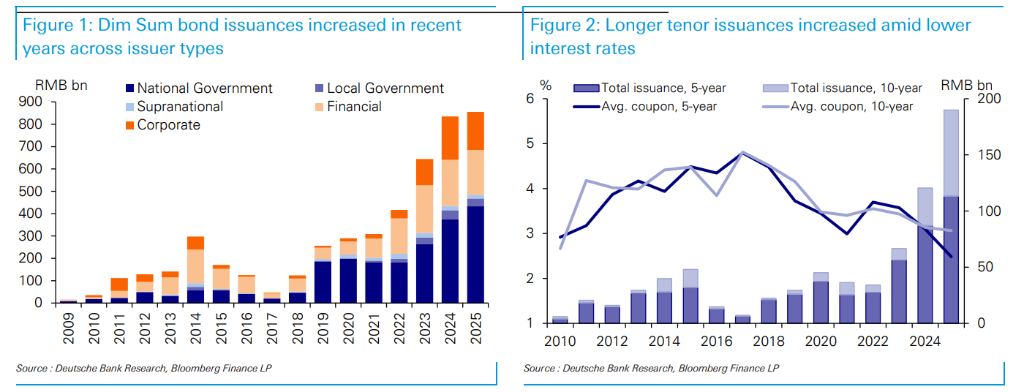
Core Viewpoint - The renminbi dim sum bond market is evolving from a marginalized niche to a mainstream asset with significant allocation value, marking a historic opportunity window [1] Group 1: Market Growth and Expansion - The dim sum bond market has shown remarkable growth, with annual issuance in renminbi terms skyrocketing from 300 billion yuan in 2021 to an estimated 850 billion yuan in 2024, and projected to reach between 900 billion to 1 trillion yuan in 2025 [2] - The current market size has reached 1.8 trillion yuan, driven by the strong appeal of renminbi as a financing currency, particularly in a low interest rate environment [2] - Notable issuers include major Chinese tech companies like Alibaba, Baidu, and Tencent, as well as international entities such as the Kazakhstan Development Bank and the Indonesian government, indicating a broadening issuer base [2] Group 2: Demand Dynamics - Historically, insufficient investor demand has been a major bottleneck for the dim sum bond market, but recent resilience has been observed despite depreciation pressures on the renminbi [4] - The nature of offshore renminbi deposits has fundamentally changed, with growth closely linked to cross-border renminbi payment volumes, indicating a shift from speculative to transactional demand [4] - The share of renminbi in current account payments has increased from 18% in 2021 to 28% in the first half of 2025, providing a more stable liquidity foundation for the dim sum bond market [4] Group 3: Supply and Policy Support - The low interest rate environment has led to unprecedented enthusiasm from various issuers, including Chinese tech giants and entities along the Belt and Road Initiative, to enter the dim sum bond market [6] - The demand side has transformed, with stable growth in offshore renminbi funds driven by real cross-border trade and capital settlement needs, supported by policy tools like the "Southbound Bond Connect" [6] - The Chinese government's commitment to accelerating renminbi internationalization, as indicated in the upcoming 14th Five-Year Plan, is providing strong support for the dim sum bond market [8] Group 4: Global Investment Opportunities - A favorable opportunity window has emerged as high dollar interest rates suppress demand for dollar-denominated bonds, with the share of dollar-denominated bonds in Asian international issuance dropping from 83% in 2020 to 67% in 2024, while renminbi-denominated bonds have increased to 11% [11] - The renminbi is expected to strengthen further, having appreciated approximately 4% against the dollar since 2025, enhancing the attractiveness of renminbi assets, including dim sum bonds, for global investors [11] - The dim sum bond market is poised to enter a self-reinforcing virtuous cycle, where increased market size and liquidity attract more issuers, ultimately solidifying the renminbi's status as a value storage tool [12]

很好!俄罗斯发行“人民币主权债”,激活沉睡资金,全球第一次
Sou Hu Cai Jing· 2025-11-07 10:58
Core Insights - Russia plans to issue RMB bonds domestically for the first time to activate dormant RMB reserves and supplement government finances [1][5] - This move is significant as it marks a shift from traditional offshore RMB bond issuance to onshore issuance, reflecting Russia's pivot away from Western currencies [5][8] Group 1: RMB Bond Issuance - Other countries issue RMB bonds as "Panda bonds" in mainland China or "Dim Sum bonds" in offshore markets, primarily in Hong Kong [3][5] - Indonesia's recent issuance of RMB Dim Sum bonds indicates a growing acceptance of RMB assets in international markets [5][6] Group 2: Strategic Implications for Russia - Russia's decision to issue RMB bonds domestically is a strategic response to its economic isolation from Western nations post-Ukraine conflict, aiming to utilize the substantial RMB reserves accumulated through trade with China [5][8] - The planned issuance includes up to four bonds totaling 400 billion rubles (approximately 35 billion RMB), with maturities ranging from 3 to 10 years, addressing both short-term liquidity and long-term development needs [6][9] Group 3: Impact on RMB Internationalization - The issuance of RMB bonds in Russia signifies a qualitative leap in the international status of the RMB, transitioning from a trade settlement currency to an investment and reserve currency [8][9] - This initiative may encourage other countries with close trade ties to China to adopt similar practices, contributing to a more diversified and resilient international financial ecosystem [9][11] Group 4: Broader Financial Trends - The diversification of RMB bond issuance models, including Panda bonds, Dim Sum bonds, and now domestic RMB sovereign bonds, reflects a trend towards a more flexible and multi-faceted integration of the RMB into global finance [9][11] - Russia's pioneering move not only provides an outlet for dormant funds but also offers a new strategy for other nations to mitigate single currency risks in a multipolar economic landscape [11]

香港恐被迫大量抛售美国国债!
Sou Hu Cai Jing· 2025-05-21 05:38
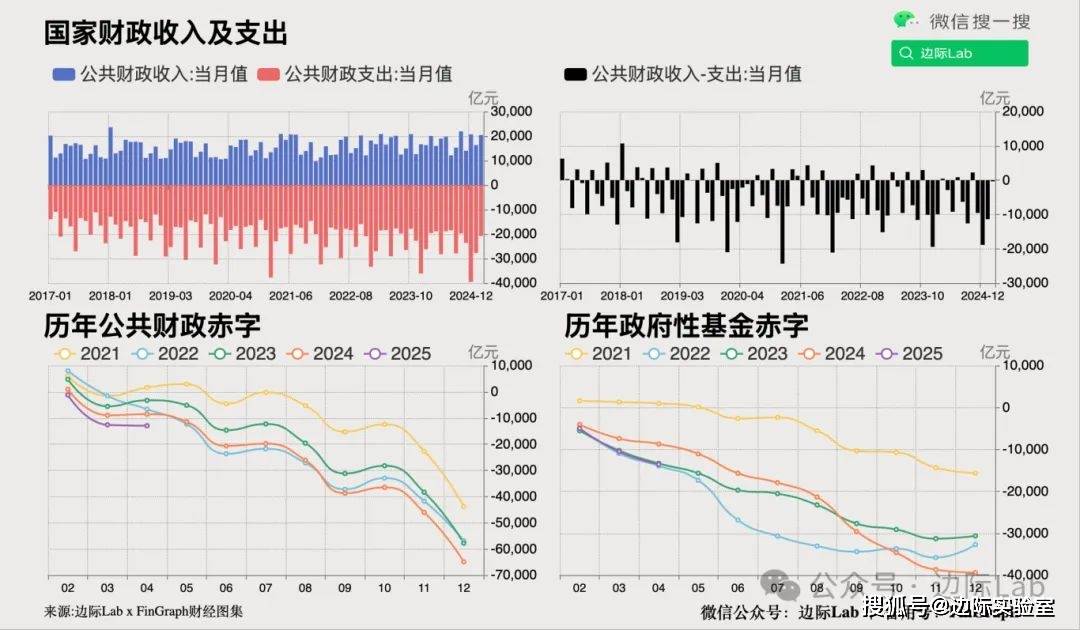
Group 1: China's Fiscal Situation - China's fiscal revenue for January to April reached 8.06 trillion yuan, while expenditure was 9.36 trillion yuan, resulting in a deficit of 1.3 trillion yuan, compared to a deficit of 0.86 trillion yuan in the same period last year [3] - In April, the public budget revenue was 2.04 trillion yuan, a year-on-year increase of 1.89%, while expenditure was 2.08 trillion yuan, up 5.8% year-on-year [3] - The largest increases in budget revenue were from land occupation tax, stamp duty, and resource tax, which rose by 15.7%, 14.7%, and 13.4% respectively [5] Group 2: Foreign Investment in Chinese Debt - In April, foreign institutions increased their holdings of Chinese government bonds by 49.3 billion yuan, the largest increase since December 2023, bringing total holdings to 2.1 trillion yuan [8] - Foreign institutions also increased their holdings of interbank certificates of deposit by 18 billion yuan, reaching a record high of 1.3 trillion yuan [8] Group 3: Youth Unemployment Trends - The unemployment rate for urban youth aged 16-24 fell to 15.8% in April, down from 16.9% in February, but is expected to rise again after the graduation season [9] Group 4: Nestlé's Bond Issuance - Nestlé issued 2 billion yuan of 10-year dim sum bonds with a coupon rate of 2.8%, which was reduced by about 40 basis points due to oversubscription of over 5.7 billion yuan [13] Group 5: Bilibili's Financial Performance - Bilibili reported a 23.6% year-on-year increase in revenue to 7.003 billion yuan for the first quarter, exceeding analyst expectations [15] - The adjusted net profit reached 362 million yuan, reversing a loss of 456 million yuan in the same period last year [15] Group 6: U.S. Credit Rating Impact - Following Moody's downgrade of U.S. debt, Hong Kong's Mandatory Provident Fund may be forced to sell U.S. government bonds, as the fund can only invest over 10% of its assets in U.S. bonds if they hold a AAA rating [18] Group 7: Corporate Earnings Guidance - Market reactions to corporate earnings reports are increasingly dependent on forward guidance, with weak guidance potentially leading to underperformance even if actual results exceed expectations [24] Group 8: AI Stocks Performance - Despite high expectations for AI, AI-related stocks have underperformed compared to the S&P 500 index this year, with AI infrastructure stocks lagging by about 2 percentage points [27] Group 9: Eurozone Labor Costs - Eurozone labor costs rose by 3.2% year-on-year in Q1 2025, the smallest increase since Q3 2022, with wage growth at 3.3% [52] Group 10: Australian Pension Fund Growth - Australia's pension industry assets reached 4.2 trillion AUD, with a planned increase in mandatory contribution rates from 11.5% to 12% starting in July [63]