
供水

Search documents
粤海投资:2025年净利润46.56亿港元 同比增长48.19%
Sou Hu Cai Jing· 2026-03-31 03:06
Core Viewpoint - The company operates in water supply and sewage treatment, with various business segments contributing to its overall performance and financial metrics. Financial Metrics - As of March 30, the company's price-to-earnings ratio (TTM) is approximately 10.52, price-to-book ratio (TTM) is about 1.14, and price-to-sales ratio (TTM) is around 2.61 [1] - The average return on equity for the company in 2025 is projected to be 11.01%, an increase of 3.48 percentage points compared to the previous year [2] Asset Changes - By the end of 2025, the company has seen a 100% reduction in assets classified as held for sale, leading to a decrease of 29.99 percentage points in their proportion of total assets [2] - Intangible assets have increased by 13.53%, raising their proportion of total assets by 7.81 percentage points [2] - Cash and cash equivalents have risen by 21.63%, increasing their share of total assets by 5.57 percentage points [2] - Investment properties have grown by 2.74% compared to the previous period [2] Liability Changes - By the end of 2025, accounts payable and notes payable have increased by 16.29%, raising their proportion of total assets by 4.38 percentage points [2] - Long-term borrowings have decreased by 7.09%, contributing to a 2.9 percentage point increase in their share of total assets [2] - Deferred tax liabilities have risen by 8.9%, increasing their proportion of total assets by 1.68 percentage points [2] - Short-term borrowings have decreased by 14.7%, leading to a 0.74 percentage point increase in their share of total assets [2] Liquidity Ratios - The company's current ratio for 2025 is 1.15, and the quick ratio is 1.12 [5]


花旗:升北控水务集团目标价至3.05港元 维持“买入”评级
Xin Lang Cai Jing· 2026-03-26 03:25
Core Viewpoint - Citigroup has downgraded the profit forecast for Beijing Enterprises Water Group (00371) for 2026 to 2027 by 9% to 11% due to a decrease in construction and technical service revenues, but has raised the target price from HKD 2.85 to HKD 3.05 based on improved free cash flow and rolling forecasts, maintaining a "Buy" rating [1][4]. Financial Performance - The company's net profit for 2025 is expected to decline by 6.9% to RMB 1.562 billion, primarily due to a reduction in non-cash construction income and impairment related to asset disposals [1][4]. - Revenue for 2025 is projected to drop by 9.1% to RMB 22.062 billion, with non-cash construction income's share decreasing from 14.2% to 7.4% [1][4]. - Operating income is expected to decrease by 1.9% due to the disposal of certain consulting businesses [1][4]. Cash Flow and Dividends - Free cash flow is anticipated to surge 2.5 times year-on-year to RMB 5.2 billion, benefiting from the collection of non-core project disposals and reduced capital expenditures [1][4]. - The company plans to exit more loss-making projects, with management expecting free cash flow to reach RMB 3 billion in 2026 and capital expenditure budgeted at no more than RMB 4 billion [1][4]. - The company is projected to increase its dividend per share by 3.1% to HKD 0.166 for 2025, with a payout ratio of 98%, and a forecasted dividend yield of 6.1% for 2026 [1][4]. Revenue Breakdown and Margins - The gross margin is expected to expand by 1.4 percentage points to 38.5%, driven by an increase in the share of revenue from wastewater treatment services [1][4]. - Total revenue for 2026 is expected to decline by 7%, with construction and technical service revenues projected to fall by 38% and 35% respectively, while urban resource service revenue is expected to remain stable, and wastewater and water supply revenues are expected to decrease by 3% [1][4].
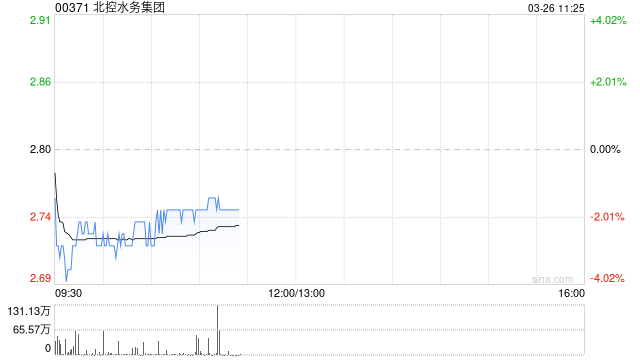
花旗:升北控水务集团(00371)目标价至3.05港元 维持“买入”评级
智通财经网· 2026-03-26 03:15
Core Viewpoint - Citi has downgraded the profit forecast for Beijing Enterprises Water Group (00371) for 2026 to 2027 by 9% to 11% due to a decrease in construction and technical service revenue, but raised the target price from HKD 2.85 to HKD 3.05 based on improved free cash flow and rolling forecasts, maintaining a "Buy" rating [1] Group 1 - The company is expected to pay a dividend of HKD 0.166 per share in 2025, representing a year-on-year increase of 3.1%, with a payout ratio of 98% [1] - The forecasted dividend yield for 2026 is 6.1%, which remains attractive [1] - The company's net profit for 2025 is projected to decline by 6.9% to RMB 1.562 billion, primarily due to a decrease in non-cash construction revenue and impairment related to asset disposals [1] Group 2 - The company's revenue for 2025 is expected to decrease by 9.1% to RMB 22.062 billion, with non-cash construction revenue's share dropping from 14.2% to 7.4% [2] - Operating revenue is projected to decline by 1.9% due to the disposal of certain consulting businesses [2] - The gross margin is expected to improve by 1.4 percentage points to 38.5% due to an increase in the share of revenue from wastewater treatment services [2] Group 3 - Management anticipates a 7% decline in total revenue for 2026, with construction and technical service revenues expected to drop by 38% and 35% respectively [2] - Revenue from urban resource services is expected to remain stable, while wastewater treatment and water supply revenues are projected to decrease by 3% [2]
中国水务(00855):新供水条例整体影响料正面
ZHONGTAI INTERNATIONAL SECURITIES· 2026-03-16 12:25
Investment Rating - The report maintains a "Buy" rating for China Water Affairs (855 HK) with a target price of HKD 6.52, indicating a potential upside of 19.2% based on a 9.5x FY27 P/E ratio [1][8]. Core Insights - The new Water Supply Regulation, effective from June 1, 2023, is expected to have a positive overall impact on the company. The report outlines four key points regarding the regulation that support this view [1][2][3][4][5]. Summary by Sections New Regulation Key Points - **Extension of Water Supply Networks**: The new regulation mandates that water supply networks must extend to rural areas when the population reaches a specified scale, which the company has already anticipated and implemented, thus avoiding additional engineering and operational costs [2]. - **Ensuring Water Sources**: Local governments are required to reasonably arrange and enhance water source construction. The company has been following a diversified water source policy and operates its own reservoirs as needed [3]. - **Multi-Department Collaboration**: The regulation requires various departments to manage water supply facilities, which may lead to more detailed guidelines and responsibilities. The effectiveness of these policies remains to be observed [4]. - **Responsibility for Last Mile**: The regulation stipulates that water supply operators will be responsible for the operation and maintenance of new supply facilities, potentially allowing the company to charge additional fees and gain more user data and direct service channels [5]. Financial Data Overview - **Revenue and Profit Forecasts**: The company’s revenue is projected to decline from HKD 12,859 million in 2024 to HKD 9,899 million in 2026, with a slight recovery expected in 2028. Shareholder net profit is expected to stabilize around HKD 1,112 million in 2026, with a gradual increase to HKD 1,156 million by 2028 [6][14]. - **Earnings Per Share (EPS)**: EPS is forecasted to be HKD 0.68 in 2026, with a slight increase to HKD 0.71 by 2028 [6][14]. - **Dividend and Yield**: The company plans to maintain a dividend of HKD 0.28 per share, resulting in a consistent dividend yield of 5.1% across the forecast period [6][14]. Stock Information - **Current Stock Price**: As of the report date, the stock is trading at HKD 5.47, with a market capitalization of HKD 8,898.12 million [8]. - **Shareholder Structure**: Major shareholders include Duan Chuanliang (27.40%) and Orix (27.27%) [8].
确保水电气暖设施安全高效运行 保障人民群众温暖度冬平安过节
Zheng Zhou Ri Bao· 2026-02-15 01:13
Group 1 - The provincial leaders emphasized the importance of ensuring stable energy supply and public services during the upcoming Spring Festival, highlighting the need for effective management of coal, electricity, oil, and gas resources [1][2][3] - Liu Ning and Wang Kai inspected various facilities, including gas boiler rooms and water treatment plants, to assess the readiness for heating and water supply during the holiday period, stressing the need for enhanced monitoring and rapid response to user feedback [2][3] - The leaders called for a comprehensive approach to public transportation, urging for optimized scheduling and improved service quality to accommodate increased passenger demand during the holiday season [3] Group 2 - The provincial government aims to strengthen market supply and price stability for essential goods, including food and daily necessities, to meet the heightened consumer demand during the Spring Festival [3] - Emphasis was placed on the implementation of safety measures and emergency response protocols to ensure the safety and well-being of the public during the holiday [3] - The leaders highlighted the importance of supporting frontline workers and maintaining effective communication channels to ensure a smooth operation of city services [3]
刘宁王凯调研检查春节期间民生保障工作 确保水电气暖设施安全高效运行 保障人民群众温暖度冬平安过节
He Nan Ri Bao· 2026-02-14 10:57
Group 1 - The provincial leaders conducted inspections in Zhengzhou to ensure the stability of essential services such as heating, water supply, electricity, and gas ahead of the Spring Festival [2][3] - Emphasis was placed on optimizing heating network layouts and exploring green technologies like geothermal heating to enhance service delivery during the holiday [3] - The leaders highlighted the importance of improving water supply capacity and emergency repair capabilities to ensure clean and safe drinking water for the public [3] Group 2 - The leaders reviewed electricity supply strategies, focusing on analyzing winter peak electricity demand and adjusting resources accordingly to ensure reliable power supply during the festive season [3] - Safety measures for gas storage and supply were reinforced, with a call for systematic thinking and detailed management to address potential risks [3] - The need for enhanced public transportation services during the holiday was discussed, with a focus on optimizing capacity and improving service quality [4] Group 3 - The leaders reiterated the importance of prioritizing public welfare and safety, aligning with national directives on urban governance and service provision [4] - There is a commitment to ensuring the supply of essential goods and maintaining price stability during the holiday period, alongside increased food safety enforcement [4] - Emergency response protocols were emphasized, including 24-hour duty systems and effective communication channels to ensure city safety [4]
中华人民共和国国务院令第831号
Xin Hua She· 2026-02-14 09:29
Group 1 - The "Water Supply Regulations" have been approved by the State Council and will be implemented starting June 1, 2026 [2] - The regulations were passed during the 76th executive meeting of the State Council held on December 31, 2025 [2] - The announcement was made by Premier Li Qiang on February 11, 2026 [2]
事关供水、供电、供气、供热……公用事业领域反垄断指南出台!
Zhong Guo Zheng Quan Bao· 2026-02-11 14:36
Core Viewpoint - The State Council's Anti-Monopoly and Anti-Unfair Competition Commission has issued the "Anti-Monopoly Guidelines for the Public Utility Sector" to prevent and curb monopolistic behaviors, maintain fair market competition, and protect consumer and public interests [1][3]. Background - The public utility sector encompasses essential services such as water supply, electricity, gas, heating, sewage treatment, waste management, and public transportation, which often exhibit natural monopoly characteristics [5]. - Monopolistic behaviors in the public utility sector are prevalent, with operators extending their monopolistic advantages to upstream and downstream competitive sectors, thereby restricting market competition [6]. Purpose of the Guidelines - The guidelines aim to address the unique characteristics and market competition rules of the public utility sector, providing clearer and more specific guidance for anti-monopoly enforcement and compliance for operators [7]. Development Process - The guidelines were developed through a systematic summary of enforcement experiences and extensive consultation with various stakeholders [8]. Main Content - The guidelines consist of seven chapters and 50 articles, detailing specific manifestations and recognition standards of monopolistic behaviors in the public utility sector [9]. - The first eight articles outline the overall principles of anti-monopoly enforcement in the public utility sector, emphasizing the establishment of compliance management systems by operators and industry associations [9]. Specific Provisions - Articles 9 to 14 elaborate on the forms of monopolistic agreements, including horizontal and vertical agreements among operators, and the conditions under which certain agreements may be exempted from prohibition [10]. - Articles 15 to 25 focus on the abuse of market dominance, detailing factors for recognizing operators with market power and specific abusive practices such as unfair pricing and refusal to deal [11][12]. - Articles 26 to 31 discuss the review of operator concentration, highlighting that certain concentrations may require notification even if they do not meet the reporting threshold [15]. - Articles 32 to 39 emphasize the need for fair competition reviews of policies affecting economic activities in the public utility sector and detail behaviors that abuse administrative power to restrict competition [18]. - Articles 40 to 48 clarify the legal responsibilities applicable to operators, industry associations, and individuals who violate anti-monopoly laws [20].

夯实公用事业领域反垄断执法与合规制度根基
Zhong Guo Jing Ji Wang· 2026-02-11 12:20
Core Viewpoint - The recent implementation of the "Antitrust Guidelines for the Public Utility Sector" aims to address antitrust enforcement challenges in the public utility sector, guiding operators to enhance compliance and regulate market order to protect public interests, thereby reinforcing the institutional foundation for antitrust enforcement and compliance in this field [1]. Group 1: Highlights of the Guidelines - The guidelines emphasize a dual focus on the public and market nature of public utilities, establishing a comprehensive system that includes principles, behavioral regulations, responsibility applications, and collaborative governance [2]. - The guidelines clarify four fundamental principles: maintaining fair competition, scientific regulation, enhancing public welfare, and serving high-quality development, ensuring that regulatory enforcement aligns with public interest [2]. - The guidelines provide a detailed list of antitrust behaviors, including horizontal and vertical agreements, and outline specific standards for identifying abuse of market dominance, thus creating a clear boundary for illegal activities [3]. Group 2: Addressing Antitrust Enforcement Challenges - The guidelines tackle the challenge of distinguishing between natural monopolies and competitive segments by defining market boundaries based on physical network coverage and franchise areas [6]. - The guidelines address regional barriers by prohibiting discriminatory practices against external operators and ensuring free circulation of goods across regions, thus promoting a unified national market [7]. - The guidelines clarify the responsibilities between government and public utility operators, preventing administrative coercion that leads to monopolistic behavior, thereby enhancing the precision of enforcement [8]. Group 3: Promoting High-Quality Development in Public Utilities - The guidelines aim to break down market barriers and support the construction of a unified national market by providing comprehensive coverage of antitrust behaviors [10]. - The guidelines encourage compliance among public utility operators through a dual approach of positive incentives and negative constraints, promoting a shift from passive to active compliance [10]. - The guidelines are expected to lower social costs and benefit the public by regulating monopolistic behaviors in public utilities, thus reducing the costs of energy and water for businesses and residents [10][11].
恶劣天气致俄罗斯摩尔曼斯克大面积停电
Xin Lang Cai Jing· 2026-01-25 01:47
Core Viewpoint - The recent severe weather, including snowfall, has caused significant disruptions in Murmansk, a key port city in the Russian Arctic, leading to widespread power outages and infrastructure failures [1] Group 1: Power Outages - The electrical grid in Murmansk experienced failures due to ice accumulation on power lines, resulting in the collapse of several transmission towers [1] - A large portion of the city is now without electricity, affecting essential services [1] Group 2: Impact on Infrastructure - The power outages have led to the failure of heating and water supply systems in the city [1] - Traffic lights have also gone out due to the power failure, causing road congestion and traffic accidents [1]