
保护膜

Search documents
Is XPEL, Inc. (XPEL) A Good Stock To Buy Now?
Yahoo Finance· 2026-03-24 20:22
Core Thesis - XPEL, Inc. presents a compelling investment opportunity driven by projected revenue growth and margin expansion through in-house manufacturing and cost management [1][5]. Company Overview - XPEL, Inc. manufactures, installs, sells, and distributes protective films, coatings, and related services [2]. Revenue Growth Projections - Revenue is expected to grow by 13% in 2025, followed by a 10% annual increase from 2026 to 2029, tapering to 5% in 2030, slightly above market expectations of around 10% growth [2]. Margin Improvement - Management anticipates gross margins to expand to 50-52% by 2030, reflecting operational leverage that enhances profitability [2]. Operating Expenses Management - Sales and Marketing expenses are projected to rise to 11% of revenue, while General and Administrative costs are expected to decline from 18% to 16% of revenue [3]. Earnings and Cash Flow Projections - Earnings per share are expected to increase from $2.47 in 2026 to $5.25 by 2030, representing a 16% CAGR, while free cash flow is projected to grow from $56.3 million to $128.7 million, an 18% CAGR [4]. Valuation Insights - A discounted cash flow analysis assigns a fair equity value of $54.32 per share, indicating upside potential relative to the current market price if the company outperforms consensus revenue growth expectations [4]. Capital Structure - XPEL's share count is expected to modestly increase to 27.8 million by 2030, maintaining a manageable capital structure that supports sustainable growth [4]. Investment Appeal - XPEL offers an attractive risk/reward profile, combining durable revenue growth, margin expansion, and strong free cash flow generation, making it strategically appealing for growth and value-oriented investors [4].

永新股份:公司目前生产的薄膜新材料主要有两类产品涉及电子领域
Zheng Quan Ri Bao Zhi Sheng· 2026-01-12 14:09
Core Viewpoint - Yongxin Co., Ltd. is currently producing two types of film materials for the electronics sector, which contribute a relatively low percentage to the company's total revenue [1] Group 1: Product Offerings - The first type of product involves providing intermediate products to clients, which are then processed using specialized techniques for application in electronic devices [1] - The second type consists of protective films produced by the company, which are used to protect displays during the production and transportation processes [1] Group 2: Revenue Contribution - The revenue generated from these two types of films currently represents a low proportion of the company's overall revenue [1]

2025年中国汽车膜行业市场政策、产业链图谱、供需现状、市场规模、竞争格局及发展趋势分析:国产化替代进程日益加速[图]
Chan Ye Xin Xi Wang· 2025-12-05 01:53
Core Viewpoint - The automotive film market in China is experiencing significant growth driven by the booming automotive market, with increasing demand in both new and aftermarket segments. By 2024, the demand for automotive films is projected to reach 25,061.27 million square meters, with a market size of 49.992 billion yuan [1][9]. Market Overview - Automotive films are specialized materials applied to vehicle windows and surfaces, serving functions such as heat insulation, sun protection, explosion resistance, and privacy protection. They can also reduce UV damage to interior items and occupants, lower cabin temperatures, and decrease fuel consumption by reducing air conditioning use. The films are categorized into three main types: protective films, color-changing films, and heat-insulating films [2][4]. Market Policies - The Chinese government has implemented various policies to support the development of the automotive film industry, including guidelines for digital transformation, green manufacturing, and standardization. These policies aim to enhance compliance, upgrade production standards, and promote high-quality development in the industry [4][5]. Supply Chain Structure - The automotive film industry supply chain consists of upstream suppliers of raw materials (such as PET films and adhesives), midstream manufacturers involved in R&D and production, and downstream markets that include both OEM and aftermarket segments. The OEM market is focusing on new energy vehicles, while the aftermarket is driven by demand for film replacement and customization [6][7]. Competitive Landscape - The automotive film market in China features numerous participants, including international brands like 3M and domestic companies such as Wan Shun New Materials and Naer Co., Ltd. International brands dominate the high-end market, while domestic companies are rapidly improving their product offerings and gaining market share in the mid-range segment [10][11]. Company Analysis - Wan Shun New Materials focuses on new materials and reported a revenue of 2.692 billion yuan in the first half of 2025, with functional film business contributing 0.12 million yuan [11]. Naer Co., Ltd. specializes in precision coating and reported a revenue of 972 million yuan in the first half of 2025, with automotive functional films accounting for 29.55% of total revenue [11][12]. Development Trends - The automotive film industry is transitioning towards high-tech integration, with advancements in materials and processes driving the evolution of products. Innovations such as nano-ceramics and smart films are enhancing functionality, while a shift towards a service-oriented model is emerging, focusing on customer experience throughout the product lifecycle [12].




淘宝上几块钱的东西还免运费,商家是怎么赚钱的?内行人道出实情
Sou Hu Cai Jing· 2025-10-08 18:44
Core Insights - The article discusses the business model behind low-priced products on e-commerce platforms, highlighting how merchants manage to sell items at prices as low as 3.8 yuan while still making a profit [1][11]. Group 1: Pricing Strategies - Low-priced items, such as those under 10 yuan, accounted for 35.7% of total transactions on e-commerce platforms in 2025, indicating their growing importance [1]. - Merchants often utilize a "consolidated shipping" model to reduce logistics costs, allowing them to lower the per-item shipping cost to 1-2 yuan [1][3]. - Some merchants employ a "freeloading" strategy, where they include their small items in larger shipments from other sellers, reducing their shipping costs to as low as 0.5 yuan [3]. Group 2: Cost Structure - The production cost for simple items like phone cases can be as low as 0.5-1 yuan, especially when purchased in bulk from manufacturing hubs [3]. - The average profit margin for low-priced items was approximately 15% in the first three quarters of 2025, meaning a 3.8 yuan item might yield a profit of around 0.7-0.8 yuan [3][11]. - Many low-priced products serve as "loss leaders" to attract customers, with some merchants willing to sell at a loss to increase foot traffic [6]. Group 3: Customer Acquisition and Retention - Low-priced items act as a draw for customers, with data showing that stores offering such products see a 30% increase in overall visitor traffic [4]. - Approximately 25% of customers who enter a store to buy low-priced items end up purchasing additional higher-margin products [4]. - Stores with low-priced items have a 20% higher repurchase rate compared to those without [11]. Group 4: Additional Revenue Streams - Many low-priced products offer upsell options, where customers can pay extra for better quality or customization, with 40% of consumers opting for these add-ons [6]. - Merchants often implement minimum purchase requirements to encourage bulk buying, increasing the average transaction value by 35% [7]. - The use of "shared logistics" and optimized packaging for small items can save 0.5-0.8 yuan per shipment, further enhancing profitability [9]. Group 5: Consumer Behavior and Satisfaction - Despite lower prices, consumer satisfaction for items under 10 yuan remains relatively high, averaging 4.1 out of 5, indicating that many low-priced products meet basic expectations [10]. - E-commerce platforms often provide subsidies for low-priced items, which can account for about 5% of the product price, making these items more attractive to consumers [10].
偏光片大厂选举新董事长!
Sou Hu Cai Jing· 2025-09-30 06:25
Core Points - The company held its 44th meeting of the 8th Board of Directors on September 29, 2025, where Li Gang was elected as the Chairman of the Board [1][2] - The previous Chairman, Yin Kefa, resigned on September 1, 2025, and will not hold any positions in the company or its subsidiaries [3][4] - The company reported a revenue of 1.6 billion yuan for the first half of 2025, a slight decrease of 1.41% year-on-year, but a significant increase in net cash flow from operating activities by 2648.95% to 325 million yuan [4][5] Company Leadership Changes - Li Gang was elected as the Chairman of the 8th Board of Directors with a unanimous vote of 8 in favor [1][2] - Yin Kefa's resignation was effective immediately upon the board's receipt of the controlling shareholder's letter, and he will not hold any positions in the company post-resignation [3][4] Financial Performance - The company achieved a net profit attributable to shareholders of 35.23 million yuan for the first half of 2025, a decrease of 19.73% year-on-year [4][5] - The core business of polarizers generated 1.511 billion yuan in revenue, accounting for 94.41% of total revenue [4][5] - The overall gross margin improved by 0.47 percentage points to 14.87% despite challenges such as increased costs and R&D investments [5]

原计划投资超10亿元 坚朗五金拟终止一募投项目
Zhong Guo Jing Ying Bao· 2025-06-18 08:45
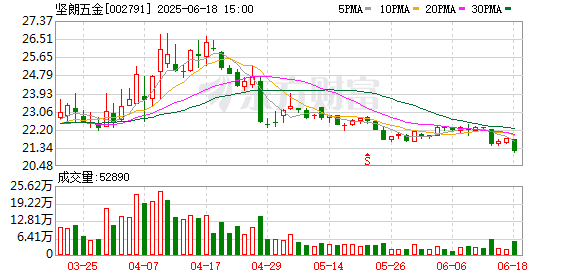
Core Viewpoint - The company, Guangdong Jianlang Hardware Products Co., Ltd., has decided to terminate its "Jianlang Hardware Zhongshan Digital Intelligent Industrial Park Project" due to adjustments in the real estate industry, reallocating the originally planned investment of 200 million yuan to other fundraising projects [2][4][5]. Group 1: Project Termination and Financial Adjustments - The termination of the industrial park project is linked to the downturn in the real estate sector, prompting the company to control costs and slow down investment progress to mitigate potential depreciation impacts on financial results [5]. - The total planned investment for the industrial park was approximately 1.034 billion yuan, with an initial fundraising allocation of 551 million yuan, which has now been reduced to 200 million yuan [3][5]. - The company plans to recover the previously invested funds through the sale of land, buildings, and associated equipment acquired for the project, with expectations of recouping the investment based on the market value of the assets [6][7]. Group 2: Adjustments to Other Fundraising Projects - Alongside the termination of the industrial park project, the company has adjusted the investment amounts and timelines for three other fundraising projects, with the assembly material project seeing an increase in investment from 100 million yuan to 190 million yuan, while the completion date has been extended to the end of 2027 [8][9]. - The assembly material project is viewed as a key growth driver due to the increasing market capacity in the construction decoration industry and government encouragement for prefabricated buildings [9][10].

绿联科技(301606) - 2025年5月20日-5月23日投资者关系活动记录表
2025-05-24 13:58
Sales Distribution and Future Plans - In 2024, online sales reached 463,086.39 million CNY, accounting for 75.10% of total revenue, while offline sales were 153,547.02 million CNY, making up 24.90% [1][2] - The company plans to deepen existing sales channels and explore new markets, focusing on both online and offline strategies [1][2] Product Categories and Revenue Contribution - The product line consists of five main categories: - Charging products: 38.08% of total revenue [3] - Transmission products: 28.40% of total revenue [3] - Audio and video products: 17.19% of total revenue [3] - Storage products: 6.34% of total revenue [3] - Mobile peripherals: 8.42% of total revenue [3] Core Competencies - The company emphasizes technological innovation, with over 90% of revenue and gross profit derived from self-designed products [4][5] - Brand value is a key competitive advantage, with a focus on long-term brand building and consumer loyalty [5][6] - A multi-channel ecosystem is established, combining online and offline sales across various global markets [6][7] Supply Chain and Operational Efficiency - The company has developed a dual-driven supply chain model, enhancing its competitive edge through quality control and innovation [7][8] - A comprehensive supplier evaluation mechanism is in place to ensure high standards in production and service delivery [7][8] Corporate Culture and Vision - The mission is to create value for users, enhance employee well-being, and contribute to social development [8] - The vision is to become a valuable and warm global brand, guided by a user-centered approach and continuous optimization [8]