全天候策略产品

Search documents
李蓓“等风来”
虎嗅APP· 2025-12-18 13:57
Core Viewpoint - The article discusses the response of Li Bei, founder of Hanxia Investment, to a critical piece published by Huxiu, highlighting the strong influence and rapid engagement of her rebuttal in the private equity circle [2][3]. Group 1: Market Risks and Asset Allocation - Li Bei identifies significant risks in current asset allocation, noting that high-net-worth individuals and wealth institutions are heavily concentrated in four main strategies: quantitative enhancement, sci-tech funds, all-weather strategies, and overseas assets, all of which carry notable risk factors [4]. - The risks associated with these strategies include the impact of small-cap factors and non-linear factors on quantitative enhancement, as well as potential downturns in the sci-tech sector due to rising domestic interest rates and the bursting of the AI bubble [4]. - Li Bei's observations on the concentration of wealth management strategies have sparked new discussions in the market, emphasizing the dangers of asset crowding and the potential for significant price volatility if common risk triggers occur [8]. Group 2: Investment Strategy - Hanxia Investment's current portfolio is characterized by a "deep value" approach, focusing on industry leaders with an average PE of 8 times, PB of 0.8 times, and a dividend yield of 5%, with 80% of holdings exhibiting strong cyclical properties [5][6]. - The portfolio also includes strategies to steepen the yield curve by buying medium- to short-term government bonds while shorting long-term bonds, which is expected to mitigate losses during prolonged deflation [7]. - Li Bei categorizes future economic scenarios into two: one where deflation reverses, leading to significant gains for Hanxia Investment, and another where deflation persists, resulting in minor losses or small gains for Hanxia while mainstream strategies continue to rise [7]. Group 3: Market Dynamics and Future Outlook - The article notes that the current market dynamics may not simply follow a "this or that" pattern, as both technology and cyclical sectors could perform well under certain conditions, depending on economic recovery and risk appetite [9]. - The performance of the AI sector, despite recent adjustments, is expected to rebound significantly in the latter half of 2024, indicating that the current asset crowding may not necessarily lead to a market style shift [8][9]. - Li Bei's strategy of waiting for the right economic conditions to capitalize on performance recovery reflects a confident stance, although it requires enduring pressure in a competitive fundraising environment [12].


20亿秒光的量化私募,值得买吗?
雪球· 2025-12-18 08:27
Core Viewpoint - The article discusses the recent surge in demand for a composite strategy product launched by Two Sigma's domestic subsidiary, Tengsheng Investment, highlighting the strong investor interest in high-quality strategies despite market fluctuations [3][5]. Group 1: Market Trends - Tengsheng Investment's product, a "80%指增 + 20% CTA" strategy, was launched with a total quota of 20 billion, which was quickly sold out, indicating a robust demand for such investment products [3][5]. - Similar trends were observed with Bridgewater's all-weather strategy, where high-net-worth clients faced challenges in securing allocations, demonstrating the persistent investor appetite for quality strategies [5][6]. Group 2: Performance Metrics - The performance metrics for the two different product channels from Tengsheng Investment are as follows: - 80%指增 + 20% CTA product: projected annualized return of 15.11% with a maximum drawdown of 16.35% [6]. - 75%指增 + 25% CTA product: projected annualized return of 17.9% with a maximum drawdown of 14.85% [6]. - The combination of CTA strategies has shown to enhance overall returns by nearly 3 percentage points while reducing drawdowns, making it attractive in a volatile market [6][7]. Group 3: Strategy Effectiveness - The article emphasizes the effectiveness of the CTA + composite strategy, which allows for efficient capital usage by leveraging margin requirements, enabling funds to be allocated to multiple strategies simultaneously [8][10]. - The complementary nature of the two strategies—quantitative long positions focusing on stock market opportunities and CTA strategies profiting from futures markets—provides a diversified revenue source and enhances resilience against market volatility [10][11]. Group 4: Investment Considerations - While Two Sigma's capabilities and industrialized quantitative systems are acknowledged, concerns about their large management scale potentially affecting service responsiveness are raised [13]. - The article suggests that investors should consider domestic quantitative managers offering similar CTA + quantitative long strategies, as they may provide competitive alternatives [16][17]. Group 5: Examples of Domestic Managers - Two domestic managers are highlighted: - A well-established quantitative private equity firm with a strong track record in both CTA and quantitative long strategies, employing a mix of 80-90% quantitative selection and 30-50% CTA strategies [18]. - A smaller, more selective private equity manager with a strategy comprising approximately 70% composite CTA and 30% quantitative selection, focusing on stable excess returns through a diversified approach [19].

全天候策略产品还香吗 本土化改造成破局关键
Zhong Guo Zheng Quan Bao· 2025-08-12 21:45
Core Insights - The recent performance of a leading private equity firm's all-weather strategy products has sparked significant discussion in the private equity community, with many products showing annual returns fluctuating between -2% and +2% as of August 1 [1][2] - The overall performance of all-weather strategy products has been under pressure this year, with a median return of approximately 7%, significantly lagging behind the median return of the broader private equity market [3][4] - There is a notable disconnect in investor perception, with many equating all-weather strategy products to high-risk CTA strategies, leading to a lack of understanding of their intended stable return profile [5][6] Performance Analysis - The negative contribution from stock assets and significant losses from commodity assets have been identified as key reasons for the net value decline of the all-weather strategy products [2][4] - As of August 1, over 60% of the all-weather strategy products under the leading private equity firm reported returns of less than 5%, with some even incurring losses, contrasting sharply with the top-performing products that achieved a return of 26.17% [2][3] - The performance gap highlights the challenges faced by institutions that have simply transplanted international models without adapting to local market conditions [3][4] Investor Perception - There is a prevalent misunderstanding among investors who associate all-weather strategies with high volatility, which complicates the marketing of genuinely low-risk products [5][6] - The confusion is exacerbated by marketing efforts that emphasize low volatility, while actual product performance has not met these expectations, leading to skepticism among clients [6] Strategic Adjustments - Some institutions are exploring localized adaptations of traditional models to better fit the Chinese market, focusing on dynamic asset allocation and risk management [6][7] - Enhancements to classic models, such as the "permanent portfolio" strategy, are being implemented to improve performance by focusing on index enhancement and utilizing futures contracts for asset allocation [6][7] Future Directions - To build sustainable competitive advantages in the all-weather strategy product space, firms need to enhance macroeconomic analysis and dynamic asset allocation capabilities [7][8] - The ongoing transformation of asset management regulations is creating significant demand for low-volatility, multi-asset allocation strategies, indicating a growing interest among investors [7][8] - The development of customized low-risk all-weather strategy products in collaboration with banks and brokerages is expected to open new avenues for growth [8]
全天候策略产品还香吗本土化改造成破局关键
Zhong Guo Zheng Quan Bao· 2025-08-12 21:06
Core Insights - The performance of all-weather strategy products from a leading private equity firm has faced significant net value declines, sparking discussions within the private equity community [1] - The overall performance of all-weather strategy products has been under pressure this year, with a median return of approximately 7%, significantly lagging behind the median return of the entire private equity market [2] - The divergence in performance among all-weather strategy products highlights the challenges faced by institutions that have simply transplanted international models into the Chinese market [2] Performance Analysis - As of August 1, several all-weather strategy products from the mentioned private equity firm reported annual returns ranging from -2% to +2%, which is considerably lower than the mainstream all-weather strategy returns exceeding 20% in 2024 [1] - Over 60% of the all-weather strategy products monitored by a third-party platform have returns of less than 5%, with some even incurring losses [2] - The significant performance gap is attributed to the failure of the stock-bond rebalancing mechanism and the volatility of long-term government bond prices [2] Asset Class Impact - Gold has dramatically influenced the performance of certain products, with those heavily invested in gold outperforming others by as much as 20 percentage points due to its strong performance in the first quarter [3] - The reliance on single assets or excessive leverage has exposed risks, leading to substantial net value declines for some products [3] Investor Perception - There is a common misconception among investors that all-weather strategy products are synonymous with high-risk CTA strategies, which has led to a lack of attention on genuinely stable, low-risk all-weather strategies [3][4] - The confusion is particularly evident in sales, where significant effort is required to clarify the differences between low-risk all-weather strategies and high-risk commodity strategies [4] Strategic Adaptations - Some institutions are exploring localized adaptations of traditional models to better fit the Chinese market, focusing on dynamic asset weight adjustments based on local market characteristics [5] - Enhancements to classic models include quantitative modifications that align with the unique asset characteristics and policy environment of China [5] Future Directions - To build sustainable competitive advantages in the all-weather strategy product space, firms need to enhance macroeconomic analysis and dynamic asset allocation capabilities [5] - There is a growing interest among investors in low-volatility, high Sharpe ratio multi-asset allocation strategies, indicating a potential market opportunity for skilled all-weather strategy managers [6] - The development of customized low-risk all-weather strategy products in collaboration with banks and brokerages is expected to open new avenues for growth [6]
桥水告别“达利欧时代”! 中国主力产品近三年净值涨幅接近80%
Di Yi Cai Jing· 2025-08-01 12:09
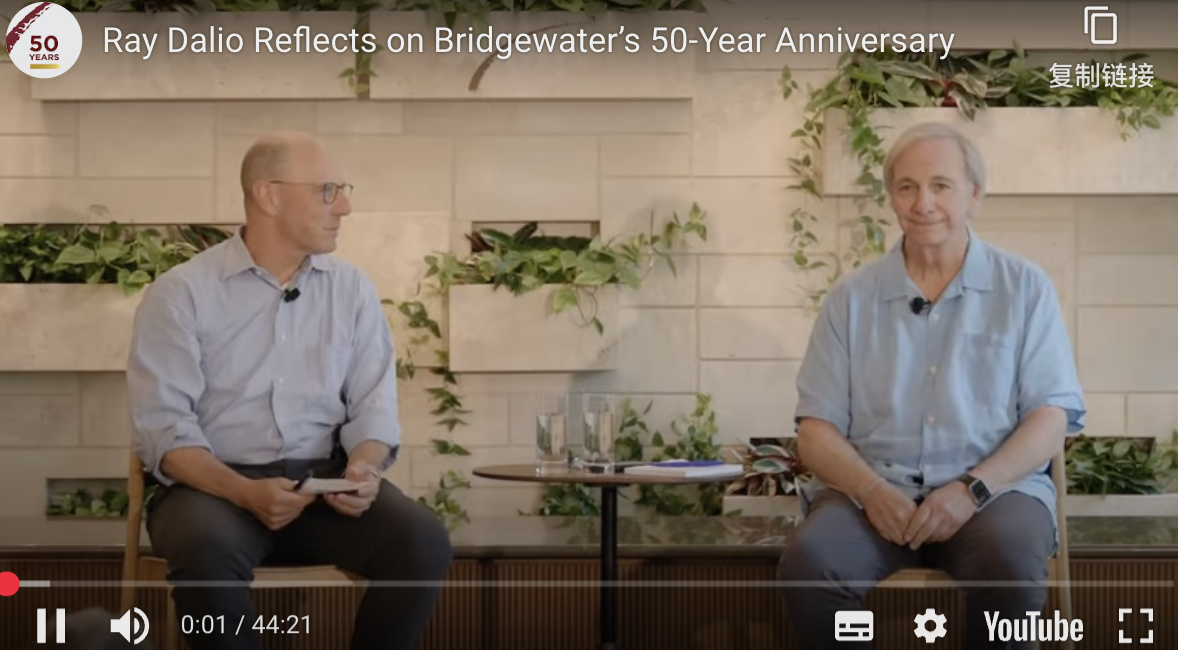
Group 1: Company Overview - Bridgewater Associates, founded by Ray Dalio 50 years ago, has become the world's largest hedge fund, with Dalio recently exiting the firm after selling his remaining shares [1][4] - The firm has issued new shares to the Brunei Investment Agency, granting it nearly 20% ownership, while Bob Prince will have a more significant role in the company [1][2] Group 2: Performance and Growth in China - Despite a significant decline in total assets under management from $168 billion in 2019 to $92.1 billion by the end of 2024, Bridgewater's operations in China have thrived [2][11] - Bridgewater China, established in 2016 and registered as a private fund manager in 2018, has seen its main private fund product achieve a cumulative net value increase of 76% over three years, with a current scale exceeding 40 billion RMB [2][11][14] - The "All Weather" strategy product has recorded an 18.55% performance increase this year, contributing to Bridgewater China's rapid growth [2][12] Group 3: Leadership Transition - The leadership of Bridgewater has transitioned to a younger generation, with key partners like Bob Prince, Greg Jensen, and others taking on more significant roles [4][16] - Ray Dalio has expressed confidence in the new leadership, emphasizing the importance of selecting capable individuals and fostering a culture of meritocracy [16][17] Group 4: Market Position and Strategy - Bridgewater's Chinese operations have become a crucial part of its business strategy, outperforming many local private equity firms during market volatility [11][12] - The firm has focused on distributing its products through top banks and brokerage channels, targeting high-net-worth clients [12][14]