
凌达压缩机

Search documents
入主6年首次减持!格力第一大股东要撤了?
Xin Lang Cai Jing· 2026-02-26 12:01
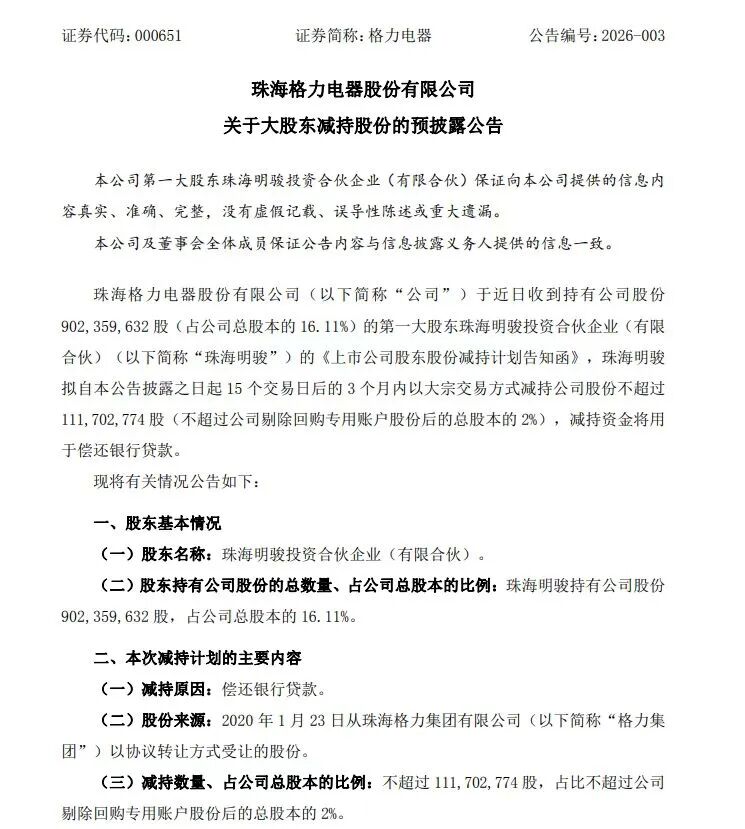
(来源:金投研) 一场震动A股的减持,把格力再次推上风口浪尖。 高瓴资本六年首减,43亿只为还贷。市场瞬间喊着"巨头要倒",其实在我看来,这不过是合伙人还私人欠款,和老匠的手艺、家底,没有太大关系。 01 突抛减持令 2月25日晚间,格力电器甩出的减持公告,直接炸醒了整个资本市场。公司第一大股东、高瓴资本旗下的珠海明骏,宣布拟减持不超2%股份,按当日收盘 价测算,套现金额足足43亿元,而这笔钱的唯一用途,仅仅只是偿还银行贷款!? | 均价: 37.65 最新: 37.59 -0.90 -2.34% | | | 2 大单模式 | | | --- | --- | --- | --- | --- | | 39.48 | | 2.57% | | | | | | | 五档 大单 分价 | | | | | | 卖5 37.64 | 781 | | | | | 三4 37.63 | 788 | | | | | 37.62 卖3 | 370 | | | | | 草2 37.61 | 1440 | | 38.49 | | | 卖1 37.60 | 2617 | | | | | 第1 37.59 | 837 | | | | | ...


格力电器:公司具备强大的核心部件研发和制造能力
Zheng Quan Ri Bao Wang· 2026-02-05 13:48
证券日报网讯 2月5日,格力电器(000651)在互动平台回答投资者提问时表示,公司具备强大的核心 部件研发和制造能力,旗下有凌达压缩机、凯邦电机、新元电子、格力电工及格力模具等子公司,在产 能、技术和质量方面均处于行业领先地位。核心零部件自主研发、制造,保障了公司产品的综合竞争 力。 ...
看懂这些关键领域,在2026年捡回「上行」信心
36氪· 2025-12-20 10:27
Core Insights - The article discusses the impact of AI on the workplace by 2025, highlighting both opportunities and challenges for job seekers and employers [5][6]. Group 1: AI and Job Market Dynamics - AI is expected to revolutionize job roles, but it also poses risks of job displacement, particularly for those in roles that can be automated [5]. - The emergence of "super individuals" in the workforce may lead to reduced job opportunities for others, as increased productivity from these individuals can displace multiple workers [5]. Group 2: Employer Branding and Recruitment Trends - There is a lack of investment in employer branding among companies, as many prioritize product performance over employee satisfaction [6]. - Companies are increasingly seeking "versatile talents" by expanding job descriptions, which may undermine the value of teamwork and specialized roles [6]. Group 3: Industry-Specific Insights - The advanced manufacturing sector is experiencing a surge in investment, particularly in robotics and 3D printing, with significant growth in talent demand [9]. - The chip manufacturing industry is accelerating its domestic production capabilities, with a reported 90% yield rate for new processes, indicating a strong push towards self-sufficiency [9]. Group 4: Employment Trends and Challenges - The article notes a structural talent shortage in various sectors, including robotics and chip manufacturing, with a reported talent gap exceeding 300,000 in the semiconductor industry [9]. - The article emphasizes the need for companies to adapt to changing market demands and invest in employee development to remain competitive [6][9].

格力电器战略解读:变与不变
Zhong Guo Chan Ye Jing Ji Xin Xi Wang· 2025-05-07 07:25
Core Viewpoint - The article discusses the strategic balance between change and stability that Chinese manufacturing, particularly Gree Electric Appliances, must navigate in an era of economic uncertainty and transformation [1][2]. Group 1: Gree's Stability - Gree Electric Appliances focuses on its core business of air conditioning, avoiding real estate and financial sectors, which has allowed it to build a strong competitive moat [4][5][6]. - The company has established a "strategic filtering mechanism" to evaluate new business opportunities, ensuring they align with its core competencies [6][8]. - Gree's commitment to quality is evident in its rigorous quality control measures, which have significantly reduced repair rates and enhanced brand reputation [7][9]. Group 2: Gree's Change - Gree is transitioning from a purely specialized approach to a related diversification strategy, leveraging its core technology in air conditioning to expand into home appliances and industrial products [14][15][16]. - The brand has undergone five iterations of its brand philosophy, evolving from a focus on product functionality to a global value-driven approach [17][18][19]. - Gree's channel strategy has shifted towards a more integrated and experiential model, enhancing customer engagement and sales efficiency [20][21][22]. Group 3: Industry Context - The Chinese home appliance industry is experiencing a significant reshuffle, driven by consumer upgrades and market challenges, necessitating strategic decisions from leading companies like Gree [2][24]. - The article emphasizes the importance of balancing short-term pain with long-term value in the face of rapid technological and market changes [23][24].
格力电器用财报诠释“技术长期主义者”胜利
凤凰网财经· 2025-05-01 11:34
Core Viewpoint - The article highlights Gree Electric's financial performance in 2024, showcasing a shift from scale-driven growth to value creation, emphasizing the importance of sustainable development and technological innovation in a competitive market [1][3][8]. Financial Performance - Gree Electric reported a total revenue of 1900.38 billion yuan in 2024, a decrease of 148.16 billion yuan from 2039.79 billion yuan in 2023, while net profit increased by 31.67 billion yuan to 321.85 billion yuan, reflecting a year-on-year growth of 10.91% [1][3]. - The company announced a cash dividend of 20 yuan for every 10 shares, demonstrating its commitment to returning value to shareholders [1]. Market Strategy - Gree Electric's strategy focuses on maintaining profitability despite a declining revenue trend, with a gross margin of 34.91% in its consumer electronics segment, which remains among the highest in the industry [4]. - The company has transformed its marketing approach by controlling costs through channel reforms and investing in technology to achieve brand premium [4][6]. Technological Innovation - Gree Electric emphasizes long-term technological accumulation over short-term market share battles, with 48 research achievements recognized as "internationally leading" and over 130,000 patents filed [6][7]. - The company leads the global market in split air conditioning retail volume and has maintained its position in the central air conditioning market for 13 consecutive years [6]. Industry Positioning - Gree Electric's approach serves as a model for the industry, advocating for a shift from price competition to technology-driven differentiation, which is essential for the health of the market ecosystem [5][8]. - The company is expanding into high-value sectors such as industrial products and green energy, which accounted for 9.12% of its revenue in 2024, showing a 0.8% year-on-year growth [7]. Global Expansion - Gree Electric is actively pursuing international markets, with a 13.25% increase in overseas revenue in 2024, exporting to over 190 countries and regions, and achieving a 70% share of its export revenue from its own brands [7].