
新业态新模式

Search documents
白酒、乳业、中式滋补的2025:崩盘、变局与增长新逻辑
Xin Lang Cai Jing· 2026-02-24 09:02
Core Viewpoint - The traditional business model of the liquor industry, particularly in the high-end white liquor segment, is failing, leading to a collapse of the pricing system and the emergence of new business models and consumer behaviors driven by the Z generation [3][4][14]. Industry Overview - In 2025, the Chinese consumer market is undergoing profound changes, with high-end liquor prices, such as those of Moutai, continuously declining, raising questions about their investment and stockpiling attributes [3][4][14]. - The Z generation (born between 1995 and 2009) has become the main consumer force, reshaping market rules and consumer preferences [3][4][14]. Pricing and Sales Performance - The prices of major white liquor products have significantly dropped, with Moutai's wholesale price falling from over 2200 yuan per bottle at the beginning of the year to below 1500 yuan by December 2025 [5][16]. - The overall performance of white liquor companies has deteriorated, with 20 A-share listed companies reporting a combined revenue of 317.78 billion yuan, a year-on-year decrease of 5.90%, and a net profit drop of 6.93% [5][17]. Corporate Strategies and Changes - Many liquor companies are experiencing frequent personnel changes, with over ten major companies, including Moutai and Yanghe, adjusting their core leadership positions in 2025 [6][18]. - Companies are exploring new business models and channels, such as switching from a "payment before delivery" to a "delivery before payment" model [8][20]. New Business Models - Moutai has announced a restructuring of its product system and pricing strategy, moving towards a direct sales model through its app, aiming to connect directly with consumers [9][20]. - The rise of "health liquor" has been notable, with a growth rate of 66%, indicating a shift in consumer preferences towards healthier options [10][21].



政策暖风叠加春节催化 消费板块投资机遇凸显
Zhong Guo Zheng Quan Bao· 2026-02-13 20:23
Core Viewpoint - The upcoming 2026 Spring Festival consumption season is expected to inject strong vitality into traditional consumption while accelerating the implementation of new business formats and models, shifting the investment logic in the consumption sector from "overall recovery" to "selective structure" [1][4]. Policy Effects - The "2026 'Shopping New Spring' Special Activity Plan" was jointly issued by nine departments, covering six areas: food, accommodation, transportation, tourism, shopping, and entertainment [1]. - The plan includes various promotional activities such as New Year’s Eve dinner packages, home renovation promotions, and increased transportation capacity by civil aviation and railway departments [1][2]. - The Ministry of Commerce announced three major incentives for consumers: trade-in programs, prize invoices, and financial support, aimed at enhancing the supply and promotional activities of retail businesses [2]. Market Dynamics - The restaurant sector is experiencing a surge in demand, with many restaurants in Beijing reporting a booking rate of 90% for New Year’s Eve dinners [3]. - Various cities are creating complex consumption scenarios, such as events in Wangfujing and Nanjing Road that combine culture, food, and interactive experiences [3]. - The trade-in program is gaining traction, with an emphasis on increasing subsidies and enhancing promotional activities during the Spring Festival [3]. Investment Opportunities - Analysts suggest focusing on four main investment lines: 1. Offline retail leaders adapting to consumer trends and regaining traffic [4]. 2. Gold and jewelry brands with fundamental and valuation recovery potential [4]. 3. Domestic beauty brands excelling in high-demand niches [4]. 4. Upstream differentiated medical beauty product manufacturers benefiting from the recovery of medical beauty consumption [4]. - Long-term investment strategies should consider changes in consumer structure and focus on new products, technologies, channels, and markets [5].
财经深一度丨从外贸万亿大省看韧性与活力
Ren Min Ri Bao· 2026-02-09 05:30
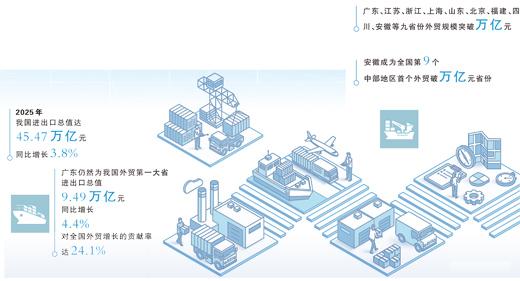
Core Insights - In 2025, China's total import and export value of goods reached 45.47 trillion yuan, a year-on-year increase of 3.8%, maintaining its position as the world's largest goods trading nation [1] - The resilience and vitality of the Chinese economy are reflected in the foreign trade "report card" [1] Group 1: Trade Performance and Contributions - Guangdong province led the nation in foreign trade for 40 consecutive years, with an import and export scale of 9.49 trillion yuan in 2025 [2] - High-tech product exports from Guangdong surpassed 1 trillion yuan for the first time, reaching 1.14 trillion yuan [2] - The combined import and export value of seven provinces and cities, including Guangdong, Jiangsu, and Zhejiang, reached 34.11 trillion yuan, contributing over half of China's foreign trade growth [3] Group 2: Market Diversification and International Cooperation - Chinese foreign trade enterprises are diversifying international market layouts to mitigate risks from single market fluctuations [4] - Guangdong's trade with ASEAN, the EU, and Hong Kong each exceeded 1 trillion yuan, while trade with Belt and Road countries reached 3.66 trillion yuan, growing by 5% [4] - Zhejiang's trade with ASEAN surpassed that with the EU for the first time, with a growth of 16.5% [5] Group 3: New Business Models and Innovations - The rise of new business models, such as cross-border e-commerce and market procurement, is enhancing the competitiveness of small and medium-sized enterprises [7][8] - Shanghai's service trade reached over 250 billion USD in 2025, accounting for nearly 30% of the national total, driven by digital technology and knowledge-intensive services [7] - Jiangsu's cross-border e-commerce platform is expected to boost exports by 35% for small and medium-sized enterprises [7] Group 4: Systemic Transformation and Future Outlook - China's foreign trade development is characterized by systemic changes in industrial upgrades, market diversification, and business model innovations [8] - The "Guangdong Goods Go Global" initiative aims to support foreign trade enterprises in expanding markets and strengthening industries [8] - Experts believe that China's trade innovation will inject more certainty into global economic development [8]
从外贸万亿大省看韧性与活力
Ren Min Ri Bao· 2026-02-09 02:17
Core Viewpoint - In 2025, China's total import and export value of goods reached 45.47 trillion yuan, a year-on-year increase of 3.8%, maintaining its position as the world's largest trading nation in goods [1] Group 1: Trade Performance and Contributions - Various provinces leveraged their geographical advantages and resource endowments to contribute to the steady development of China's imports and exports [1] - Guangdong province led the nation in import and export scale for 40 consecutive years, reaching 9.49 trillion yuan in 2025, with high-tech product exports surpassing 1 trillion yuan for the first time, totaling 1.14 trillion yuan [2] - In 2025, the combined import and export value of Guangdong, Jiangsu, Zhejiang, Shanghai, Shandong, Beijing, and Fujian reached 34.11 trillion yuan, contributing over half of China's foreign trade growth [3] Group 2: Market Diversification and New Opportunities - Chinese foreign trade enterprises are deepening cooperation in traditional markets while expanding into emerging markets, effectively diversifying market risks [4] - Guangdong's trade with ASEAN, the EU, and Hong Kong each exceeded 1 trillion yuan in 2025, while trade with Belt and Road countries reached 3.66 trillion yuan, growing by 5% [6] - Zhejiang's trade with ASEAN surpassed that with the EU for the first time, reaching 8690.7 billion yuan, a growth of 16.5% [6] Group 3: New Business Models and Innovations - The digital transformation and logistics upgrades have enabled more enterprises to participate in global competition, breaking traditional trade time and space limitations [8] - Shanghai's service trade reached over 250 billion USD in 2025, accounting for nearly 30% of the national total, with a focus on digital technology and knowledge-intensive services [8] - Jiangsu's cross-border e-commerce platform has driven a 35% increase in exports for small and medium-sized enterprises [8] Group 4: Systemic Changes in Foreign Trade - China's high-quality foreign trade development is characterized by systemic changes in industrial upgrades, market diversification, and business model innovations [9] - The "Guangdong Goods Go Global" initiative aims to assist foreign trade enterprises in expanding markets, strengthening industries, and building brands [9] - Experts emphasize the need to accelerate the development of new business models such as cross-border e-commerce and overseas warehouses to explore new trade spaces [9]
我国与APEC其他经济体进出口总值达26.29万亿元 占同期外贸总值的57.82%
Ren Min Ri Bao· 2026-02-05 22:18
Core Insights - By 2025, China's total import and export value with APEC economies is projected to reach 26.29 trillion yuan, accounting for 57.82% of the total foreign trade value during the same period [1] - China has transitioned from "processing and manufacturing" to a model that integrates "R&D + manufacturing + services" within the regional supply chain, with significant growth in high-tech product exports, which reached 4.63 trillion yuan, a year-on-year increase of 8.1% [1] - Key imports in sectors such as energy, agricultural products, semiconductor equipment, and precision instruments are also experiencing rapid growth [1] Trade Dynamics - New business models and formats are thriving, with cross-border e-commerce witnessing rapid growth [1] - Digital trade, represented by data flow and electronic documents, along with green trade in renewable energy and low-carbon products, are emerging as new highlights in foreign trade growth [1] Economic Context - The Asia-Pacific region's economic total has surpassed 60% of the global economy, with trade volume approaching half of the world's total, positioning it as an engine for global economic growth [1] - The Deputy Director of the General Administration of Customs, Zhao Zenglian, emphasized a focus on inclusive development, aiming to continuously release more benefits from openness and share opportunities in digital, intelligent, and green development with all parties [1]
我国外贸韧性从何而来
Jing Ji Ri Bao· 2026-01-31 01:10
Core Viewpoint - China's foreign trade demonstrates strong resilience amid increasing global economic uncertainties, achieving a total import and export value of 45.47 trillion yuan in 2025, a year-on-year increase of 3.8%, marking a historical high and maintaining growth for nine consecutive years [1] Group 1: Trade Performance - Exports grew by 6.1%, while imports increased by 0.5%, solidifying China's position as the world's largest goods trader [1] - High-tech products have become a significant driver of export growth, with industrial robots achieving a trade surplus for the first time, establishing China as a net exporter of industrial robots [1] Group 2: Market Diversification - China's diversified trade markets have mitigated global economic risks, with traditional markets maintaining scale and emerging markets, such as ASEAN and Africa, showing high growth [2] - Private enterprises have played a crucial role in enhancing foreign trade vitality and market adaptability, contributing significantly to stable foreign trade growth [2] Group 3: Policy and Institutional Support - Continuous efforts to build a higher-level open economy and policy innovations, such as customs facilitation and tax reductions, have lowered enterprise costs and improved the foreign trade business environment [2] - New business models, including cross-border e-commerce and market procurement trade, have experienced rapid growth, enhancing the regulatory and service systems for foreign trade [2] Group 4: Strategic Recommendations - Strengthening policy environments to stabilize foreign trade expectations through expanded institutional openness and improved international business environments [3] - Restructuring market dynamics by diversifying markets and enhancing cooperation with Belt and Road Initiative countries to reduce reliance on single markets [3] - Promoting high-quality development strategies in foreign trade by upgrading export product structures towards high-tech and high-value-added goods [3] Group 5: Innovation and Support for Trade Entities - Encouraging innovation in business models and establishing national digital trade demonstration zones to foster new growth points in foreign trade [4] - Providing targeted financial and tax support to foreign trade enterprises, especially small and medium-sized ones, to enhance their operational capabilities [4] - Assisting enterprises in navigating international trade restrictions and improving compliance capabilities through various support measures [4]
多元化服务供给释放经济新活力 新业态新模式为服务消费增长开辟新空间
Yang Shi Wang· 2026-01-27 04:04
Group 1 - The core viewpoint is that China's service consumption is expected to maintain rapid growth, with a projected retail service revenue increase of 5.5% year-on-year by 2025 [1] - The service retail sectors such as cultural and recreational activities, communication information, tourism consulting and leasing, and transportation are anticipated to experience double-digit growth [1][4] - The new trends in service consumption include travel associated with events and culinary experiences linked to movies, alongside the development of new business models like low-altitude flights and cruise tourism [4] Group 2 - By 2025, the total revenue from the catering industry is expected to reach 5.8 trillion yuan, reflecting a year-on-year growth of 3.2% [4] - The proportion of per capita service consumption expenditure by residents is projected to increase, indicating a shift towards more service-oriented spending [4] - The Ministry of Commerce plans to continue implementing actions to enhance service consumption quality and promote investment in the service sector, focusing on areas such as cultural entertainment, tourism, and healthcare [6]

协调便利与安全、平衡进口与出口 政策措施“组合拳”护航外贸创新发展
Yang Shi Wang· 2026-01-18 04:34
Group 1 - The core viewpoint of the article emphasizes that the General Administration of Customs will introduce more policy measures to promote innovative development in foreign trade during the first year of the 14th Five-Year Plan [1] - Over the past five years, the customs has effectively responded to risks and challenges, managing an average of 5.2 billion tons of import and export goods and 42.3 trillion yuan in trade annually, making it the largest in the world [3] - The Customs General Administration is positioned at the intersection of domestic and international dual circulation, focusing on coordination and balancing convenience and security, as well as imports and exports during the 14th Five-Year Plan period [6] Group 2 - The Customs General Administration aims to enhance both import and export controls, expand exports, and moderately increase imports to facilitate international circulation and better integrate domestic and foreign trade [7] - A new round of cross-border trade facilitation initiatives will be launched by 2026, introducing effective policies to support the development of new business models such as cross-border e-commerce and overseas warehouses [7] - The customs will optimize inspection and quarantine supervision to support the expansion of imports of high-quality agricultural products, consumer goods, and genetic resources, while ensuring regulatory services for major trade fairs [9]
海关总署:“新三样”产品2025年出口规模比2020年增长3.5倍
Xin Lang Cai Jing· 2026-01-14 04:07
Core Viewpoint - China's foreign trade is continuously optimizing and upgrading, with increasing "new" and "green" content in exports and imports [1] Group 1: Trade Growth - The average annual growth rate of high-tech product imports and exports over the past five years is 7.9%, with a further acceleration to 11.4% in 2025 [1] - The contribution rate of high-tech products to overall foreign trade growth is close to 60% [1] Group 2: Key Product Exports - The export scale of "new three items" including electric vehicles, photovoltaic products, and lithium batteries is expected to reach approximately 1.3 trillion yuan in 2025, representing a 3.5 times increase compared to 2020 [1] Group 3: E-commerce Growth - Preliminary statistics indicate that China's cross-border e-commerce imports and exports will reach 2.75 trillion yuan in 2025, marking a 69.7% increase from 2020 [1]
2025年跨境电商进出口2.75万亿元 比2020年增长69.7%
Zhong Guo Jing Ji Wang· 2026-01-14 03:34
Core Viewpoint - China's foreign trade is increasingly characterized by higher "new content" and "green content," with significant growth in high-tech product exports and emerging business models [1] Group 1: High-Tech Product Exports - Over the past five years, the average annual growth rate of high-tech product imports and exports has been 7.9% [1] - The year-on-year growth rate for 2025 is projected to accelerate to 11.4%, contributing nearly 60% to overall foreign trade growth [1] Group 2: Emerging Products - The export scale of electric vehicles, photovoltaic products, and lithium batteries, referred to as the "new three," is expected to reach approximately 1.3 trillion yuan by 2025, representing a 3.5-fold increase compared to 2020 [1] Group 3: Cross-Border E-Commerce - Preliminary statistics from customs indicate that cross-border e-commerce imports and exports in China are projected to reach 2.75 trillion yuan by 2025, marking a 69.7% increase from 2020 [1]