华为Mate XT

Search documents
用户到底需要怎样的品牌?从华为Now is Yours主张说起
Sou Hu Cai Jing· 2025-12-28 09:04
Core Insights - The rise of a new generation of consumers is reshaping the technology market, making youth engagement a survival necessity for brands [3][4] - Traditional marketing strategies are becoming less effective as young consumers seek authenticity and emotional connection rather than mere product features [4][6] Group 1: Consumer Behavior - Young consumers are immersed in niche cultures such as esports and subcultures, valuing individuality and emotional resonance while being critical of overt marketing tactics [4][5] - The shift from template-based marketing to a more personalized approach is essential as consumers exhibit fatigue towards standardized advertising [4][7] Group 2: Brand Strategies - Huawei has shifted its focus from technical specifications to understanding and addressing consumer needs through relatable stories and user-centric design [5][10] - The introduction of features like the wheelchair mode in Huawei's products demonstrates a commitment to inclusivity and addressing specific user needs, reflecting a deeper understanding of diverse consumer requirements [10][14] Group 3: Market Positioning - Huawei's approach emphasizes long-term engagement with consumers, fostering a community around shared interests and experiences rather than just selling products [14][15] - The brand's success in wearable technology and other segments is attributed to its ability to integrate into consumers' daily lives, making technology a part of their community [15][21] Group 4: Future Trends - The technology industry is expected to face intensified competition for youth engagement, with brands needing to adapt to diverse consumer demands driven by emotional and experiential factors [24][25] - Companies must prioritize authentic emotional connections and support for self-expression among young consumers, moving away from traditional authoritative marketing styles [24][25]


折叠屏手机竞速 产业链尚待完全成熟
Bei Jing Shang Bao· 2025-12-03 01:43
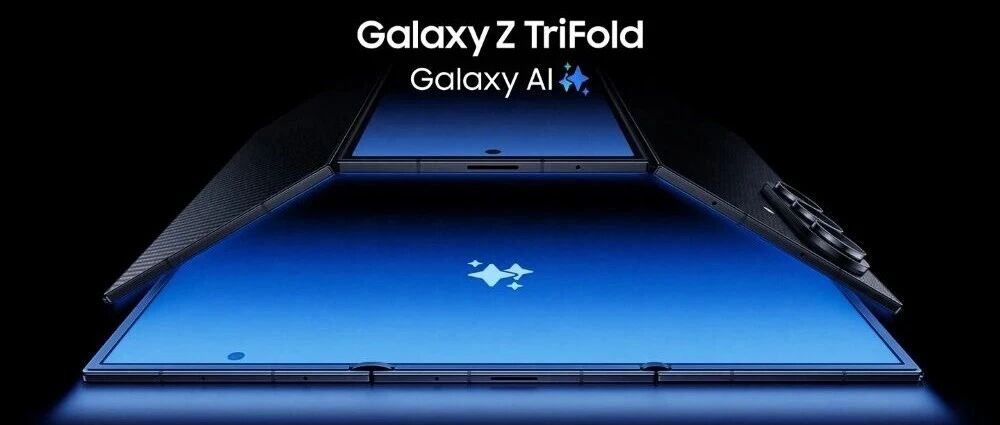
Core Viewpoint - Samsung Electronics has officially launched its first tri-fold smartphone, the Galaxy Z TriFold, which aims to showcase its leadership in foldable technology and set a new benchmark in the high-end market, ahead of Apple's upcoming foldable iPhone [1][2] Group 1: Samsung Galaxy Z TriFold - The Galaxy Z TriFold features an inward-folding design that protects the main display, offering a screen space equivalent to three 6.5-inch smartphones side by side, surpassing the previous Galaxy Z Fold 7 [2] - The device is extremely thin, measuring only 3.9 mm at its thinnest point when unfolded, and weighs 309 grams, comparable to the Galaxy Z Fold 7 [2] - It is powered by a custom Snapdragon 8 Elite for Galaxy chip, comes with 16GB of RAM, and offers storage options of 512GB and 1TB, along with a 5600mAh battery, the largest for Samsung's foldable phones, supporting 17 hours of continuous video playback [2] Group 2: Software and Features - The Galaxy Z TriFold includes Samsung's Galaxy AI feature suite, which offers generative editing, photo assistance, and writing assistance, along with a six-month trial of Google AI Pro subscription service [3] Group 3: Apple's Foldable iPhone Developments - Apple has made significant progress in developing its first foldable iPhone, the iPhone Fold, achieving a "no crease" design, which could make it the world's first truly crease-free foldable phone [4] - The expected price for the iPhone Fold is around $2399, with lifecycle sales projected to reach 15.4 million units, despite the overall smartphone market facing a decline [6][8] - The iPhone Fold's internal screen measures 7.74 inches, with an external screen of 5.49 inches, and a battery capacity between 5400-5800mAh, exceeding that of the iPhone 17 Pro Max [5] Group 4: Market Trends and Challenges - The global smartphone market is expected to continue shrinking, with a projected decline in shipments to 1.2 billion units in 2026, while Apple's foldable iPhone is anticipated to be a market highlight [6][8] - Challenges for foldable phones include high prices, durability concerns, and software compatibility issues, which may hinder widespread adoption [7] - Analysts remain optimistic about the future of foldable phones, citing ongoing improvements in durability, design, and user experience as key factors for attracting a broader consumer base [8]

售价17302元!三星发布全球首款内折三折叠手机
WitsView睿智显示· 2025-12-02 06:57
Core Viewpoint - Samsung has officially launched the world's first inward-folding tri-fold smartphone, the Galaxy Z TriFold, showcasing advanced display technology and innovative design features [1][3]. Display Features - The Galaxy Z TriFold features a 10-inch Dynamic AMOLED main screen with a resolution of 2160 x 1584, supporting a 1-120Hz adaptive refresh rate and a peak brightness of 1600 nits. The external screen measures 6.5 inches with a resolution of 2520 x 1080, also supporting a 1-120Hz adaptive refresh rate and a brightness of 2600 nits, with a 21:9 aspect ratio [1]. Design and Build - In terms of dimensions, the Galaxy Z TriFold is only 3.9 mm thick at its thinnest point when unfolded, with a central thickness of 4.2 mm and a side button thickness of 4.0 mm. The device weighs 309 grams and features Corning Gorilla Glass Ceramic 2, titanium alloy hinges, and a high-strength armor aluminum body [3]. - The folding mechanism differs from Huawei's Mate XT, with Samsung employing a G-shaped folding design that allows the flexible large screen to be fully housed within the device, while Huawei uses a Z-shaped design that leaves part of the screen exposed when folded [3]. Camera and Performance - The camera system includes a vertical pill-shaped camera island with three cameras: a 200-megapixel wide-angle sensor with 2x optical zoom, a 12-megapixel ultra-wide lens, and a 10-megapixel telephoto lens. The external screen has a 10-megapixel front camera, and the main screen integrates another 10-megapixel under-display camera [4]. - The Galaxy Z TriFold is powered by a custom Snapdragon 8 Elite for Galaxy chip (3nm process) and features a 5600mAh battery with Super Fast Charging 2.0 (45W), capable of charging to 50% in approximately 30 minutes. It comes with 16GB of RAM and storage options of 512GB or 1TB [4]. Market Availability - The Galaxy Z TriFold will first launch in South Korea on December 12, with a starting price of 3,590,400 KRW (approximately 17,302 CNY). It is expected to be available in China, Singapore, and the UAE by the end of December, with a planned release in the United States in the first quarter of 2026 [4].
华为上半年研发投入强度达22.7%
Zheng Quan Ri Bao· 2025-08-29 15:46
Core Insights - Huawei's revenue for the first half of 2025 reached 427.04 billion yuan, a year-on-year increase of 3.95%, while net profit decreased by 32% to 37.20 billion yuan [1] - The company maintained high R&D investment, with R&D expenses amounting to 96.95 billion yuan, a 9.04% increase year-on-year, representing 22.7% of total revenue [1][3] - Huawei's cash flow from operating activities showed a significant improvement, with a net inflow of 31.18 billion yuan compared to a net outflow of 25.12 billion yuan in the same period last year [3] Financial Performance - Total assets reached 1.251 trillion yuan, with total liabilities of 712.1 billion yuan, resulting in a debt-to-asset ratio of 56.9% [1] - The company reported a significant increase in sales and management expenses, with sales expenses rising by 11.09% to 39.38 billion yuan and management expenses increasing by 7% to 24.20 billion yuan [1] Market Position and Product Development - Huawei has established a leading position in the domestic foldable smartphone market, capturing 75% market share with 3.74 million units shipped in the first half of 2025 [2] - The company has achieved a cumulative shipment of over 10 million foldable smartphones since the launch of its first model in 2019, with the Huawei Mate XT nearing 500,000 units shipped [2] - In the automotive sector, Huawei's HarmonyOS has seen strong performance, with cumulative deliveries exceeding 900,000 units, maintaining the highest average transaction price among Chinese automotive brands for 14 consecutive months [2] R&D and Future Outlook - Huawei's cumulative R&D investment over the past decade has reached 1.249 trillion yuan, with a projected R&D expenditure of 179.7 billion yuan for the full year of 2024, accounting for 20.8% of total revenue [1] - The company is focused on building a technological moat through sustained high R&D investment, which is expected to drive future growth [1][3]
华为新三折定档,先于iPhone17亮相
Guan Cha Zhe Wang· 2025-08-27 07:13
Core Viewpoint - Huawei and Apple are set to launch their new flagship products, with Huawei's MateXTs scheduled for September 4 and Apple's iPhone 17 on September 9, highlighting the competitive landscape in the smartphone market [1][6]. Group 1: Huawei's Market Position - Huawei's Mate XT, the first generation of its foldable phone, has nearly 500,000 units shipped in the first half of the year, generating over 10 billion yuan in revenue [1][5]. - Huawei holds a dominant position in the Chinese foldable smartphone market with a 75% market share in the first half of the year, attributed to continuous product iterations and a lack of significant competition from other brands [4][5]. - The foldable smartphone market is experiencing a slowdown, with a projected 3.3% year-on-year growth for 2023, indicating potential challenges ahead despite Huawei's strong product lineup [5]. Group 2: Industry Trends and Innovations - The foldable smartphone segment is entering a phase where hardware innovation is slowing, shifting focus towards software upgrades and new product forms [5]. - Future innovations may include new materials, eSIM technology, low-orbit satellite internet, and advancements in AI and HarmonyOS, which could revitalize the foldable market [5]. - The competitive landscape is evolving, with Huawei's strong brand presence in the absence of Apple in the foldable segment, emphasizing the importance of brand loyalty in this high-end market [4][5]. Group 3: Apple's Challenges and Innovations - Apple's iPhone 17 series is expected to feature significant design changes and improvements in imaging and battery life, but faces pressure from competitors like Huawei [6][8]. - The company is under pressure from rising production costs in the U.S. and declining sales in China due to competition from domestic brands [7][8]. - Apple is preparing for future foldable devices, although they are not expected to debut this year, indicating a strategic focus on innovation to maintain market relevance [7][8].

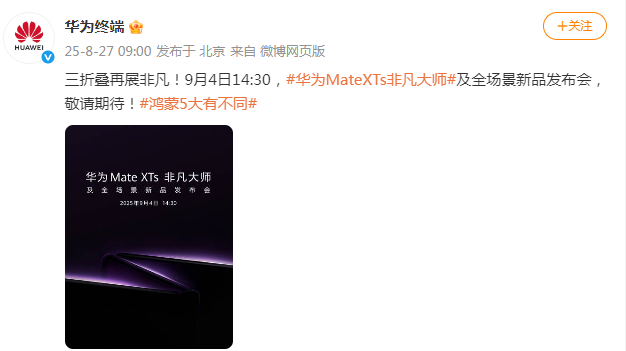
华为官宣,新三折叠来了!9月4日发布
Qi Lu Wan Bao· 2025-08-27 02:44
Core Insights - Huawei is set to launch the Mate XTs foldable smartphone on September 4 at 14:30, as announced on their official Weibo account [1][3] - The Mate XTs is expected to build on the success of its predecessor, the Mate XT, which has seen impressive sales, nearing 500,000 units shipped in the first half of the year [7] - The new device will feature the Kirin 9020 chip, with a CPU configuration of 1 x 2.5GHz large core, 3 x 2.15GHz medium cores, and 4 x 1.6GHz small cores, along with a Maleoon 920 GPU [7] Product Details - The Mate XTs will have minimal design changes from the previous model and will be available in four color options: black, red, white, and purple [7] - The pricing strategy for the Mate XTs is expected to be more competitive, with a target price around 15,000 yuan, compared to the previous model's pricing which ranged from 19,999 yuan to 23,999 yuan depending on storage options [7]
华为VS三星,三折叠大战9月对决?
Guan Cha Zhe Wang· 2025-07-29 06:20
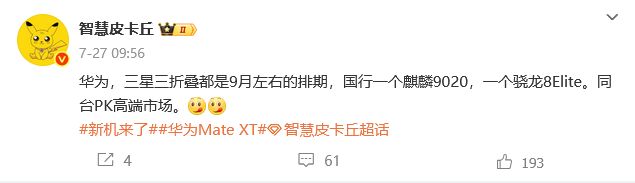
Core Insights - Huawei and Samsung are both expected to launch their new tri-fold smartphones around September, with Samsung's mobile head announcing plans for a release by the end of the year [1] - The Huawei tri-fold phone will feature a Kirin processor, while Samsung's device will be equipped with a Snapdragon 8 Elite processor, indicating a direct competition in the high-end market [1] - Samsung has registered the trademark Galaxy Z Trifold, suggesting a branding strategy that aligns with its existing Galaxy Z series [1][2] Group 1 - Samsung's Galaxy Z Trifold is rumored to be an inward-folding phone with a separate screen cover, differing from Huawei's Mate XT which folds in a "Z" shape [2] - Huawei's new tri-fold phone, codenamed "Greenlan," will have similar aesthetics to its predecessor Mate XT, available in four colors, and is expected to have improved features [3] - The Mate XT has a retail price exceeding 22,000 yuan, with sales around 500,000 units, indicating strong market performance and potential for higher sales with the new model [3] Group 2 - A Samsung executive confirmed that the hardware for the tri-fold phone is ready for production, but the company is assessing market demand for the design [4] - Samsung plans to begin small-scale production of the tri-fold phone in September, primarily targeting the Korean and Chinese markets, with an estimated factory price of 4 million KRW (approximately 20,840 yuan) [4] - The first mass-produced tri-fold phone, Huawei's Mate XT Ultimate Design, has a starting price of 19,999 yuan, highlighting competitive pricing strategies in the market [4]
李斌说黑蔚来水军每月5千万,马斯克特朗普决裂,中国收紧稀土出口
Sou Hu Cai Jing· 2025-06-06 09:13
Group 1: Rare Earth Export Restrictions - China has tightened export controls on certain rare earth alloys, mixtures, and magnets, leading to warnings from major automotive companies about potential production halts due to supply shortages [3][5] - China dominates the global rare earth market, producing 92% of high-purity and refined rare earths, with the U.S. relying on China for 70% of its rare earth needs [3][5] - The automotive industry is particularly affected, as the shortage of rare earth magnets could disrupt production lines globally [3][5] Group 2: Huawei Pura80 Series Launch - Huawei's new Pura80 series is set to be officially unveiled next week, with over 100,000 pre-orders already recorded [5] - The Pura80 features a distinctive triangular Deco design and is expected to have significant upgrades in its camera module, possibly including a one-inch sensor [5] - The Mate XT model is anticipated to be the first to support eSIM technology, eliminating the physical SIM card slot for a more streamlined design [5] Group 3: NIO's Financial Performance - NIO reported over 12 billion yuan in revenue for Q1, although it has not yet achieved profitability, yet its stock price rose following the earnings announcement [7] - CEO Li Bin expressed frustration over the prevalence of online smear campaigns against the company, estimating monthly costs related to these attacks at 30 to 50 million yuan [7] - NIO is positioned in a competitive market, and maintaining product and technology leadership is crucial for its future success [7] Group 4: Elon Musk and Trump Feud - Elon Musk publicly criticized former President Trump, leading to a significant drop in Tesla's market value, exceeding 100 billion yuan in a single night [10] - The fallout from Musk's departure from the Trump administration has resulted in a public dispute, highlighting the contrasting interests of both figures [10] - Tesla has faced challenges with stagnant growth, and Musk's return to focus on technology may be critical for revitalizing the company's narrative [10] Group 5: Rise of "Su Chao" in Sports - The "Su Chao" phenomenon has gained immense popularity, with ticket prices skyrocketing from 10 yuan to nearly 600 yuan due to increased public interest [12] - Local businesses have capitalized on this trend, with innovative marketing strategies leading to significant sales increases for related products [12] - The success of "Su Chao" illustrates the importance of local engagement and tailored strategies in the sports industry, moving beyond mere imitation of successful models [12][13]
研判2025!中国折叠屏手机行业产业链、出货量及企业市场份额分析:铰链革新与AI赋能双轮驱动,中国折叠屏手机出货量同比飙升[图]
Chan Ye Xin Xi Wang· 2025-06-06 01:33
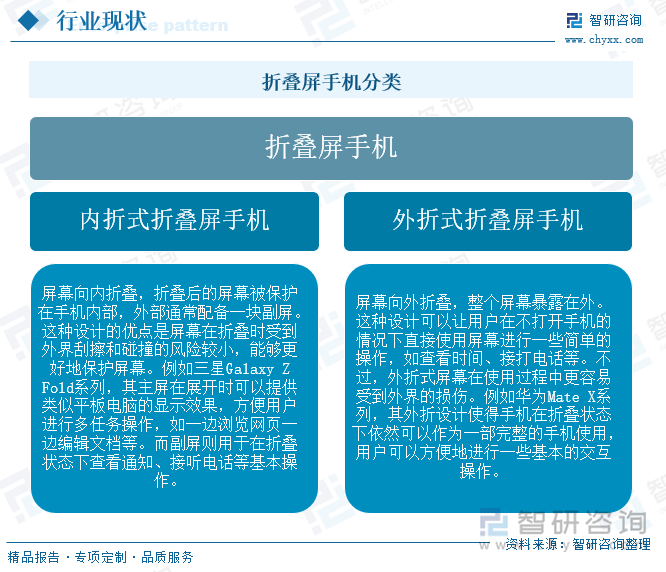
Core Viewpoint - In Q1 2025, China's foldable smartphone shipments reached 2.84 million units, marking a 53.04% year-on-year increase, driven by technological maturity and ecosystem integration [1][13]. Industry Overview - Foldable smartphones utilize flexible screen technology to change form factors, providing larger display areas when unfolded and more portability when folded, thus enhancing user interaction experiences [2]. Industry Development History - The Chinese foldable smartphone industry has evolved through five stages, starting from the exploratory phase (2012-2017) with early models like Kyocera's KSP8000, to the current phase of technological deepening and ecosystem integration [4][6]. Industry Current Status - The significant growth in foldable smartphone shipments is attributed to advancements in hinge technology and the integration of operating systems like Huawei's HarmonyOS, which enhances user experience through features like split-screen functionality [13][17]. Industry Supply Chain - The supply chain for foldable smartphones includes upstream materials such as flexible display materials (UTG glass, flexible OLED panels), hinge system materials, and production equipment, with downstream channels including e-commerce platforms and physical retail stores [9]. Key Companies' Performance - Huawei dominates the foldable smartphone market with a 76.6% market share in Q1 2025, followed by Honor, OPPO, Xiaomi, and Samsung, indicating a competitive landscape characterized by differentiation [15][17]. Industry Development Trends - The foldable smartphone market is witnessing trends such as continuous innovation in form factors and functionalities, with AI integration reshaping user interactions and driving the evolution of operating systems [20][21]. Price Point and Market Penetration - Foldable smartphones are moving towards mainstream markets, with models like OPPO Find N5 priced at 6,999 yuan, contributing to a significant increase in sales within the 6,000 yuan price segment [22]. Ecosystem Reconstruction and Global Competition - The competition in the foldable smartphone market has shifted from hardware to ecosystem development, with companies like Huawei leveraging their HarmonyOS to create a comprehensive smart life ecosystem [23].
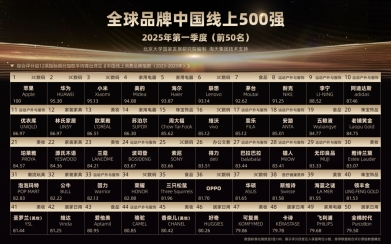
手机品牌霸榜 “全球品牌中国线上500强”,苹果夺冠,华为、小米包揽前三
Zhong Guo Jing Ji Wang· 2025-05-23 03:30
Group 1 - The first "Global Brand China Online 500" list has been officially released, with 3C digital brands performing exceptionally well, led by Apple, followed by Huawei and Xiaomi in the top three positions [1] - A total of 43 brands from the 3C digital industry made it into the top 500 list, with notable mobile brands including vivo, Honor, OPPO, Samsung, realme, and iQOO also featured [1] - Apple achieved a comprehensive score of 100, the highest among the listed brands, reflecting its strong overall performance [1] Group 2 - The list was jointly published by Peking University's National Development Research Institute and other organizations, based on consumer purchasing behavior data from Taobao and Tmall, utilizing 12 indicators for scoring [3] - The strong purchasing power of Chinese consumers has made China a key market for international brands, prompting increased investment from companies like Apple [3] - During the Tmall 618 event, Apple offered unprecedented discounts on the iPhone 16 series, with the iPhone 16 Pro 128GB version priced at 5499 yuan after various subsidies, leading to significant sales growth [3] Group 3 - Domestic smartphone brands are showing a strong upward trend, with Huawei and Xiaomi's sales growth surpassing that of Apple, indicating their competitive edge in key metrics [4] - The launch of new products has become a core growth driver for smartphone brands, with over 70% of new flagship phones achieving significant sales shortly after their debut [4] - Innovation is a key factor in the rise of domestic brands, with Huawei introducing groundbreaking products like the world's first foldable phone, and other brands focusing on advanced imaging technologies [4]