华夏中证细分有色金属产业主题ETF

Search documents
有色金属主题基金还能上车吗?市场观察
私募排排网· 2026-03-02 12:00
Core Viewpoint - The article discusses the performance of the non-ferrous metals sector in the A-share market since 2025, highlighting its strong performance and questioning whether it is still a good time to invest, given the changes in the underlying logic of price increases [4]. Group 1: Changes in Upward Logic - The current rally in non-ferrous metals is driven by improvements in supply and demand structures rather than mere speculative sentiment. The ongoing global electrification process is boosting demand for industrial metals like copper and aluminum, while supply remains constrained due to insufficient capital expenditure and stricter environmental regulations [6]. - Initially, the price increases were primarily driven by "profit recovery," but the market is now beginning to reflect future profit expectations, leading to a shift towards "trend-driven" investment. This transition is expected to increase volatility in the market [7][8]. Group 2: Current Valuation Position - Non-ferrous metals are currently not considered cheap, with the industry PE (TTM) at approximately 60% of the historical range, while the PB ratio is nearing 100%, indicating a historically high valuation. This suggests that the market's pricing of assets is becoming aggressive, and caution is advised regarding the "low PE" appearance [10]. - The performance of various indices shows that the non-ferrous metals sector has seen a significant increase of 137.46% since 2025, with a near 100% PB ratio, indicating a high valuation level compared to historical data [11]. Group 3: ETF Fund Flows - Over the past year, the scale of non-ferrous metal-themed ETFs has expanded significantly, with notable net inflows and high trading activity, indicating continued participation from trend-driven funds. However, the rapid expansion of ETF sizes may lead to increased concentration of holdings, which could amplify volatility during market corrections [15]. - The article lists the top ten ETFs by net inflow, with significant contributions from funds focused on non-ferrous metals, indicating strong interest in this sector [16]. Group 4: Investment Strategies - For trend traders, as long as the driving factors and supply-demand dynamics remain unchanged, there may still be opportunities for continued gains, although the current high volatility requires careful position management [17]. - Mid-term investors should be cautious due to high valuations and crowded positions, suggesting a phased approach to investment rather than a lump-sum entry [18]. - Long-term strategic investors may still find value in the non-ferrous metals sector due to ongoing global resource constraints and energy transition trends, recommending dollar-cost averaging or contrarian strategies to smooth out volatility [19]. Group 5: Recommended Funds - The article suggests several public funds for consideration, including: 1. Southern CSI Non-Ferrous Metals ETF Link A (004432), tracking the CSI Non-Ferrous Metals Index [20]. 2. Huaxia CSI Non-Ferrous Metals Industry Theme ETF Link A (016707), focusing on larger, liquid stocks in the non-ferrous metals and mining sectors [20]. 3. Qianhai Kaiyuan Hong Kong-Shenzhen Core Resource Flexible Allocation Mixed A (003304), which emphasizes gold and small metal-related stocks [21].


ETF周报2026年1月第3期:宽基流出边际趋缓,个人投资者积极-20260202
East Money Securities· 2026-02-02 13:11
Overall ETF Fund Flow Overview - During the period from January 26 to 30, 2026, the overall market stock ETFs (excluding cross-border) experienced a net outflow of 314.93 billion, with a notable decrease in outflow scale towards the end of the week as the market weakened [11][14] - A-share industry and thematic ETFs saw a net inflow of 71.75 billion, an increase of 12.88 billion compared to the previous period, indicating strong market entry willingness from individual investors who view market pullbacks as opportunities for allocation [14][16] - Hong Kong stock ETFs recorded a net inflow of nearly 10 billion, continuing the inflow trend, while cross-border industry and thematic ETFs had a net inflow of 1.16 billion, a decrease of 6.35 billion from the previous week [16] Sector Analysis - The inflow into sectors such as non-ferrous metals, semiconductors, chemicals, and gold stocks showed strong sustainability, while the oil and petrochemical sector saw a significant increase in net inflow, although recent market volatility may affect price direction [20][22] - In the cross-border sector, emerging markets, Hong Kong's Hang Seng Technology, and major industry categories like technology and financial real estate saw relatively high inflows [25] Representative ETF Fund Flow - For stock ETFs, the top five by net inflow from January 26 to 30 were: - Huaxia CSI Non-ferrous Metals Industry Thematic ETF (6.46 billion) - Southern CSI Shenwan Non-ferrous Metals ETF (5.63 billion) - Penghua CSI Chemical Industry ETF (4.01 billion) - Huaxia CSI Shanghai-Hong Kong Gold Industry Stock ETF (3.82 billion) - Fortune CSI Chemical Industry Thematic ETF (2.78 billion) - The top five by net outflow were: - E Fund CSI 300 ETF (-74.73 billion) - Huatai-PB CSI 300 ETF (-74.20 billion) - Huaxia CSI 300 ETF (-54.71 billion) - Huaxia SSE 50 ETF (-41.73 billion) - Jiashi CSI 300 ETF (-40.63 billion) [28] Cross-Border ETF Representative Products - The top five cross-border ETFs by net inflow were: - GF CSI Hong Kong Stock Connect Non-bank ETF - Tianhong Hang Seng Technology ETF - Southern Fund Southern Dongying FTSE Asia Pacific Low Carbon Selected ETF (QDII) - GF CSI Hong Kong Innovative Medicine (QDII-ETF) - E Fund CSI Hong Kong Stock Connect Consumer Thematic ETF [3]
差异化布局显成效 主题ETF开年吸金超95亿元
Zheng Quan Ri Bao· 2026-01-11 17:08
Group 1 - The A-share market has shown a structural trend since the beginning of 2026, with thematic ETFs gaining popularity due to their precise sector positioning and efficiency, resulting in a net inflow of 9.519 billion yuan and an average net value growth rate of 6.6% as of January 11 [1] - Leading products in niche sectors have performed exceptionally well, with eight ETFs, including Huaxia CSI Nonferrous Metals Industry ETF and E Fund CSI 300 Non-Bank ETF, each seeing net inflows exceeding 1 billion yuan within the month [2] - The strong performance of thematic ETFs reflects a market focus on technology innovation and high-end manufacturing, with 99 products achieving net value growth rates exceeding 10% in January [2] Group 2 - The impressive performance of thematic ETFs is attributed to the public fund industry's ongoing deepening and refinement of product layouts, moving away from homogeneous competition to focus on differentiated niche themes [3] - New product launches, such as Yongying Fund's Industrial Software Theme ETF and E Fund's CSI All-Index Food ETF, demonstrate the trend of targeting specific segments within broader industries, enhancing the product spectrum [3] - The competitive landscape has shifted, with leading institutions and smaller public funds adjusting strategies to create "blockbuster products" in niche areas, as evidenced by the rapid scale growth of E Fund's AI Theme ETF [3][4]
多只有色金属ETF周涨超4%丨ETF基金周报
2 1 Shi Ji Jing Ji Bao Dao· 2025-10-13 03:01
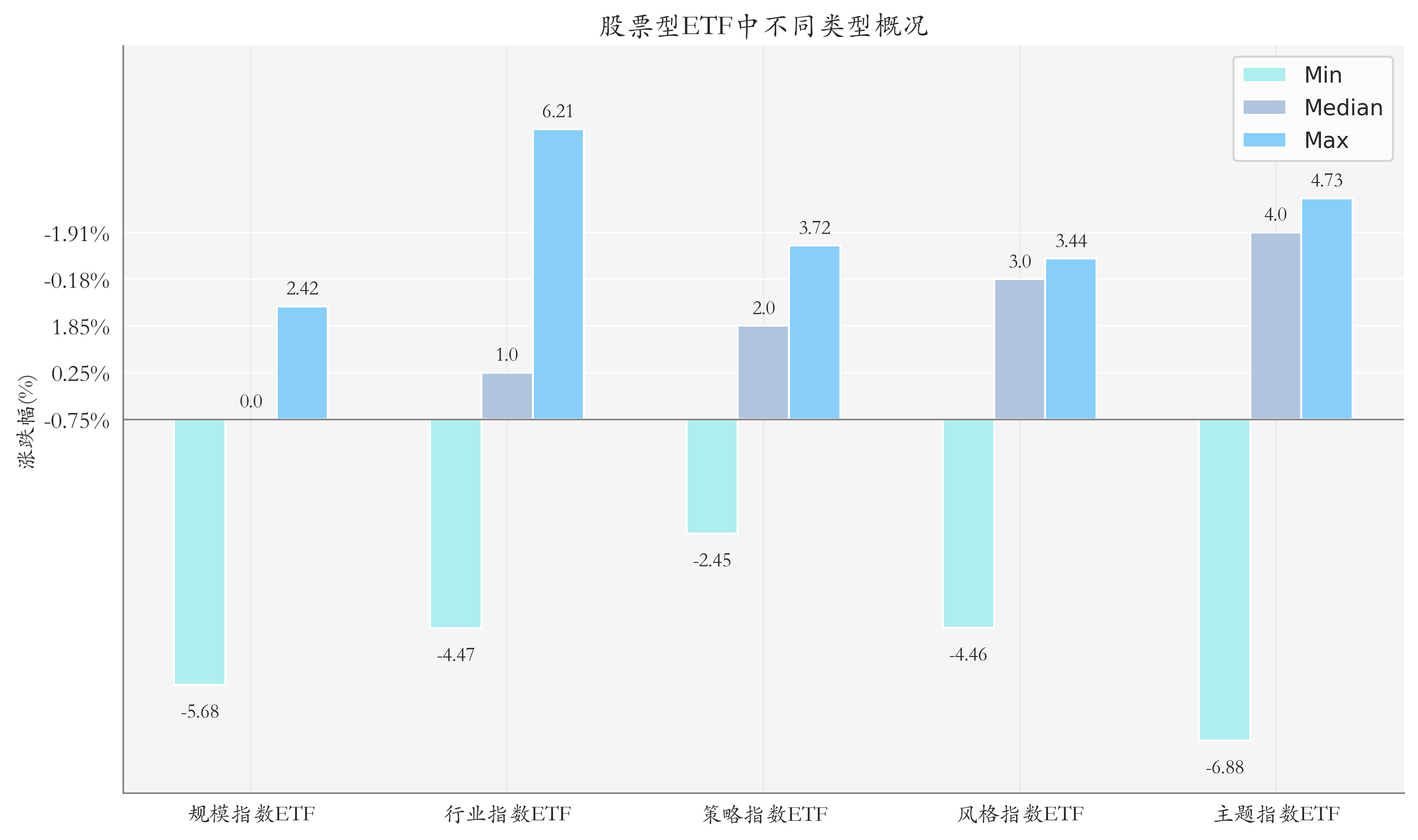
Market Overview - The Shanghai Composite Index rose by 0.37% to close at 3897.03 points, with a weekly high of 3936.58 points. In contrast, the Shenzhen Component Index fell by 1.26% to 13355.42 points, reaching a high of 13806.69 points. The ChiNext Index experienced a decline of 3.86%, closing at 3113.26 points, with a peak of 3322.44 points. Globally, major indices mostly declined, with the Nasdaq down 2.53%, the Dow Jones down 2.73%, and the S&P 500 down 2.43%. In the Asia-Pacific region, the Hang Seng Index fell by 3.13%, while the Nikkei 225 rose by 5.07% [1]. ETF Market Performance 1. Overall Performance - The median weekly return for stock ETFs was -0.84%. Among different categories, the highest weekly return was from the Penghua CSI 800 Free Cash Flow ETF at 2.42%, followed by the Wanji CSI Industrial Nonferrous Metals Theme ETF at 6.21% [2]. 2. Top and Bottom Performers - The top five performing stock ETFs were: - Wanji CSI Industrial Nonferrous Metals Theme ETF (6.21%) - Huabao CSI Nonferrous Metals ETF (5.27%) - Huaxia CSI Subdivision Nonferrous Metals Theme ETF (5.05%) - Yinhua CSI Nonferrous Metals ETF (4.84%) - Penghua Guozheng Nonferrous Metals Industry ETF (4.82%) [5][6] - The bottom five performing stock ETFs were: - Jiashi CSI Battery Theme ETF (-6.88%) - Huitianfu CSI Battery Theme ETF (-6.88%) - Fuguo CSI Battery Theme ETF (-6.8%) - Zhaoshang CSI Battery Theme ETF (-6.7%) - Huaxia CSI Animation Game ETF (-6.1%) [5][6] 3. Liquidity - The average daily trading volume of stock ETFs increased by 14.3%, with a 48.1% rise in average daily trading volume and a 0.71% increase in turnover rate [7]. 4. Fund Flows - The top five stock ETFs by fund inflow were: - Huaxia Shanghai Stock Exchange Sci-Tech Innovation Board 50 ETF (inflow of 3.295 billion) - Jiashi Shanghai Stock Exchange Sci-Tech Innovation Board Chip ETF (inflow of 2.748 billion) - Huatai-PB CSI 300 ETF (inflow of 1.587 billion) - Yifangda Shanghai Stock Exchange Sci-Tech Innovation Board 50 ETF (inflow of 1.226 billion) - Southern CSI Shenwan Nonferrous Metals ETF (inflow of 1.208 billion) [9][10] - The top five stock ETFs by fund outflow were: - Southern CSI 1000 ETF (outflow of 666 million) - Fuguo CSI A500 ETF (outflow of 575 million) - Southern CSI A500 ETF (outflow of 525 million) - Guangfa CSI A500 ETF (outflow of 305 million) - Yifangda CSI 300 ETF Initiated (outflow of 260 million) [9][10] Financing and Margin Trading - The financing balance for stock ETFs increased from 44.345 billion to 47.3024 billion, while the margin balance rose from 2.3399 billion shares to 2.3575 billion shares. The highest financing buy amount was for the Huaxia Shanghai Stock Exchange Sci-Tech Innovation Board 50 ETF, totaling 1.228 billion [12]. Market Size - The total number of ETFs in the market was 1317, with 1042 stock ETFs, 53 bond ETFs, 27 money market ETFs, 17 commodity ETFs, and 178 cross-border ETFs. The total market size for ETFs reached 5613.153 billion, a decrease of 12.221 billion from the previous week [13][15]. Institutional Insights 1. Investment Opportunities in Nonferrous Metals - CITIC Securities suggests focusing on investment opportunities in the nonferrous metals sector, noting that precious metals like gold saw significant gains during the recent holiday. Supply shortages and the logic of computational revolution have led to a noticeable increase in copper prices [17]. 2. Copper Price Trends - Huatai Securities indicates that frequent disturbances in copper mines since 2025 have had limited short-term supply impacts. The expected reduction in supply from the Grasberg mine in Q4 2025 could significantly improve the copper supply-demand balance, potentially leading to a price rally [18].