易方达中证海外互联ETF

Search documents
黄金回调,原油上涨,商品基金涨幅0.29%
Tai Ping Yang Zheng Quan· 2026-03-09 09:30
Investment Rating - The report does not explicitly provide an investment rating for the industry. Core Insights - The report highlights a significant increase in crude oil prices by 29.35% due to geopolitical tensions, while gold prices have decreased by 2.17%. The commodity fund recorded a growth of 0.29% [3][52]. - The A-share market saw a decline, with the Shanghai Composite Index closing at 4124.19, down by 0.93%. The Shenzhen Component Index and other indices also experienced declines, with the largest drop being 7.14% for the CSI 2000 [7][8]. - In the bond market, the yields for 1-year, 3-year, and 10-year government bonds were 1.29%, 1.36%, and 1.78%, respectively, with slight decreases in yields [25]. - The fund market saw the establishment of 10 new funds, including 7 equity funds and 2 fixed income + funds, with notable sizes for the funds established [43]. Summary by Sections 1. Major Asset Market Overview (1) Equity - The Shanghai Composite Index closed at 4124.19, with a decline of 0.93%. The Shenzhen Component Index and other indices also saw declines, with the largest drop being 7.14% for the CSI 2000. The oil and petrochemical sectors showed significant gains of 8.06% and 3.79%, respectively, while media and technology sectors faced declines of 6.97% and 5.29% [7][8]. (2) Bonds - The report indicates that the 1-year, 3-year, and 10-year government bond yields are 1.29%, 1.36%, and 1.78%, respectively, with slight decreases in yields. The credit spreads for 1-year AAA corporate bonds and local government bonds were 35.63 BP and 36.19 BP, respectively [25][27]. (3) Commodities - The commodity market experienced a notable increase in crude oil prices by 29.35%, while gold prices decreased by 2.17%. Other commodities like industrial silicon and lithium carbonate also showed positive trends [35][36]. (4) Foreign Exchange - The report notes the exchange rates of major currencies against the RMB, with the US dollar appreciating by 0.62% while the euro depreciated by 1.19% [40][42]. 2. Fund Market Overview (1) New Fund Establishments - A total of 10 new funds were established, including 7 equity funds and 2 fixed income + funds, with significant sizes for the funds established [43]. (2) Quantity and Scale - As of March 6, 2026, there are 13,731 open-end public funds with a total scale of 37.68 trillion RMB. Equity funds account for the largest number at 7,376, while fixed income funds hold the largest scale at 23.65 trillion RMB [45][51]. (3) Performance - The report indicates that commodity funds had a relative increase of 0.29%, while QDII and equity funds faced declines of 2.85% and 2.52%, respectively [51][52].
ETF规模速报 | 中概互联网ETF净流入超5亿元,30年国债ETF博时净流出超3亿元
Sou Hu Cai Jing· 2025-12-05 01:36
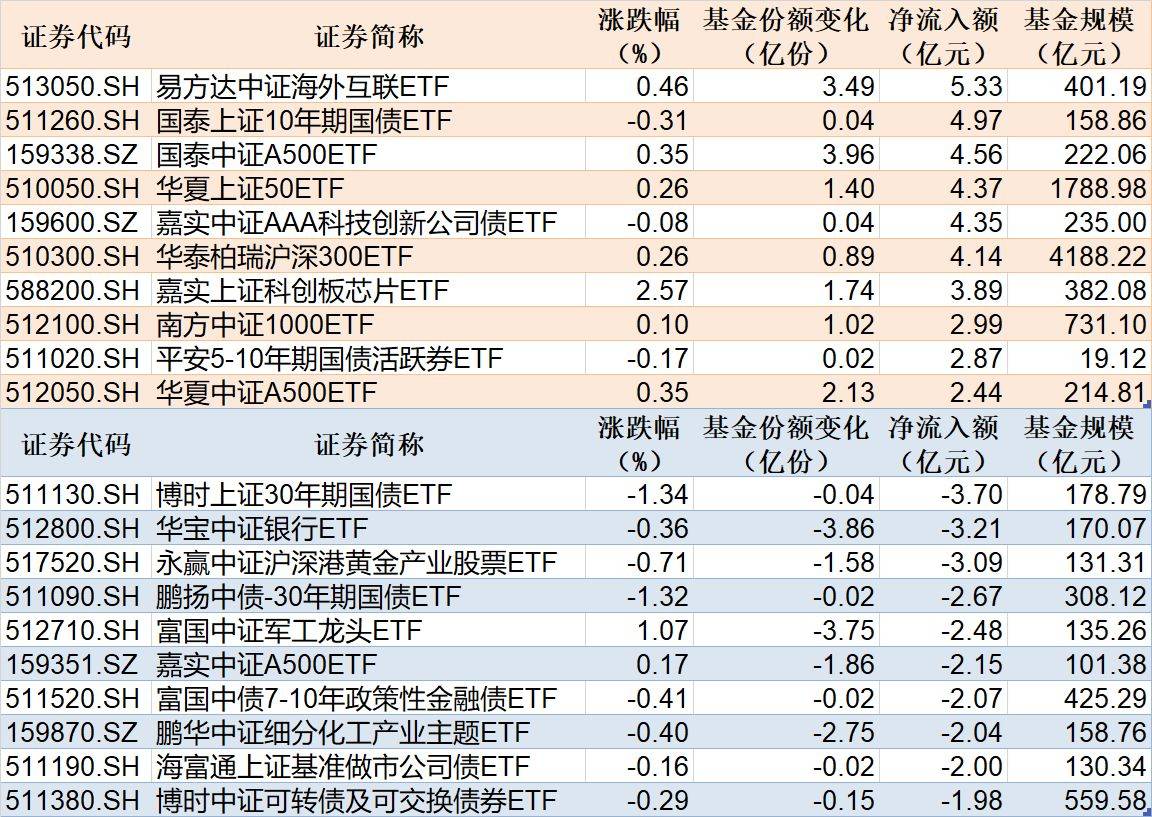
Market Overview - The market rebounded after hitting a low, with the ChiNext Index rising over 1% [1] - The robotics sector experienced a significant surge, while the commercial aerospace sector continued its strong performance [1] - The consumer sector showed volatility, particularly in Hainan, which saw a collective decline [1] ETF Market Activity - On December 4, the non-monetary ETF market saw notable inflows, with E Fund's CSI Overseas Internet ETF increasing by 349 million shares, resulting in a net inflow of 533 million yuan [1] - Other ETFs with significant inflows included Guotai's 10-Year Government Bond ETF, which saw a 4.97 million yuan net inflow, and Guotai's CSI A500 ETF, which had a net inflow of 456 million yuan [1][2] Fund Performance - The top-performing ETFs by net inflow for December 4 included: - E Fund's CSI Overseas Internet ETF with a 0.46% increase and a net inflow of 533 million yuan [2] - Guotai's CSI A500 ETF with a 0.35% increase and a net inflow of 456 million yuan [2] - Conversely, the worst performers included Bosera's 30-Year Government Bond ETF, which saw a 1.34% decrease and a net outflow of 370 million yuan [2] Monthly ETF Inflows - As of December 4, the top 20 ETFs by net inflow for the month included: - Harvest's CSI AAA Technology Innovation Bond ETF with a net inflow of 2.576 billion yuan [4] - Huaxia's CSI A500 ETF with a net inflow of 1.087 billion yuan [4] - E Fund's CSI Overseas Internet ETF with a net inflow of 822 million yuan [4] Overall ETF Market Statistics - As of December 4, the total ETF shares in the market reached 32,527.70 million, with a total scale of 57,034.88 million yuan [4] - The materials sector saw the largest increase in shares, with two funds tracking it, while the Shanghai Stock Exchange Sci-Tech Innovation Board Chip Index had the highest number of funds tracking it [4]

ETF兵器谱、金融产品每周见:qdiiETF:折溢价探讨与产品投资策略分析-20251203
Shenwan Hongyuan Securities· 2025-12-03 12:05
Group 1: Overview of QDII ETF - QDII ETFs are primarily focused on Hong Kong stocks, experiencing rapid growth since 2021, with a significant increase in non-Hong Kong ETFs starting in 2023, reflecting a shift in investor interest towards overseas markets [3][12] - As of November 28, 2025, the cumulative scale of QDII ETFs reached 185.86 billion, indicating a growing trend in overseas investment opportunities [12] - The top 15 QDII ETFs by scale include products like Huaxia Hang Seng Technology ETF and Guotai Junan Nasdaq 100 ETF, with scales of 47.64 billion and 16.90 billion respectively [9][13] Group 2: Mechanism of Premium and Discount Formation - The premium formation mechanism for QDII ETFs relies on cash subscription and redemption, where the return to premium depends on the ability to arbitrage through "subscription + sale" [3][21] - High premiums often arise from disruptions in the arbitrage chain, particularly when subscription limits are imposed due to insufficient QDII quotas [27] - The expected arbitrage returns vary based on market conditions, with overlapping trading hours leading to different calculations of the indicative optimized price value (IOPV) [31][36] Group 3: Evaluation of QDII ETF Premiums - The premium rate is negatively correlated with the cost-effectiveness of QDII ETFs; for instance, when the premium rate exceeds 8%, holding the ETF for a month typically results in significant negative returns [3] - Daily subscription limits and market sentiment are significant factors influencing premium rates, with emotional factors providing long-term explanations for premium levels [3][27] - Some QDII ETFs exhibit additional premiums that cannot be easily explained by market sentiment, indicating potential inefficiencies in pricing [3][27] Group 4: Recent Developments in QDII ETFs - The number of QDII ETFs tracking new indices has been increasing, particularly those focusing on non-Hong Kong indices such as the Dow Jones Industrial Average and the S&P 500 Consumer Select Index [17] - Newly launched QDII ETFs often experience initial premiums, with the Huatai Baichuan South China Arabian ETF showing a first-day premium of 6.31% [17][18] - The overall market enthusiasm for QDII ETFs remains high, as evidenced by the sustained premium levels of newly listed products [17][18]
297只ETF获融资净买入 富国中债7—10年政策性金融债ETF居首
Zheng Quan Shi Bao Wang· 2025-11-19 02:14
Core Viewpoint - As of November 18, the total margin balance for ETFs in the Shanghai and Shenzhen markets reached 123.813 billion yuan, reflecting an increase of 3.81 billion yuan from the previous trading day [1] Summary by Category ETF Financing and Margin Balance - The ETF financing balance stood at 115.675 billion yuan, up by 3.9 billion yuan from the previous trading day [1] - The ETF margin short balance was recorded at 8.138 billion yuan, showing a decrease of 90 million yuan compared to the previous trading day [1] Net Inflows and Top Performers - On November 18, 297 ETFs experienced net financing inflows, with the top performer being the Fortune China Government Bond ETF (7-10 years), which saw a net inflow of 1.739 billion yuan [1] - Other notable ETFs with significant net inflows included the Bosera China Government Bond ETF (0-3 years), Guotai Junan 5-Year Government Bond ETF, Huaan Gold ETF, Hai Fu Tong China Short-term Bond ETF, E Fund ChiNext ETF, and E Fund China Overseas Internet ETF [1]
248只ETF获融资净买入 华夏恒生互联网科技业ETF居首
Zheng Quan Shi Bao Wang· 2025-11-17 02:58
Core Viewpoint - As of November 14, the total margin balance for ETFs in the Shanghai and Shenzhen markets is 118.423 billion yuan, showing a decrease of 0.311 billion yuan from the previous trading day [1] Summary by Category ETF Margin Balance - The ETF financing balance is 110.189 billion yuan, down by 0.103 billion yuan from the previous trading day [1] - The ETF margin short balance is 8.234 billion yuan, decreasing by 0.208 billion yuan compared to the previous trading day [1] Net Buy Activity - On November 14, 248 ETFs experienced net financing purchases, with the top net purchase being the Huaxia Hang Seng Internet Technology ETF, which saw a net buy of 0.174 billion yuan [1] - Other ETFs with significant net buy amounts include the E Fund ChiNext ETF, E Fund CSI Overseas Internet ETF, GF CSI Hong Kong Innovative Medicine ETF, GF Shanghai Gold ETF, and Guotai Junan CSI A500 ETF [1]
跨境ETF密集发布溢价提示 需求升温刺激规模翻倍扩张
Zheng Quan Shi Bao· 2025-11-16 22:36
Core Insights - Recent surge in cross-border ETFs has led to noticeable premiums in the secondary market, driven by increased demand from domestic investors for overseas assets [2][3] - The cross-border ETF market has experienced rapid expansion this year, with significant growth in various thematic products, indicating a robust inflow of incremental capital and diversification of investment strategies [4][5] Group 1: Premiums in Cross-Border ETFs - Multiple cross-border ETFs have shown varying degrees of premiums in the secondary market, with some products experiencing significant intraday premium rates [2] - For instance, the E Fund MSCI US 50 ETF had a premium deviation of 6.66% from its reference net value as of November 14, while the E Fund Nikkei 225 ETF had a premium of 6.01% [2] Group 2: Short-Term Mismatches - The cross-border ETFs exhibit a characteristic of time-lagged valuation, leading to short-term mismatches where prices may lead while net values lag [3] - External factors such as market volatility, exchange rate fluctuations, and liquidity of underlying stocks can influence the pace of premium convergence [3] Group 3: Growth of Cross-Border ETF Scale - The scale of cross-border ETFs has doubled this year, reaching 923.78 billion yuan, up from 424.02 billion yuan at the beginning of the year, marking it as one of the fastest-growing segments in public funds [4] - Key products like the FTSE China Hong Kong Internet ETF and others have surpassed 40 billion yuan in scale, contributing to the overall growth and liquidity of the cross-border ETF market [4] Group 4: Notable Trends in Hong Kong Stock ETFs - Hong Kong stock ETFs have shown particularly strong growth, with several products increasing by over 20 billion yuan this year, indicating a trend of accelerated expansion [5] - Newly established cross-border ETFs are continuously accumulating assets, enhancing the product diversity and depth within the market [5]
跨境ETF溢价频现:交易活跃度抬升,赛道加速扩容
证券时报· 2025-11-16 03:25
Core Insights - Recent surge in cross-border ETFs has led to noticeable premiums in the secondary market, attracting market attention [1][3] - The rapid expansion of cross-border ETF scale reflects increasing investor demand for overseas asset allocation and the continuous inflow of incremental funds [2][5] Group 1: Market Dynamics - Cross-border ETFs are experiencing a phase of premium due to a mismatch between price and net value, influenced by structural capital flows and market sentiment [2][4] - Multiple cross-border ETFs have issued premium announcements recently, with significant premiums observed in products like E Fund MSCI US 50 ETF and E Fund Nikkei 225 ETF, indicating high trading activity in cross-border assets [3][4] Group 2: Structural Premiums - The structural premium in cross-border ETFs arises from the asynchronous nature of net value updates and overseas market trading, leading to short-term price mismatches [4] - External factors such as overseas market volatility, exchange rate changes, and liquidity of constituent stocks also impact the speed of premium convergence [4] Group 3: Growth of Cross-Border ETFs - The scale of cross-border ETFs has doubled this year, reaching 923.78 billion, up from 424.02 billion at the beginning of the year, indicating a rapid growth in this segment of public funds [5] - Notable products like the FTSE China Hong Kong Internet ETF and Huaxia Hang Seng Technology ETF have surpassed 40 billion in scale, contributing to the overall growth of cross-border ETFs [5]

跨境ETF溢价频现:交易活跃度抬升,赛道加速扩容
券商中国· 2025-11-16 02:00
Core Viewpoint - Recent observations indicate that several cross-border ETFs have experienced temporary premiums in the secondary market, attracting market attention [1] Group 1: Market Dynamics - The cross-border ETF market has seen a rapid expansion this year, with significant growth in multiple thematic products, driven by continuous inflow of incremental funds and the introduction of new products [2][5] - The trading activity of cross-border ETFs has increased significantly due to domestic investors' growing demand for overseas asset allocation, leading to noticeable premiums in the secondary market [3] Group 2: Premium Mechanism - The cross-border ETFs exhibit a "price leading, net value lagging" phenomenon due to their cross-time valuation mechanism and structural capital flows, making short-term mismatches more likely [2][4] - The premium observed in cross-border ETFs is primarily a temporary deviation between price and net value, rather than an indication of inherent excess value in the products [4] Group 3: Fund Size and Growth - The latest scale of cross-border ETFs has reached 9237.82 billion, doubling from 4240.17 billion at the beginning of the year, reflecting a diversification in investor allocation needs [5][6] - Several cross-border ETFs, such as those tracking Hong Kong stocks, have shown particularly notable growth, with some products exceeding 200 billion in incremental scale this year [6]
216只ETF获融资净买入 华夏恒生互联网科技业ETF居首
Zheng Quan Shi Bao Wang· 2025-11-10 01:47
Core Viewpoint - As of November 7, the total margin balance for ETFs in the Shanghai and Shenzhen markets is 118.109 billion yuan, showing a decrease of 2.67 billion yuan from the previous trading day [1] Summary by Category ETF Margin Balance - The ETF financing balance is 109.725 billion yuan, down by 2.626 billion yuan from the previous trading day [1] - The ETF margin short balance is 8.384 billion yuan, decreasing by 0.044 billion yuan compared to the previous trading day [1] Net Inflows - On November 7, 216 ETFs experienced net financing inflows, with the top inflow being the Huaxia Hang Seng Internet Technology ETF, which saw a net inflow of 87.3479 million yuan [1] - Other ETFs with significant net inflows include the Penghua CSI Subdivision Chemical Industry Theme ETF, the Da Cheng Hang Seng Technology ETF, the E Fund CSI Overseas Internet ETF, the Huatai-PineBridge CSI Photovoltaic Industry ETF, and the Fortune CSI Hong Kong Stock Connect Internet ETF [1]
“国家队”最新ETF持仓出炉
券商中国· 2025-11-01 02:21
Core Viewpoint - The "National Team," including Central Huijin Investment and its asset management plans, has maintained a stable position in broad-based ETFs while making minor adjustments in sector-specific ETFs, reflecting a strategic approach to stabilize the A-share market [1][2][3]. Group 1: ETF Holdings and Performance - The "National Team" has kept its holdings in broad-based ETFs largely unchanged, with significant performance in the third quarter, where the average increase of ETFs held exceeded 20%, resulting in a scale increase of over 200 billion yuan [2][6]. - As of mid-2025, the "National Team" holds over 40% of the total A-share ETF market, indicating a strong influence on market stability [3]. - The total scale of ETFs held by Central Huijin Investment and its asset management plans reached 1.55 trillion yuan by the end of the third quarter, marking an increase of over 200 billion yuan from the previous quarter [7]. Group 2: Specific ETF Adjustments - Central Huijin Asset Management's two specialized asset management plans have shown more frequent trading activity, including a reduction in holdings of specific ETFs, which should not be interpreted as a broader "National Team" strategy [4][5]. - Notably, the specialized plans reduced their holdings in the Guotai Zhongzheng 800 Automotive and Parts ETF by 800,000 shares in July, and completely divested from the Huaxia Hang Seng China Mainland Enterprises High Dividend ETF [4]. Group 3: Market Conditions and Influences - The significant rebound in the A-share market during the third quarter was a primary driver of the "National Team's" unrealized gains, supported by favorable domestic liquidity conditions and expectations of U.S. Federal Reserve interest rate cuts [8]. - Factors such as policy support, active trading, and capital inflows contributed to the overall positive market performance, with a notable increase in risk appetite among investors [8].