富国中债7—10年政策性金融债ETF

Search documents
308只ETF获融资净买入 富国中债7—10年政策性金融债ETF居首
Zheng Quan Shi Bao Wang· 2026-01-13 02:04
Core Viewpoint - As of January 12, the total margin balance for ETFs in the Shanghai and Shenzhen markets reached 122.95 billion yuan, reflecting an increase of 3.51 billion yuan from the previous trading day [1] Group 1: ETF Financing and Margin Balances - The ETF financing balance stood at 114.98 billion yuan, up by 3.24 billion yuan compared to the previous trading day [1] - The ETF margin short balance was recorded at 7.97 billion yuan, which is an increase of 0.27 billion yuan from the previous trading day [1] Group 2: Top Performing ETFs - On January 12, a total of 308 ETFs experienced net financing inflows, with the top performer being the Fortune China Bond 7-10 Year Policy Financial Bond ETF, which saw a net inflow of 681 million yuan [1] - Other ETFs with significant net financing inflows included the GF CSI Media ETF, Hai Fu Tong CSI Short-term Bond ETF, Southern CSI 500 ETF, Yongying National Standard Commercial Satellite Communication Industry ETF, Southern CSI 1000 ETF, and Harvest CSI Software Service ETF [1]
2026年开年两融余额增长显著
Zheng Quan Ri Bao· 2026-01-07 23:39
Core Viewpoint - The A-share market has seen a significant increase in trading activity and margin financing, with the margin balance reaching a historical high of 2.58 trillion yuan as of January 6, indicating enhanced market confidence and investor risk appetite [1][2]. Group 1: Margin Financing Overview - As of January 6, the margin financing balance reached 2.58 trillion yuan, a year-on-year increase of 40.93% [2]. - The financing balance accounted for 2.56 trillion yuan, while the securities lending balance was 175.96 billion yuan [2]. - On January 6, the total margin trading volume was 328.91 billion yuan, representing 11.61% of the total A-share trading volume for that day [2]. Group 2: Sector and Stock Preferences - The top sectors attracting margin financing include semiconductors, industrial metals, and general equipment, with net financing amounts of 2.90 billion yuan, 2.29 billion yuan, and 2.07 billion yuan respectively from January 5 to January 6 [2]. - The leading individual stocks in net financing from January 5 to January 6 were Dongfang Wealth, Shenghong Technology, and XW Communications, with net financing amounts exceeding 1 billion yuan each [3]. - ETFs have also been a significant channel for margin inflows, with the Hai Fu Tong CSI Short Bond ETF receiving a net financing amount of 1.22 billion yuan [3]. Group 3: Brokerages and Business Opportunities - Brokerages are actively seizing business opportunities by increasing margin financing limits and optimizing their service offerings to meet investor demand [4]. - Northeast Securities focuses on high-net-worth individuals and private equity firms, enhancing service capabilities through AI technology [4]. - Analysts expect the growth potential for brokerage capital intermediary services to be promising due to the rapid expansion of margin financing and strong investor demand [4]. Group 4: Future Market Outlook - Analysts predict that the margin financing market will transition from a "high-speed expansion phase" to a "high-quality growth phase" by 2026, with the balance expected to range between 2.6 trillion yuan and 3.2 trillion yuan [4]. - The average margin balance for 2026 is anticipated to reach between 2.8 trillion yuan and 3 trillion yuan, indicating steady growth but a slowdown in growth rate compared to 2025 [4].
2026年开年两融余额增长显著 半导体、工业金属等板块成为年初融资流入的重要方向
Zheng Quan Ri Bao Zhi Sheng· 2026-01-07 17:17
Core Viewpoint - The A-share market has seen increased trading activity since the beginning of the year, with the margin trading balance reaching a historical high of 2.58 trillion yuan as of January 6, indicating enhanced market confidence and investor risk appetite [1][2]. Group 1: Margin Trading Data - As of January 6, the margin trading balance reached 2.58 trillion yuan, a year-on-year increase of 40.93% [2]. - The financing balance accounted for 2.56 trillion yuan, while the securities lending balance was 175.96 billion yuan [2]. - On January 6, the margin trading transaction volume was 328.91 billion yuan, representing 11.61% of the total A-share trading volume for that day [2]. Group 2: Sector and Stock Preferences - The top three sectors attracting net financing inflows from January 5 to January 6 were semiconductors (2.90 billion yuan), industrial metals (2.29 billion yuan), and general equipment (2.07 billion yuan) [2]. - The top ten stocks with the highest net financing inflows included Dongfang Wealth (1.10 billion yuan) and Shenghong Technology (1.05 billion yuan) [3]. - The most favored ETFs for financing during the same period were Hai Fu Tong CSI Short Bond ETF (1.22 billion yuan) and Fu Guo China Bond 7-10 Year Policy Financial Bond ETF (0.78 billion yuan) [3]. Group 3: Brokerage Firms and Business Opportunities - Brokerage firms are actively seizing business opportunities by increasing margin trading limits and adjusting credit limits to meet investor demand [4]. - Northeast Securities focuses on high-net-worth individuals and private equity firms, enhancing service capabilities through AI technology for risk warning and customized services [4]. - Analysts expect significant growth potential in brokerage capital intermediary services due to the rapid expansion of margin trading and strong investor demand [4]. Group 4: Future Market Outlook - Analysts predict that the margin trading market will transition from a "high-speed expansion period" to a "high-quality growth period" by 2026 [4]. - The margin trading balance is expected to continue reaching new highs, with projections for 2026 ranging between 2.6 trillion yuan and 3.2 trillion yuan, with an anticipated average of 2.8 trillion yuan to 3 trillion yuan [4].



288只ETF获融资净买入 海富通中证短融ETF居首
Zheng Quan Shi Bao Wang· 2026-01-07 02:12
Core Viewpoint - As of January 6, the total margin balance for ETFs in the Shanghai and Shenzhen markets reached 119.895 billion yuan, reflecting an increase of 2.787 billion yuan from the previous trading day [1] Group 1: ETF Financing and Margin Balances - The ETF financing balance stood at 112.23 billion yuan, up by 2.646 billion yuan compared to the previous trading day [1] - The ETF margin short balance was 7.665 billion yuan, which increased by 0.141 billion yuan from the previous trading day [1] Group 2: Net Inflows in ETFs - On January 6, a total of 288 ETFs experienced net financing inflows, with the Hai Fu Tong CSI Short Bond ETF leading with a net inflow of 1.202 billion yuan [1] - Other ETFs with significant net inflows included the Fortune China Government Bond 7-10 Year Policy Financial Bond ETF, Southern CSI 500 ETF, Huatai-PB CSI 300 ETF, and others [1]
257只ETF获融资净买入 富国中债7—10年政策性金融债ETF居首
Zheng Quan Shi Bao Wang· 2025-12-23 02:38
Group 1 - The total margin balance of ETFs in the Shanghai and Shenzhen markets reached 119.742 billion yuan as of December 22, an increase of 0.612 billion yuan from the previous trading day [1] - The financing balance of ETFs was 112.374 billion yuan, up by 0.507 billion yuan, while the margin balance for securities lending was 7.368 billion yuan, increasing by 0.105 billion yuan [1] - On December 22, 257 ETFs experienced net financing inflows, with the top inflow being the Fortune China Government Bond 7-10 Year Policy Financial Bond ETF, which saw a net inflow of 460 million yuan [1] Group 2 - Other ETFs with significant net financing inflows included the Guotai CSI All Share Communication Equipment ETF, Invesco Nasdaq Technology Market Cap Weighted ETF, Bosera CSI Convertible Bonds and Exchangeable Bonds ETF, Huaxia CSI A500 ETF, GF CSI Hong Kong Innovative Drug ETF, and Southern CSI Shenwan Nonferrous Metals ETF [1]
321只ETF获融资净买入 富国中债7—10年政策性金融债ETF居首
Zheng Quan Shi Bao Wang· 2025-12-17 03:53
Core Viewpoint - As of December 16, the total margin balance of ETFs in the Shanghai and Shenzhen markets reached 124.408 billion yuan, an increase of 6.429 billion yuan from the previous trading day [1] Group 1: ETF Financing and Margin Balances - The ETF financing balance was 117.118 billion yuan, up by 6.598 billion yuan compared to the previous trading day [1] - The ETF margin short balance was 7.29 billion yuan, showing a decrease of 0.169 billion yuan from the previous trading day [1] Group 2: Net Inflows into ETFs - On December 16, 321 ETFs experienced net financing inflows, with the top net inflow being the Fuguo Zhongzhai 7-10 Year Policy Financial Bond ETF, which saw a net inflow of 3.25 billion yuan [1] - Other ETFs with significant net inflows included the Bosera Zhongzhai 0-3 Year National Development Bank ETF, the Guotai Securities Shanghai Stock Exchange 5-Year Government Bond ETF, the Haifutong Zhongzhai Short-term Bond ETF, and the Huaxia Hang Seng Technology ETF [1]
291只ETF获融资净买入 富国中债7—10年政策性金融债ETF居首
Zheng Quan Shi Bao Wang· 2025-12-16 02:44
Core Viewpoint - As of December 15, the total margin balance for ETFs in the Shanghai and Shenzhen markets reached 117.979 billion yuan, reflecting a slight increase from the previous trading day [1] Group 1: ETF Financing and Margin Data - The ETF financing balance stood at 110.52 billion yuan, which is an increase of 0.614 billion yuan compared to the previous trading day [1] - The ETF margin short balance was recorded at 7.459 billion yuan, showing a decrease of 0.553 billion yuan from the previous trading day [1] Group 2: Net Inflows into ETFs - On December 15, a total of 291 ETFs experienced net financing inflows, with the top inflow being the Fuguo Zhongzhai 7-10 Year Policy Financial Bond ETF, which saw a net inflow of 194 million yuan [1] - Other ETFs with significant net inflows included the E Fund ChiNext ETF, Harvest SSE STAR Chip ETF, Huaxia Hang Seng Internet Technology ETF, Huaxia Hang Seng Technology ETF, Huaxia SSE STAR 50 ETF, and Haitai Baichuan Hang Seng Technology ETF [1]
216只ETF获融资净买入 博时中证可转债及可交换债券ETF居首
Zheng Quan Shi Bao Wang· 2025-12-01 02:18
Core Viewpoint - As of November 28, the total margin balance for ETFs in the Shanghai and Shenzhen markets is 118.316 billion yuan, showing a decrease of 0.221 billion yuan from the previous trading day [1] Summary by Category ETF Financing and Margin Balance - The ETF financing balance stands at 110.65 billion yuan, down by 0.325 billion yuan compared to the previous trading day [1] - The ETF margin short balance is 7.666 billion yuan, which has increased by 0.104 billion yuan from the previous trading day [1] Net Buy and Performance of ETFs - On November 28, 216 ETFs experienced net financing purchases, with the highest net purchase amounting to 92.1675 million yuan for the Bosera CSI Convertible Bonds and Exchangeable Bonds ETF [1] - Other ETFs with significant net financing purchases include the E Fund ChiNext ETF, HFT CSI Short-term Bond ETF, Huaan ChiNext 50 ETF, Guotai CSI All-Share Communication Equipment ETF, and others [1]
突破700亿!超级单品来了
Zhong Guo Ji Jin Bao· 2025-11-21 07:09
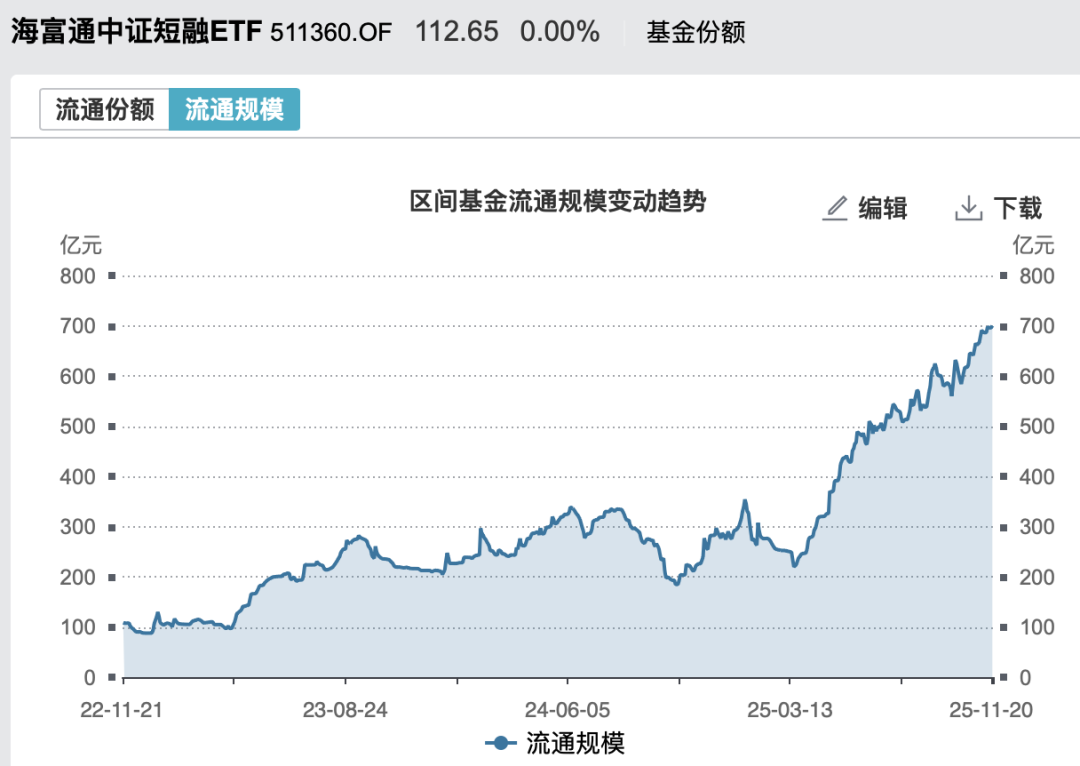
Core Insights - Hai Fu Tong Short-term Bond ETF has reached a scale of 700.01 billion yuan, becoming the first bond ETF in China to surpass the 700 billion yuan mark [2][3] - The overall bond ETF market has seen significant growth, with a total scale of 7150.60 billion yuan as of November 20, marking a historical high and an increase of over 540 billion yuan this year [2][9] - The growth of Hai Fu Tong Short-term Bond ETF is attributed to a shift in investor preferences towards short-term investments due to declining yields in money market funds [6][10] Market Performance - Hai Fu Tong Short-term Bond ETF's scale increased by 4.3 billion yuan from the previous trading day, reflecting a year-to-date growth of 138.58% from 293.41 billion yuan at the end of last year [3][6] - The unit net value of Hai Fu Tong Short-term Bond ETF has risen by 1.37% since March, indicating stable performance in the secondary market [6] Investor Behavior - Investors are increasingly attracted to bond ETFs due to lower management fees and higher transparency compared to traditional bond funds, leading to a significant inflow of funds into this segment [10] - The demand for short-term bond ETFs has been bolstered by the growing number of Fund of Funds (FOF) products that are allocating more resources to these ETFs, with 67 FOFs holding a combined market value of 3.29 billion yuan in short-term bond ETFs as of the end of Q3 [6][7] Regulatory and Market Dynamics - The rapid growth of bond ETFs is supported by regulatory initiatives and product innovations from exchanges, which have introduced various new bond ETF products this year [10][11] - Increased participation from market makers and broker-dealer proprietary trading has improved liquidity in the bond ETF market, creating a positive cycle of growth and investment [11] Future Outlook - Despite the current rapid growth, the bond ETF market is still in its early stages, with significant room for expansion as the product offerings remain limited [11] - Future innovations are expected to include cross-border bond ETFs and thematic bond ETFs to meet diverse investor needs and further expand market opportunities [11]

突破700亿!超级单品来了
中国基金报· 2025-11-21 07:00
Core Viewpoint - The rapid growth of bond ETFs in China is highlighted by the Hai Futong Short-term Bond ETF surpassing 70 billion yuan, marking a significant milestone in the domestic bond ETF market [2][4][6]. Group 1: Market Growth - As of November 20, the total scale of bond ETFs reached 715.06 billion yuan, a historical high, with an increase of over 540 billion yuan this year, representing a growth rate of 311.02% compared to the end of last year [8][10]. - The Hai Futong Short-term Bond ETF, established on August 3, 2020, has seen its scale grow from 29.34 billion yuan at the end of last year to 70 billion yuan, an increase of 406.6 billion yuan, or 138.58% [6][9]. Group 2: Investment Demand - The low interest rate environment has led to a shift in investor strategies, with a growing demand for trading to achieve returns rather than traditional buy-and-hold strategies [10]. - Investors are increasingly sensitive to management fees, making bond ETFs, which have lower fees and higher transparency, more attractive [10]. Group 3: Regulatory Support - Continuous support from regulatory bodies and exchanges has been crucial for the rapid development of bond ETFs, with innovations in product offerings driving market growth [10][11]. Group 4: Market Liquidity - The involvement of more market makers and proprietary trading firms has significantly improved the liquidity of bond ETFs, creating a positive cycle of scale, liquidity, and capital inflow [11]. - Despite the rapid growth, the bond ETF market is still in its early stages, indicating substantial future growth potential [11].