华泰柏瑞中证A500ETF

Search documents
大额买入与资金流向跟踪(20260323-20260327)
GUOTAI HAITONG SECURITIES· 2026-03-31 03:18
- **Tracking indicators and calculation methods** The report uses two key metrics: the proportion of large buy order transaction amounts and the proportion of net active buy transaction amounts. The large buy order transaction amount proportion reflects the buying behavior of large funds. It is calculated by restoring tick-by-tick transaction data into buy and sell order data based on bid and ask sequence numbers, filtering for large orders by transaction volume, and computing the proportion of large buy order transaction amounts relative to the total daily transaction amount. The net active buy transaction amount proportion reflects investors' active buying behavior. It is calculated by identifying whether each transaction is an active buy or sell based on tick-by-tick transaction data, subtracting active sell transaction amounts from active buy transaction amounts, and computing the proportion of net active buy transaction amounts relative to the total daily transaction amount[7] - **Individual stock tracking** The report tracks individual stocks based on the two metrics mentioned above. For the past 5 trading days (20260323-20260327), the top 10 stocks with the highest average proportion of large buy order transaction amounts include New Energy Taishan (93.2%), Snow Wave Environment (85.7%), and Zhongli Group (85.4%). Similarly, the top 10 stocks with the highest average proportion of net active buy transaction amounts include Zhen De Medical (16.7%), China General Nuclear (15.9%), and Zhejiang Energy Power (12.6%)[9][10] - **Broad-based index tracking** The report applies the same metrics to major broad-based indices. For the past 5 trading days, the average proportion of large buy order transaction amounts for indices such as the Shanghai Composite Index, SSE 50, and CSI 300 ranged from 69.5% to 73.7%. The average proportion of net active buy transaction amounts for these indices ranged from 1.0% to 3.2%[12] - **Sector tracking** The report tracks the metrics across various sectors based on the CITIC primary industry classification. For the past 5 trading days, sectors such as coal (78.4%), steel (78.7%), and real estate (78.9%) had high proportions of large buy order transaction amounts. Sectors like medicine (12.3%), steel (10.8%), and food & beverage (10.6%) had high proportions of net active buy transaction amounts[13] - **ETF tracking** The report tracks ETFs using the same metrics. For the past 5 trading days, the top 10 ETFs with the highest average proportion of large buy order transaction amounts include Guotai CSI A500 ETF (92.4%), Huatai-PineBridge CSI A500 ETF (92.1%), and Penghua CSI Oil & Gas ETF (91.3%). The top 10 ETFs with the highest average proportion of net active buy transaction amounts include Haifutong SSE Urban Investment Bond ETF (24.4%), Fuguo ChiNext Artificial Intelligence ETF (19.4%), and Guotai SSE 10-Year Treasury Bond ETF (16.9%)[15][16]


大额买入与资金流向跟踪20260316-20260320
GUOTAI HAITONG SECURITIES· 2026-03-23 14:20
- The report constructs indicators using transaction details data to track large purchases and net active purchases[1][7] - The large order transaction amount ratio depicts the buying behavior of large funds[7] - The net active purchase amount ratio depicts investors' active buying behavior[7] - The large order transaction amount ratio is calculated by restoring transaction data to buy and sell order data and filtering large orders based on transaction volume, then calculating the ratio of large order transaction amount to the total transaction amount of the day[7] - The net active purchase amount ratio is calculated by identifying each transaction as active buy or active sell based on transaction data, subtracting the transaction amounts of the two, and calculating the ratio of net active purchase amount to the total transaction amount of the day[7] Model Backtest Results - Large order transaction amount ratio for individual stocks (20260316-20260320): Shaoneng Co., Ltd. 86.7%, Angang Steel Co., Ltd. 85.7%, Zhongli Group 85.5%, Huadian Liaohe Energy 85.5%, Wentou Holdings 85.3%, Xining Special Steel 84.9%, Jiangyan Group 84.8%, China High-Speed Railway 84.7%, Guangshen Railway 84.6%, Shaanxi International Trust 84.6%[9] - Net active purchase amount ratio for individual stocks (20260316-20260320): Yunnan Baiyao 15.5%, Supor 14.9%, ZJ Bio-Tech-U 14.5%, Industrial and Commercial Bank of China 13.9%, Fulin Precision 13.6%, China World Trade Center 13.3%, Anbotong 13.0%, Zhongwang Fabric 13.0%, Shandong Expressway 12.2%, Youngor 12.2%[10] - Large order transaction amount ratio for broad-based indices (20260316-20260320): SSE Composite Index 72.3%, SSE 50 Index 71.3%, CSI 300 Index 73.4%, CSI 500 Index 71.3%, ChiNext Index 72.4%[12] - Net active purchase amount ratio for broad-based indices (20260316-20260320): SSE Composite Index -4.6%, SSE 50 Index -4.3%, CSI 300 Index -2.3%, CSI 500 Index -3.9%, ChiNext Index 0.7%[12] - Large order transaction amount ratio for CITIC first-level industries (20260316-20260320): Petroleum and Petrochemical 76.4%, Coal 77.5%, Nonferrous Metals 73.7%, Electric Power and Public Utilities 77.5%, Steel 78.3%, Basic Chemicals 74.1%, Construction 76.9%, Building Materials 75.1%, Light Manufacturing 74.4%, Machinery 72.6%, Electric Power Equipment and New Energy 74.8%, National Defense and Military Industry 69.5%, Automotive 72.5%, Commercial Retail 74.6%, Consumer Services 74.7%, Home Appliances 75.0%, Textiles and Apparel 75.8%, Medicine 71.1%, Food and Beverage 68.7%, Agriculture, Forestry, Animal Husbandry, and Fishery 75.1%, Banking 80.0%, Non-Banking Finance 74.2%, Real Estate 77.3%, Transportation 78.3%, Electronics 69.5%, Communications 73.4%, Computers 70.5%, Media 73.3%, Comprehensive 76.1%, Comprehensive Finance 73.3%[13] - Net active purchase amount ratio for CITIC first-level industries (20260316-20260320): Petroleum and Petrochemical -3.4%, Coal 0.5%, Nonferrous Metals -4.8%, Electric Power and Public Utilities -1.0%, Steel -10.2%, Basic Chemicals -5.4%, Construction -10.0%, Building Materials -5.5%, Light Manufacturing -5.4%, Machinery -4.1%, Electric Power Equipment and New Energy -0.1%, National Defense and Military Industry -9.0%, Automotive -3.6%, Commercial Retail -12.4%, Consumer Services -4.4%, Home Appliances -5.9%, Textiles and Apparel -8.2%, Medicine -6.1%, Food and Beverage -5.1%, Agriculture, Forestry, Animal Husbandry, and Fishery -6.9%, Banking -2.2%, Non-Banking Finance -11.9%, Real Estate -8.4%, Transportation -2.3%, Electronics -2.3%, Communications 1.2%, Computers -10.9%, Media -11.4%, Comprehensive -14.2%, Comprehensive Finance -20.8%[13] - Large order transaction amount ratio for ETFs (20260316-20260320): Huatai-PineBridge CSI A500 ETF 93.6%, Huatai-PineBridge MSCI China A50 Interconnection ETF 93.5%, Guotai CSI A500 ETF 93.4%, Haifutong SSE Urban Investment Bond ETF 92.0%, Huaxia CSI A500 ETF 91.5%, Tianhong CSI Computer Theme ETF 91.2%, Guotai CSI All Index Building Materials ETF 90.4%, Southern CSI All Index Dividend Quality ETF 89.6%, Penghua CSI Oil and Natural Gas ETF 89.1%, Harvest CSI Rare Earth Industry ETF 89.1%[15] - Net active purchase amount ratio for ETFs (20260316-20260320): Tianhong CSI Industrial Nonferrous Metals Theme ETF 18.3%, Harvest CSI Green Power ETF 14.0%, Huaxia CSI Subdivided Nonferrous Metals Industry ETF 13.9%, Invesco Great Wall CSI Dividend Low Volatility 100 ETF 13.2%, Huaxia CSI Semiconductor Materials and Equipment Theme ETF 12.2%, Haifutong SSE Urban Investment Bond ETF 12.0%, Huatai-PineBridge CSI Energy ETF 11.1%, E Fund Shenzhen 100 ETF 11.0%, Southern ChiNext Artificial Intelligence ETF 10.1%, Huatai-PineBridge Dividend Low Volatility ETF 9.4%[16]




大额买入与资金流向跟踪(20260309-20260313)
GUOTAI HAITONG SECURITIES· 2026-03-17 08:47
- The report focuses on tracking large buy orders and net active buy orders using transaction detail data[1][2] - Two key indicators are used: the proportion of large buy order transaction amounts and the proportion of net active buy order amounts[7] - The proportion of large buy order transaction amounts reflects the buying behavior of large funds[7] - The proportion of net active buy order amounts reflects investors' active buying behavior[7] - The report provides rankings for stocks, industries, and ETFs based on these indicators over the past 5 trading days (20260309-20260313)[4][6] Quantitative Models and Construction Methods 1. **Model Name**: Large Buy Order Transaction Amount Proportion - **Construction Idea**: To track the buying behavior of large funds[7] - **Construction Process**: - Restore transaction data to buy and sell order data using the buy and sell sequence numbers in the transaction detail data - Filter out large orders based on transaction volume - Calculate the proportion of large buy order transaction amounts to the total transaction amount of the day[7] - **Evaluation**: This indicator effectively captures the buying behavior of large funds[7] 2. **Model Name**: Net Active Buy Order Amount Proportion - **Construction Idea**: To track investors' active buying behavior[7] - **Construction Process**: - Identify each transaction as either an active buy or an active sell using the buy and sell markers in the transaction detail data - Subtract the transaction amounts of active sells from active buys to get the net active buy amount - Calculate the proportion of net active buy amounts to the total transaction amount of the day[7] - **Evaluation**: This indicator effectively captures investors' active buying behavior[7] Model Backtest Results 1. **Large Buy Order Transaction Amount Proportion** - **Top 5 Stocks**: - Jiugang Hongxing: 87.2%, 90.5%[9] - Wentou Holdings: 86.6%, 97.1%[9] - Jinbin Development: 86.3%, 86.4%[9] - Ningbo Construction: 85.6%, 98.8%[9] - Xining Special Steel: 85.3%, 97.9%[9] - **Top 5 Industries**: - Banking: 81.3%, 61.3%[13] - Real Estate: 79.8%, 51.0%[13] - Construction: 78.5%, 88.9%[13] - Comprehensive: 77.9%, 46.1%[13] - Steel: 77.7%, 35.4%[13] - **Top 5 ETFs**: - Guotai SSE 10-Year Treasury Bond ETF: 95.4%, 99.6%[15] - Huatai-PineBridge MSCI China A50 Interconnection ETF: 94.0%, 93.4%[15] - Huatai-PineBridge CSI A500 ETF: 93.2%, 90.9%[15] - Guotai CSI A500 ETF: 92.5%, 53.9%[15] - Huaxia CSI A500 ETF: 92.0%, 97.5%[15] 2. **Net Active Buy Order Amount Proportion** - **Top 5 Stocks**: - Minsheng Bank: 22.2%, 98.8%[10] - SDIC Power: 21.8%, 97.1%[10] - Everbright Bank: 19.5%, 99.6%[10] - Zhejiang Bank: 19.2%, 96.3%[10] - Shangtai Technology: 18.9%, 100.0%[10] - **Top 5 Industries**: - Banking: 10.5%, 64.2%[13] - Food & Beverage: 4.7%, 56.0%[13] - Real Estate: 2.5%, 50.2%[13] - Construction: 0.4%, 72.4%[13] - Basic Chemicals: -0.9%, 75.7%[13] - **Top 5 ETFs**: - Harvest CSI Green Power ETF: 35.4%, 98.4%[16] - E Fund CSI Dividend Low Volatility ETF: 21.6%, 97.9%[16] - Huatai-PineBridge CSI All Index Power Utilities ETF: 18.7%, 97.9%[16] - Southern S&P China A-Share Large Cap Dividend Low Volatility 50 ETF: 15.7%, 96.7%[16] - GF GEM ETF: 13.8%, 90.9%[16]



ETF日报2026.02.04-20260204
Hongxin Security· 2026-02-04 09:09
Report Industry Investment Rating - Not provided in the content Core View of the Report - On February 4, 2026, the Shanghai Composite Index rose 0.85% to 4102.20 points, the Shenzhen Component Index rose 0.21% to 14156.27 points, and the ChiNext Index fell 0.40% to 3311.51 points. The trading volume of A-shares in the two markets was 2503.5 billion yuan. The top-performing industries were coal (7.58%), building materials (3.48%), and real estate (2.97%), while the worst-performing industries were media (-3.12%), communication (-2.73%), and computer (-1.70%) [2][6] Summary by Relevant Catalogs Market Overview - On February 4, 2026, the Shanghai Composite Index rose 0.85% to 4102.20 points, the Shenzhen Component Index rose 0.21% to 14156.27 points, and the ChiNext Index fell 0.40% to 3311.51 points. The trading volume of A-shares in the two markets was 2503.5 billion yuan. The top-performing industries were coal (7.58%), building materials (3.48%), and real estate (2.97%), while the worst-performing industries were media (-3.12%), communication (-2.73%), and computer (-1.70%) [2][6] Stock ETF - The top-traded stock ETFs on February 4, 2026, were Huaxia CSI A500 ETF, which rose 0.73% with a discount rate of 0.73%; Huatai-PineBridge CSI A500 ETF, which rose 0.69% with a discount rate of 0.65%; and Southern CSI 500 ETF, which rose 0.26% with a discount rate of 0.28% [3][7] Bond ETF - The top-traded bond ETFs on February 4, 2026, were Haifutong CSI Short-term Financing ETF, which rose 0.01% with a discount rate of 0.01%; Bosera CSI Convertible and Exchangeable Bond ETF, which fell 0.12% with a discount rate of -0.20%; and Huaxia Shanghai Stock Exchange Benchmark Market-making Treasury Bond ETF, which fell 0.05% with a discount rate of -0.08% [4][9] Gold ETF - On February 4, 2026, gold AU9999 rose 3.86%, and Shanghai Gold rose 4.40%. The top-traded gold ETFs were Huaan Gold ETF, which rose 4.27% with a discount rate of 3.66%; Bosera Gold ETF, which rose 4.43% with a discount rate of 3.67%; and E Fund Gold ETF, which rose 4.40% with a discount rate of 3.65% [12] Commodity Futures ETF - On February 4, 2026, Dacheng Nonferrous Metals Futures ETF rose 0.85% with a discount rate of 2.42%; Jianxin Yisheng Zhengzhou Commodity Exchange Energy and Chemical Futures ETF rose 1.33% with a discount rate of 1.20%; and Huaxia Feed Soybean Meal Futures ETF rose 0.20% with a discount rate of 4.52% [13] Cross-border ETF - The previous trading day, the Dow Jones Industrial Average fell 0.34%, the Nasdaq Composite fell 1.43%, the S&P 500 fell 0.84%, and the German DAX fell 0.07%. On February 4, 2026, the Hang Seng Index rose 0.05%, and the Hang Seng China Enterprises Index fell 0.05%. The top-traded cross-border ETFs were E Fund CSI Hong Kong Securities Investment Theme ETF, which rose 2.10% with a discount rate of 1.75%; Huatai-PineBridge CSI KRX Korea-China Semiconductor ETF, which fell 1.18% with a discount rate of 13.24%; and Huaxia Hang Seng Tech ETF, which fell 1.39% with a discount rate of -1.20% [16] Money ETF - The top-traded money ETFs on February 4, 2026, were Yin Hua Ri Li ETF, Hua Bao Tian Yi ETF, and Money ETF Jianxin [18]
AI投资告别“讲故事”:公募四季报告诉你,2026年该投什么?
券商中国· 2026-02-04 06:29
Core Viewpoint - The 2025 fund quarterly report indicates a shift in investment strategy from emotion-driven to performance-based, emphasizing stability and safety in the market [1] Group 1: Market Activity and Fund Performance - The average daily trading volume in A-shares reached 3.11 trillion yuan, a month-on-month increase of over 10%, indicating active trading despite the approaching Spring Festival [1] - As of December 2025, the net asset value of domestic public funds in China reached 37.71 trillion yuan, nearing the 38 trillion yuan mark, and has set a historical high for nine consecutive months [1] Group 2: Passive vs. Active Funds - By the end of 2025, the market value of stock index funds reached 4.7 trillion yuan, a quarter-on-quarter increase of 3.4%, while active equity funds fell to 3.39 trillion yuan, down 5.2% [4] - The gap between passive and active funds widened from 970 billion yuan in Q3 2025 to 1.31 trillion yuan by the end of 2025, reflecting a growing preference for transparent and cost-effective investment tools [4][5] Group 3: Sector Focus and Investment Trends - In 2025, active equity funds showed a reduction in allocation to TMT sectors, with a notable increase in the communication sector by approximately 1.9 percentage points [7] - Companies in the storage chip sector, such as Baiwei Storage, are expected to see significant profit growth, with projected net profits increasing by 427.19% to 520.22% year-on-year [8] Group 4: Safety and Stability in Investments - Commodity funds saw a surge of over 40% in scale, with gold-related ETFs increasing by over 100 billion yuan, highlighting a shift towards safe-haven assets amid global economic uncertainties [10] - The "fixed income plus" products reached a scale of 2.74 trillion yuan by the end of 2025, growing approximately 60% year-on-year, catering to cautious investors seeking stable returns [11]





公募基金 2025 年四季报规模点评:ETF 规模继续扩张,固收加和 FOF 产品市场认可度提升
GUOTAI HAITONG SECURITIES· 2026-01-23 05:47
Report Industry Investment Rating No relevant content provided. Core Viewpoints of the Report - In Q4 2025, after excluding ETF-linked funds and duplicate holdings of internal funds, the scale of equity, bond, commodity, domestic other, QDII equity-mixed, QDII bond, QDII other, and FOF funds increased compared to the previous quarter, while the scale of hybrid and MOM funds decreased [1][6]. - As of December 31, 2025, the total public fund management scale (excluding money market funds) was approximately 22.66 trillion yuan, an increase of about 0.65 trillion yuan compared to September 30, 2025. After excluding the scale of ETF-linked funds invested in ETFs and holdings of internal funds, the total public fund scale (excluding money market funds) was about 21.68 trillion yuan, an increase of about 0.54 trillion yuan compared to September 30, 2025 [4][6]. Summary by Relevant Catalogs Index Funds - As of the end of Q4 2025, excluding commodity and domestic other types of funds and the part of ETF-linked funds invested in ETFs, the total passive management product volume of fund companies was about 7.16 trillion yuan. Among them, the passive management scale of equity (including QDII) was about 5.48 trillion yuan, an increase of about 131.116 billion yuan compared to the end of Q1; the passive management scale of fixed income was about 1.68 trillion yuan, an increase of about 231.211 billion yuan compared to the end of Q1 [4][6]. - **Equity**: In Q4, 183 index equity funds were established in the public fund market, with a total issuance scale of about 81.679 billion yuan and an average issuance scale of about 446 million yuan, showing a significant decline in both the number and scale of new issuances compared to Q3 2025. In the top ten new products in terms of fundraising scale in Q4, 4 were broad-based funds, 3 were thematic index funds, and 3 were strategic index funds. In the Q4, ETF products tracking the CSI A500 index were favored by investors, and the scale of thematic ETF products tracking popular themes also increased rapidly [7]. - **Fixed Income**: In Q4 2025, 4 index bond funds were issued, with a total fundraising scale of 12.549 billion yuan, a significant decline compared to the previous quarter. In Q4, the scale of ongoing index bond funds increased against the trend, with over 57% of funds achieving positive growth. Some科创 bond ETF products and medium - and short - term policy financial bond products saw significant scale expansion [8]. Active Equity - Mixed Funds - As of December 31, 2025, the total scale of active equity - mixed funds in the market after excluding FOF products was about 4.40 trillion yuan, a decrease of about 156.297 billion yuan compared to the end of the previous quarter [4][9]. - **Newly Issued Funds**: In Q4 2025, 106 active equity funds were established, with a total fundraising scale of about 60.218 billion yuan, accounting for 42.44% of equity funds. Since 2025, the active equity new - issuance market has continued to strengthen [9]. - **Ongoing Funds**: Currently, investors' investment sentiment towards active equity - mixed funds remains low. In Q4, only about 25% of active equity - mixed funds achieved scale expansion. Among high - position products, thematic products with clearer investment goals were more popular, and some stable - performing dividend - value style products or cycle - themed products also saw significant scale growth [9][10]. Active Bond Funds - As of December 31, 2025, the scale of active bond funds after excluding FOF products reached 9.31 trillion yuan, an increase of about 158.803 billion yuan compared to the end of the previous quarter [4][11]. - **Newly Issued Funds**: In Q4 2025, 57 new products were issued, with a total fundraising scale of about 62.486 billion yuan. The top five active bond funds in terms of fundraising scale were all partial - bond products, and the fundraising scale of the top 5 did not exceed 5 billion yuan [11]. - **Ongoing Funds**: Since 2025, with the bull market in the equity market, the market recognition of fixed - income plus products has been significantly improved. In Q4, the scale growth of ongoing active fixed - income funds still mainly came from fixed - income plus products [11]. FOF - As of December 31, 2025, after excluding the duplicate part of FOF's holdings of internal funds, the scale of FOF in Q4 2025 was about 17.2836 billion yuan, continuing the growth trend compared to the previous quarter, but the scale growth still mainly came from newly issued products [4][12]. - **Newly Issued Funds**: In Q4 2025, 42 FOFs were established, an increase of 25 compared to Q3. The total fundraising scale was about 45.246 billion yuan, a significant increase of about 38.714 billion yuan compared to the previous quarter. The average fundraising scale in Q4 was about 1.077 billion yuan, an increase of 693 million yuan compared to the previous quarter [12]. - **Ongoing Funds**: High - performing medium - and low - position FOF products were still more popular among investors. The low - position ordinary FOF product Guotai Ruiyue 3 - month Holding under Guotai had the largest scale growth in Q4, with a growth of 2.619 billion yuan [12]. Other Products - As of December 31, 2025, after excluding the scale of ETF - linked funds invested in ETFs and holdings of internal funds, the total scale of other types of products in Q4 2025 was about 66.9156 billion yuan, an increase of about 12.5121 billion yuan compared to the previous quarter [4][13]. - Gold - themed ETF products and ETF - linked funds continued to rise significantly in Q4 due to the continuous increase in international gold prices. Silver - themed products also saw a significant increase in scale in Q4. In addition, inter - bank certificate of deposit products continued to attract investors' attention, with a total scale growth of 2.6553 billion yuan in Q4 [13].
大额买入与资金流向跟踪(20260112-20260116)
GUOTAI HAITONG SECURITIES· 2026-01-20 11:45
Quantitative Factors and Construction Methods 1. Factor Name: Large Order Transaction Amount Ratio - **Factor Construction Idea**: This factor captures the buying behavior of large funds by analyzing the proportion of large order transaction amounts relative to the total daily transaction amount[7] - **Factor Construction Process**: 1. Use tick-by-tick transaction data to identify buy and sell orders based on bid and ask sequence numbers 2. Filter transactions by order size to identify large orders 3. Calculate the proportion of large buy order transaction amounts to the total daily transaction amount Formula: $ \text{Large Order Transaction Amount Ratio} = \frac{\text{Large Buy Order Transaction Amount}}{\text{Total Daily Transaction Amount}} $ - **Factor Evaluation**: This factor effectively reflects the buying behavior of large funds[7] 2. Factor Name: Net Active Buy Amount Ratio - **Factor Construction Idea**: This factor measures the active buying behavior of investors by calculating the net active buy amount as a proportion of the total daily transaction amount[7] - **Factor Construction Process**: 1. Use tick-by-tick transaction data to classify each transaction as either active buy or active sell based on trade direction 2. Subtract the active sell transaction amount from the active buy transaction amount to obtain the net active buy amount 3. Calculate the proportion of the net active buy amount to the total daily transaction amount Formula: $ \text{Net Active Buy Amount Ratio} = \frac{\text{Active Buy Amount} - \text{Active Sell Amount}}{\text{Total Daily Transaction Amount}} $ - **Factor Evaluation**: This factor provides insights into the active buying behavior of investors[7] --- Factor Backtesting Results 1. Large Order Transaction Amount Ratio - **Top 5 Stocks by 5-Day Average**: 1. 惠博普 (92.6%, 99.6% percentile)[9] 2. 美年健康 (89.6%, 99.2% percentile)[9] 3. 志特新材 (89.2%, 99.2% percentile)[9] 4. 津滨发展 (88.4%, 99.6% percentile)[9] 5. 江南高纤 (87.7%, 98.8% percentile)[9] 2. Net Active Buy Amount Ratio - **Top 5 Stocks by 5-Day Average**: 1. 杭萧钢构 (16.7%, 99.8% percentile)[10] 2. 纬德信息 (15.4%, 100.0% percentile)[10] 3. 中科微至 (15.0%, 99.6% percentile)[10] 4. 新风光 (13.8%, 100.0% percentile)[10] 5. 联合水务 (13.3%, 97.5% percentile)[10] 3. Broad-Based Indices - **Large Order Transaction Amount Ratio (5-Day Average)**: - 上证指数: 73.8% (12.8% percentile)[12] - 上证50: 70.6% (64.2% percentile)[12] - 沪深300: 73.1% (64.2% percentile)[12] - 中证500: 73.0% (6.6% percentile)[12] - 创业板指: 71.6% (90.1% percentile)[12] - **Net Active Buy Amount Ratio (5-Day Average)**: - 上证指数: -5.8% (86.8% percentile)[12] - 上证50: -12.9% (90.5% percentile)[12] - 沪深300: -8.8% (89.3% percentile)[12] - 中证500: -3.4% (86.0% percentile)[12] - 创业板指: -4.4% (84.8% percentile)[12] 4. Industry-Level Results - **Top 5 Industries by Large Order Transaction Amount Ratio (5-Day Average)**: 1. 房地产: 79.8% (90.1% percentile)[13] 2. 煤炭: 78.5% (66.3% percentile)[13] 3. 钢铁: 78.2% (42.8% percentile)[13] 4. 建筑: 77.9% (24.3% percentile)[13] 5. 综合: 77.8% (50.6% percentile)[13] - **Top 5 Industries by Net Active Buy Amount Ratio (5-Day Average)**: 1. 房地产: -9.5% (95.1% percentile)[13] 2. 电子: 2.2% (78.6% percentile)[13] 3. 汽车: 0.9% (60.9% percentile)[13] 4. 家电: 0.1% (84.4% percentile)[13] 5. 通信: -4.7% (89.7% percentile)[13] 5. ETFs - **Top 5 ETFs by Large Order Transaction Amount Ratio (5-Day Average)**: 1. 华泰柏瑞中证A500ETF (92.9%, 96.3% percentile)[15] 2. 易方达中证A500ETF (91.6%, 100.0% percentile)[15] 3. 国泰中证A500ETF (91.5%, 15.6% percentile)[15] 4. 华泰柏瑞沪深300ETF (91.0%, 99.2% percentile)[15] 5. 易方达沪深300ETF (91.0%, 99.6% percentile)[15] - **Top 5 ETFs by Net Active Buy Amount Ratio (5-Day Average)**: 1. 东财上证科创板50成份ETF (23.4%, 100.0% percentile)[16] 2. 海富通上证城投债ETF (20.9%, 88.5% percentile)[16] 3. 国泰上证10年期国债ETF (15.6%, 61.3% percentile)[16] 4. 富国创业板人工智能ETF (14.3%, 65.9% percentile)[16] 5. 嘉实中证稀土产业ETF (14.1%, 92.6% percentile)[16]


多只宽基ETF成交量放大 有色金属相关ETF领涨
Xin Lang Cai Jing· 2026-01-15 05:04
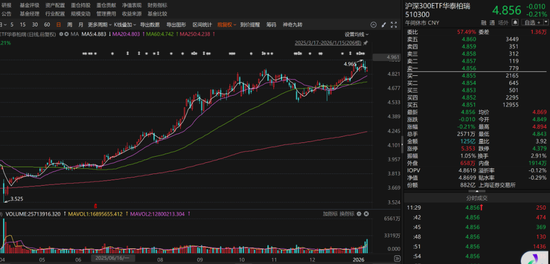
Group 1: ETF Market Performance - On January 15, multiple broad-based ETFs saw a significant increase in trading volume, with the Huatai-PB CSI 300 ETF achieving a half-day trading volume of 12.5 billion yuan, surpassing the highest daily trading volume since April 9, 2025 [1][11] - The Huatai-PB CSI 300 ETF experienced a slight decline of 0.21%, but its trading volume exceeded the previous day's total of 10.5 billion yuan [1][11] - Other ETFs, such as the Huatai-PB CSI A500 ETF and the Huaxia CSI A500 ETF, also reported substantial trading volumes of 12.6 billion yuan and 12.3 billion yuan, respectively, indicating a strong market interest [3][11] Group 2: Sector Performance - The performance of ETFs related to non-ferrous metals and batteries led the market on January 15, with the Southern Non-Ferrous Metals ETF rising by 2.75%, the GF Rare Metals ETF increasing by 2.45%, and the ICBC Credit Suisse Lithium Battery ETF up by 2.42% [6][13] - Analysts from Huatai Securities noted that the recent rise in resource prices is driven by multiple factors, including global monetary easing and increased demand for copper, silver, and rare metals due to AI data centers [13][14] Group 3: Investment Insights - The managers of the Ping An Resource Selected Mixed Fund highlighted a significant structural market for resource products in 2025, with precious metals and industrial metals like copper leading the gains [15] - They emphasized the importance of focusing on key sub-industry investment opportunities in 2026, particularly in industrial metals such as copper and aluminum, as well as in new energy metals like lithium and rare earths [15][16] - The long-term investment value of precious metals, particularly gold and silver, was also underscored, with gold being a core asset for risk diversification [16][17]
超800亿资金 加仓!
Zhong Guo Zheng Quan Bao· 2026-01-08 12:59
Group 1 - The A-share market experienced fluctuations and corrections on January 8, with the satellite and aerospace sectors showing strong gains, leading the top ten in ETF performance [1][8] - The satellite industry chain has been consistently strong since the beginning of the year, with significant increases in sub-sectors such as Beidou navigation, space stations, and commercial aerospace [7][10] - Several ETFs related to satellites and aerospace have shown notable price increases, with the Satellite ETF rising by 6.20% and the Aerospace ETF by 5.62% [9] Group 2 - A total of 876.98 billion yuan was raised by six major A500 ETFs from December 8, 2025, to January 7, 2026, indicating a strong inflow of funds into the market [3][18] - The military industry sector also saw significant inflows, with multiple military-themed ETFs rising over 4% in value [11][12] - Bond and money market ETFs were actively traded, with several achieving transaction volumes exceeding 100 billion yuan, indicating robust investor interest in these asset classes [15][16] Group 3 - Analysts suggest that after recent market rallies, some funds are seeking to allocate to dividend-paying assets with defensive characteristics, leading to a noticeable inflow into the Low Volatility Dividend ETF [21] - The Low Volatility Dividend Index's dividend yield has been rising, currently at 5.06%, which remains attractive compared to the 10-year government bond yield, appealing to medium- to long-term investors [21][22]

官宣:中国最大ETF更名
3 6 Ke· 2026-01-07 13:12
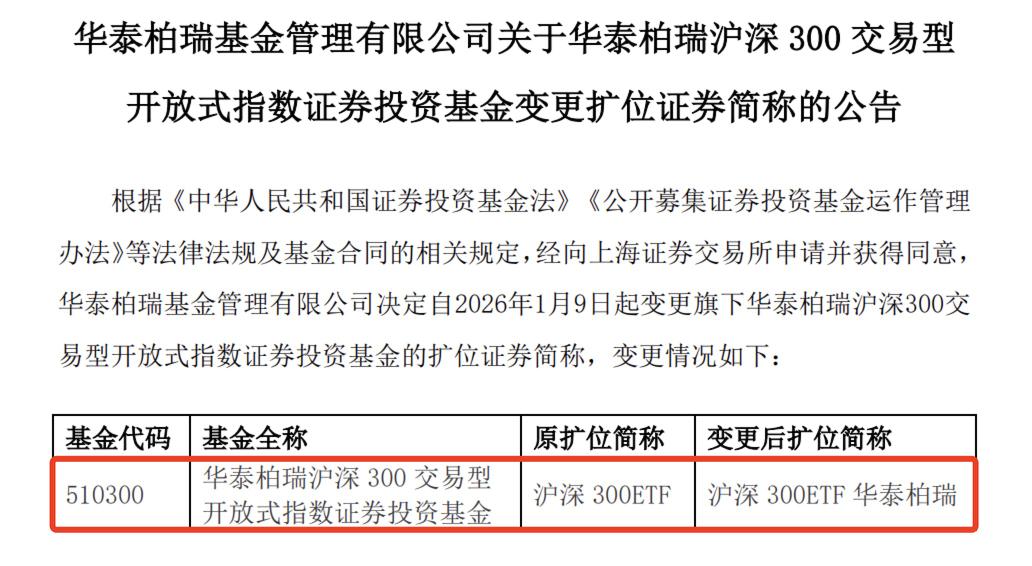
Core Viewpoint - The announcement of the name change for Huatai-PineBridge's CSI 300 ETF marks a significant move in the ETF market, reflecting a trend towards standardized naming conventions that enhance product identification and reduce operational risks for investors [2][4][10]. Group 1: ETF Name Change Announcement - On January 7, 2026, Huatai-PineBridge announced that the abbreviation for its CSI 300 ETF would change to "CSI 300 ETF Huatai-PineBridge," effective January 9, 2026 [2][4]. - This is the first name change for the CSI 300 ETF since its inception over 13 years ago, and it is currently the largest ETF in China's market, with a size close to 440 billion yuan [2][7]. Group 2: Industry Trends and Implications - In the past six months, several fund companies, including Huatai-PineBridge, E Fund, GF Fund, and others, have initiated standardized naming for their ETFs, aiming to improve product recognition and trading efficiency [3][10]. - The standardized naming format follows the guidelines issued by the Shanghai and Shenzhen Stock Exchanges, which require the inclusion of the fund manager's name in the ETF abbreviation, thereby clarifying the product's identity [6][10]. Group 3: Market Context and Growth - As of January 6, 2026, the Huatai-PineBridge CSI 300 ETF had a total size of 439.44 billion yuan, with a growth of over 87 billion yuan in the past year, representing approximately 55% of the trading volume among similar products in 2025 [7][10]. - The ETF serves multiple market functions, including being the only underlying asset for the CSI 300 ETF options contracts and a key tool for various investors in asset allocation and risk management [7]. Group 4: Future Outlook - The ETF market in China has surpassed 6 trillion yuan in total size, with over 1,400 products available, indicating a rapid expansion that necessitates improved foundational systems and market ecology [12]. - The move towards standardized naming is expected to create a clearer and fairer market environment, reducing selection costs for investors and shifting industry competition from scale expansion to quality enhancement and service optimization [12].