
易方达恒生科技ETF

Search documents
公募积极布局港股 科技与周期品种仍是投资主线
Zhong Guo Zheng Quan Bao· 2026-02-25 20:55
Core Viewpoint - The Hong Kong stock market has shown volatility post-Spring Festival, with public funds actively positioning themselves to seize future opportunities, particularly in technology and cyclical sectors [1][2]. Market Performance - As of February 25, the Hang Seng Index has increased by 0.22%, while the Hang Seng Technology Index has decreased by nearly 2%. Various sectors have shown mixed performance, with telecommunications, energy, industrials, and materials rising, while consumer staples, conglomerates, and healthcare sectors have faced adjustments [2]. - Notable individual stock performances include significant increases for companies like Dachen Microline Group and Jiu Yuan Group, while Tencent Holdings and Alibaba have seen declines [2]. Fund Positioning - Multiple fund institutions maintain a positive outlook on Hong Kong stocks, with significant inflows into ETFs focused on this market. For instance, the Huatai-PB Hang Seng Technology ETF saw an increase of 13.436 billion shares, while several other ETFs also reported substantial share increases [2]. - Active funds are also adjusting their portfolios to include major Hong Kong internet stocks, indicating a strategic focus on these companies [3]. Long-term Investment Outlook - According to Huaxia Fund, the current market conditions may present a valuable investment window for Hong Kong stocks, driven by attractive valuations and expectations of improved liquidity. The market is experiencing a convergence of factors such as low historical valuations and continued inflows from southbound capital [4]. - Fund managers from various institutions express optimism about the potential for valuation recovery in Hong Kong stocks, supported by improving corporate performance and favorable macroeconomic conditions, including a potential decline in U.S. interest rates [4]. Sector Focus - The technology sector remains a primary focus for investment, with expectations of explosive growth in AI-related capital expenditures. Major domestic internet companies are anticipated to maintain stable growth, enhancing both earnings and valuations [5][6]. - The ongoing economic transformation and industrial upgrades in China are expected to provide significant support for the valuation of Hong Kong's technology sector, despite short-term fluctuations in interest rate expectations [5].
公募积极布局港股科技与周期品种仍是投资主线
Zhong Guo Zheng Quan Bao· 2026-02-25 20:22
Market Overview - The Hong Kong stock market has shown volatility after the Spring Festival, with mixed performance across sectors. Public funds are actively positioning themselves in the market to seize future opportunities, particularly in technology and cyclical sectors [1][2]. Fund Flows - As of February 24, half of the top ten ETFs with increased shares this year are cross-border ETFs investing in the Hong Kong market. Notably, the Huatai-PB Hang Seng Technology ETF saw an increase of 13.436 billion shares, while several other ETFs also reported significant increases [2]. - Active funds are also adjusting their portfolios to include Hong Kong stocks, with notable holdings in major internet companies like Tencent, Alibaba, Meituan, and Xiaomi [2]. Long-term Investment Outlook - According to Huaxia Fund, the Hong Kong market may present a noteworthy investment window in 2026, driven by attractive valuations and expectations of improved liquidity. The current valuations are at historically low levels, providing a safety margin for investors [2]. - The market is experiencing a resurgence of foreign capital inflows, which is expected to support the Hong Kong stock market [2]. Sector Focus - The technology and cyclical sectors are identified as the main investment themes in the Hong Kong market, with a focus on the AI industry, which is anticipated to see explosive capital expenditure growth [3][4]. - The ongoing economic transformation and industrial upgrades in China are providing significant support for the valuation of the technology sector in Hong Kong [4]. Investment Sentiment - Fund managers express optimism about the Hong Kong market, citing the potential for valuation recovery linked to corporate performance and favorable macroeconomic conditions, including a potential decline in U.S. interest rates [3][4]. - The perception of AI is shifting towards a more rational assessment of return on investment, which is expected to reduce bubble risks and enhance long-term opportunities in the technology sector [4].
千亿资金 流入
Shang Hai Zheng Quan Bao· 2026-02-25 14:48
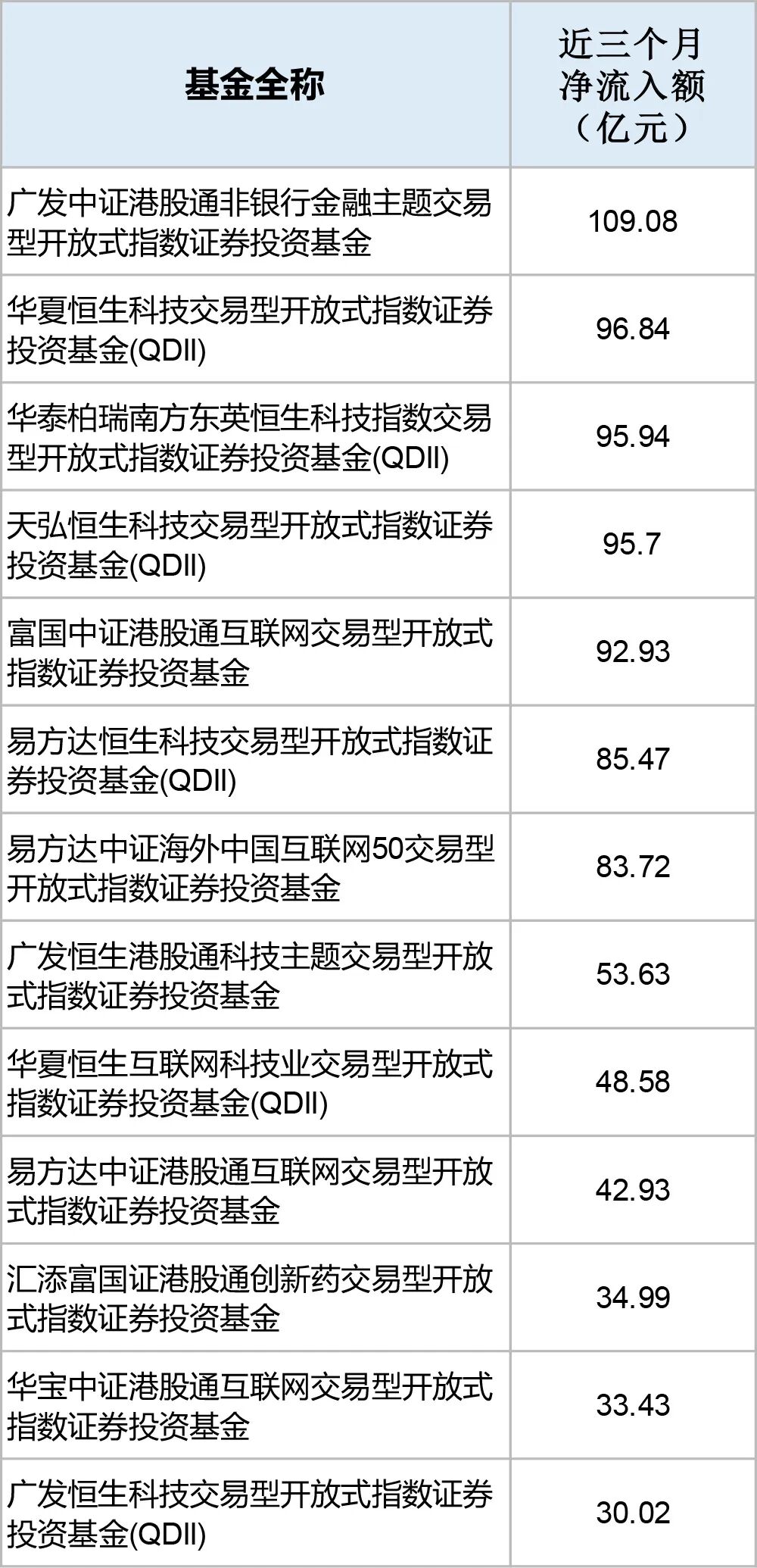
Group 1 - Significant capital inflow into Hong Kong thematic ETFs, with nearly 10 billion yuan net inflow on February 24, focusing on technology ETFs [1][2] - Over the past three months, net inflow into Hong Kong thematic ETFs exceeded 100 billion yuan [1] - Multiple Hong Kong technology thematic ETFs reached historical highs in terms of shares, with notable inflows into various funds [2] Group 2 - Specific funds with substantial net inflows over the past three months include: - GF CSI Hong Kong Stock Connect Non-Bank Financial Theme ETF: 10.91 billion yuan - Huaxia Hang Seng Technology ETF: 9.68 billion yuan - Haitong Southbound Hang Seng Technology ETF: 9.59 billion yuan - Tianhong Hang Seng Technology ETF: 9.57 billion yuan - Fortune CSI Hong Kong Stock Connect Internet ETF: 9.29 billion yuan [3][4] - New products focused on Hong Kong thematic ETFs are being launched, primarily targeting the technology sector [5] - Analysts suggest that the current valuation of the Hang Seng Technology Index is at a historically low level, indicating potential for recovery [5][6]

超130亿元,“跑了”!
Zhong Guo Ji Jin Bao· 2026-02-03 06:49
Group 1 - The stock ETF market experienced a significant net outflow of 790 billion yuan in January, with broad-based ETFs being the main contributors to this outflow [2] - On February 2, the first trading day of the month, stock ETFs saw a net outflow of 13.771 billion yuan, influenced by a sharp decline in the three major stock indices [2] - Broad-based ETFs and the metals sector were the largest "bloodletting" categories, while sector-specific ETFs like semiconductors and pharmaceuticals attracted significant inflows [2][3] Group 2 - As of February 2, the total scale of 1,321 stock ETFs (including cross-border ETFs) was 4.09 trillion yuan, showing a notable decrease due to the market downturn [3] - Sector-specific ETFs and Hong Kong stock ETFs saw substantial inflows, with 3.715 billion yuan and 3.346 billion yuan respectively on the previous trading day [3] - The semiconductor sector had a remarkable net inflow of 2.61 billion yuan on February 2, with the Guolian An CSI All-Share Semiconductor ETF leading with a net inflow of 903 million yuan [3] Group 3 - Over the past five days, the SGE Gold 9999 index saw inflows exceeding 13.9 billion yuan, while the specialized chemical index attracted over 7 billion yuan [4] - Leading institutions like E Fund reported a total ETF scale of 642.71 billion yuan, with a net inflow of 800 million yuan on the previous day [4] - Notable single product inflows included 526 million yuan for the ChiNext ETF and 352 million yuan for the Hang Seng Technology ETF [4] Group 4 - Broad-based ETFs continued to experience significant outflows, with a net outflow of 23.778 billion yuan on the previous day, leading to a scale decrease of 68.672 billion yuan [5] - The CSI 500 ETF had the largest single-day outflow of 13.02 billion yuan, followed by the CSI 300 ETF with 7.2 billion yuan [5] Group 5 - The metals sector also faced notable outflows, with a net outflow of 4.39 billion yuan, influenced by expectations surrounding the Federal Reserve's monetary policy and profit-taking sentiments [6] - Despite short-term volatility, the long-term investment logic for the metals sector remains solid, supported by global manufacturing cycles and energy transition demands [6] Group 6 - Current market adjustments are viewed as providing better valuation windows for long-term investments, with a stable long-term market outlook supported by policy measures and improving economic fundamentals [7] - Key factors include ongoing policy support, marginal improvements in economic indicators, and a favorable funding environment with increasing allocations to A-shares from various institutional investors [7]

持续“吸金” 科技方向ETF规模大增
Shang Hai Zheng Quan Bao· 2026-01-13 18:34
Core Viewpoint - The Chinese technology sector has seen significant capital inflow in 2026, driven by strong performance in various technology-related ETFs and positive market sentiment towards the long-term growth potential of the sector [1][2][4]. Group 1: ETF Inflows - Several technology-focused ETFs have attracted substantial net inflows this year, with the Yongying Satellite ETF leading at 4.79 billion yuan, followed by the Guotai Semiconductor Equipment ETF at 3.014 billion yuan and the Fuguo Satellite ETF at 2.824 billion yuan [1][2]. - Other ETFs, including the Fuguo Hong Kong Internet ETF and Huatai-PB Hang Seng Technology ETF, have also seen significant inflows, with amounts exceeding 1 billion yuan [1][2]. Group 2: Market Performance - The performance of technology indices has been strong, with the Shenwan Computer and Shenwan Electronics indices rising by 14.13% and 5.7% respectively, while the Hang Seng Technology Index increased by 6.41% [2]. - In the U.S. market, Alibaba and Baidu stocks have outperformed the Nasdaq index, rising by 13.46% and 16.53% respectively, compared to the Nasdaq's 2.12% increase [2]. Group 3: Growth Potential - Foreign institutions express confidence in the long-term growth logic of the Chinese technology sector, highlighting the potential for continued market performance in 2026 [4]. - Key sub-sectors such as robotics, autonomous driving, and commercial aerospace are expected to experience significant growth, driven by technological advancements and increasing policy support [5][6]. Group 4: AI and Emerging Technologies - The integration of AI across various industries is anticipated to be a transformative process over the next 3 to 5 years, with core companies in the AI sector currently valued reasonably without entering bubble territory [5]. - Specific applications of AI, such as smart glasses and autonomous driving, are identified as having high growth potential, with ongoing technological breakthroughs and market expansion [6].


跨境ETF扩容持续,港股科技股ETF放量增长
Zheng Quan Shi Bao· 2025-12-31 09:21
Core Viewpoint - The expansion of cross-border ETFs has accelerated significantly this year, with both the scale and number of related products increasing, making it an important observation window for changes in capital allocation [1][2]. Group 1: Cross-Border ETF Expansion - As of December 26, the total scale of cross-border ETFs has increased by 514.7 billion, with the number of products rising by 63 since the beginning of the year [2]. - Hong Kong stock-related ETFs have become the main source of this expansion, particularly those focused on technology stocks, which have seen significant growth [2][3]. - Several ETFs focusing on Hong Kong technology assets have achieved substantial scale increases, indicating that some funds are still participating in the Hong Kong technology sector through cross-border ETF tools despite global market volatility [1][2]. Group 2: Market Dynamics and Fund Flows - In the fourth quarter, the performance of Hong Kong technology stocks has shown phase volatility, but there has not been a consistent withdrawal of funds [1][3]. - Despite the decline in net value of related technology indices, some ETFs have continued to see growth, indicating ongoing structural investment [3]. - Specific ETFs such as Tianhong Hang Seng Technology ETF, Huaxia Hang Seng Technology ETF, and E Fund Hang Seng Technology ETF have reported scale increases of 10.257 billion, 5.502 billion, and 5.330 billion respectively over the past three months [3]. Group 3: Institutional Outlook - Institutions remain optimistic about the future, citing multiple narratives such as AI development, potential Federal Reserve interest rate cuts, and accelerated inflows from the south as factors attracting market attention [4]. - The liquidity environment is expected to become more accommodative, which may support risk assets like Hong Kong technology stocks [4]. - The recent market corrections have released some risk factors, providing opportunities for long-term investors to position themselves in quality technology assets [4]. Group 4: Industry Trends - The development of AI is heavily supported by capital expenditures in cloud and computing power, with global cloud giants increasing investments in data centers to meet rising AI inference demands [5]. - Hong Kong technology companies are expanding their market boundaries and entering new phases of internationalization [5][6].
跨境ETF扩容持续,港股科技股ETF放量增长!
券商中国· 2025-12-31 05:54
Core Viewpoint - The expansion of cross-border ETFs has accelerated significantly this year, with both the scale and number of related products increasing, becoming an important observation window for changes in capital allocation [1] Group 1: Cross-Border ETF Expansion - The overall expansion of cross-border ETFs is evident, with a total growth of 514.7 billion yuan in scale and an increase of 63 products since the beginning of the year, as of December 26 [3] - Hong Kong stock-related ETFs have become the main source of this expansion, particularly those focused on technology stocks, which have shown remarkable growth [2][3] Group 2: Performance of Technology ETFs - Several technology-themed ETFs have seen significant scale growth, with products like the Fortune CSI Hong Kong Internet ETF increasing by 58.27 billion yuan, the ICBC National Index Hong Kong Technology ETF by 27.45 billion yuan, and the Huaxia Hang Seng Technology ETF by 25.84 billion yuan [3] - Despite a phase of volatility in the Hong Kong technology sector in the fourth quarter, there has been no consistent withdrawal of funds, indicating ongoing interest in these assets [2][4] Group 3: Market Outlook and Institutional Perspectives - Institutions remain optimistic about the future, citing multiple narratives such as AI development, potential interest rate cuts by the Federal Reserve, and accelerated inflows from the south as factors attracting market attention [5] - The liquidity environment is expected to become more accommodative, which may enhance market risk appetite and provide support for Hong Kong technology assets [5][6] - The recent market corrections have released some risk factors, presenting opportunities for long-term investors to position themselves in quality technology assets [6]

跨境ETF扩容持续,港股科技股ETF放量增长!
Zheng Quan Shi Bao Wang· 2025-12-31 03:56
Core Viewpoint - The expansion of cross-border ETFs has accelerated significantly this year, with both the scale and number of related products increasing, making it an important observation window for changes in capital allocation [1][2]. Group 1: Cross-Border ETF Expansion - As of December 26, the total scale of cross-border ETFs has increased by 514.7 billion, with the number of products rising by 63 since the beginning of the year [2]. - Hong Kong stock-related ETFs have become the main source of this expansion, particularly those focused on technology stocks, which have shown remarkable growth [2]. - Several ETFs focusing on Hong Kong technology assets have achieved significant scale increases this year, indicating that some funds are still participating in the Hong Kong technology sector through cross-border ETF tools despite global market volatility [1][2]. Group 2: Performance of Technology ETFs - Multiple technology-themed ETFs have seen scale growth exceeding 10 billion, with the top ten products primarily concentrated in technology ETFs [2]. - Specific products such as the FTSE China Hong Kong Internet ETF and the ICBC National Index Hong Kong Technology ETF have seen scale increases of 58.27 billion and 27.45 billion, respectively [2]. - Despite a phase of volatility in the Hong Kong technology sector in the fourth quarter, some funds continue to flow into technology-related ETFs, indicating ongoing interest [3]. Group 3: Market Outlook and Institutional Perspectives - Institutions remain optimistic about the future, citing multiple narratives such as AI development and potential easing of monetary policy as factors that will continue to attract market attention to the Hong Kong technology sector [4]. - The liquidity environment is expected to improve, which may enhance market risk appetite and provide support for risk assets like Hong Kong technology stocks [4]. - The recent market corrections are seen as opportunities for long-term investors to position themselves favorably in high-quality technology assets [4]. Group 4: Industry Dynamics - The growth of AI is supported by significant capital expenditures in cloud and computing power, with global cloud giants increasing investments in data centers to meet rising AI demand [5]. - Hong Kong technology companies are expanding their market boundaries and entering new phases of internationalization [5][6].
12月以来超千亿资金涌入权益类ETF
Sou Hu Cai Jing· 2025-12-26 02:21
Core Viewpoint - The pace of capital inflow into the market has significantly accelerated as the year comes to a close, with a notable peak in net subscriptions for equity ETFs observed in December [1] Group 1: Capital Inflow - As of December 24, net subscriptions for equity ETFs reached 106.37 billion yuan, marking a recent high in capital inflow [1] - Several ETFs saw net subscriptions exceeding 10 billion yuan, indicating strong investor interest [1] Group 2: Notable ETFs - The Southern A500 ETF led with a net subscription of 22.65 billion yuan, followed by Huatai-PB A500 ETF with 19.67 billion yuan, and Huaxia A500 ETF with 16.28 billion yuan [1] - Other ETFs, including Guotai A500 ETF and E Fund A500 ETF, also surpassed 10 billion yuan in net subscriptions [1] Group 3: Thematic ETFs - In addition to broad-based ETFs, several industry-themed ETFs attracted significant capital, with Yongying Satellite ETF and Huatai-PB Dividend ETF each exceeding 2 billion yuan in net subscriptions [1] - Hong Kong stock technology-themed ETFs gained attention, with the GF Hong Kong Stock Technology ETF seeing over 3 billion yuan in net subscriptions, while Tianhong Hang Seng Technology ETF, Huaxia Hang Seng Technology ETF, and E Fund Hang Seng Technology ETF each surpassed 2 billion yuan [1]
四季度以来近2000亿元资金涌入权益类ETF
Sou Hu Cai Jing· 2025-11-26 06:59
Group 1 - The pace of capital inflow into equity ETFs has significantly accelerated, with a total net subscription amount reaching 196.48 billion yuan as of November 21 [1] - On November 21, the single-day net subscription amount for equity ETFs exceeded 40 billion yuan, marking the highest net inflow in over seven months [1] - The capital flow is directed towards three main categories: broker-themed ETFs and dividend-themed ETFs, technology growth-themed ETFs, and Hong Kong stock-themed ETFs [1] Group 2 - Morgan Asset Management states that despite recent market adjustments, liquidity shocks are nearing full pricing, and the overall market trend has not fundamentally changed [2] - The Chinese AI industry is still in its early development stage, avoiding the excessive capital expenditure issues seen in the U.S., with a solid foundation for technological innovation and self-sufficiency [2]