
南方中证A500ETF

Search documents
节后两个交易日ETF资金净流入近40亿元
Zheng Quan Ri Bao· 2026-02-26 16:15
Core Viewpoint - The ETF market has experienced a significant inflow of funds post-Spring Festival, with a net inflow of 3.937 billion yuan from February 24 to February 25, reversing the net outflow trend observed in the five trading days prior to the holiday [1][2]. Fund Flow Analysis - The ETF market saw a stark contrast in fund flows before and after the Spring Festival. Prior to the holiday, the market experienced a net outflow of 14.369 billion yuan due to liquidity management and profit-taking sentiments [2]. - Post-holiday, the return of wealth management funds and the release of allocation demand contributed to the 3.937 billion yuan net inflow [2]. - Broad-based ETFs have been particularly attractive, with significant inflows into the Southern CSI 500 ETF (1.522 billion yuan), Southern CSI A500 ETF (372 million yuan), and Huaxia CSI 500 ETF (215 million yuan), totaling 2.109 billion yuan [2]. Sector-Specific Inflows - Technology-related ETFs have emerged as key areas for fund inflows, driven by high growth expectations. Notable inflows include the Satellite ETF (483 million yuan), Huaxia CSI Robotics ETF (332 million yuan), Tianhong CSI Robotics ETF (331 million yuan), and E Fund CSI Artificial Intelligence Theme ETF (319 million yuan), collectively attracting 1.465 billion yuan [3]. Institutional Insights - Institutions view the post-holiday fund flow characteristics as indicative of a trend where ordinary investors are increasingly using ETFs for convenient allocation, reflecting professional funds' judgment on market opportunities [4]. - The sustained inflow into broad-based ETFs suggests a preference for diversified allocation to mitigate risks associated with single sectors, while the activity in technology ETFs highlights expectations for supportive policies and technological breakthroughs in sectors like semiconductors and AI [4]. - The concentration of funds in broad-based and technology-themed ETFs aligns with a "steady foundation + elastic offense" investment strategy, resonating with the core role of technology in economic transformation [4]. Investor Recommendations - For ordinary investors, it is advised to select products based on their risk tolerance: those with lower risk tolerance may consider broad-based ETFs for core holdings, while those seeking higher elastic returns could allocate to technology sector ETFs, ensuring to manage position sizes to avoid over-concentration in a single sector [5]. - Overall, the positive fund movement in ETFs post-Spring Festival injects liquidity support into the market and provides clear directional guidance for investors to seize future opportunities [5].
招商策略:历史上两会前后A股风格如何演绎?
Sou Hu Cai Jing· 2026-02-24 14:29
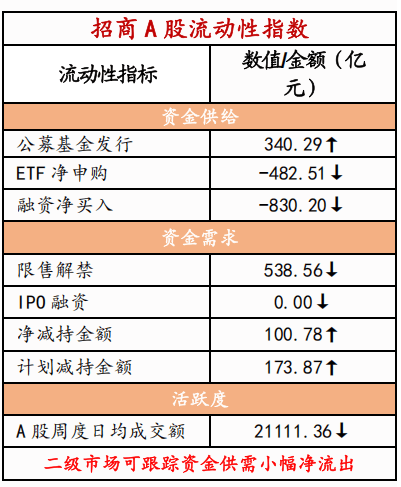
Market Performance - Historically, A-shares perform well in the two weeks leading up to the Two Sessions and slightly worse during the sessions, with an increased probability of rising post-sessions [2][9] - The small-cap style dominates both before and after the Two Sessions, with the CSI 500 and CSI 1000 indices benefiting from expectations of stable growth policies and industrial policies [2][11] - After the Two Sessions, cyclical sectors are expected to perform better, with higher average returns [2][11] Monetary Policy and Interest Rates - The central bank's net injection in the open market was 23,969 billion yuan last week, with a future injection of 22,524 billion yuan in reverse repos and 3,000 billion yuan in MLF [2][18] - Money market rates are declining, with the R007 and DR007 rates down by 18.4 basis points and 14.0 basis points respectively [2][18] Fund Supply and Demand - In the last week, there was a slight net outflow of funds in the secondary market, with a net sell-off of 830.2 billion yuan in financing [3][23] - The issuance of public funds increased by 340.3 billion units, while ETF saw a net outflow of 482.5 billion yuan [3][23] Market Sentiment - Financing trading activity weakened, with a decrease in the proportion of financing transactions in A-share turnover to 8.6% [3][28] - The VIX index fell, indicating improved risk appetite in overseas markets [3][33] Industry Preferences - The only sectors with net inflows were media and building materials, while significant outflows were seen in sectors like electronics and power equipment [3][35] - The highest net inflow was in the media sector (+15.1 billion yuan), while the largest net outflow was in power equipment (-97.3 billion yuan) [3][36] Industry Performance Post-Two Sessions - Post-Two Sessions, industries such as real estate, building materials, and consumer electronics are expected to see higher probabilities of price increases as stable growth policies are confirmed [2][15]

ETF规模速报 | 创业板ETF易方达净流入超10亿元,A500ETF南方净流出超6亿元
Mei Ri Jing Ji Xin Wen· 2026-02-12 01:42
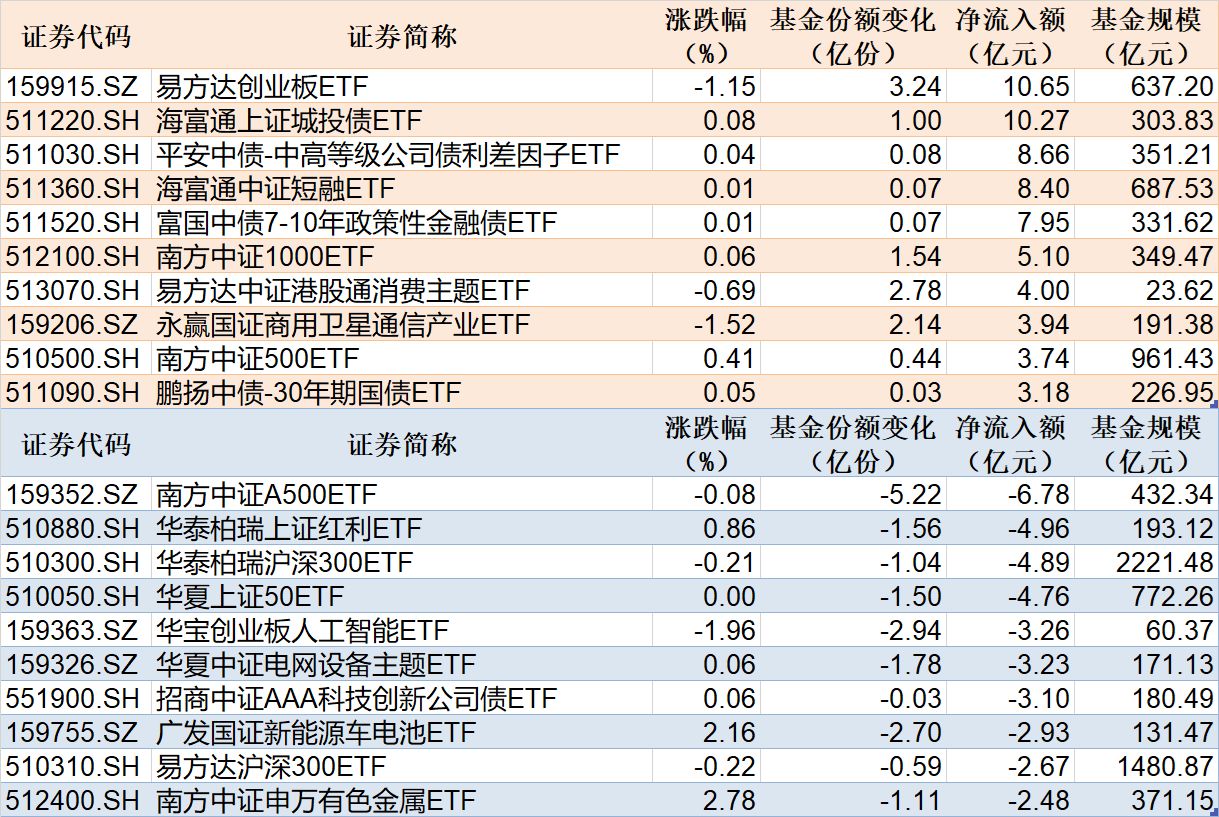
Market Overview - The three major indices showed mixed performance, with the ChiNext Index and the STAR 50 Index both declining over 1% [1] - The chemical sector has recently shown strength, particularly in the fiberglass concept, while the film and cinema sector experienced a collective decline [1] ETF Market Activity - On February 11, the non-monetary ETF market saw significant inflows, with the E Fund ChiNext ETF increasing by 324 million shares and a net inflow of 1.065 billion yuan [1] - The Hai Fu Tong Shanghai City Investment Bond ETF also saw an increase of 100 million shares with a net inflow of 1.027 billion yuan [1] - The Ping An Zhongdai High-Grade Corporate Bond Spread Factor ETF had an increase of 8 million shares and a net inflow of 866 million yuan [1] Fund Performance - The E Fund ChiNext ETF had a decline of 1.15%, despite the increase in shares and net inflow [2] - The Hai Fu Tong Shanghai City Investment Bond ETF had a slight increase of 0.08% with a net inflow of 1.027 billion yuan [2] - The Ping An Zhongdai High-Grade Corporate Bond Spread Factor ETF increased by 0.04% with a net inflow of 866 million yuan [2] Fund Outflows - The Southern CSI A500 ETF saw a reduction of 522 million shares and a net outflow of 678 million yuan [2] - The Huatai-PB Shanghai Dividend ETF experienced a decrease of 156 million shares with a net outflow of 496 million yuan [2] - The Huatai-PB CSI 300 ETF had a reduction of 104 million shares and a net outflow of 489 million yuan [2] Top ETF Inflows - The top 20 ETFs by net inflow for the month include the Huatai-PB Hang Seng Technology ETF with 3.885 billion yuan and the Hai Fu Tong CSI Short-term Bond ETF with 3.852 billion yuan [4] - Other notable inflows include the Huatai-PB Hang Seng Internet Technology ETF with 2.872 billion yuan and the E Fund ChiNext ETF with 1.772 billion yuan [4] Overall Market Statistics - As of February 11, the total ETF shares in the market reached 33,335.10 billion shares, with a total scale of 54,141.40 billion yuan [4] - The information sector saw the largest increase in shares, with four funds tracking it, while the largest thematic increase was in the CSI Robotics Index, tracked by nine funds [4]



AI投资告别“讲故事”:公募四季报告诉你,2026年该投什么?
券商中国· 2026-02-04 06:29
Core Viewpoint - The 2025 fund quarterly report indicates a shift in investment strategy from emotion-driven to performance-based, emphasizing stability and safety in the market [1] Group 1: Market Activity and Fund Performance - The average daily trading volume in A-shares reached 3.11 trillion yuan, a month-on-month increase of over 10%, indicating active trading despite the approaching Spring Festival [1] - As of December 2025, the net asset value of domestic public funds in China reached 37.71 trillion yuan, nearing the 38 trillion yuan mark, and has set a historical high for nine consecutive months [1] Group 2: Passive vs. Active Funds - By the end of 2025, the market value of stock index funds reached 4.7 trillion yuan, a quarter-on-quarter increase of 3.4%, while active equity funds fell to 3.39 trillion yuan, down 5.2% [4] - The gap between passive and active funds widened from 970 billion yuan in Q3 2025 to 1.31 trillion yuan by the end of 2025, reflecting a growing preference for transparent and cost-effective investment tools [4][5] Group 3: Sector Focus and Investment Trends - In 2025, active equity funds showed a reduction in allocation to TMT sectors, with a notable increase in the communication sector by approximately 1.9 percentage points [7] - Companies in the storage chip sector, such as Baiwei Storage, are expected to see significant profit growth, with projected net profits increasing by 427.19% to 520.22% year-on-year [8] Group 4: Safety and Stability in Investments - Commodity funds saw a surge of over 40% in scale, with gold-related ETFs increasing by over 100 billion yuan, highlighting a shift towards safe-haven assets amid global economic uncertainties [10] - The "fixed income plus" products reached a scale of 2.74 trillion yuan by the end of 2025, growing approximately 60% year-on-year, catering to cautious investors seeking stable returns [11]





公募基金 2025 年四季报规模点评:ETF 规模继续扩张,固收加和 FOF 产品市场认可度提升
GUOTAI HAITONG SECURITIES· 2026-01-23 05:47
Report Industry Investment Rating No relevant content provided. Core Viewpoints of the Report - In Q4 2025, after excluding ETF-linked funds and duplicate holdings of internal funds, the scale of equity, bond, commodity, domestic other, QDII equity-mixed, QDII bond, QDII other, and FOF funds increased compared to the previous quarter, while the scale of hybrid and MOM funds decreased [1][6]. - As of December 31, 2025, the total public fund management scale (excluding money market funds) was approximately 22.66 trillion yuan, an increase of about 0.65 trillion yuan compared to September 30, 2025. After excluding the scale of ETF-linked funds invested in ETFs and holdings of internal funds, the total public fund scale (excluding money market funds) was about 21.68 trillion yuan, an increase of about 0.54 trillion yuan compared to September 30, 2025 [4][6]. Summary by Relevant Catalogs Index Funds - As of the end of Q4 2025, excluding commodity and domestic other types of funds and the part of ETF-linked funds invested in ETFs, the total passive management product volume of fund companies was about 7.16 trillion yuan. Among them, the passive management scale of equity (including QDII) was about 5.48 trillion yuan, an increase of about 131.116 billion yuan compared to the end of Q1; the passive management scale of fixed income was about 1.68 trillion yuan, an increase of about 231.211 billion yuan compared to the end of Q1 [4][6]. - **Equity**: In Q4, 183 index equity funds were established in the public fund market, with a total issuance scale of about 81.679 billion yuan and an average issuance scale of about 446 million yuan, showing a significant decline in both the number and scale of new issuances compared to Q3 2025. In the top ten new products in terms of fundraising scale in Q4, 4 were broad-based funds, 3 were thematic index funds, and 3 were strategic index funds. In the Q4, ETF products tracking the CSI A500 index were favored by investors, and the scale of thematic ETF products tracking popular themes also increased rapidly [7]. - **Fixed Income**: In Q4 2025, 4 index bond funds were issued, with a total fundraising scale of 12.549 billion yuan, a significant decline compared to the previous quarter. In Q4, the scale of ongoing index bond funds increased against the trend, with over 57% of funds achieving positive growth. Some科创 bond ETF products and medium - and short - term policy financial bond products saw significant scale expansion [8]. Active Equity - Mixed Funds - As of December 31, 2025, the total scale of active equity - mixed funds in the market after excluding FOF products was about 4.40 trillion yuan, a decrease of about 156.297 billion yuan compared to the end of the previous quarter [4][9]. - **Newly Issued Funds**: In Q4 2025, 106 active equity funds were established, with a total fundraising scale of about 60.218 billion yuan, accounting for 42.44% of equity funds. Since 2025, the active equity new - issuance market has continued to strengthen [9]. - **Ongoing Funds**: Currently, investors' investment sentiment towards active equity - mixed funds remains low. In Q4, only about 25% of active equity - mixed funds achieved scale expansion. Among high - position products, thematic products with clearer investment goals were more popular, and some stable - performing dividend - value style products or cycle - themed products also saw significant scale growth [9][10]. Active Bond Funds - As of December 31, 2025, the scale of active bond funds after excluding FOF products reached 9.31 trillion yuan, an increase of about 158.803 billion yuan compared to the end of the previous quarter [4][11]. - **Newly Issued Funds**: In Q4 2025, 57 new products were issued, with a total fundraising scale of about 62.486 billion yuan. The top five active bond funds in terms of fundraising scale were all partial - bond products, and the fundraising scale of the top 5 did not exceed 5 billion yuan [11]. - **Ongoing Funds**: Since 2025, with the bull market in the equity market, the market recognition of fixed - income plus products has been significantly improved. In Q4, the scale growth of ongoing active fixed - income funds still mainly came from fixed - income plus products [11]. FOF - As of December 31, 2025, after excluding the duplicate part of FOF's holdings of internal funds, the scale of FOF in Q4 2025 was about 17.2836 billion yuan, continuing the growth trend compared to the previous quarter, but the scale growth still mainly came from newly issued products [4][12]. - **Newly Issued Funds**: In Q4 2025, 42 FOFs were established, an increase of 25 compared to Q3. The total fundraising scale was about 45.246 billion yuan, a significant increase of about 38.714 billion yuan compared to the previous quarter. The average fundraising scale in Q4 was about 1.077 billion yuan, an increase of 693 million yuan compared to the previous quarter [12]. - **Ongoing Funds**: High - performing medium - and low - position FOF products were still more popular among investors. The low - position ordinary FOF product Guotai Ruiyue 3 - month Holding under Guotai had the largest scale growth in Q4, with a growth of 2.619 billion yuan [12]. Other Products - As of December 31, 2025, after excluding the scale of ETF - linked funds invested in ETFs and holdings of internal funds, the total scale of other types of products in Q4 2025 was about 66.9156 billion yuan, an increase of about 12.5121 billion yuan compared to the previous quarter [4][13]. - Gold - themed ETF products and ETF - linked funds continued to rise significantly in Q4 due to the continuous increase in international gold prices. Silver - themed products also saw a significant increase in scale in Q4. In addition, inter - bank certificate of deposit products continued to attract investors' attention, with a total scale growth of 2.6553 billion yuan in Q4 [13].
腰部基金公司规模“突围”!“爆款基”密集现身
Zhong Guo Zheng Quan Bao· 2026-01-22 23:19
Group 1 - The total scale of public funds reached 37.26 trillion yuan by the end of Q4 2025, with a quarter-on-quarter increase of over 1.3 trillion yuan [2] - The largest growth came from money market funds, which increased by 571.93 billion yuan, followed by bond funds with an increase of 446.94 billion yuan, and stock funds with an increase of 155.08 billion yuan [2] - The top two fund companies by total management scale are E Fund and Huaxia Fund, each managing over 2 trillion yuan, while eight other companies manage over 1 trillion yuan [2] Group 2 - The largest increase in non-money management scale was seen in Guotai Fund, which grew by 62 billion yuan, followed by Invesco Great Wall Fund with a growth of 53.12 billion yuan [3] - Several large fund companies experienced significant growth, with notable products contributing over 20 billion yuan in scale increase, such as the Huaxia CSI 500 ETF and the Invesco Great Wall Jing Sheng Dual Income Bond [3] - Mid-sized fund companies showed considerable changes, with several becoming "dark horses" in Q4 2025, such as Changcheng Fund and Dongcai Fund, which saw increases of over 20 billion yuan [4] Group 3 - Smaller fund companies like Shanzheng Asset Management and Huayin Fund also reported substantial growth in non-money management scale in Q4 2025 [4] - The rebranding of Beixin Ruifeng Fund to Huayin Fund led to a rapid increase in scale, reaching 26.75 billion yuan with a growth of 6.1 billion yuan [4] - Notable products from smaller firms, such as the Debon Xin Xing Value Fund, contributed significantly to their growth [4]
公募基金规模环比大增 腰部机构黑马频现
Zhong Guo Zheng Quan Bao· 2026-01-22 22:42
Core Insights - The public fund management scale increased by over 1.3 trillion yuan in Q4 2025, driven mainly by money market funds, bond funds, commodity funds, and index funds [1][2] Group 1: Fund Management Scale - As of the end of Q4 2025, the total scale of public funds reached 37.26 trillion yuan, with significant contributions from various fund types: stock funds at 5.997 trillion yuan, mixed funds at 3.769 trillion yuan, bond funds at 10.907 trillion yuan, money market funds at 14.969 trillion yuan, overseas investment funds at 0.971 trillion yuan, commodity funds at 0.04268 trillion yuan, fund of funds (FOF) at 0.02188 trillion yuan, and other funds at 0.0001367 trillion yuan [2] - The largest growth in scale was seen in money market funds, which increased by 571.93 billion yuan, followed by bond funds with an increase of 446.94 billion yuan, and stock funds with an increase of 155.08 billion yuan, primarily from index stock funds [2] Group 2: Competitive Landscape - The top two fund companies, E Fund and Huaxia Fund, each managed over 2 trillion yuan, while eight other companies managed over 1 trillion yuan [3] - Among the top twenty fund companies by non-money management scale, most experienced growth in Q4 2025, with Guotai Fund leading the increase at 62 billion yuan, followed by Invesco Great Wall Fund at 53.11 billion yuan [3][4] Group 3: Emerging Players - The mid-tier fund companies saw significant changes, with several emerging as "dark horses" in Q4 2025, such as Changcheng Fund with over 20 billion yuan growth, and Dongcai Fund, Zhongjia Fund, Guotai Haitong Asset Management, Morgan Fund, and Rongtong Fund each growing by over 15 billion yuan [5] - Notably, Dongcai Fund's growth was driven by its bond fund, while Morgan Fund's growth was attributed to its index funds [5][6] Group 4: Small Fund Companies - Smaller public fund institutions like Shanzheng Asset Management, Huayin Fund, and Debang Fund also saw substantial growth in their non-money management scales [6] - Huayin Fund, after rebranding from Beixin Ruifeng Fund, achieved a scale of 26.753 billion yuan, with a significant contribution from a single product [6]
公募基金规模环比大增腰部机构黑马频现
Zhong Guo Zheng Quan Bao· 2026-01-22 20:56
Core Insights - The public fund management scale increased by over 1.3 trillion yuan in Q4 2025, driven primarily by money market funds, bond funds, commodity funds, and index funds [1][2] Fund Scale Growth - As of the end of Q4 2025, the total scale of public funds reached 37.26 trillion yuan, with significant contributions from various fund types: stock funds at 5.997 trillion yuan, mixed funds at 3.769 trillion yuan, bond funds at 10.907 trillion yuan, money market funds at 14.969 trillion yuan, overseas investment funds at 0.971 trillion yuan, commodity funds at 0.043 trillion yuan, fund of funds (FOF) at 0.022 trillion yuan, and other funds at 0.0000137 trillion yuan [1][2] - The largest growth was seen in money market funds, which increased by 571.93 billion yuan, followed by bond funds with an increase of 446.94 billion yuan, and stock funds with an increase of 155.08 billion yuan, primarily from index stock funds [2] Competitive Landscape - The top two fund companies, E Fund and Huaxia Fund, both managed over 2 trillion yuan, while eight other companies, including GF Fund and Southern Fund, managed over 1 trillion yuan [2] - The top twenty fund companies in non-money management scale saw most companies achieve growth, with Guotai Fund leading with an increase of 62 billion yuan, followed by Invesco Great Wall Fund with an increase of 53.12 billion yuan [3] Emerging Players - The mid-tier fund companies experienced significant changes, with several emerging as "dark horses" in Q4 2025, such as Changcheng Fund, which grew by over 20 billion yuan, and Dongcai Fund, among others, which saw increases exceeding 15 billion yuan [3][4] - Notably, Dongcai Fund's growth was primarily driven by its bond fund, while Morgan Fund's growth stemmed from its index funds [4] Small Fund Institutions - Smaller public fund institutions, including Shanzheng Asset Management and Huayin Fund, also experienced substantial growth in non-money management scale [4] - After rebranding, Beixin Ruifeng Fund, now known as Huayin Fund, saw rapid growth, reaching a non-money management scale of 26.75 billion yuan, with a significant contribution from a single product [4]
互联互通机制下首只A500 ETF“出海”,南方东英南方中证A500指数ETF在新交所上市
Sou Hu Cai Jing· 2026-01-21 06:34
Core Insights - The first A500 ETF under the cross-border mutual access mechanism, the Southern Eastern Southern CSI A500 Index ETF (stock code: SUN), was officially listed on the Singapore Exchange on January 20, 2026, marking a significant step in financial cooperation between China and Singapore [1][4] Group 1: ETF Listing Details - SUN was listed at a price of 1 Singapore dollar per share, with a minimum trading requirement of 1 share and an annual management fee of 0.89% [3] - As a feeder ETF, SUN will invest at least 90% of its net assets in its main fund, the Southern CSI A500 ETF (code: 159352), which had an asset management scale of 47.1 billion RMB as of January 8, 2026, ranking second globally among similar products [3] - The CSI A500 Index reflects the performance of 500 large-cap A-share securities across various industries, with a balanced sector allocation focusing on industrial, information technology, materials, finance, and communication services [3] Group 2: Market Impact and Strategic Importance - The successful listing of SUN is a key outcome of the deepening ETF mutual access mechanism initiated by the Shenzhen Stock Exchange and the Singapore Exchange in 2022, facilitating global capital flow into technology innovation and core Chinese assets [4] - SUN provides a convenient tool for Singapore and global investors to access high-quality Chinese broad-based assets, with a low investment threshold of 1 Singapore dollar, thereby expanding the international investor base for Shenzhen ETFs [4] - The listing of SUN exemplifies China's commitment to high-level financial openness and serves as a new impetus for deepening capital market connectivity between China and Singapore [4] Group 3: Company Background - Southern Eastern entered the Singapore market in 2018 and has established itself as a leading ETF issuer, with total assets under management reaching approximately 2.5 billion USD as of December 31, 2025 [5] - The company has achieved significant milestones in innovative products, including the ICBC Southern Eastern FTSE China Government Bond Index ETF, which is one of the largest in its category globally [6] - The Southern Eastern Southern CSI A500 Index ETF further strengthens the product lineup of Southern Eastern in Singapore [6]
首例,这类中国ETF新加坡上市
3 6 Ke· 2026-01-20 08:38
Core Insights - The launch of the Southern Dongying CSI A500 Index ETF on the Singapore Exchange marks a significant step in the internationalization of China's capital markets, providing overseas investors with efficient access to leading companies across various industries in China [1][4] Group 1: ETF Launch Details - The Southern Dongying CSI A500 Index ETF (stock code: SUN) is the first A500 ETF listed in Singapore, with an initial price of 1 Singapore dollar per share and a management fee of 0.89% [2] - This ETF is a feeder fund that will invest at least 90% of its net assets in the Southern CSI A500 ETF, utilizing QFII quotas and other legal investment methods [2] - As of January 8, 2026, the Southern CSI A500 ETF had an asset management scale of 471 billion RMB, ranking second globally and first among similar products on the Shenzhen Stock Exchange [2] Group 2: Index Characteristics - The CSI A500 Index is a core broad-based index in China, comprising 500 securities with large market capitalization and good liquidity, representing key assets in A-shares while balancing traditional and emerging industries [3] - The index is designed to reflect China's economic transformation and emerging growth drivers, with a focus on sectors like information technology and communication services [3] Group 3: Market Impact and Opportunities - The launch of the ETF provides Singapore investors with a low entry point of just 1 Singapore dollar, facilitating participation in the long-term growth of China's core assets [3] - The successful listing of this ETF enhances the Singapore ETF market and meets investor demand for broad-based index exposure to A-shares [4] - The establishment of the ETF mutual recognition between Shenzhen Stock Exchange and Singapore Exchange represents a milestone in cross-border investment opportunities, promoting resource allocation towards key sectors like technology and green economy [4]