
南方东英南方中证A500指数ETF

Search documents
首只!中证A500 ETF登陆港交所
Zhong Guo Ji Jin Bao· 2026-01-28 00:33
Core Viewpoint - The Southbound East Asia Huatai-Pinebridge CSI A500 ETF has been listed on the Hong Kong Stock Exchange, marking a significant step in the internationalization of the CSI A500 index and providing a new channel for international investors to access A-share markets [1][2][4]. Group 1: Product Launch and Features - The Southbound East Asia Huatai-Pinebridge CSI A500 ETF (stock code: 3101.HK) was listed on January 28, with an initial price of approximately HKD 7.9 per share and a management fee of 0.99% [2][3]. - The ETF will invest at least 90% of its net assets directly into the Huatai-Pinebridge A500 ETF through QFII and Stock Connect channels, allowing international investors to indirectly invest in a basket of quality listed companies in mainland China [2][3]. Group 2: Market Context and Trends - The listing of the ETF is part of a broader trend where global investors are increasingly allocating funds to Chinese assets, with the CSI A500 index being a key representative of China's economic landscape [4][5]. - The CSI A500 index employs an "industry-neutral" methodology, covering 35 secondary industries and 89 tertiary industries, with over 70% of its weight in new economy sectors, aligning with China's high-quality economic development [4][5]. Group 3: Performance and Growth - As of January 26, the Huatai-Pinebridge A500 ETF had a total size of CNY 46.265 billion, making it the largest product tracking the CSI A500 index, with an average daily trading volume of CNY 14.304 billion this year [3][5]. - The total size of all ETFs tracking the CSI A500 index has exceeded CNY 280 billion, making it the second-largest index product in mainland markets after the CSI 300 index [5]. Group 4: Internationalization Efforts - The internationalization of the CSI A500 index is accelerating, with the listing of the Southbound East Asia Huatai-Pinebridge CSI A500 ETF in Singapore on January 20, allowing Singaporean investors to trade the ETF conveniently [6]. - Deutsche Asset Management announced a partnership with Harvest Global Investments to transform one of its ETFs into a product tracking the CSI A500 index, furthering the index's international presence [5].
今日视点:中国资本市场双向开放呈现新图景
Xin Lang Cai Jing· 2026-01-22 23:09
Core Viewpoint - The China Securities Regulatory Commission (CSRC) has set a clear direction for the capital market's opening in 2026, emphasizing the need for a deeper and higher level of dual-directional opening in the capital market [1][6]. Group 1: Introduction of Foreign Capital - Foreign institutions are no longer just "landing" in China but are focusing on "rooting" themselves in the market, with 15 foreign securities firms currently operating in China [2][7]. - Major foreign players include Goldman Sachs (China) Securities and JPMorgan Securities (China), which represent international investment banks, as well as Standard Chartered Securities (China) and DBS Securities (China), which represent commercial banks [2][7]. - Foreign firms are expanding beyond traditional securities business into asset management and wealth management, with differentiated entry points [2][7]. Group 2: Going Global - Chinese securities firms are transitioning from merely "going out" to building a global service ecosystem, enhancing international competitiveness and contributing to high-level openness [3][8]. - Currently, 38 domestic securities firms have established overseas subsidiaries, and the international business revenue of highly internationalized firms accounts for about 25% of their total revenue, indicating significant growth in this sector [3][8]. Group 3: Synergistic Effects - The dual-directional opening creates significant synergies, with foreign institutions driving domestic firms to enhance their professional capabilities and service levels [4][9]. - Innovations in cross-border financial products are being facilitated by this dual opening, exemplified by the recent listing of the Southern Eastern Southern CSI A500 Index ETF in Singapore [4][9]. - Mechanisms such as the Shanghai-Hong Kong Stock Connect and the expansion of the Cross-Border Wealth Management Connect are improving market connectivity and providing efficient channels for capital flow [4][9].
中国资本市场双向开放呈现新图景
Zheng Quan Ri Bao· 2026-01-22 16:25
Group 1 - The core viewpoint of the article emphasizes the dual opening of China's capital market, highlighting the importance of both "bringing in" foreign investment and "going out" to international markets, aiming for a deeper and higher level of integration [1][4] - The China Securities Regulatory Commission (CSRC) has set a clear direction for the capital market's opening in 2026, focusing on strengthening domestic capabilities while promoting international collaboration [1][4] - The establishment of foreign securities firms, such as Resona Securities (China), and the listing of the Southern Eastern Index ETF on the Singapore Exchange signify the steady progress of China's capital market opening [1][2] Group 2 - Foreign institutions are no longer just entering the Chinese market but are focusing on establishing a strong presence, with 15 foreign securities firms currently operating in China, including major players like Goldman Sachs and Morgan Stanley [2][3] - These foreign firms are expanding their services beyond traditional securities to include asset management and wealth management, indicating a shift towards comprehensive financial services [2][3] - Chinese securities firms are increasingly building a global service ecosystem, moving from basic business operations abroad to offering a full range of services, including IPO financing and risk management [3][4] Group 3 - The interaction between "bringing in" and "going out" creates significant synergies, enhancing the professional capabilities of domestic institutions and providing foreign firms with local partners and cross-border service networks [4] - Innovations in cross-border financial products, such as the Southern Eastern Index ETF, exemplify the benefits of this dual opening strategy [4] - The continuous optimization of mechanisms like the Shanghai-Hong Kong Stock Connect and the expansion of cross-border wealth management initiatives facilitate efficient capital flow between domestic and international markets [4]
互联互通机制下首只A500 ETF“出海”,南方东英南方中证A500指数ETF在新交所上市
Sou Hu Cai Jing· 2026-01-21 06:34
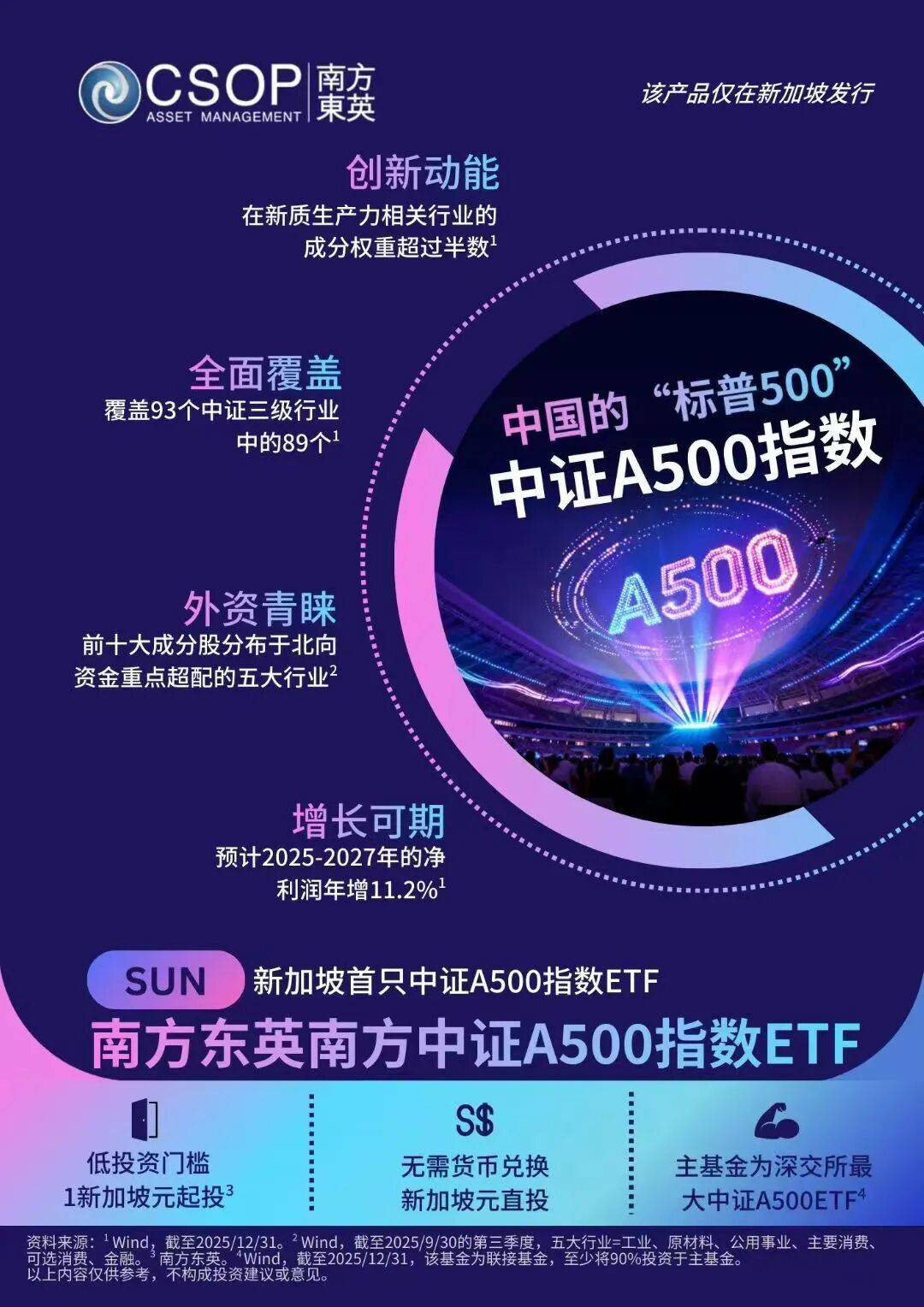
Core Insights - The first A500 ETF under the cross-border mutual access mechanism, the Southern Eastern Southern CSI A500 Index ETF (stock code: SUN), was officially listed on the Singapore Exchange on January 20, 2026, marking a significant step in financial cooperation between China and Singapore [1][4] Group 1: ETF Listing Details - SUN was listed at a price of 1 Singapore dollar per share, with a minimum trading requirement of 1 share and an annual management fee of 0.89% [3] - As a feeder ETF, SUN will invest at least 90% of its net assets in its main fund, the Southern CSI A500 ETF (code: 159352), which had an asset management scale of 47.1 billion RMB as of January 8, 2026, ranking second globally among similar products [3] - The CSI A500 Index reflects the performance of 500 large-cap A-share securities across various industries, with a balanced sector allocation focusing on industrial, information technology, materials, finance, and communication services [3] Group 2: Market Impact and Strategic Importance - The successful listing of SUN is a key outcome of the deepening ETF mutual access mechanism initiated by the Shenzhen Stock Exchange and the Singapore Exchange in 2022, facilitating global capital flow into technology innovation and core Chinese assets [4] - SUN provides a convenient tool for Singapore and global investors to access high-quality Chinese broad-based assets, with a low investment threshold of 1 Singapore dollar, thereby expanding the international investor base for Shenzhen ETFs [4] - The listing of SUN exemplifies China's commitment to high-level financial openness and serves as a new impetus for deepening capital market connectivity between China and Singapore [4] Group 3: Company Background - Southern Eastern entered the Singapore market in 2018 and has established itself as a leading ETF issuer, with total assets under management reaching approximately 2.5 billion USD as of December 31, 2025 [5] - The company has achieved significant milestones in innovative products, including the ICBC Southern Eastern FTSE China Government Bond Index ETF, which is one of the largest in its category globally [6] - The Southern Eastern Southern CSI A500 Index ETF further strengthens the product lineup of Southern Eastern in Singapore [6]

互联互通机制下首只A500ETF“出海”
Cai Jing Wang· 2026-01-21 06:05
Core Viewpoint - The listing of the Southern Dongying CSI A500 Index ETF on the Singapore Exchange marks a significant step in the internationalization of China's capital markets, providing overseas investors with an efficient tool to invest in leading companies across various industries in China [1][3]. Group 1: Product Overview - The CSI A500 Index is a new generation core broad-based index in China, selecting 500 securities with large market capitalization and good liquidity from various industries, representing core leading assets in A-shares while balancing traditional and emerging sectors [1][2]. - The Southern Dongying CSI A500 Index ETF is recognized for its excellent tracking accuracy and market activity, making it a preferred choice for investors looking to allocate funds to the CSI A500 Index [2]. Group 2: Market Impact - The launch of the Southern Dongying CSI A500 Index ETF enhances the accessibility of A-share core leading companies for Singaporean investors, allowing them to share in the long-term growth of China's core assets [3]. - The ETF listing is expected to broaden the overseas investment channels and customer base for Shenzhen's ETFs, thereby increasing the global influence of A-share ETFs and showcasing a new level of openness in China's capital markets [3]. Group 3: Future Developments - The company plans to continue enhancing cross-border collaboration and product offerings, aiming to develop more specialized products that meet the needs of both domestic and international investors [4]. - There is a commitment to expanding the cross-border ETF product line and improving the global reach of China's core assets, contributing to the efficient integration of domestic and foreign capital [4].
首只互联互通中证A500ETF今日在新加坡上市,基金“出海”方式日趋多元化
Mei Ri Jing Ji Xin Wen· 2026-01-21 04:41
Core Viewpoint - The launch of the Southern Eastern Southern CSI A500 Index ETF on the Singapore Exchange marks the first instance of a CSI A500 ETF "going abroad" under the mutual connectivity mechanism, expanding the global investment pathways for Chinese assets [1][3]. Group 1: ETF Launch Details - The Southern Eastern Southern CSI A500 Index ETF (stock code: SUN) was listed at a price of 1 Singapore dollar per share, with a minimum trading unit of 1 share and an annual management fee of 0.89% [3]. - The ETF is structured as a feeder fund, aiming to invest at least 90% of its net assets in the Southern CSI A500 ETF through QFII quotas or other legally permissible methods [3]. - The CSI A500 Index represents a new generation of core broad-based indices in China, comprising 500 securities with significant market capitalization and liquidity, balancing traditional industries with emerging sectors [3]. Group 2: Market Context and Trends - The trend of funds "going abroad" has been increasing, with the ETF "going out" being a key part of the internationalization of China's capital markets [2][5]. - Since the inclusion of ETFs in the mutual connectivity mechanism in July 2022, the total trading volume of northbound funds through "ETF Connect" is projected to reach 816.58 billion yuan in 2025, marking a 76% increase from 2024 [5]. - The expansion of the mutual connectivity mechanism is expected to attract more medium- to long-term capital into the market, enhancing the international influence of A-shares [5]. Group 3: Broader Implications for Fund Companies - The emergence of various "going abroad" mechanisms, including ETF mutual linking, signifies a new avenue for fund companies to expand their business boundaries and seek new profit growth points [6][7]. - These initiatives not only provide overseas investors with access to domestic assets but also enhance the professional capabilities of fund companies in product design, investment management, and risk management [7].
四大证券报头版头条内容精华摘要_2026年1月21日_财经新闻
Xin Lang Cai Jing· 2026-01-21 00:41
Group 1 - Shanghai has introduced 18 measures to enhance the competitiveness of non-ferrous metal commodities, aiming for improved market interconnectivity and internationalization by December 30, 2025 [1] - The average return of quantitative index enhancement strategies for 2025 is reported to be 45.08%, with nearly 90% of products achieving positive excess returns [4][21] - Over 500 A-share companies have disclosed their 2025 performance forecasts, with many in the technology sector expected to see robust growth due to AI advancements [9][26] Group 2 - The stock price of Kailong High-Tech (300912) was reported at 19.85 yuan per share, with a total market capitalization of 2.28 billion yuan, as it plans a major asset restructuring [5][22] - Yihualu (300212) announced the termination of several projects due to low input-output ratios, reallocating approximately 355 million yuan of remaining funds to enhance liquidity [6][23] - The securities sector has shown signs of recovery, with a slight increase of 0.42% after a previous decline of over 4% [7][24] Group 3 - The A-share market is experiencing a high-volume consolidation, with traditional sectors like non-ferrous metals and AI applications showing strong performance [8][25] - QDII fund total assets have reached 970 billion yuan, marking a 59% increase from the previous year, indicating a growing demand for global asset allocation [14][32] - The South China East Ying South China Index ETF has been listed on the Singapore Exchange, reflecting China's ongoing efforts to enhance its capital market's global influence [15][33]
互联互通机制下首只A500ETF“出海 ” 南方基金拓宽全球配置新路径
Sou Hu Cai Jing· 2026-01-21 00:37
Core Viewpoint - The listing of the Southern Dongying CSI A500 Index ETF on the Singapore Exchange marks a significant step in the internationalization of China's capital markets, providing overseas investors with an efficient tool to invest in leading companies across various sectors in China [1][5]. Group 1: Product Overview - The CSI A500 Index is a new generation core broad-based index in China, selecting 500 securities with large market capitalization and good liquidity from various industries, representing core assets in A-shares while balancing traditional and emerging sectors [4]. - The Southern Dongying CSI A500 Index ETF is recognized for its excellent tracking accuracy and market activity, becoming a preferred choice for investors looking to allocate funds to the CSI A500 Index [4]. Group 2: Market Impact - The listing of the Southern Dongying CSI A500 Index ETF in Singapore enhances the accessibility of A-share core leading companies for Singaporean investors, allowing them to efficiently and transparently invest in Chinese core assets [5]. - This development broadens the overseas investment channels and customer base for Shenzhen market ETFs, increasing the global influence of A-share ETFs and showcasing a new level of openness in China's capital markets [5]. Group 3: Company Strategy - Southern Fund has been pursuing international development since establishing its subsidiary in Hong Kong in 2008, focusing on global asset allocation and cross-border collaboration [6]. - The company has launched over 60 ETFs and leveraged inverse products in Hong Kong and Singapore, becoming a crucial bridge for overseas investors to access Chinese assets [6]. - Future plans include expanding the cross-border ETF product line and enhancing connectivity channels to improve the global reach of Chinese core assets [6].
“引进来、走出去”合力提升中国资本市场影响力
Zheng Quan Ri Bao· 2026-01-20 16:12
Group 1: Core Views - The listing of the Southern Eastern Ying Southern CSI A500 Index ETF on the Singapore Exchange marks a significant achievement in the collaboration between the Shenzhen Stock Exchange and the Singapore Exchange, reflecting China's commitment to high-level capital market opening [1] - The China Securities Regulatory Commission has set a clear direction for capital market opening in 2026, emphasizing the need for deeper and higher-level bilateral openness [1] - Experts suggest that the core of achieving deep and high-level bilateral openness lies in constructing a new pattern of "internal and external coordination" [1] Group 2: Internal Market Activation - Foreign capital is a crucial participant in China's capital market, bringing long-term stable funding and advanced investment concepts [2] - Upgrading the "bringing in" strategy is essential for high-level capital market openness, requiring enhanced internal stability through improved information disclosure and investor protection [2] - There is a need to cultivate a more vibrant group of quality listed companies, focusing on effective corporate governance and predictable dividend mechanisms [3] Group 3: Institutional Opening and Investment Environment - Accelerating the institutional opening process is vital for optimizing the investment ecosystem and enhancing the attractiveness of investing in China [3] - Current institutional mismatches pose challenges for foreign capital, necessitating improvements in the QFII/RQFII systems to enhance cross-border capital efficiency [4] - A dual regulatory system combining macro-prudential and micro-regulation is recommended to stabilize exchange rate expectations and enhance monitoring of cross-border capital flows [4] Group 4: Cross-Border Development - The capital market's high-level opening should also focus on enhancing the effectiveness of "going out" strategies, which are crucial for increasing China's international influence [5] - Recent years have seen a rapid increase in China's capital market "going out," with various products and institutions expanding internationally [6] - Challenges remain for domestic institutions in overseas markets, including regulatory differences and high operational costs [7] Group 5: Enhancing Global Influence - To improve China's capital market's voice in global capital allocation, strengthening financial infrastructure and expanding the application of the CIPS is essential [8] - Promoting the internationalization of the RMB and integrating high-credit bonds into mainstream international indices can attract more passive investment [8] - Supporting quality domestic enterprises in overseas listings and financing through diverse methods will facilitate global investment in Chinese assets [8]
新交所证券市场欢迎南方东英南方中证A500指数ETF在深交所—新交所ETF互联互通机制下上市
Sou Hu Wang· 2026-01-20 13:54
Core Viewpoint - The launch of the CSOP Asset Management Southbound CSI A500 Index ETF on the Singapore Exchange marks a significant step in enhancing cross-border investment opportunities between Singapore and China, providing investors with a convenient channel to access the Chinese A-share market [1][2]. Group 1: ETF Overview - The ETF tracks the CSI A500 Index, which is recognized as a new mainstream benchmark for the Chinese A-share market, selecting 500 of the largest and most liquid companies across 89 industries [1]. - The CSI A500 Index includes industry leaders with strong profitability and resilient long-term growth characteristics, with a high allocation to innovation-driven sectors such as technology hardware and advanced manufacturing, where the weight of "new productivity" related industries exceeds 50% [1]. Group 2: Market Impact and Growth - The ETF is the 11th ETF launched under the Singapore-China ETF cross-border connectivity mechanism and the 6th under the Shenzhen-Singapore framework, highlighting the commitment of the Singapore Exchange Group to expand cross-border connectivity [2]. - The total number of ETFs listed on the Singapore Exchange has increased to 51, with total assets under management exceeding SGD 18 billion, reflecting a 37% year-on-year growth in total assets and a 69% increase in average daily trading volume compared to the previous year [2].