
即时配送

Search documents
7.17亿美元拿下叮咚买菜,美团要把生鲜即时零售收官了?
Sou Hu Cai Jing· 2026-02-07 06:44
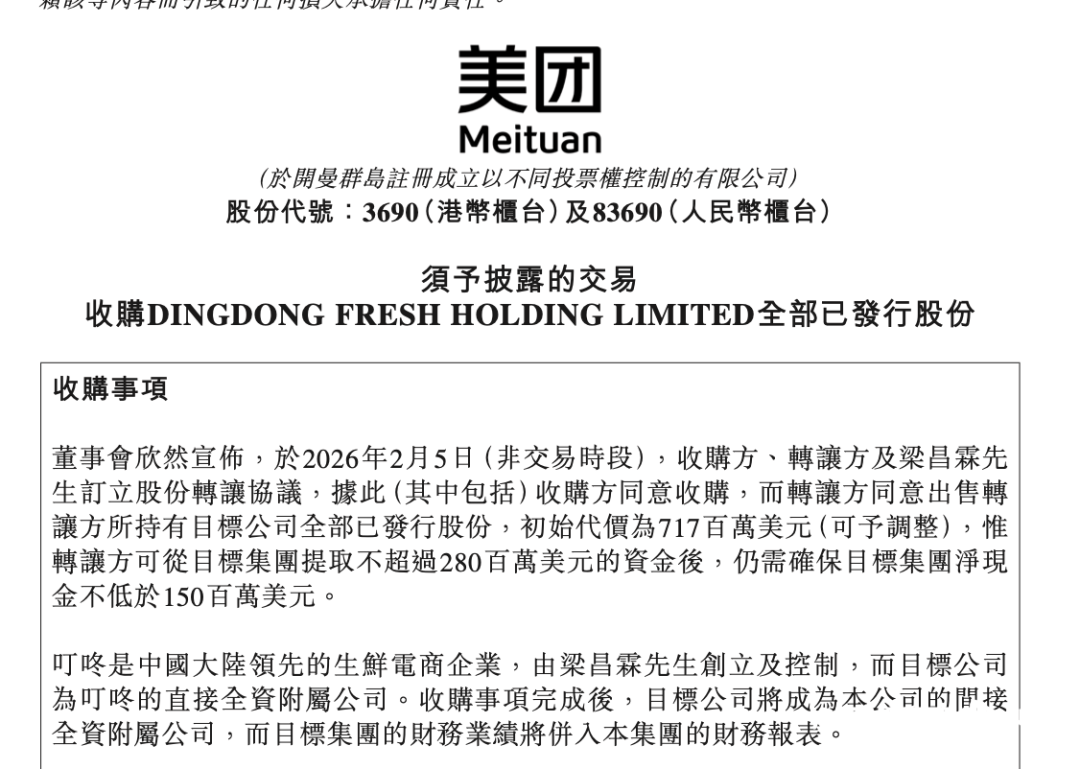
Core Viewpoint - Meituan announced the acquisition of Dingdong Maicai's China business for $717 million, marking a significant shift in the fresh food instant retail industry as it transitions from independent e-commerce platforms to consolidation led by major players [1][34]. Group 1: Acquisition Details - Meituan's acquisition price is $717 million, with the potential total price reaching $997 million, exceeding Dingdong Maicai's pre-acquisition market value of $694 million [1]. - Dingdong Maicai will maintain its operational model during the transition period, continuing to provide fresh food procurement and instant delivery services [1]. Group 2: Market Landscape - The instant retail market in China is projected to reach 781 billion yuan in 2024, growing by 20.15%, with expectations to exceed 1 trillion yuan by 2026 and reach 2 trillion yuan by 2030 [5]. - Fresh food, characterized by high frequency and essential demand, is a core battleground for major players in the instant retail sector [5]. Group 3: Competitive Dynamics - The competition in the fresh food instant retail industry is shifting from broad expansion to refined operations, with major players like Meituan, Alibaba, and JD.com intensifying their strategies [9][29]. - Meituan's acquisition of Dingdong Maicai is seen as a move to strengthen its market position against competitors like Alibaba and JD.com, who are also expanding their instant retail capabilities [15][31]. Group 4: Strategic Benefits of the Acquisition - The acquisition allows Meituan to enhance its regional layout, particularly in the Jiangsu, Zhejiang, and Shanghai areas, where Dingdong Maicai has a strong presence [13]. - Meituan can leverage Dingdong Maicai's supply chain and user base to improve delivery efficiency and product offerings, creating a synergistic effect [18][20]. - The combined resources are expected to lead to significant scale effects, with an anticipated increase in the number of fresh food warehouses to over 2,000 [20]. Group 5: Industry Implications - The acquisition signifies the end of the era where independent e-commerce platforms relied on heavy spending for growth, as the market consolidates around major players [25]. - Future competition will focus on supply chain efficiency, operational precision, and user experience rather than just scale [29]. - The consolidation may pressure smaller players, like Pupu Supermarket, to either deepen their regional focus or seek partnerships with larger companies to survive [33].



政策“组合拳”助推服务消费提质增效
Ren Min Wang· 2026-01-28 07:33
Group 1 - The core viewpoint is that China's service retail sector is expected to grow at a rate of 5.5% year-on-year by 2025, outpacing goods retail growth by 1.7 percentage points, with per capita service consumption reaching 46.1% of total spending [1] - The growth in service consumption is reflected in increased accessibility to tourism, with 2,485 tourist trains operating in 2025, marking a 33.6% increase year-on-year, enhancing the vitality of county-level tourism [1] - The shift in consumer demand is evident as residents' income levels rise, leading to a balanced focus on both goods and services, while new business models in low-altitude flights, cruise tourism, and performance arts are emerging to support this growth [1] Group 2 - The restaurant industry is projected to generate nearly 5.8 trillion yuan in revenue by 2025, with a year-on-year growth of 3.2%, driven by continuous optimization of supply in the sector [2] - The service consumption quality is improving due to supportive policies, with initiatives focusing on cultural entertainment, tourism, and dining, enhancing service supply levels [2] - The ongoing "service consumption quality improvement and benefit action" is fostering new growth points and innovative consumption scenarios, promising a more diverse and convenient consumer experience [3]
人民财评:政策“组合拳”助推服务消费提质增效
Sou Hu Cai Jing· 2026-01-28 00:59
Group 1 - The core viewpoint of the articles highlights the significant growth in service consumption in China, with a projected increase of 5.5% in service retail sales by 2025, outpacing the 1.7% growth in goods retail sales [1] - By 2025, the per capita expenditure on service consumption is expected to reach 46.1%, indicating a shift in consumer spending patterns towards services [1] - The tourism sector is set to see a substantial increase, with 2,485 tourist trains expected to operate in 2025, marking a 33.6% year-on-year growth, enhancing accessibility to remote scenic areas [1] Group 2 - The restaurant industry is projected to generate nearly 5.8 trillion yuan in revenue by 2025, with a year-on-year growth of 3.2%, driven by continuous optimization of supply in the sector [2] - The rise of digital services, such as online consultations and instant delivery, is contributing to the growth of communication and information services, benefiting various demographics including the elderly and rural residents [2] - The government's dual approach of "policy + activities" is aimed at enhancing service consumption quality, focusing on key areas like cultural entertainment, tourism, and dining [2] Group 3 - The ongoing service consumption enhancement actions are expected to foster new growth points and innovative consumption scenarios, with a focus on integrated experiences such as "tourism +", "food +", and "sports +" [3]
多家物流企业宣布:春节不打烊
Sou Hu Cai Jing· 2026-01-25 10:13
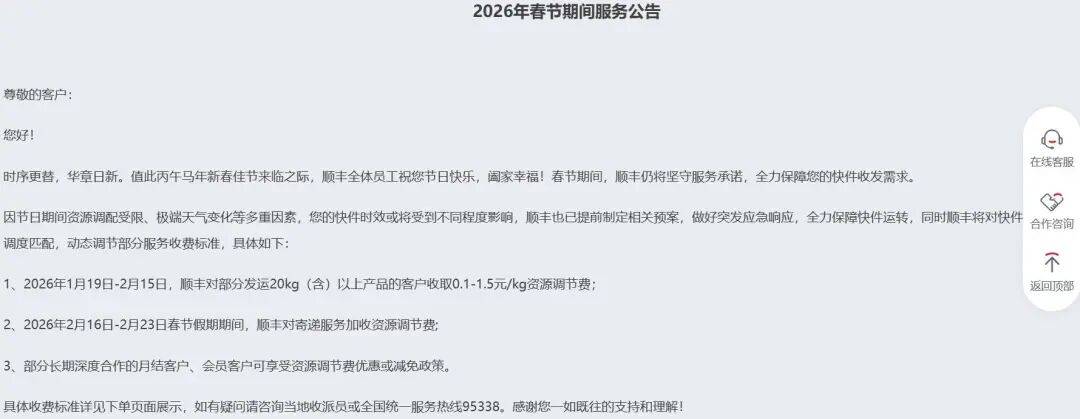
Core Viewpoint - The logistics industry is preparing for the upcoming Spring Festival, with several companies announcing service adjustments and resource fees to manage increased demand and operational challenges during the holiday period [1][2][5]. Group 1: Service Adjustments - SF Express, JD Logistics, and Deppon have announced that they will implement resource adjustment fees during the Spring Festival due to limited resource allocation and extreme weather conditions [2][5]. - SF Express will charge a resource adjustment fee of 0.1-1.5 yuan/kg for shipments over 20kg from January 19 to February 15, 2026, and additional fees during the holiday period [2]. - JD Logistics will add a resource adjustment fee of 0.1-1.2 yuan/kg for express heavy goods from January 19 to February 23, 2026, with varying fees for different customer agreements [5]. Group 2: Service Continuity - JD Logistics will continue to provide services such as warehousing, delivery, and express collection during the Spring Festival, with all "Asia No. 1" smart industrial parks operating around the clock [8]. - Deppon will also implement resource adjustment fees for certain customers and products during the peak period from January 19 to February 23, 2026 [8][9]. Group 3: Temporary Service Suspensions - Yimidida and Shunxin Express will suspend collection and delivery services during the Spring Festival, with Yimidida ceasing operations from February 10 to February 25, 2026, and Shunxin Express from February 12 to February 24, 2026 [10][12]. - Cross-border Express will maintain normal collection and delivery services but will not guarantee timeliness for shipments during the holiday period [14]. Group 4: Industry Trends - The Spring Festival is a peak period for logistics demand, leading to increased operational costs due to labor shortages and uneven cargo volumes [9]. - The practice of charging "resource adjustment fees" during the Spring Festival has become a common industry standard, primarily affecting commercial clients [9].


多家宣布:春节不打烊
Nan Fang Du Shi Bao· 2026-01-24 22:11
Core Viewpoint - The logistics industry is preparing for the upcoming Spring Festival, with major companies like SF Express, JD Logistics, and Deppon announcing service adjustments and resource adjustment fees to manage increased demand and operational challenges during the holiday period [1][2][5]. Group 1: Service Adjustments and Fees - SF Express will implement a resource adjustment fee of 0.1-1.5 yuan/kg for shipments over 20kg from January 19 to February 15, 2026, and will charge additional fees during the holiday period [2]. - JD Logistics will add a resource adjustment fee of 0.1-1.2 yuan/kg for express heavy cargo from January 19 to February 23, 2026, with varying fees for different customer agreements [5]. - Deppon will charge a resource adjustment fee of 0.2-0.5 yuan/kg for certain customers and products from January 19 to February 14, 2026, and additional fees during the holiday period [6]. Group 2: Operational Challenges - The Spring Festival is a peak time for logistics demand, leading to increased operational costs due to labor shortages and uneven cargo volumes [7]. - Many frontline workers, such as couriers and drivers, are migrant workers returning home for the holiday, resulting in a temporary labor shortage that necessitates hiring temporary workers [7]. - Companies are expected to incentivize frontline staff to ensure service continuity during the holiday period [15]. Group 3: Service Continuity and Limitations - Cross-Express will maintain normal pickup and delivery services during the Spring Festival, but will not guarantee delivery times for shipments in lower-tier cities [13]. - Some companies, like Yimi Dida and Shunxin Express, will suspend collection and delivery services during the holiday, with Yimi Dida ceasing operations from February 10 to February 25, 2026 [8][11]. - JD Logistics will continue to provide various services, including warehousing and instant delivery, with a focus on meeting customer needs during the holiday [6].

商务部等5部门:鼓励电商企业与快递企业合作,推广即时配送、无人配送
Zheng Quan Shi Bao Wang· 2025-10-29 06:11
Core Viewpoint - The article discusses the "Urban Commercial Quality Improvement Action Plan" issued by the Ministry of Commerce and other departments, emphasizing the integration of online and offline retail development [1] Group 1: Online and Offline Integration - The plan encourages collaboration between commercial circulation enterprises and e-commerce companies to achieve synergy through instant retail models [1] - It promotes various operational models such as platform ordering with store delivery and store ordering with instant delivery [1] Group 2: Delivery and Logistics Enhancements - E-commerce companies are encouraged to partner with courier services to consolidate fragmented demand orders [1] - The initiative aims to develop joint and centralized delivery systems, promoting instant and unmanned delivery to enhance precise response capabilities [1] Group 3: Infrastructure Improvements - The plan suggests utilizing urban spatial layouts for facilities like front warehouses, smart parcel boxes, and comprehensive courier service stations [1] - These improvements are intended to increase the efficiency and quality of last-mile delivery services [1]
豪掷2亿股与员工共同成长,顺丰王卫的逻辑是什么?
Sou Hu Cai Jing· 2025-08-29 09:48
Core Insights - SF Holding's Chairman Wang Wei emphasizes the importance of employees and talent in the company's growth strategy, showcasing a commitment to shared success with staff [3][6] - The company reported impressive financial results for the first half of 2025, with revenue reaching 146.858 billion yuan, a year-on-year increase of 9.26%, and net profit of 5.738 billion yuan, up 19.37% [3] - SF Holding introduced a "Shared Growth Stock Ownership Plan" that allows employees to receive up to 200 million A-shares without any investment, highlighting the company's focus on long-term talent engagement [5][6] Financial Performance - In the logistics sector, SF Holding achieved a significant growth rate, with its express logistics business handling 7.85 billion packages, a year-on-year increase of 25.7%, surpassing the industry average growth of 19.3% [3] - The company's revenue growth is attributed to its strategic focus on "expansion" and "consolidation," with instant delivery revenue increasing by 38.86% year-on-year [5] Employee Engagement and Incentives - The "Shared Growth Stock Ownership Plan" is characterized by a long vesting period of 9 years, no employee investment required, and broad participation among key personnel, covering 7,177 individuals [5] - Wang Wei's personal initiative to distribute gratitude bonuses to employees with over 10 years of service reflects a culture of appreciation and long-term commitment to staff [6] Corporate Culture and Management Philosophy - SF Holding's corporate culture emphasizes respect for employees and equality, aiming to create a supportive environment for staff [6][12] - The company has upgraded its cultural values to focus on customer-first, integrity, and love, indicating a holistic approach to both internal and external relations [12] Growth Strategy - SF Holding's growth strategy involves not only external market expansion but also internal talent management, recognizing employees as the most valuable asset [9][13] - The company aims to create a positive feedback loop where employee satisfaction leads to customer satisfaction, ultimately driving business success [12][13]
以产业新特征为锚 重塑上市公司产业投资价值
Shang Hai Zheng Quan Bao· 2025-07-27 18:48
Core Insights - The article emphasizes the importance of industry investment value as a comprehensive measure of a company's collaborative ability, technological potential, and long-term development prospects within the industrial ecosystem [1][3] - It highlights that traditional industry companies must actively redefine their industrial roles and strategic positioning to enhance their investment value in the context of rapid digital economic growth and technological revolution [2][4] Group 1: Understanding Industry Investment Value - Industry investment value is crucial for assessing a company's long-term sustainability and its ability to integrate into the industrial ecosystem, contrasting with financial investment which focuses on short-term returns [3][4] - The evaluation of industry investment value is evolving due to profound changes in the industrial landscape driven by technological innovation and the digital economy [6][7] Group 2: Opportunities for Traditional Industry Companies - Traditional industry companies must seize four key opportunities arising from the deep evolution of the industrial landscape: leveraging digital economy opportunities, understanding new demand characteristics, utilizing network hub advantages, and adapting to the characteristics of the industrial era [1][7] - Many excellent traditional industry companies have not received reasonable valuations due to static categorization and labeling by investors, which often overlooks their innovative capabilities [4][5] Group 3: Digital Economy and New Demand - The digital economy is reshaping industrial organization and competition, creating a three-tiered ecosystem that includes core technology companies, transformation platforms, and application scenario enterprises [9][10] - Companies must actively engage with end-user demands and create new consumption experiences to enhance their investment value, moving beyond traditional supply-demand logic [12][13] Group 4: Flow and Network Hub Advantages - In the information age, flow (people, logistics, capital, information, energy) is a core element of value creation, and companies that can leverage their network hub positions will gain competitive advantages [17][18] - Traditional companies must transition to digital value hubs by effectively utilizing their existing infrastructure and flow resources to enhance their investment value [18][19] Group 5: Industry Transformation and Innovation - The boundaries between traditional and emerging industries are increasingly blurred, and companies must redefine their identities and capabilities to adapt to this transformation [20][21] - Emerging industry companies must maintain their innovation momentum to avoid becoming stagnant and losing their competitive edge [23][24]
申万宏源交运一周天地汇:25年下半年交运新方向:亚洲区域集运、即时配送、海外仓
Shenwan Hongyuan Securities· 2025-06-08 03:45
Investment Rating - The report maintains a positive outlook on the logistics and transportation industry, particularly focusing on cross-border logistics and express delivery sectors [2][3]. Core Views - The report highlights the significant impact of new consumption patterns on logistics demand, emphasizing companies like SF Express and JD Logistics [3]. - It notes the potential for AI to enhance logistics efficiency, particularly for companies like SF Holdings [3]. - The report identifies opportunities in overseas warehouses and recommends companies with operational capabilities in this area, such as Zongteng Network and Huamao Logistics [3]. - The shipping sector is viewed as entering a left-side layout phase, with a focus on companies like Yangtze River Shipping and China Power [3]. - The report indicates that the VLCC freight rates have stabilized at the bottom and are expected to improve gradually [3]. - The report also discusses the performance of various shipping indices, noting a significant increase in the Baltic Dry Index and Shanghai Container Freight Index [4][26]. Summary by Sections Transportation Industry Performance - The transportation index decreased by 0.54%, underperforming the CSI 300 index by 1.42 percentage points [4]. - The cross-border logistics sector showed the highest increase of 0.28%, while the public transport sector experienced the largest decline of -2.78% [4]. Shipping and Logistics - The report emphasizes the strong performance of the Southeast Asian shipping sector, particularly companies like DeXiang Shipping and HaiFeng International [3]. - It notes that the SCFI index rose by 8.1%, indicating a positive trend in container shipping rates [3][24]. - The report highlights the importance of monitoring capacity adjustments and port congestion, which could impact freight rates [3][24]. Express Delivery - The express delivery sector is expected to maintain high growth rates, with a focus on companies like SF Holdings and JD Logistics [3]. - The report suggests that the upcoming policies will optimize logistics costs, benefiting leading companies in the sector [3]. Aviation and Airports - The report indicates that the aviation market is transitioning into a stable phase, with expectations of increased passenger volume and potential recovery in ticket prices [37]. - It recommends several airlines, including China Eastern Airlines and Spring Airlines, as key players to watch [37]. Rail and Road Transport - The report notes the resilience in railway freight volumes and highway truck traffic, suggesting steady growth in these sectors [3]. - It highlights investment opportunities in high-dividend stocks and potential value management catalysts in the highway sector [3].