哔哩哔哩APP

Search documents
QuestMobile2025年新媒体生态盘点:五大平台月活用户达11.49亿,多元内容与算法技术差异化竞争,年轻用户更爱跨平台
3 6 Ke· 2025-12-16 05:43
Core Insights - The active user base of typical new media platforms is projected to reach 1.149 billion by October 2025, with an average monthly usage time of 3,367.5 minutes, reflecting year-on-year growth of 7.3% and 5.4% respectively, indicating increasing user engagement driven by diverse content and algorithmic recommendations [1] User Demographics and Behavior - The competitive landscape among platforms has stabilized, with distinct user demographics: platforms like Weibo, Xiaohongshu, and Bilibili have a significant proportion of users under 30 years old, at 58.6%, 54.2%, and 66.5% respectively, while Douyin and Kuaishou have 22.2% and 22.6% of users aged 51 and above [1] - Users are increasingly adopting a multi-platform usage habit, with 39.8% of users engaging with three or more new media platforms, and 54.2% of these users are under 30 years old [1] Content and Platform Dynamics - New media platforms are capturing user attention through enhanced content quality and technology, leading to deeper user engagement [7] - The growth in user engagement time is increasingly reliant on content quality and recommendation technology rather than just user base expansion [12] - Platforms are shifting from merely attracting users to seeking them across various scenarios, enhancing flow through capability output and ecosystem integration [14] User Segmentation and Growth Drivers - The competition is becoming more segmented, with growth driven by diverse user groups, including younger and older demographics, as well as lower-tier markets [17] - Multi-faceted users, primarily young and high-spending, are using different platforms to meet various needs such as socializing, entertainment, and learning, fostering a complementary ecosystem among platforms [20] Content Ecosystem Characteristics - Platforms are transitioning from broad traffic competition to enhancing their unique ecological characteristics, with strategies tailored to their specific user bases [23] - AI-related content has seen a 9.9 percentage point increase in user penetration year-on-year, with younger male users showing a higher interest [26] - The rise of knowledge-based influencers reflects a shift in user demand from entertainment to practical value [32][38] Commercialization Strategies - New media platforms are entering a phase of strategic deepening in commercialization, with hard advertising revenues leading the way [40] - The unique characteristics of platform ecosystems are shaping differentiated advertising models, with soft advertising becoming a significant monetization method [42] - Platforms are enhancing local business strategies, extending their reach from online to offline commerce, with various initiatives to support local merchants [54]

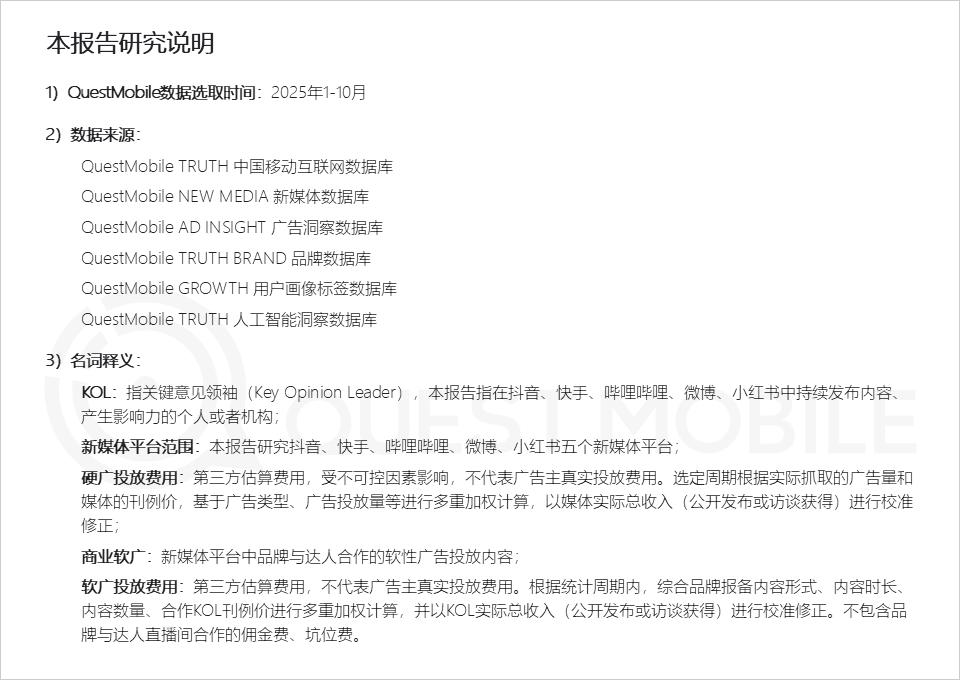
QuestMobile2025年新媒体生态盘点:五大平台月活用户达11.49亿,多元内容与算法技术差异化竞争,年轻用户更爱跨平台
QuestMobile· 2025-12-16 02:01
Core Insights - The article discusses the evolving landscape of new media platforms and their user engagement trends, highlighting the growth in active users and usage duration by 2025 [4][5][6]. User Engagement and Demographics - By October 2025, the active user base of typical new media platforms is projected to reach 1.149 billion, with an average monthly usage time of 3367.5 minutes, reflecting year-on-year growth of 7.3% and 5.4% respectively [5]. - Platforms like Weibo, Xiaohongshu, and Bilibili show a significant concentration of users under 30 years old, with respective proportions of 58.6%, 54.2%, and 66.5%, while Douyin and Kuaishou have 22.2% and 22.6% of users aged 51 and above [5][6]. Multi-Platform Usage - A notable trend is the combination usage of multiple platforms, with 39.8% of users engaging with three or more new media platforms, particularly among users under 30 (54.2%) and those from first and new first-tier cities (31.6%) [6]. Content Quality and User Attention - The article emphasizes that the growth in user engagement is increasingly driven by content quality and algorithmic recommendations rather than just user base expansion [18]. - New media platforms are focusing on enhancing user attention through improved content quality and technology, leading to deeper user participation [13][18]. Competitive Landscape - The competitive landscape among platforms is stabilizing, with distinct user demographics and content strategies emerging. Platforms are shifting from broad traffic competition to focusing on unique ecological characteristics and user engagement [30][32]. - The rise of AI content and tools is reshaping user engagement, with a 9.9 percentage point increase in AI-related content penetration among users by October 2025 [34][36]. Monetization Strategies - New media platforms are entering a phase of strategic deepening in monetization, with hard advertising revenues leading the way. The unique characteristics of each platform are shaping differentiated advertising models [48][50]. - Soft advertising is becoming a significant revenue stream, with brands selecting platforms based on their marketing goals, reflecting the alignment of KOL income with platform content and user expectations [54]. Local Business Integration - Platforms are increasingly integrating local businesses into their ecosystems, transitioning from rapid growth to a more stable phase in local merchant numbers [63].



Flutter高级进阶实战_仿哔哩哔哩APP-慕课网
Sou Hu Cai Jing· 2025-07-02 02:20
Group 1 - The course addresses the complexity of modern mobile applications, highlighting the challenges of state management as applications scale, using Bilibili's app as a case study [2] - A "State Complexity Assessment Model" is introduced to help developers identify potential issues based on state sources, component dependencies, and lifecycle requirements [2] - The course emphasizes the importance of architectural decision-making over mere functionality implementation, guiding learners through a complete architecture design process [3] Group 2 - Various state management solutions within the Flutter ecosystem are compared, providing a comprehensive selection guide for developers [4] - A "State Management Decision Tree" is created to assist developers in choosing the most suitable solution based on state scope, update frequency, and synchronization requirements [4] Group 3 - The course teaches how to decompose complex UI pages into manageable component trees, enhancing development efficiency [5] - The concept of "Component Contracts" is introduced, allowing team members to work in parallel on different components, significantly improving development speed [5] Group 4 - The course covers state persistence and performance optimization strategies, including local storage methods and advanced rendering optimization techniques [6] - Performance improvements are demonstrated, with a specific example of increasing the frame rate of a homepage from 45fps to a stable 60fps [6] Group 5 - Asynchronous state handling is explored, with a focus on creating robust asynchronous processing flows using models like "Asynchronous State Machine" [7] - The course illustrates how to reduce boilerplate code and improve robustness in handling network exceptions [7] Group 6 - Test-Driven Development (TDD) principles are integrated into Flutter architecture teaching, emphasizing the importance of testing in validating architecture [8] - The course covers a full range of testing strategies, focusing on the testability of state management [8] Group 7 - The course discusses architectural evolution and refactoring strategies, teaching developers how to upgrade architecture while maintaining functionality [9] - "Architecture Metrics" are introduced to quantitatively assess architecture health, aiding in objective decision-making [9] Group 8 - The course addresses cross-platform consistency and platform adaptation within Flutter, using Bilibili's app as a practical example [10] - Techniques for managing platform-specific code while maintaining a clean architecture are shared [10] Group 9 - The ultimate goal of the course is to cultivate architectural thinking in learners, transitioning from imitation to creation [11] - A "Architecture Pattern Handbook" is provided as a long-term reference for common patterns and anti-patterns in commercial Flutter applications [11] Group 10 - The course emphasizes the importance of mastering core architectural thinking over memorizing specific APIs in the rapidly evolving Flutter ecosystem [13]
2025Q1中国移动互联网流量季度报告
艾瑞咨询· 2025-06-09 09:22
User Changes - In Q1 2025, the average number of monthly independent devices in China's mobile internet increased by 2.6% year-on-year, indicating a stabilization in market demand and a shift towards intensified competition in a saturated market [1][5] - User stickiness continues to decline, with the effective daily usage time per device at 268.0 minutes, down 3.9% year-on-year, and usage frequency at 63.4 times, down 5.1% year-on-year, reflecting a fierce competition for existing users' attention [1][11] Industry Changes - E-commerce sector saw peak traffic of 1.216 billion in Q1, driven by upgraded gifting features in social consumption, with platforms like Taobao and JD introducing new services [2] - The food delivery market is experiencing intense competition with JD's entry and Meituan's expansion, leading to a multi-player competitive landscape [2][26] - The social network sector is expanding, with Xiaohongshu benefiting from internationalization and a surge of users from TikTok [2][67] - The AI sector is leading growth with a 46.5% year-on-year increase in monthly active devices, driven by practical applications in various verticals [2][44] APP Changes - In March 2025, the top three apps with over 100 million monthly active users (MAU) in terms of compound growth were Personal Income Tax, WiFi Master Key, and Xianyu [3][84] - The top three apps favored by Generation Z users were Boss Zhipin, Honor of Kings, and Peace Elite, indicating a trend in user preferences [3][86] Mobile Internet Traffic Trends - Q1 2025 saw a slight increase in mobile internet traffic, with the industry entering a phase of deepened competition in a saturated market [4][5] User Engagement Metrics - The effective daily usage time and frequency of mobile internet users have both declined, indicating a fragmentation of user attention and a heated competition for existing users [11][18] - Entertainment content continues to attract user attention, with short videos accounting for 29.1% of usage time, while communication and information aggregation saw a decline [14] Smart Screen Trends - By Q1 2025, the scale of smart screen terminals reached 339 million, with daily average operating time increasing year-on-year [21] E-commerce Overview - The e-commerce sector's user scale and stickiness are steadily improving, with peak traffic in Q1 approaching last November's levels [32] - JD's app led the industry with a 3.4% year-on-year growth in traffic, while other platforms like Taobao and Pinduoduo experienced slight user scale contractions [35] AI Industry Overview - The AI industry is experiencing explosive growth, with a 46.5% year-on-year increase in monthly active devices, focusing on practical applications in various fields [44][49] Social Network Overview - The social network sector's user scale continues to expand, with Q1 traffic peaking at over 900 million [65] - Weibo and Xiaohongshu lead the industry, with Xiaohongshu experiencing significant growth due to international user influx [67] Video Service Overview - The video service sector saw stable growth in Q1, with significant contributions from aggregated video and game live streaming [71][75]