
嘉实中证港股通创新药ETF

Search documents
创新药再度“起舞”,“出海”或成关键词
Zheng Quan Shi Bao· 2026-01-08 06:07
Core Viewpoint - The A-share market has shown strength in early 2026, with significant gains in the semiconductor and non-ferrous sectors, while the previously quiet innovative drug sector has also regained attention, particularly in the Hong Kong market. The "brain-computer interface" trend is emerging, suggesting potential investment opportunities in the medical device sector [1][5]. Innovative Drug Sector Recovery - The innovative drug sector has seen a resurgence, with several ETFs, including the Jiashi China Securities Hong Kong Innovative Drug ETF and the Fuguo Hang Seng Hong Kong Innovative Drug and Healthcare ETF, rising over 7% within three days. Other related products have also shown gains of over 5% [3]. - After a period of decline in Q4 2025, many fund managers believe that current valuations in the innovative drug sector are attractive, indicating that 2026 may be a good time to invest in pharmaceuticals. The sector is expected to remain a key investment theme in 2026, with positive catalysts expected to drive stock prices [3][4]. Brain-Computer Interface Potential - The "brain-computer interface" concept has gained traction, with Elon Musk's Neuralink expected to begin mass production in 2026, signaling a potential commercialization milestone. This technology could significantly impact the medical device sector, offering solutions for patients with disabilities [6][7]. - The medical device sector is seen as a direct beneficiary of brain-computer interface advancements, with opportunities for innovation and market growth driven by supportive policies and domestic companies increasing their market share [6][7]. Focus on Overseas Expansion - Fund managers are emphasizing the importance of "overseas expansion" as a key factor in selecting companies. The innovative drug sector is expected to see significant differentiation, with a focus on companies that can effectively execute overseas collaborations and clinical trials [8][9]. - The two main pathways for Chinese pharmaceutical companies to expand internationally include the popular BD licensing model and the less common approach of establishing overseas channels. Companies with strong execution capabilities in these areas are likely to succeed in international markets [9].
久违大涨!创新药再度“起舞”,“出海”或成关键词
券商中国· 2026-01-07 23:25
Core Viewpoint - The A-share market has shown strength in early 2026, with significant gains in the semiconductor and non-ferrous sectors, while the previously quiet innovative drug sector has also become prominent, particularly in the Hong Kong market. Additionally, the medical device sector may present investment opportunities due to the rising trend of brain-computer interfaces [1][3]. Innovative Drug Sector Recovery - Several ETFs related to innovative drugs have seen substantial gains, with five funds increasing over 7% in just three days. The innovative drug sector in both A-shares and Hong Kong has experienced a rally, although there was a significant pullback in the fourth quarter of 2025, with many funds dropping over 20%. Current valuations in the innovative drug sector are considered attractive, making 2026 a potentially good time for investment [3][4]. - The innovative drug sector is expected to remain a key investment theme in 2026, with positive catalysts such as industry conferences and advancements in commercialization and overseas expansion expected to drive stock prices [3][4]. Brain-Computer Interface Potential - The brain-computer interface concept has gained traction, particularly with Neuralink's anticipated mass production in 2026, signaling a potential commercialization milestone. This technology could significantly impact the medical device sector, offering solutions for patients with disabilities [5][6]. - The medical device sector is expected to benefit from innovation-driven growth, with domestic leaders focusing on high-end equipment and market share expansion, supported by favorable policies [6]. Focus on Overseas Expansion - Fund managers emphasize the importance of "overseas expansion" as a key factor in stock selection. The innovative drug sector is expected to see value realization through clinical data and milestone payments, particularly in areas like ADC and dual antibodies [7][8]. - Companies with strong overseas clinical capabilities and business development potential are highlighted as having significant growth opportunities, with some medical device companies already generating over 50% of their revenue from international markets [8].


久违大涨!创新药再度“起舞”,“出海”或成关键词
Xin Lang Cai Jing· 2026-01-07 23:24
Core Viewpoint - The A-share market has shown strength in early 2026, with significant gains in the semiconductor and non-ferrous sectors, while the previously quiet innovative drug sector has also regained attention, particularly in the Hong Kong market [1][8]. Group 1: Innovative Drug Sector Recovery - Several ETFs related to innovative drugs have seen substantial gains, with five funds increasing over 7% in just three days, and others tracking A-shares also showing over 5% growth [2][9]. - After a downturn in the fourth quarter of 2025, many fund managers believe that the current valuation of the innovative drug sector is attractive, suggesting that 2026 may be a good time to invest in pharmaceuticals [2][10]. - The innovative drug sector is expected to remain a key investment theme in 2026, with positive catalysts emerging from industry events and improved overseas liquidity conditions [10][11]. Group 2: Market Trends and Individual Stock Selection - The consensus among fund managers indicates that a broad market rally is unlikely to repeat, with a focus on high-quality assets that can sustain independent performance [3][10]. - The "outbound" capability of companies is becoming a critical factor in stock selection, with a focus on those that can effectively commercialize their products internationally [6][12]. - Fund managers emphasize the importance of companies with strong execution capabilities in the innovative drug sector, particularly those that can leverage partnerships for international clinical trials and market entry [12][13]. Group 3: Brain-Computer Interface and Medical Devices - The brain-computer interface (BCI) concept has gained traction, with expectations for commercialization in 2026, driven by advancements from companies like Neuralink [4][11]. - The medical device sector is seen as a primary application area for BCI technology, with potential benefits for patients with disabilities [4][11]. - The industry is expected to experience growth due to innovation and government support, with domestic leaders in high-end equipment continuing to gain market share [4][11].
【ETF观察】9月17日跨境ETF净流入16.79亿元
Sou Hu Cai Jing· 2025-09-17 23:58
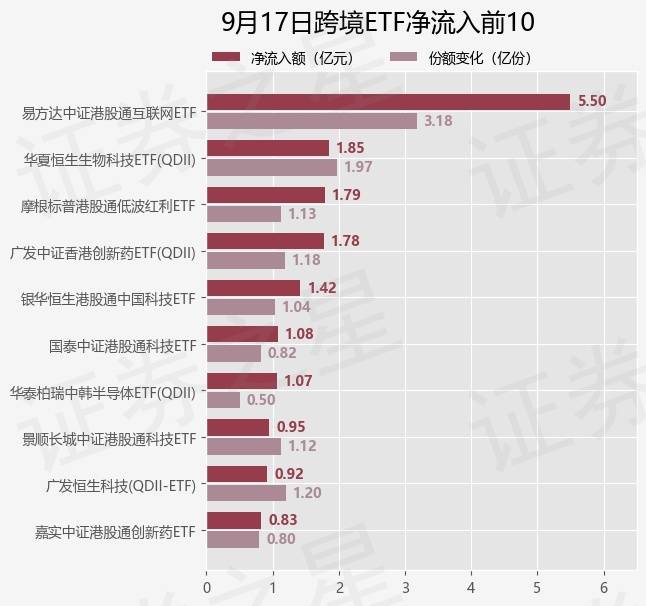
Core Insights - On September 17, the total net inflow of cross-border ETFs reached 1.679 billion yuan, with a cumulative net inflow of 18.097 billion yuan over the past five trading days [1][2] - A total of 40 cross-border ETFs experienced net inflows on the same day, with the E Fund CSI Hong Kong Stock Connect Internet ETF (513040) leading the inflow, increasing by 319 million shares and net inflow of 550 million yuan [1][3] - Conversely, 24 cross-border ETFs saw net outflows, with the Huatai-PineBridge Southbound Hang Seng Technology (QDII-ETF) (513130) having the largest outflow, decreasing by 300 million shares and a net outflow of 249 million yuan [1][4] Inflow Details - The E Fund CSI Hong Kong Stock Connect Internet ETF (513040) had a price increase of 3.35%, with a total of 2.092 billion yuan in the latest scale [3][5] - Other notable inflows included: - China Asset Management Hang Seng Biotechnology ETF (159892) with a net inflow of 185 million yuan [3] - Morgan Stanley S&P Hong Kong Low Volatility Dividend ETF (513630) with a net inflow of 179 million yuan [3] Outflow Details - The top outflow ETFs included: - Huatai-PineBridge Southbound Hang Seng Technology (QDII-ETF) (513130) with a net outflow of 249 million yuan [4][5] - Invesco CSI Hong Kong Stock Connect Central State-Owned Enterprises Dividend ETF (520990) with a net outflow of 65 million yuan [5] - E Fund Hang Seng State-Owned Enterprises ETF (510900) with a net outflow of 53 million yuan [5]
【ETF观察】9月10日跨境ETF净流入16.54亿元
Sou Hu Cai Jing· 2025-09-10 23:48
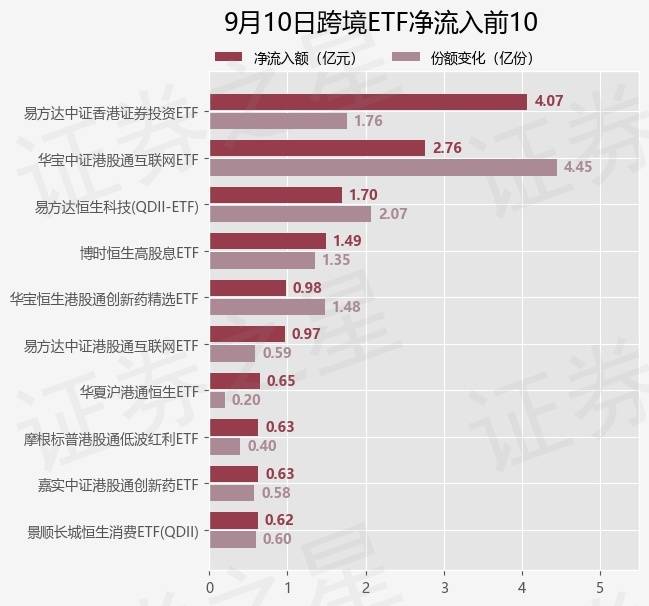
Summary of Key Points Core Viewpoint - On September 10, the total net inflow of cross-border ETFs reached 1.654 billion yuan, with a cumulative net inflow of 12.134 billion yuan over the past five trading days, indicating strong investor interest in these funds [1]. Fund Inflows - A total of 34 cross-border ETFs experienced net inflows on September 10, with the E Fund CSI Hong Kong Securities Investment ETF (513090) leading the inflow, increasing by 17.5 million shares and a net inflow of 407 million yuan [1][3]. - Other notable ETFs with significant inflows include: - Hua Bao CSI Hong Kong Stock Connect Internet ETF (513770) with a net inflow of 276 million yuan [3]. - E Fund Hang Seng Technology (QDII-ETF) (513010) with a net inflow of 170 million yuan [3]. Fund Outflows - On the same day, 17 cross-border ETFs recorded net outflows, with the Huatai-PB Korea Semiconductor ETF (QDII) (513310) showing the largest outflow, decreasing by 22 million shares and a net outflow of 42.67 million yuan [1][4]. - Other ETFs with notable outflows include: - Hua An Hang Seng Stock Connect Technology Theme ETF with a net outflow of 26 million yuan [5]. - Penghua CSI Hong Kong Stock Connect Medical and Health Comprehensive Trading ETF with a net outflow of 11 million yuan [5]. Performance Overview - The performance of the top inflow ETF, E Fund CSI Hong Kong Securities Investment ETF, showed a 1.00% increase, while the top outflow ETF, Huatai-PB Korea Semiconductor ETF, increased by 2.54% despite the outflow [3][5]. - The overall trend indicates a mixed performance among the ETFs, with some gaining traction while others faced withdrawals [1][4].
8/21财经夜宵:得知基金净值排名及选基策略,赶紧告知大家
Sou Hu Cai Jing· 2025-08-21 15:49
Group 1 - The article provides a ranking of the top 10 open-end funds based on net asset value growth as of August 21, 2025, highlighting the performance of various funds [2][4][7] - The top-performing fund is "汇添富双鑫添利债券D" with a net value of 1.2019, showing a significant increase from 1.0000 [2] - The bottom-performing fund is "前海开源周期精选混合C," which has a net value of 1.0343, down from 1.0816 [4][7] Group 2 - The article notes that a total of 28,402 funds have updated their net values, indicating a broad market activity [3] - The sectors leading the market include multi-financial and telecommunications, both showing gains of over 2% [7] - The article mentions that the "万家中证港股通创新药ETF" has experienced rapid net value growth, indicating strong performance in the healthcare sector [7] Group 3 - The article discusses the concentration of holdings in the top funds, with "万家中证港股通创新药ETF" having a concentration of 67.67% in its top ten holdings, primarily in the pharmaceutical sector [8] - The top holdings in this fund include "信达生物" and "药明生物," which have shown significant daily increases [8] - Conversely, the "前海开源周期精选混合C" fund has a lower concentration of 58.34% in its top holdings, with notable declines in some of its key stocks [8]

18只ETF公告上市,最高仓位54.18%
Zheng Quan Shi Bao Wang· 2025-08-20 03:48
Group 1 - The core point of the news is the launch of the Huaan Hang Seng Hong Kong Stock Connect Technology Theme ETF, which will be listed on August 25, 2025, with a total of 1.453 billion shares [1] - As of August 18, 2025, the fund's asset allocation shows that bank deposits and settlement reserves account for 84.72% of total assets, while stock investments account for 15.26% [1] - The fund is currently in the accumulation phase, with a low average position of 24.50% among 18 newly announced stock ETFs in August [1][2] Group 2 - The Huaan Hang Seng Hong Kong Stock Connect Technology Theme ETF has the largest trading share among newly listed ETFs at 1.453 billion shares, followed by the Jiashi Zhongzheng Hong Kong Stock Connect Innovative Drug ETF with 890 million shares [2] - Institutional investors hold an average of 19.31% of the shares in the newly announced ETFs, with the highest proportions in the Huaxia Zhongzheng Hong Kong Stock Connect Medical Theme ETF at 95.41% and the Jiashi Hang Seng Hong Kong Stock Connect Technology Theme ETF at 83.60% [2] - The fund's stock position is expected to increase before the official listing date, as ETFs typically need to meet position requirements outlined in their fund contracts [1]
14只ETF公告上市,最高仓位54.18%
Zheng Quan Shi Bao Wang· 2025-08-14 05:08
Core Viewpoint - Two stock ETFs have announced their listing, with the highest stock allocation being 54.18% for the Jiashi Hang Seng Hong Kong Stock Connect Technology Theme ETF [1] Group 1: ETF Listings and Allocations - As of August, a total of 14 stock ETFs have announced their listings, with an average allocation of 28.06% [1] - The Jiashi Hang Seng Hong Kong Stock Connect Technology Theme ETF has the highest allocation at 54.18%, followed by the Sci-Tech 200 ETF at 52.40%, the Penghua National Robot Industry ETF at 45.43%, and the Huatai-PineBridge National Internet ETF at 37.46% [1] - The lowest allocations are seen in the Industrial Bank Sci-Tech Value ETF and the Sci-Tech 50 ETF, both at 0.00%, and the Jiashi CSI Hong Kong Stock Connect Innovative Drug ETF at 16.11% [1] Group 2: Fundraising and Share Statistics - The average fundraising for the ETFs listed in August is 4.02 million shares, with the Jiashi CSI Hong Kong Stock Connect Innovative Drug ETF leading at 8.90 million shares, followed by the Sci-Tech 50 ETF at 7.54 million shares and the Sci-Tech 200 ETF at 6.17 million shares [1][2] - The Jiashi Hang Seng Consumption ETF has a fundraising size of 2.21 million shares with an allocation of 16.34% [2] - The Jiashi Hang Seng Hong Kong Stock Connect Technology Theme ETF has a fundraising size of 2.48 million shares with an allocation of 54.18% [2]
【ETF观察】8月13日跨境ETF净流入9.06亿元
Sou Hu Cai Jing· 2025-08-14 00:09
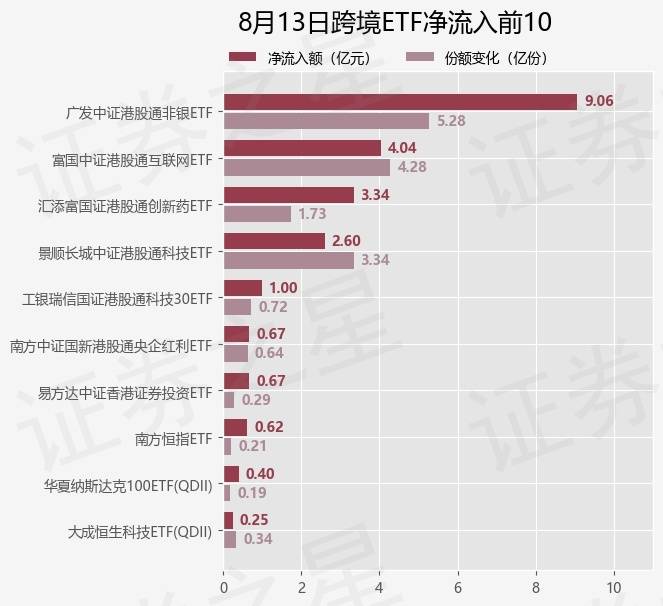
Summary of Key Points Core Viewpoint - On August 13, the total net inflow of cross-border ETFs reached 906 million yuan, with a cumulative net inflow of 20.62 billion yuan over the past five trading days, indicating strong investor interest in these funds [1]. Fund Inflows - A total of 40 cross-border ETFs experienced net inflows on August 13, with the top performer being the GF CSI Hong Kong Stock Connect Non-Bank ETF (513750), which saw an increase of 528 million shares and a net inflow of 906 million yuan [1][3]. - The GF CSI Hong Kong Stock Connect Non-Bank ETF had a latest scale of 14.879 billion yuan, reflecting a 1.78% increase in value [3]. Fund Outflows - Conversely, 50 cross-border ETFs recorded net outflows on the same day, with the leading outflow being the E Fund China Concept Internet 50 ETF (513050), which saw a reduction of 309 million shares and a net outflow of 454 million yuan [4][5]. - The E Fund China Concept Internet 50 ETF had a latest scale of 33.942 billion yuan, with a 4.06% increase in value despite the outflow [5]. Performance Overview - The top 10 ETFs by net inflow included several funds focused on technology and healthcare sectors, indicating a trend towards these industries among investors [3][5]. - The top 10 ETFs by net outflow highlighted a mix of technology and healthcare funds, suggesting a potential shift in investor sentiment or profit-taking in these areas [4][5].
8月以来公告上市股票型ETF平均仓位26.86%
Zheng Quan Shi Bao Wang· 2025-08-13 02:50
Core Insights - Three stock ETFs have recently published listing announcements, with varying stock positions: Huaxia CSI A500 Enhanced Strategy ETF at 30.86%, Huatai-PineBridge CSI Hong Kong Internet ETF at 37.46%, and Industrial Bank Sci-Tech Price ETF at 0.00% [1][2] - Since August, a total of 12 stock ETFs have announced listings, with an average position of 26.86%. The highest position is held by Sci-Tech 200 ETF at 52.40% [1][2] - The average fundraising for the newly announced ETFs is 430 million shares, with the largest being Harvest CSI Hong Kong Innovative Medicine ETF at 890 million shares [1][2] ETF Positioning - The ETFs with the highest stock positions include: - Sci-Tech 200 ETF at 52.40% - Penghua CSI Robot Industry ETF at 45.43% - Huatai-PineBridge CSI Hong Kong Internet ETF at 37.46% - Harvest CSI Hong Kong Cloud Computing Industry ETF at 35.63% [1][2] - The ETFs with the lowest stock positions are: - Industrial Bank Sci-Tech Price ETF at 0.00% - Sci-Tech 50 ETF at 0.00% - Harvest CSI Hong Kong Innovative Medicine ETF at 16.11% [1][2] Institutional Investor Holdings - The average proportion of shares held by institutional investors is 18.92%, with the highest being: - Huaxia CSI Hong Kong Medical Theme ETF at 95.41% - Fuguo CSI Hong Kong High Dividend Investment ETF at 65.21% - Penghua Hang Seng ETF at 14.09% [2] - The ETFs with the lowest institutional investor holdings include: - Harvest CSI Hong Kong Innovative Medicine ETF at 2.13% - Sci-Tech 50 ETF at 2.28% - Sci-Tech 200 ETF at 4.47% [2]