
地理标志

Search documents
地方两会·检察视角|山西:检察监督擦亮三晋品牌
Xin Lang Cai Jing· 2026-02-22 02:32
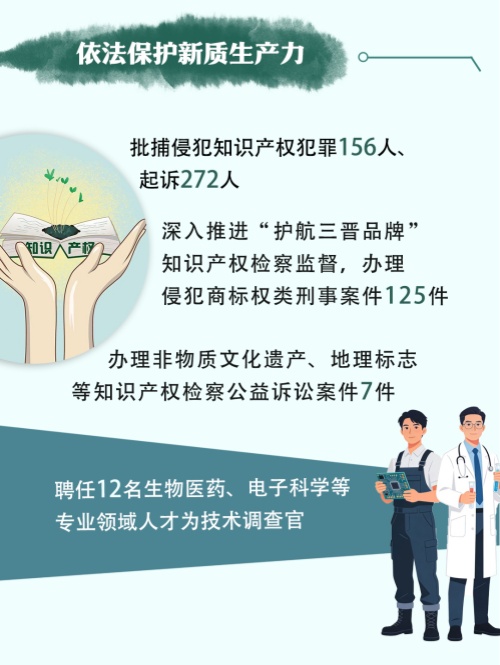
Group 1 - The core viewpoint of the news highlights the collaborative efforts of criminal, civil, administrative, and public interest litigation prosecutors in protecting intellectual property rights, resulting in the arrest of 156 individuals and the prosecution of 272 individuals for related crimes [1] - The Shanxi Provincial Procuratorate's work report emphasizes the promotion of "Protecting the Three Jin Brands" intellectual property supervision, with a focus on enhancing the protection of geographical indications, time-honored brands, intangible cultural heritage, traditional Chinese medicine, and seed industry intellectual property [1] - A total of 125 criminal cases involving trademark infringement were handled, along with 7 public interest litigation cases related to intellectual property, including those concerning the "Qinzhou Book Fair" intangible cultural heritage and the "Youyu Lamb" geographical indication [1] Group 2 - The data reflects the commitment of the procuratorial authorities to support the development of new productive forces tailored to local conditions and to maintain fair competition in the market [2] - A representative from Shanxi Gaotao Ceramics expressed the hope that the procuratorial authorities would strengthen their intellectual property protection efforts, optimize the legal business environment, and expand the coverage of the technical investigator system to enhance the quality and efficiency of their work [2]

国家知识产权局:加快推动《集成电路布图设计保护条例》修改
Shang Hai Zheng Quan Bao· 2026-01-23 05:52
Core Viewpoint - The National Intellectual Property Administration plans to implement a high-quality "14th Five-Year" plan, focusing on revising trademark laws and regulations for new fields like artificial intelligence by 2026 [2] Group 1: Intellectual Property Data - In 2025, a total of 972,000 invention patents, 1,461,000 utility model patents, and 666,000 design patents were granted, with a reduction in the examination cycle for invention patents to 15 months and an accuracy rate of 95.6% [3] - By the end of 2025, the effective number of invention patents in China reached 5.32 million, with a high-value invention patent ownership rate of 16 per 10,000 people [3] - The value added by patent-intensive industries accounted for 13.38% of GDP, exceeding the targets set in the "14th Five-Year" plan [3] Group 2: Trademark Data - In 2025, 4,206,000 trademarks were registered, with an average examination cycle of 4 months and an approval rate exceeding 97% [4] - By the end of 2025, the effective number of registered trademarks in China reached 49.877 million, with the value of Chinese brands in the top 5,000 globally amounting to $1.81 trillion, ranking second worldwide [4] Group 3: Geographical Indications - In 2025, 104 new geographical indication products were recognized, and 2,639 products were converted, with over 20,000 entities approved to use geographical indication special marks [5] - By the end of 2025, a total of 5,066 geographical indication products were recognized, and 7,425 were approved as collective or certification trademarks [5] Group 4: Integrated Circuit Layout Design - In 2025, 10,000 integrated circuit layout designs were registered [6] - By the end of 2025, a cumulative total of 93,000 integrated circuit layout designs had been registered [7] Group 5: Data Intellectual Property Pilot - As of October 2025, over 40,000 data intellectual property registration certificates were issued, with financing and licensing transaction amounts nearing 15 billion yuan [8] Group 6: Future Work Focus - The administration will focus on seven areas for the "14th Five-Year" plan, including top-level design, legal protection, quality orientation, collaborative governance, efficient utilization, public service optimization, and open cooperation [9][10]
【省知识产权局】激活创新“密钥” 赋能三秦发展
Shan Xi Ri Bao· 2026-01-06 00:26
Core Viewpoint - The 20th National Congress of the Communist Party of China emphasizes "significantly improving the level of technological self-reliance and self-improvement" as a key goal for the 14th Five-Year Plan, highlighting the importance of independent innovation to seize technological high ground and foster new productive forces [1] Group 1: Strategic Goals and Framework - The 14th Provincial Congress of Shaanxi has approved the 14th Five-Year Plan, focusing on building a modern industrial system with Shaanxi characteristics, leveraging rich educational resources and addressing regional development imbalances [1][2] - Knowledge property rights are identified as a legal carrier of innovation results and a key support for building a modern industrial system, essential for activating corporate innovation vitality [1][2] Group 2: Knowledge Property Rights and Innovation - Knowledge property rights are crucial for protecting innovation, clarifying ownership, and ensuring reasonable returns for innovators, thus stimulating innovation among enterprises, universities, and research institutions [3][4] - The Shaanxi Provincial Knowledge Property Bureau has made significant progress in building a strong knowledge property province since the 14th Five-Year Plan, with a focus on enhancing the legal and policy support system [4][5] Group 3: Implementation and Policy Measures - The Shaanxi Provincial Knowledge Property Bureau plans to deepen institutional supply innovation during the 14th Five-Year Plan, implementing targeted policies to support different regions based on their unique characteristics [5][9] - The province aims to enhance the cultivation of high-value patents and improve the efficiency of patent examination to support original and disruptive innovations [5][9] Group 4: Economic and Industrial Development - The transition from a knowledge property importing country to a knowledge property creating country is underway, with a focus on high-value patents as a core element for enhancing industrial quality and efficiency [6][8] - Shaanxi is working towards building a trillion-level industrial cluster characterized by intelligence, greenness, and integration, supported by high-value patents and well-known brands [6][8] Group 5: Future Directions and Goals - The Shaanxi Provincial Knowledge Property Bureau will continue to strengthen the role of enterprises as the main body of innovation, enhancing their ability to utilize knowledge property rights effectively [10][11] - Future initiatives will include establishing a high-value patent conversion special zone and improving financial services related to knowledge property rights to support innovation and economic development [12][13]
最高法新修民事案由规定:新增标准必要专利、数据纠纷等多个案由
3 6 Ke· 2025-12-18 00:53
Core Viewpoint - The recent amendments to the "Civil Case Cause Regulations" by the Supreme People's Court focus on the adjustment of intellectual property-related causes, including the addition of new causes such as standard essential patent disputes and data disputes, which has garnered significant attention in the intellectual property community [1][2][3]. Group 1: Background and Necessity of Amendments - The amendments are in response to the increasing number of intellectual property cases and the emergence of new types of disputes driven by technological advancements such as 5G and the digital economy [2][3]. - The existing cause system was deemed insufficient to meet the practical needs due to the rapid development of new civil disputes, necessitating a third revision of the "Civil Case Cause Regulations" [2][3]. Group 2: Key Additions and Changes - The revised regulations introduce several new causes related to intellectual property, enhancing the precision and effectiveness of intellectual property protection [4]. - A new primary cause for "data and network virtual property disputes" has been established, reflecting the growing importance of these issues in the digital economy [5]. - The introduction of a new tertiary cause for "standard essential patent disputes" aims to address the complexities arising from new technologies [6][7]. - The cause system has been refined to categorize patent rights into specific types, such as invention patents, utility model patents, and design patents, improving the clarity and efficiency of legal proceedings [9]. - The addition of "geographical indication infringement disputes" and "drug patent linkage disputes" as new tertiary causes aims to protect local industries and clarify the intersection of drug approval and patent validity [10][11]. Group 3: Enhancements in Legal Framework - The amendments emphasize the practical utility and convenience of the cause system, making it easier for parties to engage in civil litigation and for courts to handle cases [16]. - The revised cause system is designed to be scientific and systematic, facilitating accurate case identification and improving judicial efficiency [17]. - The focus on emerging fields in the amendments addresses the growing demand for intellectual property protection in new technologies and industries, thereby reducing litigation costs and enhancing judicial effectiveness [18]. Group 4: Implications for Future Developments - The third revision of the "Civil Case Cause Regulations" represents a significant step towards a more refined and modernized intellectual property judicial protection system in China, responding accurately to the needs of the new era [19]. - The application of the new causes in judicial practice is expected to enhance the effectiveness of intellectual property protection, providing a solid legal foundation for the innovation-driven development strategy [19].
陕西加快建设西部示范知识产权强省
Shan Xi Ri Bao· 2025-08-26 23:54
Core Viewpoint - The news highlights the progress and achievements of Shaanxi Province in building a strong intellectual property (IP) system, showcasing its innovative practices and work results in enhancing IP creation, utilization, protection, and management services [1][2]. Group 1: Intellectual Property Development - As of June 30 this year, Shaanxi has 125,000 valid invention patents and 879,000 valid trademark registrations, along with 96 geographical indication protected products [1]. - The province has implemented the "Lingxi" plan for patent transformation, effectively promoting the conversion of intellectual property from "laboratory" to "production line" [1]. - Shaanxi has completed comprehensive IP legislation in the western region and is advancing the construction of Xi'an as a national IP strong country demonstration city [1]. Group 2: Innovation and Technology Transfer - A total of 83 universities and research institutions in the province have identified nearly 90,000 existing patents, with 63,000 entering the national convertible patent resource database [1]. - The province is exploring new models for IP financing, such as "patent + geographical indication" and "data assets + trademark" combinations [1]. Group 3: Business Environment and Protection - Shaanxi is focusing on optimizing the business environment by establishing a provincial-level IP protection system with 46 projects and creating overseas IP rights protection assistance stations in the UK and Kazakhstan [2]. - The province is enhancing regional coordinated development by promoting the use of IP in key industrial chains and implementing projects that combine geographical indications with culture, tourism, and intangible cultural heritage [2]. Group 4: International Cooperation - Shaanxi is actively expanding its "friend circle" by establishing high-level IP cooperation mechanisms across regions and building an international cooperation and exchange platform for IP along the Belt and Road [2]. - The continuous improvement of innovation capabilities in western regions like Shaanxi is recognized as a significant part of China's high-quality development in the field of intellectual property [2].
出新招、选好品!广东省2025年“消费帮扶仲夏行动”即将启动
Nan Fang Nong Cun Bao· 2025-05-20 03:31
Core Viewpoint - Guangdong Province is launching the "2025 Consumption Assistance Summer Action" to enhance market-oriented operations for consumption assistance, focusing on promoting agricultural products and cultural tourism [6][12][14]. Group 1: Event Overview - The launch ceremony for the "2025 Consumption Assistance Summer Action" will take place on May 21 at the Guangzhou Canton Fair Exhibition Center [3][28]. - The initiative aims to strengthen government guidance and better serve the market-oriented entities involved in consumption assistance within the Greater Bay Area [13][14]. Group 2: Historical Context - In 2023, Guangdong's Development and Reform Commission organized various online and offline activities to enhance cooperation in consumption assistance, building on previous initiatives like the "New Spring Action" and "Golden Autumn Action" [15][19]. - The province successfully established cooperative relationships with other key consumption assistance regions, expanding new models for consumption assistance [16][18]. Group 3: Key Activities and Goals - The "Consumption Assistance Summer Action" will run from May to August 2025, focusing on leveraging the strengths of sales entities and enhancing the connection between agricultural products, cultural tourism services, and the Greater Bay Area market [23][24]. - The launch event will include the release of the "Consumption Assistance Summer Action" initiative and a selection guide for agricultural products entering the Bay Area [25][26]. Group 4: Participation and Collaboration - The first offline selection meeting, the "Guangzhou Faraway Goodies Summer Selection Meeting," will feature nearly 200 quality enterprises showcasing a range of products [28][29]. - The event is organized by multiple government departments and aims to create a collaborative ecosystem through market-oriented selection mechanisms [33][35].

一文了解知识产权
蓝色柳林财税室· 2025-05-05 10:46
Core Viewpoint - Intellectual property (IP) is essential in daily life, influencing various aspects such as clothing and beverages, highlighting its pervasive presence in society [2]. Group 1: Definition and Types of Intellectual Property - Intellectual property refers to the exclusive rights that individuals or organizations have over their intellectual achievements, including works, inventions, trademarks, geographical indications, trade secrets, integrated circuit layout designs, new plant varieties, and other legally defined objects [3]. - The main types of intellectual property include patent rights, trademark rights, geographical indications, data intellectual property, copyright, new plant varieties, integrated circuit layout designs, and trade secrets [4]. Group 2: Protection Duration of Intellectual Property - Patent rights have varying protection durations: invention patents for 20 years, utility model patents for 10 years, and design patents for 15 years, all calculated from the application date [5]. - Trademark rights are protected for 10 years from the date of approval [5]. - The protection duration for geographical indications depends on the registration form, typically lasting 10 years with the possibility of renewal [5]. - Data intellectual property protection duration varies based on data type and legal regulations, with copyright lasting for the author's lifetime plus 50 years, while trade secrets depend on their confidentiality and value [6]. Group 3: Infringement of Intellectual Property - Infringement actions include unauthorized use of similar trademarks, special signs, patents, and other creative works in production, advertising, and other activities [8]. - Other infringement behaviors involve counterfeiting trademarks, unauthorized registration of similar trademarks, and providing facilities for infringement activities [8]. Group 4: Intellectual Property Pledge Financing - Intellectual property pledge financing allows enterprises to use legally owned patents, trademarks, and copyrights as collateral to obtain loans from banks, addressing funding challenges for technology-based SMEs lacking real estate guarantees [9]. - Eligible for this financing are valid patents and trademarks granted by the National Intellectual Property Office and copyright registration certificates from the National Copyright Administration [9].

海南推进知识产权强省建设 每万人口发明专利拥有量达10.1件
Hai Nan Ri Bao· 2025-04-23 01:33
Core Insights - Hainan Province is advancing its intellectual property (IP) initiatives, aiming for an invention patent ownership of 10.1 per 10,000 people by February 2025, exceeding the "14th Five-Year Plan" target ahead of schedule [1] Group 1: Policy and Structural Changes - The provincial IP bureau has been upgraded to a directly subordinate agency of the provincial government, addressing the challenges of limited resources in IP work [1] - New local regulations, such as the "Hainan Free Trade Port Intellectual Property Protection Regulations," are being developed to align with international standards [1] - A pilot IP special zone is being established in Sanya's Yazhou Bay Science and Technology City, integrating various IP management systems [1] Group 2: Enforcement and Protection - Hainan has established national-level IP protection centers focused on marine and modern agriculture industries in Sanya, and on equipment manufacturing and biomedicine in Haikou [2] - From 2021 to 2024, Hainan has handled 2,434 cases related to trademarks and patents, with fines totaling 12.301 million yuan [2] - The province has also concluded 168 copyright enforcement cases, collecting nearly 900,000 yuan in fines [2] Group 3: IP Creation and Utilization - Hainan is promoting the establishment of an international IP trading center and a copyright protection center to enhance IP creation and utilization [2] - Between 2021 and 2024, the province granted 50,855 patents and recorded a total of 12.667 billion yuan in trademark and patent pledge registrations [2] - Hainan currently has 15 geographical indication protected products, 112 geographical indication trademarks, and 434 entities using special marks, with 40 products generating over 100 million yuan in annual output [2]