
复配食品添加剂

Search documents
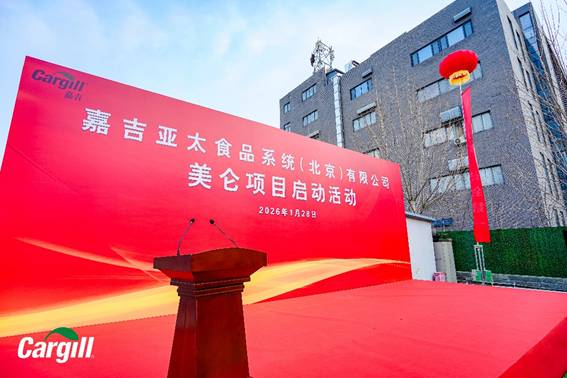
加码本土,辐射亚太:嘉吉北京工厂扩建项目正式启动
Zhong Guo Shi Pin Wang· 2026-01-28 08:31
Core Viewpoint - Cargill is expanding its Beijing factory to enhance its local operations and strengthen its position in the food industry, with a total investment exceeding 45 million RMB, aiming for production in the first half of 2027 [1][2]. Group 1: Project Details - The expansion includes the construction of two independent production lines for flavored solid beverages and flavored frozen coatings, along with a new vertical warehouse [1]. - The project is expected to improve Cargill's comprehensive service capabilities in the food solutions sector across China and the Asia-Pacific region [1][3]. Group 2: Strategic Importance - Cargill has been operating in Beijing for over 20 years, leveraging a "global technology + local insight" model to grow alongside the Chinese food industry [3]. - The expansion is seen as a significant milestone in Cargill's long-term commitment to the Chinese market and aims to enhance local innovation and supply chain capabilities [3][8]. Group 3: Technological Advancements - The new production lines will incorporate advanced visual recognition robots and automated operations, ensuring efficient and safe production processes [7]. - The project will establish a complete digital management system from raw material intake to finished product delivery, enhancing transparency and traceability [7]. Group 4: Market Response - The expansion is designed to meet the growing demand in the Chinese food and beverage market, which is projected to reach a trillion RMB scale [5]. - Cargill aims to provide more flexible and agile product solutions to local customers, reinforcing its service capabilities in the Asia-Pacific market [5][6].

推动食品安全与产业升级
Xin Lang Cai Jing· 2026-01-06 21:34
Core Viewpoint - The Jiangxi Provincial Market Supervision Administration is implementing a "Six Chains" initiative to enhance food safety and promote high-quality development in the food industry by 2025, focusing on quality, standards, branding, intellectual property, government services, and regulatory enforcement [2][4]. Group 1: Quality Assurance - The Jiangxi Provincial Market Supervision System is prioritizing "Quality Strong Chain" as a main line, executing the 2025 Food Production Supervision Inspection Plan, achieving full coverage in categories such as infant cereal products, salt, and dairy products, and extending oversight to 50% of food additive enterprises and high-risk bulk food companies [3]. - A total of 98 enterprises have been guided to rectify and eliminate risk hazards, with 36 special food enterprises undergoing comprehensive inspections, ensuring full coverage for infant formula and special medical purpose foods [3]. - The system has certified 1,362 food enterprises with 2,062 management system certification certificates and trained nearly 100 quality management personnel, supporting industry quality upgrades [3]. Group 2: Collaborative Innovation - The "Six Chains" initiative aims to address pain points in the food industry by constructing a multi-level standard system, guiding enterprises to participate in the formulation of 12 national standards and 4 group standards [4]. - Jiangxi Province has 42 food enterprises listed in the "Gansu Quality Products" directory, ranking 4th and 5th nationally for organic and green food certifications, respectively, with plans to add 14 geographical indication products and 103 new marking enterprises by 2025 [4]. Group 3: Regulatory Support - The Jiangxi Provincial Market Supervision System employs a combination of online monitoring and offline inspections to combat counterfeit and substandard food products, focusing on major consumer goods during peak periods [5]. - The system is enhancing the development environment through targeted actions against the production and sale of fake meat products and other substandard foods [5]. Group 4: Enterprise Support - The "Hundred Enterprises Thousand Workshops" initiative aims to provide tailored support to key enterprises in the food industry, enhancing their food safety management systems and inspection processes [6]. - The system has implemented pre-approval guidance for food production licenses, improving the first-time approval rate for applications and promoting the fulfillment of food safety responsibilities [6]. Group 5: Additive Management - The Jiangxi Provincial Market Supervision System is addressing the misuse of food additives through a comprehensive governance approach, including a pilot program in Yichun City to reduce the quantity and variety of additives used [7]. - Over 300 improvement suggestions have been made for 23 enterprises, with 109 varieties achieving "dual reduction" in additive use, promoting clean label certification and enhancing brand competitiveness [7].
食品添加剂生产有了新审查标准
Xin Lang Cai Jing· 2025-12-29 17:12
Core Viewpoint - The State Administration for Market Regulation has released the "Food Additive Production License Review Guidelines (2025 Edition)" to standardize the production licensing of food additives and enhance supervision of production enterprises [1][2]. Group 1: Production Licensing Requirements - The guidelines specify production access requirements and detail enterprise system regulations, including basic conditions related to production sites, facilities, and processes [1]. - Enterprises are required to establish and implement a series of food safety management systems, including raw material procurement, production process control, sanitation, food safety traceability, and label management [1]. Group 2: Risk Prevention and Classification - The production licensing for food additives is categorized into six specific types: single variety food additives, food flavorings, compound food additives, food nutrition enhancers, basic substances in gel-based candies, and enzyme preparations [1]. - The guidelines emphasize the prohibition of repackaging certain high-risk products, particularly those classified as hazardous chemicals [1]. Group 3: Additional Review Requirements - The guidelines focus on high-risk products, particularly compound food additives and food flavorings, which will have additional review requirements related to formula development management, quality control, and labeling [2]. - The new licensing requirements aim to raise the entry barriers for production and enhance overall safety standards in the industry [2].
食品添加剂生产监管新规出台
Xin Hua Wang· 2025-12-29 10:08
Core Viewpoint - The State Administration for Market Regulation has released the "Food Additive Production License Review Guidelines (2025 Edition)" to further standardize food additive production and enhance quality safety supervision [1] Group 1: Regulatory Changes - The guidelines specify additional review requirements for compound food additives and food flavorings, including formulation development management, quality safety control, and labeling management, thereby raising the production licensing standards [1] - Food additive production licenses are categorized into six subcategories: single variety food additives, food flavorings, compound food additives, food nutrition enhancers, basic substances in gel-based candies, and enzyme preparations, implementing classified licensing review [1] Group 2: Safety Management - The guidelines prohibit the repackaging of high-risk food additives and those classified as hazardous chemicals, which have special management requirements [1] - Basic conditions for enterprises are outlined, including requirements for production sites, facilities, layout, and process flow, as well as the establishment of food safety management systems covering raw material procurement, production process control, and labeling management [1]
科拓生物:公司所属行业为食品制造业
Zheng Quan Ri Bao Wang· 2025-11-18 11:42
Group 1 - The company, Keta Bio (300858), operates in the food manufacturing industry, focusing on the research, production, and sales of edible probiotics, animal and plant micro-ecological preparations, and compound food additives [1] - The company has also made early investments in the pharmaceutical sector, collaborating with Shenzhen Unknown Jun Biotechnology Co., Ltd. to advance the research and development of probiotic drugs [1] - The company has accumulated a wealth of strain resources and key processes in core technologies, and its project on "Key Technology Creation and Application for the Excavation and Industrialization of Excellent Lactic Acid Bacteria Germplasm Resources" won the second prize of the 2023 National Science and Technology Progress Award [1]
科拓生物:正与深圳未知君生物科技有限公司等合作推进益生菌新药研发
Mei Ri Jing Ji Xin Wen· 2025-11-18 00:57
Group 1 - The company operates in the food manufacturing industry, focusing on the research, production, and sales of probiotic products, plant and animal micro-ecological preparations, and compound food additives [2] - The company has also made initial investments in the pharmaceutical sector, collaborating with Shenzhen Unknown Jun Biotechnology Co., Ltd. to advance the research and development of probiotic drugs [2] - The company has accumulated a rich resource of strains and key processes, and its project on "Key Technology Creation and Application for the Excavation and Industrialization of Excellent Lactic Acid Bacteria Germplasm Resources" won the second prize of the 2023 National Science and Technology Progress Award [2]
科拓生物的前世今生:孙天松掌舵引领业务发展,食用益生菌制品营收占比71.03%,新工厂投产扩张可期
Xin Lang Cai Jing· 2025-10-31 00:04
Core Insights - The company, Keta Bio, is a leading provider of probiotic products and services in China, established in 2003 and listed on the Shenzhen Stock Exchange in 2020 [1] - The company specializes in the research, production, and sales of food additives, edible probiotic products, and micro-ecological preparations for plants and animals [1] Financial Performance - For Q3 2025, Keta Bio reported revenue of 267 million yuan, ranking 23rd in the industry, significantly lower than the top competitors, Meihua Biological and Xinhacheng, with revenues of 18.215 billion yuan and 16.642 billion yuan respectively [2] - The company's net profit for the same period was 76.23 million yuan, ranking 18th in the industry, again trailing behind the leaders [2] - The main business segments include edible probiotic products (71.03% of revenue), micro-ecological preparations (16.96%), and food additives (11.14%) [2] Financial Ratios - Keta Bio's debt-to-asset ratio was 5.90% in Q3 2025, an increase from 4.65% year-on-year, which is significantly lower than the industry average of 28.46%, indicating strong solvency [3] - The gross profit margin for Q3 2025 was 52.04%, slightly down from 54.14% year-on-year, but still above the industry average of 28.77%, reflecting robust profitability [3] Executive Compensation - The chairman, Sun Tiansong, received a salary of 1.991 million yuan in 2024, an increase of 217,000 yuan from the previous year [4] - The general manager, Liu Xiaojun, had a salary of 3.3787 million yuan in 2024, a modest increase of 15,800 yuan [4] Shareholder Information - As of September 30, 2025, the number of A-share shareholders increased by 5.63% to 17,100, while the average number of shares held per shareholder decreased by 5.33% to 11,300 [5] - The top ten circulating shareholders include funds like Fu Guo Growth Navigation Mixed Fund, which held 6.6083 million shares [5] Market Outlook - The probiotic industry is experiencing high demand, with Keta Bio's new production facility in Inner Mongolia expected to generate 30 to 40 million yuan in annual output once fully operational [5] - Projections for net profit from 2025 to 2027 are 1.03 billion yuan, 1.24 billion yuan, and 1.57 billion yuan, with corresponding growth rates of 9%, 20%, and 27% [5] - The market for probiotic raw powder is expected to reach 10.6 billion yuan by 2027, driven by increased consumer spending and domestic strain development [6]

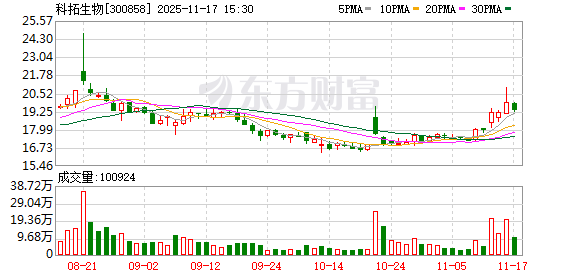
科拓生物跌2.05%,成交额5630.78万元,主力资金净流出744.60万元
Xin Lang Zheng Quan· 2025-10-30 02:51
Core Viewpoint - Keta Bio's stock price has shown fluctuations, with a year-to-date increase of 21.15% and a recent decline over the past 20 days, indicating mixed market sentiment towards the company [1][2]. Company Overview - Keta Bio, established on September 5, 2003, and listed on July 27, 2020, is located in Beijing and specializes in the research, production, and sales of food additives, probiotics, and micro-ecological preparations for plants and animals [1]. - The company's revenue composition includes 71.03% from probiotics, 16.96% from micro-ecological preparations, 11.14% from food additives, 0.73% from probiotic technology services, and 0.14% from other sources [1]. Financial Performance - For the period from January to September 2025, Keta Bio reported a revenue of 267 million yuan, reflecting a year-on-year growth of 22.25%, while the net profit attributable to shareholders was 76.23 million yuan, up 7.08% year-on-year [2]. - Since its A-share listing, Keta Bio has distributed a total of 289 million yuan in dividends, with 132 million yuan distributed over the past three years [3]. Shareholder Information - As of September 30, 2025, Keta Bio had 17,100 shareholders, an increase of 5.63% from the previous period, with an average of 11,343 circulating shares per shareholder, down 5.33% [2]. - Among the top ten circulating shareholders, the "Fuguo Growth Navigation Mixed Fund" holds 6.6083 million shares, unchanged from the previous period, while the "Fuguo Balanced Preferred Mixed Fund" reduced its holdings by 3.1617 million shares to 4.2466 million shares [3].
北京发布3项食品地方标准,涉及低温巴氏杀菌乳、焙炒咖啡等
Xin Jing Bao· 2025-10-13 06:13
Core Points - Beijing has released three local standards for high-quality development in food production, focusing on low-temperature pasteurized milk, roasted coffee, and blended food additives [1][2] - The standards aim to provide a comprehensive quality management system, standardized production processes, and guidance for enhancing food nutrition and flavor [1][2] Group 1: Low-Temperature Pasteurized Milk - The standard for low-temperature pasteurized milk defines the pasteurization process as heating raw milk to 72℃–76℃ for 15 seconds, integrating raw material requirements, production process control, and product quality indicators [1] - The microbial limits for raw milk are stricter than those set by EU and US standards, with active nutritional indicators leading the industry [1] Group 2: Roasted Coffee - The roasted coffee standard emphasizes improving coffee quality by regulating key aspects such as coffee bean origin certification, roasting, grinding, and foreign object detection [1][2] - This standard aims to differentiate roasted coffee from cold brew and instant coffee, enhancing flavor richness and aroma to meet consumer demand for premium coffee [1][2] Group 3: Blended Food Additives - The standard for blended food additives focuses on verifying the uniformity of the mixing process, providing scientific sampling and calculation methods to accurately assess component content [2] - It also offers reference methods for uniformity verification applicable to similar production processes in solid beverages and special dietary foods [2] Group 4: Overall Impact - The series of quality management standards is a guiding document for the high-quality development of food production enterprises in Beijing [2] - The release of these standards aims to establish a scientific quality control system, enhance production efficiency and product competitiveness, and meet consumer expectations for food nutrition and quality [2]
科拓生物(300858):25H1益生菌主业增长稳健 看好公司长期发展潜能
Xin Lang Cai Jing· 2025-08-21 10:36
Core Viewpoint - The company reported a revenue of 163 million yuan for H1 2025, reflecting an 18.32% year-over-year increase, but the net profit attributable to shareholders decreased by 5.31% to 41 million yuan [1][2] Financial Performance - For H1 2025, the company achieved a revenue of 163 million yuan, with a net profit of 41 million yuan and a non-recurring net profit of 35 million yuan, showing a decrease of 5.31% and 6.67% year-over-year respectively [1][2] - In Q2 2025, the company generated a revenue of 86 million yuan, with a net profit of 21 million yuan, marking a 16.49% decline year-over-year [1][2] Revenue Breakdown - The revenue from probiotic products and plant-animal micro-ecological preparations reached 116 million yuan and 28 million yuan, respectively, with year-over-year increases of 13.85% and 83.12% [2] - Revenue from compound food additives and probiotic technology services was 18 million yuan and 1 million yuan, showing declines of 0.49% and 43.42% year-over-year [2] Profitability Analysis - The company's gross margin and net profit margin for H1 2025 were 49.24% and 25.23%, down by 5.74 and 6.30 percentage points year-over-year, primarily due to product mix adjustments and increased depreciation from new factories [3] - The company’s operating expenses showed a mixed trend, with sales, management, and R&D expense ratios decreasing, while financial expenses increased [3] Strategic Initiatives - The company is focusing on expanding its C-end market and overseas presence, including a strategic investment in Qinghe Shixiang to develop ready-to-eat probiotic products for teenagers [3] - The establishment of an overseas division and participation in international exhibitions signify the company's commitment to global market expansion [3] Future Outlook - The company is expected to achieve revenues of 383 million yuan, 471 million yuan, and 569 million yuan from 2025 to 2027, with year-over-year growth rates of 26.5%, 23%, and 20.7% respectively [4] - Projected net profits for the same period are 110 million yuan, 141 million yuan, and 184 million yuan, with expected growth rates of 16.5%, 28.4%, and 30.3% [4]