
质量强链

Search documents
高质量党建引领高质量发展|支部建在产业链上 安徽市监局“质”上突围
Zhong Guo Jing Ying Bao· 2026-02-26 06:46
Group 1 - The core idea of the article is that the integration of party building work into the industrial chain in Anhui is transforming the region's development, providing a replicable model for high-quality growth [1][2]. - The Anhui Provincial Market Supervision Administration is implementing the "Quality Strong Chain" initiative, which involves forming quality technology innovation alliances among leading enterprises in the industrial chain [2]. - As of now, 181 quality innovation alliances have been established, with 544 projects implemented and 1,322 quality issues resolved [2]. Group 2 - The establishment of seven provincial-level industrial measurement testing centers and the formulation of 11 international standards and 1,150 national standards have improved the infrastructure in Anhui [2]. - The Anhui Provincial Market Supervision Administration has initiated a special service project for foreign trade enterprises to facilitate their transition to domestic sales, addressing concerns about certification and regulatory processes [4]. - A total of 4,852 foreign trade enterprises were visited, resulting in the resolution of 156 various difficulties, showcasing a tailored approach to support businesses [4].
湖北质量基础设施“硬实力”再升级
Xin Lang Cai Jing· 2026-02-12 06:09
Core Insights - Hubei Province aims to enhance its quality infrastructure by revising and formulating over 1,200 international and national standards by 2025, with a significant increase in the number of standards compared to the previous year [1] Group 1: Quality Infrastructure Development - The Hubei Market Supervision Administration plans to promote the formulation and revision of 37 international standards and 1,197 national standards in 2025, representing year-on-year growth of 48% and 47% respectively [1] - The province has accelerated the construction of the "Quality Three Strong" initiative, recognizing 161 "Hubei Quality" products and implementing 33 provincial projects aimed at enhancing quality across industrial chains [2] Group 2: Industry Chain Quality Improvement - Hubei has initiated 33 provincial projects focused on quality improvement in key industrial chains, which have collectively helped enterprises save over 6 billion yuan [2] - The province's quality enhancement projects have served 65,200 enterprises and resolved 39,600 quality issues, contributing to a total cost reduction and revenue increase exceeding 40 billion yuan [2] Group 3: Standard Supply Optimization - The Hubei Market Supervision Administration is optimizing the supply of standards in key areas, planning to release a technical standard system for phosphogypsum utilization and participating in the revision of 72 vehicle-related national standards [3] - The province has also engaged in the development of 109 national standards in artificial intelligence and integrated circuits, while eliminating 722 ineffective local standards, achieving a 42% reduction [3] Group 4: Quality Technical Service Platform - Hubei is advancing the construction of quality technical service platforms, with plans to establish 74 public service platforms for inspection and testing by 2025 [4] - The province has initiated 615 capability verification projects and developed 143 inspection and testing standards, significantly enhancing the capacity for quality inspection services [4] - Hubei has established 240 quality service stations and 446 service windows, achieving an 85% coverage rate for one-stop quality infrastructure services in county-level markets [4]
向“新”而行 向“质”图强 向“链”聚势
Zhong Guo Zhi Liang Xin Wen Wang· 2026-02-10 05:25
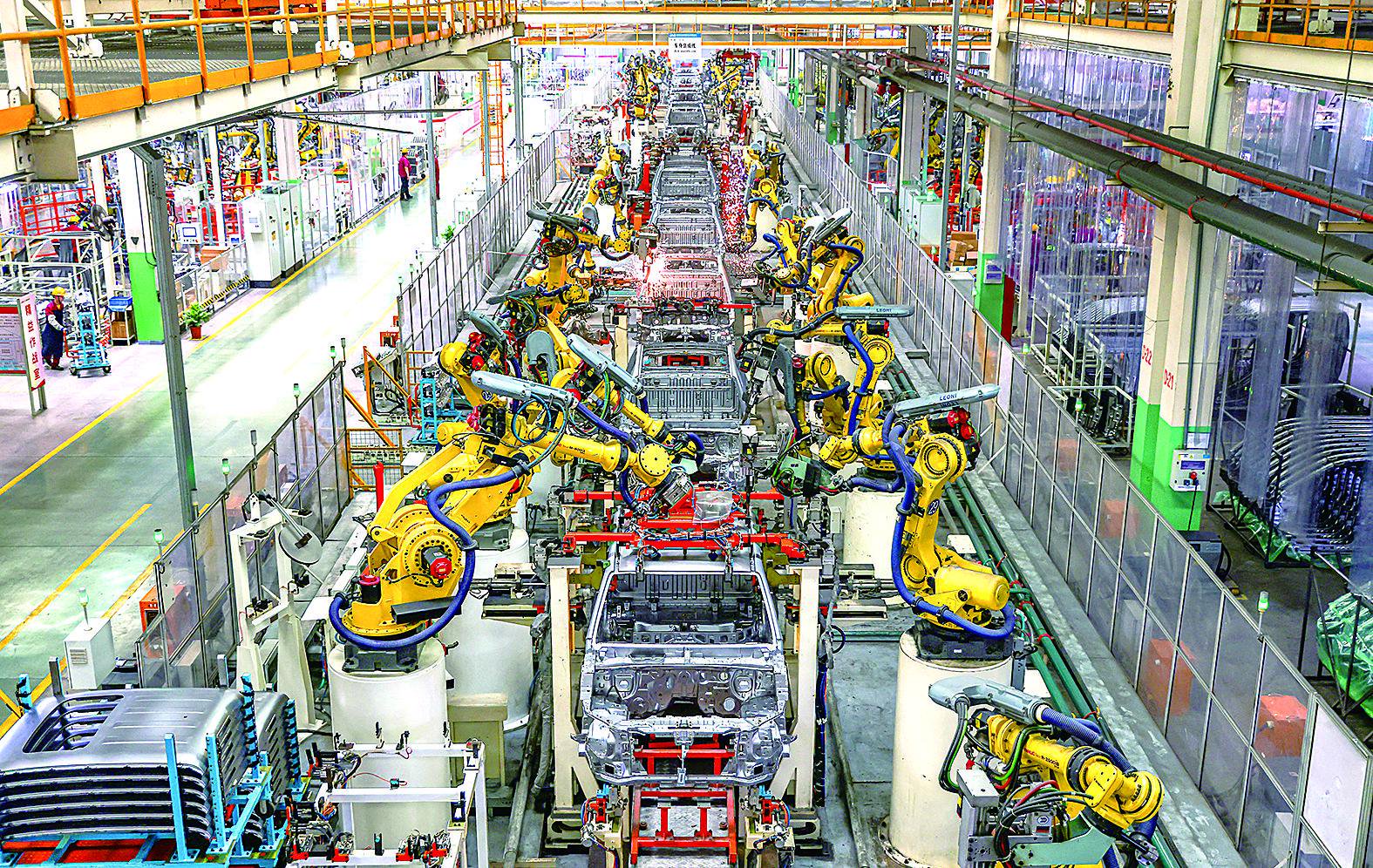
Core Viewpoint - The State Administration for Market Regulation (SAMR) is focusing on enhancing quality across key industrial chains through targeted initiatives, investing 220 million yuan to tackle 289 critical tasks, and implementing ten flagship projects to improve quality and competitiveness in various sectors, including automotive and new energy [1][2]. Group 1: Quality Improvement Initiatives - SAMR has launched ten flagship projects aimed at addressing challenges in technology iteration and quality upgrades within key industrial chains, with a total investment of 220 million yuan [1][2]. - In the automotive chip sector, 25 key chips have been certified, with over 20 million units installed, reducing the selection cycle for vehicle manufacturers by an average of three months and cutting verification costs by approximately 40% [1]. - The initiative has led to the establishment of 1,420 innovation consortia, involving 5,375 chain-leading enterprises and 280,000 chain-member enterprises, successfully resolving 25,000 quality bottlenecks and enhancing the resilience and competitiveness of the industrial chain [1]. Group 2: Specific Industry Projects - The electric vehicle supercharging project has established a comprehensive standard system for design, construction, management, and evaluation, connecting 150,000 charging stations with over 90% consistency in measurement results [3]. - In the new display industry, the defect rate of core suppliers for polarizers has decreased by 60%, and the localization rate of key materials has increased from 13% in 2021 to approximately 60% [3]. - The industrial robot project has improved the quality of key components, leading to a 20% increase in overall efficiency and the development of national standards for performance requirements and testing methods [5]. Group 3: Regional and Cross-Regional Collaboration - The SAMR is promoting cross-regional quality chain projects, with 21 initial projects covering 27 provinces, focusing on both emerging and traditional industries to enhance quality and competitiveness [15][16]. - The collaboration aims to address common quality issues across regions, facilitating technology sharing, standard development, and market integration [15]. - Local initiatives, such as those in Inner Mongolia and Xinjiang, are designed to leverage regional strengths and foster cooperative quality improvement efforts [15]. Group 4: Future Industry Focus - The SAMR is prioritizing strategic emerging industries such as artificial intelligence, quantum information, and new energy vehicles, launching projects to enhance quality and support the development of new productive forces [7][11]. - The focus on future industries aims to ensure that quality improvements align with technological advancements and market demands, fostering sustainable growth [11][12].

强“四链”激活力 江西省新余市市场监管局全力服务地方经济高质量发展
Xin Lang Cai Jing· 2026-02-10 04:37
Group 1 - The Jiangxi Province's Xinyu City Market Supervision Administration has implemented a comprehensive strategy focusing on quality enhancement, standard stabilization, brand promotion, and intellectual property improvement to support local economic development [1][2][3] - The "6313" action plan has been introduced, featuring 12 measures and 25 specific projects aimed at upgrading quality management across the entire industrial chain [1] - The establishment of Chief Quality Officer positions in 409 companies has significantly improved quality governance capabilities, with one individual recognized as an outstanding contributor at the provincial level [1] Group 2 - The implementation of a standardization strategy has led to the publication of 1 international standard, 13 national standards, and 10 industry standards, enhancing the quality of the lithium battery sector [2] - The number of publicly disclosed enterprise standards has reached 1,593, marking a 50% year-on-year increase, indicating a growing awareness among companies regarding standardization [2] - The "Xinyu Lithium Battery Industry Standardization Pilot" has been approved as a national-level pilot project, showcasing significant advancements in the lithium sector [2] Group 3 - The total number of effective registered trademarks in Xinyu has reached 27,500, reflecting a 7.4% year-on-year growth, driven by initiatives to enhance brand creation [3] - The "Xinyu Honey Orange" has been recognized as a geographical indication product, with its brand value exceeding 5 billion yuan [3] - The city has organized 21 events under the "Intellectual Property Service Journey," stimulating enthusiasm for brand development among businesses [3] Group 4 - The organization of four "bank-enterprise docking" meetings for intellectual property pledge financing has resulted in a registration amount of 450 million yuan, a 12% increase year-on-year [3] - The number of invention patents per 10,000 people in Xinyu has reached 8.7, showing a 15.5% year-on-year increase, indicating a continuous release of innovation vitality [3] - The Market Supervision Administration plans to further enhance the integrated promotion mechanism of quality, standards, brands, and intellectual property to better serve the local economy [3]
护航经营主体从“多起来”迈向“强起来”
Xin Lang Cai Jing· 2026-02-08 19:33
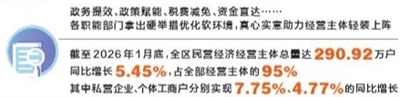
Core Viewpoint - The Inner Mongolia Autonomous Region is actively promoting the development of private enterprises by enhancing the business environment and providing various support measures to stimulate economic growth and high-quality development [3][10]. Group 1: Business Environment Improvement - The government emphasizes the importance of a favorable business environment, stating that the quality of the business environment should be assessed by the enterprises themselves [3]. - A monitoring system for the business environment will be established, focusing on creating a supportive atmosphere for private enterprises [3]. - The region has shifted from a cumbersome process to a more efficient one, allowing businesses to obtain licenses quickly through self-service terminals [3][4]. Group 2: Economic Growth and Support Measures - As of January 2026, the total number of private economic entities reached 2.9092 million, a year-on-year increase of 5.45%, accounting for 95% of all business entities [4]. - The government has implemented various measures, including tax reductions and direct funding, to alleviate the operational costs for businesses [8]. - A total of 363 billion yuan in loans has been granted to 25,000 business entities through credit-enabled financing initiatives [7]. Group 3: Industry-Specific Initiatives - The government is facilitating the marketing of local products, such as desert ginseng, by helping businesses establish online sales channels [4][6]. - A comprehensive regulatory network has been established to ensure product quality and safety, particularly for new products entering the market [4][9]. - The focus on quality improvement in key industries, such as dairy, rare earth materials, and wind power equipment, is aimed at enhancing the overall competitiveness of local enterprises [9]. Group 4: Overall Economic Impact - The combined efforts of the government to create a favorable business environment and provide support have resulted in a significant increase in the number of business entities, reaching 3.0624 million by January 2026 [10]. - The initiatives are expected to inject strong momentum into the development of numerous business entities, contributing positively to the economic landscape of Inner Mongolia [10].
实施“强企、强链、强县”行动 “十四五”时期我国质量工作取得显著成效
Jing Ji Guan Cha Wang· 2026-01-26 05:22
Core Insights - The "14th Five-Year Plan" period has seen the implementation of innovative quality initiatives such as "Strong Enterprises," "Strong Chains," and "Strong Counties," with a total of 1,856 quality chain projects executed [1] - The manufacturing quality competitiveness index has steadily increased to 85.86, while the satisfaction levels for quality in life services and public services have entered the "satisfactory" range [1] - A total of 32,000 enterprises have established Chief Quality Officer positions, and 36 universities have introduced quality-related academic programs [1] - Quality infrastructure integrated service pilot projects have been launched in 14 regions [1] - Over the past five years, 38.03 million vehicles and 40.40 million consumer products have been recalled, effectively safeguarding public safety and property [1]
以质量为纽带构建产业全链条信任机制
Xin Lang Cai Jing· 2026-01-13 06:23
Core Insights - The Industrial Robot Quality Strong Chain Project aims to enhance the quality of industrial robots and their core components, establishing a trust mechanism across the entire industry chain [1] - This initiative is a key measure by the State Administration for Market Regulation to address industrial development bottlenecks and support national strategies for manufacturing, quality, and digital transformation [1][2] - The project seeks to improve supply chain resilience and security by reducing reliance on imported core components and enhancing the overall quality of the industrial robot industry [1][2] Group 1 - The project focuses on three dimensions to build a trust mechanism in the industrial robot sector, facilitating a shift from "capable of manufacturing" to "capable of producing quality" [1] - It addresses issues of overcapacity in low-end production and insufficient supply in high-end components, promoting collaboration among upstream and downstream enterprises to enhance reliability and stability [2] - The initiative drives innovation across multiple disciplines, leading to breakthroughs in materials science, precision processing, and AI algorithms, thus transforming the industry towards intelligent manufacturing [2][3] Group 2 - The project represents a paradigm shift in industrial governance, integrating government guidance, enterprise initiative, and market validation to overcome structural barriers in innovation [3] - Quality is redefined from a cost constraint to a collaborative language, facilitating a transition from physical aggregation to chemical reactions within the industry chain [3] - The experience gained from this project offers a new path for developing countries to achieve industrialization without relying on existing technological hegemony [3]
大连市多领域参与全国首批跨区域“质量强链”联动行动
Zhong Guo Fa Zhan Wang· 2026-01-07 08:21
Core Viewpoint - The cross-regional quality enhancement project aims to innovate regional quality cooperation mechanisms and address "involution" competition, establishing a new collaborative development framework for regional quality [1] Group 1: Project Overview - The project involves the market supervision administrations of Qinghai, Liaoning, Zhejiang, Guangdong, Chongqing, and Shaanxi, focusing on key industrial chains and quality infrastructure technology innovation cooperation [1] - The initiative plans to strengthen standards, measurement, testing, and certification over three years, with 34 key projects and 16 common quality challenges to be addressed [1] Group 2: Dalian's Involvement - Dalian will participate in eight key projects and three critical common quality challenges in the textile, new energy, and low-altitude economy sectors [2] - Specific projects include establishing a cross-regional testing and certification service platform for the textile industry and developing testing technologies for new materials [2] Group 3: Future Plans - Dalian's market supervision bureau aims to create a regular cross-regional communication mechanism and enhance collaboration in the supply chain [2] - The bureau will leverage local quality technical institutions to ensure project objectives are met and promote resource sharing and complementary advantages [2]
推动食品安全与产业升级
Xin Lang Cai Jing· 2026-01-06 21:34
Core Viewpoint - The Jiangxi Provincial Market Supervision Administration is implementing a "Six Chains" initiative to enhance food safety and promote high-quality development in the food industry by 2025, focusing on quality, standards, branding, intellectual property, government services, and regulatory enforcement [2][4]. Group 1: Quality Assurance - The Jiangxi Provincial Market Supervision System is prioritizing "Quality Strong Chain" as a main line, executing the 2025 Food Production Supervision Inspection Plan, achieving full coverage in categories such as infant cereal products, salt, and dairy products, and extending oversight to 50% of food additive enterprises and high-risk bulk food companies [3]. - A total of 98 enterprises have been guided to rectify and eliminate risk hazards, with 36 special food enterprises undergoing comprehensive inspections, ensuring full coverage for infant formula and special medical purpose foods [3]. - The system has certified 1,362 food enterprises with 2,062 management system certification certificates and trained nearly 100 quality management personnel, supporting industry quality upgrades [3]. Group 2: Collaborative Innovation - The "Six Chains" initiative aims to address pain points in the food industry by constructing a multi-level standard system, guiding enterprises to participate in the formulation of 12 national standards and 4 group standards [4]. - Jiangxi Province has 42 food enterprises listed in the "Gansu Quality Products" directory, ranking 4th and 5th nationally for organic and green food certifications, respectively, with plans to add 14 geographical indication products and 103 new marking enterprises by 2025 [4]. Group 3: Regulatory Support - The Jiangxi Provincial Market Supervision System employs a combination of online monitoring and offline inspections to combat counterfeit and substandard food products, focusing on major consumer goods during peak periods [5]. - The system is enhancing the development environment through targeted actions against the production and sale of fake meat products and other substandard foods [5]. Group 4: Enterprise Support - The "Hundred Enterprises Thousand Workshops" initiative aims to provide tailored support to key enterprises in the food industry, enhancing their food safety management systems and inspection processes [6]. - The system has implemented pre-approval guidance for food production licenses, improving the first-time approval rate for applications and promoting the fulfillment of food safety responsibilities [6]. Group 5: Additive Management - The Jiangxi Provincial Market Supervision System is addressing the misuse of food additives through a comprehensive governance approach, including a pilot program in Yichun City to reduce the quantity and variety of additives used [7]. - Over 300 improvement suggestions have been made for 23 enterprises, with 109 varieties achieving "dual reduction" in additive use, promoting clean label certification and enhancing brand competitiveness [7].
“十四五”期间安徽省经营主体净增263.69万户
Xin Hua Wang· 2025-12-30 04:38
Group 1 - The core viewpoint of the articles highlights the significant progress made by Anhui Province in market regulation and quality development during the "14th Five-Year Plan" period, with a focus on enhancing the business environment and consumer protection [1][2] Group 2 - Anhui Province has seen a net increase of 2.6369 million business entities over five years, moving from 14th to 9th in the national ranking of total business entities, reaching a total of 8.5151 million by the end of November this year [1] - The province has implemented several groundbreaking reforms, including "multiple certificates combined," "separation of licenses," and "mandatory cancellation," which have significantly reduced institutional transaction costs for market entry and operation [1] - The province's quality competitiveness index for manufacturing reached 89.25, with a consumer product quality pass rate of 93%, both exceeding the national average by 3.65 and 0.9 standard points respectively [2] - The 12315 platform in Anhui received 6.7888 million complaints and consultations, recovering economic losses of 0.779 billion yuan for consumers, with a high success rate of 87.38% in online dispute resolutions [2] - Food safety supervision has been strengthened, with a compliance rate of over 99% for food and drug quality inspections, and a stable pass rate of 93% for provincial product quality supervision [2]