
全市场选股

Search documents
年内狂涨54%!这几只基金重仓资源股,却根本不是资源主题基金
Hua Xia Shi Bao· 2026-02-26 15:21
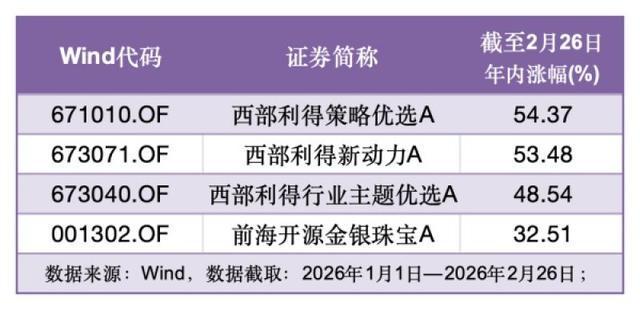
Core Viewpoint - The resource sector has shown strong performance in early 2026, with several funds heavily invested in this area achieving significant returns, despite not being classified strictly as resource-themed funds [1][2]. Fund Performance - As of February 26, 2026, the top-performing funds include: - Western Leading Strategy Preferred A with a return of 54.37% - Western Leading New Power A at 53.48% - Western Leading Industry Theme Preferred A at 48.54% - Qianhai Kaiyuan Gold and Silver Jewelry A at 32.51% [1]. Fund Structure and Strategy - The funds mentioned are classified as mixed funds with broad investment mandates, allowing for flexibility in stock selection and sector allocation [2][3]. - Western Leading Strategy Preferred A aims to identify companies with sustainable growth potential, with stock investments ranging from 60% to 95% of fund assets [3]. - Western Leading New Power A targets companies in consumer services and technological innovation, with stock assets also ranging from 0% to 95% [3]. Portfolio Composition - The top holdings of the Western Leading funds show significant overlap, with key stocks including Zijin Mining, Chifeng Jilong Gold, and Muyuan Foods, indicating a concentrated investment in both resource and domestic demand sectors [4]. - A notable shift in portfolio composition occurred in Q4 2025, where the funds increased their allocation to resource stocks, moving away from previous investments in aviation and brokerage sectors [5]. Fund Management Insights - The flexibility of all-market selection funds allows managers to adjust their portfolios based on market conditions, which has proven beneficial in the current resource stock rally [6]. - The distinction between all-market selection funds and thematic funds is emphasized, with the former relying on manager judgment and timing rather than strict thematic exposure [6]. Investor Considerations - Investors are advised to differentiate between a fund's temporary holdings and its long-term investment strategy, as short-term performance may not reflect the fund's intended focus [8]. - The potential for "style drift" exists if investors purchase funds based on short-term gains without understanding their contractual investment mandates [8].

“固收+”规模突围主动产品热点频现
Zhong Guo Zheng Quan Bao· 2026-01-22 20:56
Core Insights - In Q4 2025, "fixed income +" products, led by secondary bond funds, experienced significant growth, with secondary bond funds adding over 250 billion yuan in scale, reaching a total of over 1.5 trillion yuan by the end of 2025 [1] - Active equity funds, including ordinary stock, mixed equity, balanced, and flexible allocation funds, faced redemption and scale shrinkage, although some high-performing products attracted investments, leading to scale increases [1] Group 1: Growth of "Fixed Income +" Products - Secondary bond funds saw explosive growth in Q4 2025, with Invesco Great Wall Fund being a leading public institution, managing over 190 billion yuan in secondary bond funds by the end of 2025 [1] - In Q4 2025, Invesco Great Wall Fund was the only public institution to add over 50 billion yuan in secondary bond fund management scale, with the Invesco Great Wall Jing Sheng Shuang Xi fund being the only product to add over 20 billion yuan in scale during the quarter [1] - Other funds, such as Yongying Stable Enhancement Fund, also saw significant scale increases, with a total scale approaching 50 billion yuan by the end of 2025, and a yield of 16.47% for the A class share [2] Group 2: Performance of Active Equity Funds - Despite facing redemptions, some active equity funds focusing on niche sectors attracted significant investments, with funds like Yongying Pioneer Semiconductor Smart Selection and Yongying High-end Equipment Smart Selection increasing their scales by over 8 billion yuan each in Q4 2025 [3] - Funds focusing on AI and technology sectors, such as Zhonghang Opportunity Leading and Debang Xinxing Value, also saw scale increases of over 1.5 billion yuan, with returns exceeding 25% for some products [4] - Overall, the number of secondary bond fund products exceeding 20 billion yuan in scale reached 14 by the end of 2025, with many maintaining stock positions above 16% [3]
“全市场撒网”还是“主题深耕”?公募投资逻辑正深度重构
券商中国· 2025-11-24 01:33
Core Viewpoint - The investment style of public funds is shifting from "full market stock selection" to "thematic investment," driven by economic transformation and the emergence of high-growth stocks [1][3]. Group 1: Shift in Investment Strategies - Public funds previously favored "core assets" like large-cap stocks, but this strategy is losing traction as thematic investments gain popularity [2][3]. - Thematic investments allow for a more comprehensive layout of high-growth stocks and can enhance competitive rankings among funds [1][2]. - The shift is attributed to changes in the investment environment, including slower economic growth and the emergence of new industries, which have made traditional core assets less attractive [3][5]. Group 2: Characteristics of Thematic Investment - Thematic funds have been performing well, often ranking at the top in annual performance due to their focus on high-growth sectors like AI and innovative pharmaceuticals [4][5]. - The concentration on specific themes allows for greater potential returns, but also increases volatility and risk [5][11]. - Thematic investments help investors engage with long-term trends and direct capital towards state-supported sectors, fostering a positive cycle between capital markets and technological innovation [6][11]. Group 3: Challenges of Thematic Investment - Thematic investment requires deeper industry understanding and foresight, as it involves answering long-term questions about market dynamics and competition [7][8]. - The need for rigorous valuation discipline and risk management is heightened, as concentrated portfolios are more susceptible to individual stock performance and policy changes [8][9]. - The complexity of managing risks increases with thematic investments, necessitating precise control over concentration and liquidity [8][9]. Group 4: Future of Full Market Stock Selection - Despite the rise of thematic investments, "full market stock selection" is not expected to disappear, as it offers unique advantages in capturing structural opportunities across various sectors [10][11]. - The ability to conduct fundamental comparisons across industries will remain relevant, especially in a market characterized by frequent sector rotations [10][11]. - The long-term viability of "full market stock selection" will depend on its adaptation to new macroeconomic and industry conditions [10].

公募基金投资逻辑深度重构:“主题投资”风行一时 “全市场选股”暂避锋芒
Zheng Quan Shi Bao Wang· 2025-11-23 23:42
Core Viewpoint - The investment style of public funds has shifted from core assets to high-growth stocks amid economic transformation, moving from "full market stock selection" to "thematic investment" strategies [1][3]. Group 1: Shift in Investment Strategies - Public funds previously favored large-cap stocks like Sany Heavy Industry and Kweichow Moutai, achieving significant returns through a diversified stock selection approach [2]. - The "full market stock selection" strategy has become less prominent, with thematic products dominating annual performance rankings [2][3]. - Changes in the investment environment, including economic deceleration and shifts in consumer behavior, have led to decreased profitability and valuation of traditional core assets [3]. Group 2: Rise of Thematic Investment - Thematic funds have gained popularity due to structural opportunities concentrated in high-growth sectors, outperforming traditional industries [5]. - The volatility of thematic products can lead to substantial excess returns, encouraging funds to increase style purity and concentration [5]. - Thematic investments help investors engage with long-term trends and direct capital towards government-supported sectors, fostering a positive cycle of capital market support for national strategies [6]. Group 3: Challenges of Thematic Investment - Thematic investment requires deeper industry understanding and foresight, raising the bar for fund managers [7]. - The need for rigorous valuation and risk management frameworks is heightened, as concentrated portfolios are more susceptible to individual stock performance and policy changes [8]. - The complexity of managing risks in concentrated portfolios necessitates meticulous control over concentration, liquidity, and stress testing [8]. Group 4: Future of Full Market Stock Selection - The "full market stock selection" strategy is unlikely to disappear, as it offers unique advantages in capturing structural opportunities across various sectors [10]. - Market aesthetics will continue to evolve with macroeconomic and structural changes, but the fundamental capabilities of full market stock selection will remain relevant [10]. - Thematic investments, while potentially lucrative, carry risks of significant losses if market trends shift unfavorably [11].
“主题投资”风行一时 “全市场选股”暂避锋芒
Zheng Quan Shi Bao· 2025-11-23 23:34
Core Viewpoint - The investment style of public funds in China is shifting from traditional core assets to emerging industries, driven by economic transformation and policy support, leading to a focus on thematic investments rather than broad market selection [2][3][5]. Group 1: Investment Strategy Changes - Public funds are moving from a "full market selection" strategy to a "thematic investment" approach, allowing for better positioning in high-growth stocks and enhancing competitiveness in performance rankings [3][4]. - The previous success of large-cap stocks like Sany Heavy Industry and Kweichow Moutai has diminished, with thematic products now dominating annual performance rankings [4][5]. - The rapid development of broad-based indices and Smart Beta products has made traditional active equity products less competitive, necessitating differentiation in style and active management [5][6]. Group 2: Thematic Investment Trends - Thematic funds have gained prominence, focusing on high-growth sectors such as artificial intelligence and innovative pharmaceuticals, which are seen as more lucrative compared to traditional sectors [6][7]. - Structural opportunities are increasingly concentrated in a few high-growth sectors, leading to significant performance disparities among funds [7][8]. - The focus on single themes allows for potentially higher returns, but also increases volatility and risk, necessitating careful management of exposure and risk [8][9]. Group 3: Challenges of Thematic Investment - Thematic investment requires deeper industry understanding and foresight, raising the bar for fund managers in terms of research and analysis capabilities [9][10]. - The need for rigorous valuation and risk management frameworks is heightened, as concentrated investments in specific sectors can lead to significant impacts from individual stock performance or policy changes [10][11]. - The complexity of managing concentrated portfolios increases, demanding more sophisticated risk management strategies to mitigate potential losses [10][11]. Group 4: Future of Investment Strategies - The "full market selection" strategy is not expected to disappear, as it offers unique advantages in capturing structural opportunities across various sectors [12][13]. - The market's aesthetic preferences will continue to evolve, but the fundamental skills associated with "full market selection" will remain relevant [12][13]. - The dual nature of thematic investments presents both opportunities for high returns and risks of significant losses, emphasizing the need for careful asset allocation and risk management [14][15].

公募基金投资逻辑深度重构: “主题投资”风行一时 “全市场选股”暂避锋芒
Zheng Quan Shi Bao· 2025-11-23 21:45
Core Viewpoint - The investment style of public funds has shifted from core assets to high-growth stocks under the backdrop of economic transformation, moving from "full market stock selection" to "thematic investment" strategies [1][3][10] Group 1: Shift in Investment Strategies - Public funds previously favored large-cap stocks like Sany Heavy Industry and Kweichow Moutai, achieving significant returns through a diversified portfolio [2] - The "full market stock selection" strategy has become less prominent, with thematic products dominating annual performance rankings [2][3] - Changes in the investment environment, including economic deceleration and structural adjustments, have led to a decline in the profitability of traditional consumer and manufacturing leaders [3][5] Group 2: Rise of Thematic Investment - Thematic funds have gained popularity due to structural opportunities concentrated in high-growth sectors, outperforming traditional industries [5][6] - Thematic investment allows investors to engage with long-term trends more intuitively, simplifying complex macro and industry logic [6][9] - The focus on specific high-growth sectors, such as AI and innovative pharmaceuticals, has led to significant capital inflows and heightened competition among funds [4][5] Group 3: Challenges of Thematic Investment - Thematic investment requires deeper industry understanding and foresight, raising the bar for fund managers [7][8] - The need for rigorous valuation and risk management frameworks is critical, as concentrated portfolios can be significantly impacted by individual stock performance and market events [8][12] - The complexity of managing risks in highly concentrated portfolios necessitates advanced strategies to maintain overall risk within acceptable limits [8][12] Group 4: Future of Investment Strategies - The "full market stock selection" strategy is not expected to disappear, as it offers unique advantages in capturing structural opportunities across various sectors [10][11] - The market's aesthetic preferences will continue to evolve, but the fundamental capabilities of "full market stock selection" will remain relevant [11] - Thematic investment can lead to high volatility and potential reputational risks for fund companies, emphasizing the need for careful asset allocation and risk management [12]
量化私募业绩“吊打”主观私募?1000指增、选股策略集体爆发,有产品年内狂赚46%
Mei Ri Jing Ji Xin Wen· 2025-07-24 08:21
Core Viewpoint - The A-share market is experiencing a volatile upward trend, with small-cap growth style indices performing strongly, highlighting a structural market characteristic [1][2] Group 1: Performance of Quantitative and Subjective Strategies - Quantitative private equity funds have shown remarkable performance, with many strategies yielding over 30% returns year-to-date as of July 11 [1][2] - In contrast, subjective private equity funds, particularly those with over 100 billion in assets, have lagged behind due to strategy limitations, with an average return of 11.38% for their long-only equity products [3] Group 2: Quantitative Strategy Performance - The 1000 index growth strategy has outperformed, with top performers like Lingjun's 1000 index growth strategy achieving a return of 36.79% and an excess return of 17.4% [3] - The 500 index growth strategies also performed well, with top returns of 33.13% from Xinhong Tianhe and 30.63% from Abama [2][3] - The 300 index growth strategies have underperformed, with the highest return being 19.13% from Lingjun [2] Group 3: Quantitative Stock Selection Strategies - Quantitative stock selection strategies have emerged as the biggest winners, with the highest return reaching 46.26% from Xiaoyong's strategy [4] - Many quantitative private equity firms are promoting "full market stock selection" products, aiming to maximize absolute returns without additional risk [4][5] Group 4: Market Research and Trends - A total of 135 quantitative private equity firms have participated in A-share company research activities this year, covering 395 stocks across 29 industries [6] - The electronics, pharmaceuticals, and machinery sectors have been the most frequently researched, indicating a focus on these industries by quantitative firms [6]