
天智·石油化工大模型

Search documents
海尔深耕六大产业生态 努力创造更美好的生活
Ren Min Ri Bao· 2026-02-12 22:24
Group 1 - The company focuses on six major industrial ecosystems: smart home, health care, digital economy, robotics, new energy, and automotive, while actively developing artificial intelligence technology to enhance the "user-centered" philosophy [1][2] - The key to smart homes is making artificial intelligence more intuitive to daily life, exemplified by the three-tub washing machine, which has sold over 400,000 units online, showcasing user participation in product co-creation [1] - The number of smart terminals linked to the platform has exceeded 100 million, providing users with more convenient smart home services [1] Group 2 - The company leverages the Kaos industrial internet platform to deepen its engagement in the digital economy, having developed the Tianzhi industrial model, which integrates over 4,700 mechanism models and 200 expert algorithms to assist enterprises in digital transformation [2] - The transition from a home appliance company to an ecosystem enterprise is underway, with ongoing expansion into new industries such as robotics, new energy, and automotive [2] - The competition in the future is expected to shift from individual companies to dialogues between ecosystems, as stated by the company's chairman and CEO [2]

卡奥斯以AI+工业互联网推动制造大省实数融合
Sou Hu Cai Jing· 2026-01-28 13:06
Core Viewpoint - Shandong Province is advancing its industrial optimization and upgrading by implementing the "Artificial Intelligence +" initiative, with significant recognition for the Kaos COSMOPlat and Tianzhi Industrial Model as key achievements in AI innovation and application [1][2]. Group 1: AI Integration and Industrial Upgrading - By 2025, Shandong aims to achieve substantial progress in industrial optimization and integration of AI technologies, with the AI core industry generating over 120 billion yuan, accounting for approximately 10% of the national total [1]. - The Kaos COSMOPlat platform has developed the Tianzhi Industrial Model, which is tailored for various industries, enabling applications in over 40 scenarios across nine sectors [2][4]. Group 2: Practical Applications and Case Studies - In the Haier factory, the Tianzhi Industrial Model supports processes from AI visual inspection to automated labeling, achieving a prediction accuracy of over 96% [2]. - The Kaos platform has integrated various components such as sensors and intelligent algorithms to create a comprehensive equipment management system, enhancing operational efficiency [2][4]. Group 3: Industry Collaboration and Digital Transformation - Shandong is actively promoting AI technology across all sectors, establishing 130 "industrial brains" to enhance the depth and breadth of intelligent transformation, maintaining a leading position nationally [5]. - The collaboration with Shandong Boxing has led to the creation of a digital service platform for the commercial kitchen industry, providing comprehensive digital management support and aiding in industry governance [6][8]. Group 4: Impact on Manufacturing and Sustainability - The Kaos Tianzhi models have contributed to a 10% reduction in labor and energy costs in the petrochemical sector, showcasing the economic benefits of AI integration [8]. - The platform's development of the energy-carbon model from sustainable factory practices highlights its commitment to green development and digital economic growth in urban areas [8].

三大政策密集落地,高质量升级聚焦核心:双跨平台如何领航产业AI转型?
Sou Hu Wang· 2026-01-15 07:06
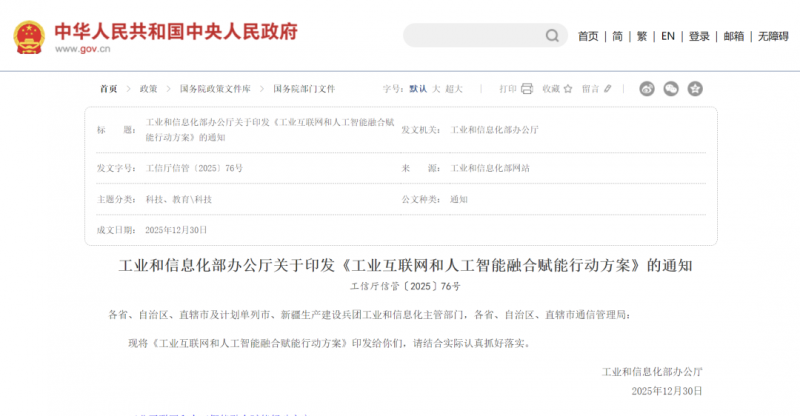
Core Insights - The integration of "Artificial Intelligence + Industrial Internet" is positioned as a core engine for advancing new industrialization, with a focus on transforming policy blueprints into effective industrial upgrades [1][2] - The Ministry of Industry and Information Technology (MIIT) has outlined clear development goals for the industrial internet sector, including the implementation of new industrial network transformations for over 50,000 enterprises by 2028 and the cultivation of more than 450 influential platforms [1][2] - The industrial internet's core industry scale is projected to exceed 1.6 trillion yuan by 2025, driving an increase in industrial added value of approximately 2.5 trillion yuan [1] Policy Developments - The MIIT has released the "Action Plan for High-Quality Development of Industrial Internet Platforms (2026-2028)", which includes specific targets such as exceeding 1.2 billion connected industrial devices and achieving a platform penetration rate of over 55% by 2028 [1][2] - The "Fusion Empowerment Action Plan" emphasizes upgrading foundational infrastructure and ensuring data model interoperability to enhance the integration of AI and industrial internet [2][3] Industry Challenges - The industrial sector has faced challenges due to unclear transformation paths, leading to fragmented progress and a lack of replicable models for different industries and enterprise sizes [3][4] - The "Action Plan" aims to provide a systematic transformation guide, addressing issues such as data silos and weak foundational support [3][4] Technological Innovations - The "Action Plan" prioritizes upgrading the intelligence level of industrial internet platforms and enhancing industrial computing power, recognizing the importance of a stable foundation for successful transformation [4] - The integration of AI technologies with industrial applications is crucial, with companies like Kaos COSMOPlat leading the way through innovative architectures and tailored solutions for various industries [8][9] Data Governance - Effective data governance is essential for unlocking the value of industrial data, with the "Action Plan" promoting the establishment of a trusted data circulation space and mechanisms for data asset registration and revenue distribution [6][12] - Kaos COSMOPlat has developed a comprehensive data governance and model application system, facilitating the flow and value realization of industrial data [12][13] Ecosystem Development - The "Action Plan" calls for the implementation of a "chain-network collaboration" project to cultivate high-level intelligent solution providers, with Kaos adopting an ecosystem model that promotes collaboration between large and small enterprises [15][20] - Kaos has established a global network of lighthouse factories and actively participates in international standard-setting, contributing to the development of a cohesive industrial ecosystem [15][20] Conclusion - The practices of Kaos COSMOPlat serve as a comprehensive framework for leading the transformation of the industrial sector, aligning with the policy directives outlined in the "Action Plan" and accelerating the integration of AI and industrial internet [16][19]
聚焦垂直场景,工业大模型商业化加速
2 1 Shi Ji Jing Ji Bao Dao· 2025-07-29 09:50
Core Insights - The year 2023 marks a period of rapid development and popularization of general large models, while 2024 and beyond will see the application of various specialized large and small models in vertical fields, becoming a major trend in the integration of artificial intelligence across industries [1] - Industrial sectors, characterized by complex production processes and clear mechanisms, are identified as key areas for the commercialization of vertical large models [1] Group 1: Industrial Applications - Industrial large models are being applied in energy conservation, manufacturing, and management, with expectations for accelerated commercialization as data accumulation enhances model capabilities [1] - The introduction of large models can significantly improve production accuracy, with average accuracy rates increasing from 70% to 90% in complex manufacturing processes [2] - Large models facilitate the integration of various energy mediums and types of water used in production, allowing for comprehensive decision-making in energy conservation efforts [2] Group 2: Challenges and Solutions - Challenges include the limited understanding of production processes by personnel and the lack of integration between independent systems, which hampers effective energy efficiency control [3] - The introduction of large models enables comprehensive energy and carbon management, creating a unified service model that enhances operational efficiency [4] - Data issues remain a significant barrier, with many facilities lacking real-time data collection capabilities, which is essential for deploying large models effectively [6] Group 3: Implementation Strategies - The fastest implementation projects are often retrofitting older facilities, particularly in the energy sector, which yields immediate economic benefits and encourages further digitalization efforts [6] - Service providers are also engaging in new facility construction, establishing digital twin systems to facilitate comprehensive large model integration across the entire production chain [7] - The combination of immediate results and flexible implementation strategies is accelerating the commercialization of industrial large models, providing better adaptability and customized solutions for various application scenarios [7]
AI赋能新型工业化 推动制造业迈向智能化新阶段
Shang Hai Zheng Quan Bao· 2025-07-28 18:58
Group 1 - The World Artificial Intelligence Conference 2025 highlighted the latest advancements in AI-enabled new industrialization, focusing on four major trends in manufacturing: data as a key production factor, human-machine collaboration becoming mainstream, intelligent manufacturing transitioning from "point" to "area," and enhanced capabilities for value-added services [1] - The integration of AI and industrial internet is showcased by Haier Group's subsidiary, showcasing innovations in industrial models, digital twins, and intelligent entities, with practical cases aiding companies like Yanchang Petroleum and New Jin Group in their transformation [1] - The launch of the "AI + Manufacturing" initiative aims to enhance the industrial internet sector, with significant growth expected in applications such as predictive maintenance and intelligent supply chain management [2] Group 2 - The industrial internet industry is projected to grow, particularly in sectors like petrochemicals and home appliances, driven by the application of large models and intelligent entities, leading to significant improvements in production efficiency and quality [2] - AI is expected to transform management models by breaking down information silos in enterprise systems, enabling deeper integration and profound changes in operations [2] - China Unicom is enhancing the integration of digital and physical realms, supporting the construction of smart factories across various industries, and accelerating the digital twin development of industrial equipment [2] Group 3 - China Telecom, in collaboration with the China Industrial Internet Research Institute, launched an "Industrial + AI" integrated service platform, demonstrating a large industrial weaving machine with an embedded intelligent entity that significantly improves delivery rates and production efficiency [3] - Financial institutions, including major banks, announced a credit facility of 400 billion yuan to support the development of "AI + Manufacturing," emphasizing the critical role of finance in this sector [3]