
天治量化核心精选A

Search documents
刚刚过去的蛇年,你的基金赚钱了吗?
Sou Hu Cai Jing· 2026-02-25 09:15
Core Insights - The A-share market experienced a significant structural bull market during the Snake Year (January 29, 2025 - February 16, 2026), with the Shanghai Composite Index returning to 4000 points after ten years, while global capital markets showed a trend of strong stocks and stable bonds, alongside a historic surge in precious metals [2][3]. Market Performance - The A-share market saw substantial gains, with the Shanghai Composite Index rising by 25.58%, the Shenzhen Component Index by 38.84%, and the ChiNext Index by 58.73%. The Hong Kong market also performed well, with the Hang Seng Index increasing by 32.04%. Precious metals saw remarkable increases, with the Wande Silver Industry Index and Wande Gold Industry Index rising by 295.37% and 127.66%, respectively [3][4]. Fund Performance - The Snake Year was a "harvest year" for the public fund industry, with an average return of 24.13% across 12,027 funds, where 97.41% of funds achieved positive returns. Commodity funds led with an average return of 60.78%, while active equity funds averaged 39.82% with nearly 99% achieving positive returns. Index funds also performed well with an average return of 37.97%, and bond funds provided stable returns averaging 3.85% [4][5]. Top Performing Funds - A total of 170 funds achieved returns exceeding 100%, with six funds surpassing 150%. The top three funds were all focused on technology themes, with returns of 221.41% for Yongying Technology Select A, 171.25% for Huashang Balanced Growth A, and 163.23% for AVIC Opportunity Navigator A. Additionally, several funds related to non-ferrous metals also performed strongly, with returns exceeding 120% [5][6]. Underperforming Funds - Despite the overall strong market performance, 311 funds recorded negative returns, with 15 funds experiencing declines of over 10%. The worst performer was Tongtai Huize A, with a return of -21.17%, attributed to a change in fund management and a shift in investment focus [7][9].


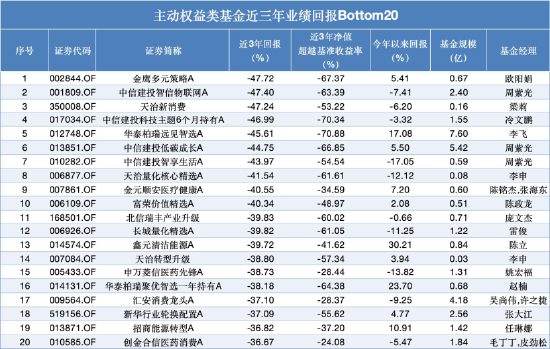
权益类基金三年业绩“黑榜”:10只产品亏损超40%,金鹰多元策略A跌48%垫底,中信建投、天治多只基金上榜
Xin Lang Cai Jing· 2025-12-26 10:22
Core Insights - The A-share market experienced a comprehensive upward trend in 2025, with significant recovery in market sentiment [1] - As of December 25, nearly 4,700 active equity funds were analyzed, with only 194 showing negative returns this year, while over 4,500 achieved positive returns [1][5] - A total of 83 funds reported annual returns exceeding 100%, with the top ten funds all surpassing 144% [1] - The top twenty funds over a three-year period had returns exceeding 160%, with an average return of 193% [1][5] - The worst-performing twenty funds averaged a loss of nearly 41% over the same period, highlighting a stark contrast with top performers [1][6] Fund Performance - The fund with the worst performance, Jin Ying Multi-Strategy A, recorded a loss of 47.72%, followed closely by CITIC Construction Investment Smart IoT A and Tianzhi New Consumption, both exceeding 47% losses [2][6] - Despite the overall market uptrend, ten funds still reported negative returns this year, with CITIC Construction Investment Smart Life A down 17.05% and Shenyin Wanguo Medical Pioneer A down 13.82% [7] - The underperforming funds primarily consisted of flexible allocation and equity mixed funds, many of which were themed around popular sectors like technology and new energy [7] Management and Size Analysis - CITIC Construction Investment Fund was notably affected, with four of its products appearing in the bottom twenty, managed by Zhou Ziguang, whose funds underperformed their benchmarks by over 54% [7] - Tianzhi Fund also had three products in the bottom list, with two managed by Li Shen, showing significant underperformance against benchmarks [7] - Most underperforming funds were categorized as "mini funds," with 15 having assets under 200 million yuan, and Tianzhi Transformation Upgrade nearing liquidation with only 0.03 billion yuan [3][7] Investment Style and Future Outlook - Some funds failed to manage drawdowns effectively during adjustments in sectors like new energy and healthcare, exemplified by Shenyin Wanguo Medical Biology A, which lost 38.73% over three years [8] - The future of the industry is expected to trend towards more refined and transparent fund assessment systems, with a focus on long-term performance metrics [8] - This shift aims to promote rational investment behavior and encourage fund managers to focus on long-term industry trends and corporate value, fostering sustainable benefits for investors [8]

53只翻倍基扎堆科技医药,关税再扰动市场怎么走?
Di Yi Cai Jing· 2025-10-13 11:13
Core Viewpoint - The A-share market has shown a clear "track market" characteristic this year, with significant performance in sectors like AI and innovative pharmaceuticals, while traditional sectors like consumption and banking are struggling [1][2]. Group 1: Market Performance - As of October 10, 2023, 53 funds have doubled their performance year-to-date, with 43 of these being actively managed equity products, highlighting the advantage of active management in a structural market [2][3]. - The technology and pharmaceutical sectors have emerged as the biggest winners, with top-performing funds like Yongying Technology Smart A achieving a return of 187.86% [2]. - The overall performance of the A-share market has been mixed, with over 96% of equity products showing positive returns, but 20 funds still experiencing declines of over 10% [3]. Group 2: Impact of External Factors - The recent escalation of the US-China tariff conflict has introduced new uncertainties to the market, with the A-share indices experiencing slight declines on October 13, 2023 [1][5]. - Analysts believe the current market reaction to the tariff threat is different from the sharp declines seen in April, as the market has become somewhat immune to such threats due to previous experiences [5][6]. - The consensus among analysts is that while short-term market fluctuations may occur, the long-term focus on technology and growth sectors remains unchanged [7]. Group 3: Investment Strategies - In light of the current market conditions, it is suggested that investors focus on funds with mature strategies and stable teams, balancing performance with stability [4]. - The recommendation is to wait for short-term market risks to fully materialize before increasing positions, while maintaining a focus on sectors with clear growth trends like AI and innovative pharmaceuticals [7].
最高近190%!前三季度37只基金收益翻倍!AI主题表现领跑
Sou Hu Cai Jing· 2025-09-30 12:53
Core Viewpoint - The A-share and Hong Kong stock markets have shown a continuous upward trend since mid-April, achieving new highs in the third quarter, with equity funds yielding significant returns [1] Group 1: Active Equity Funds - A total of 37 funds have doubled their returns this year as of September 26, with 31 active equity funds in A-shares achieving over 100% returns [2][4] - The average return for active equity funds is 30.32%, with over 98% of these funds reporting positive returns [4] - The top-performing fund, Yongying Technology Smart Selection A, has a return rate of 189.58%, significantly boosted by its focus on AI concept stocks [4][6] Group 2: Passive Index Funds - Nearly 98% of index funds have achieved positive returns, with an average return of 27.53% [7] - Funds tracking innovative drugs, communications, and artificial intelligence have outperformed, with the top two funds yielding returns of 103.96% and 100.59% [7] - Underperforming index funds are primarily those tracking energy, food and beverage, and coal sectors, with losses exceeding 5% [7] Group 3: QDII Funds - QDII funds focused on the Hong Kong market, particularly in innovative drug assets, have performed well, with four funds exceeding 100% returns [3][8] - The top-performing QDII fund, Huatai Bairui Hang Seng Innovation Drug ETF, has a return of 152.25% [8] - Other notable funds in this category have also shown strong performance, with several exceeding 90% returns [8]
逾300只量化基金净值创历史新高 小微盘“高光”背后有何风险?
Di Yi Cai Jing· 2025-07-30 03:22
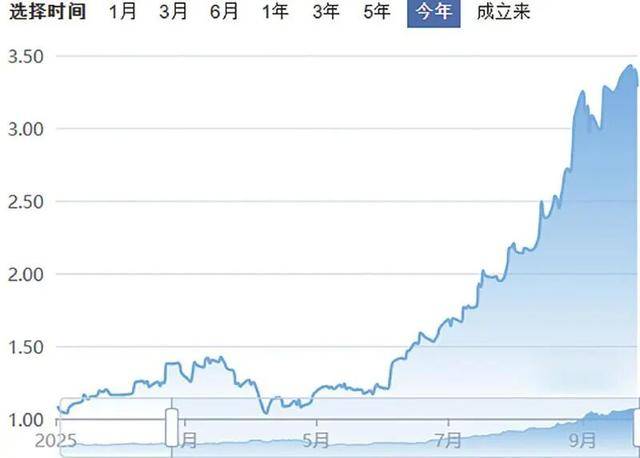
Group 1 - The A-share market has recently rebounded, with small-cap stocks outperforming the broader market significantly, leading to a collective rise in the net value of quantitative public funds, with over 97% achieving positive returns this year [1][2][3] - The Wind data shows that as of July 28, 314 out of 652 quantitative public funds have refreshed their historical net value highs, representing over 48% of the total [2][3] - The small-cap stock index reached a historical high of 476,824.12 points on July 29, with a year-to-date return of 50.23%, significantly outperforming larger indices [2][3] Group 2 - Due to the limited capacity of small-cap stocks to absorb funds, several high-performing products have implemented purchase limits, with some reducing the daily purchase limit to as low as 1,000 yuan [3][4] - Approximately 28 quantitative products are currently under restrictions for large purchases, with some tightening their purchase limits further [4] - Fund managers indicate that maintaining a comfortable management scale around 20 billion yuan is crucial for effective strategy execution [4] Group 3 - Despite the strong performance of small-cap stocks, there are emerging risks, including high crowding in small-cap strategies, which could lead to significant downturns if market sentiment shifts [6][7][8] - Analysts have noted that the current rally in small-cap stocks is heavily reliant on sentiment and liquidity rather than solid performance fundamentals, raising concerns about potential valuation bubbles [6][7] - Fund managers have cautioned about the risks associated with high crowding and the need for careful monitoring of market volatility and external uncertainties [7][8]
逾300只量化基金净值创历史新高,小微盘“高光”背后有何风险?
Di Yi Cai Jing· 2025-07-30 03:09
Group 1 - The core viewpoint of the articles highlights the strong performance of small-cap stocks in the A-share market, significantly outperforming larger indices, leading to a surge in public quantitative fund net values, with over 97% of these funds achieving positive returns this year [1][2][3] - The Wind data indicates that as of July 28, 314 out of 652 public quantitative funds have reached historical net value highs, representing over 48% of the total [2][3] - The small-cap stock index reached a historical high of 476,824.12 points on July 29, with a year-to-date return of 50.23%, while the mid-cap indices also showed substantial gains compared to larger indices [2][3] Group 2 - Due to the limited capacity of small-cap stocks to absorb funds, several high-performing products have implemented purchase limits, with some reducing daily purchase limits to as low as 1,000 yuan [3][4] - Approximately 28 quantitative products, including the CITIC Prudential Multi-Strategy Fund, have suspended large purchases, indicating a trend towards tighter purchase limits across the sector [4] - Fund managers suggest that a comfortable management scale for small-cap products is around 20 billion yuan, with a target position maintained between 60% to 80% to manage risks effectively [4] Group 3 - Analysts express concerns about the high "crowding" in small-cap stocks, which could lead to significant risks if market sentiment shifts, although the likelihood of extreme adjustments similar to early 2024 is considered low [6][7][8] - The reliance on sentiment and liquidity in small-cap stocks has raised concerns about their underlying fragility, with many stocks driven by themes rather than solid performance, leading to potential valuation bubbles [6][7] - Fund managers have cautioned about the need to monitor market volatility closely and prepare for potential risks, emphasizing that the current high levels of investment in small-cap stocks may not be sustainable [7][8]