巧克力换电站

Search documents
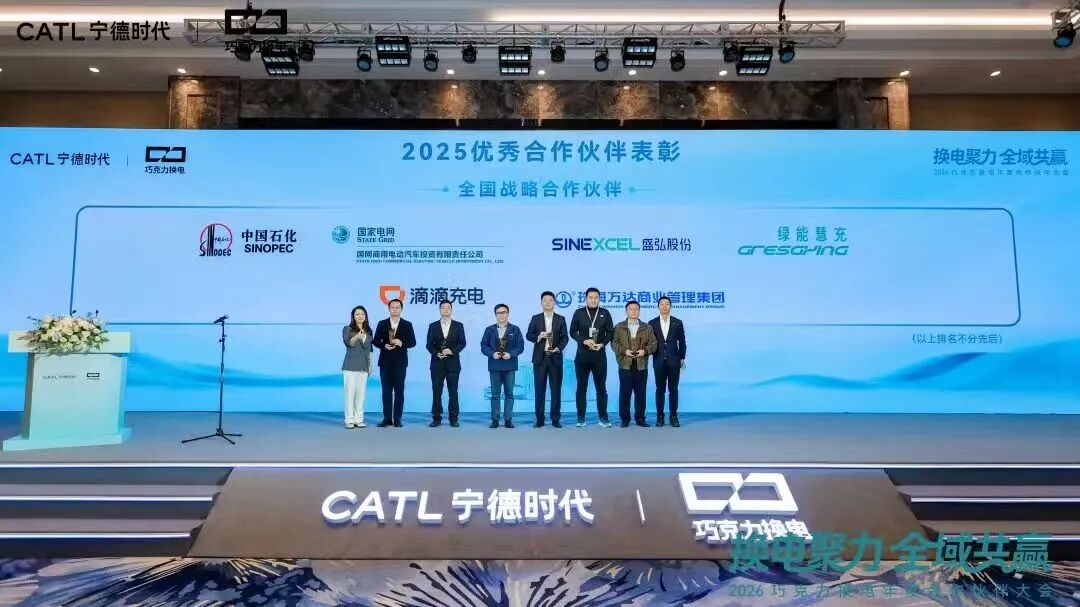
瞄准电车「加油站」,宁德时代再建万亿公共换电生态
3 6 Ke· 2026-02-07 10:25
Core Insights - CATL is transitioning from a battery manufacturing company to a comprehensive energy service provider, focusing on building a battery swapping ecosystem in collaboration with various partners [1][5][29] Group 1: Business Strategy and Partnerships - CATL held a low-profile annual partner conference in Xiamen, featuring companies like Sinopec and Didi, indicating a shift towards collaboration in building a charging ecosystem [1] - The company aims to establish 30,000 battery swapping stations across China, with a target of over 3,000 stations by the end of 2026 [3][4] - CATL's subsidiary, Times Electric, has demonstrated strong execution capabilities by rapidly building 1,000 swapping stations within a year, showcasing organizational efficiency [4][28] Group 2: Market Position and Competition - The battery swapping model is gaining traction, with CATL's approach aiming to compete with established players like NIO, which currently operates around 3,700 swapping stations [3][4] - The company is positioning itself to capture a significant share of the growing electric vehicle market, which saw a penetration rate of 52% in 2025 [7][22] Group 3: Technological and Operational Efficiency - CATL is focusing on standardizing battery packs to cover 95% of electric vehicle models, enhancing compatibility and operational efficiency [10][25] - The company has developed a robust operational model, evidenced by the successful establishment of over 70 swapping stations in Chongqing, achieving a high user satisfaction rate [16][18] Group 4: Future Outlook and Market Trends - The demand for efficient and sustainable energy solutions is driving the need for a comprehensive battery swapping infrastructure, which CATL aims to fulfill [6][12] - The company is leveraging its technological expertise to create a closed-loop battery lifecycle management system, addressing supply chain challenges in lithium sourcing [7][24]


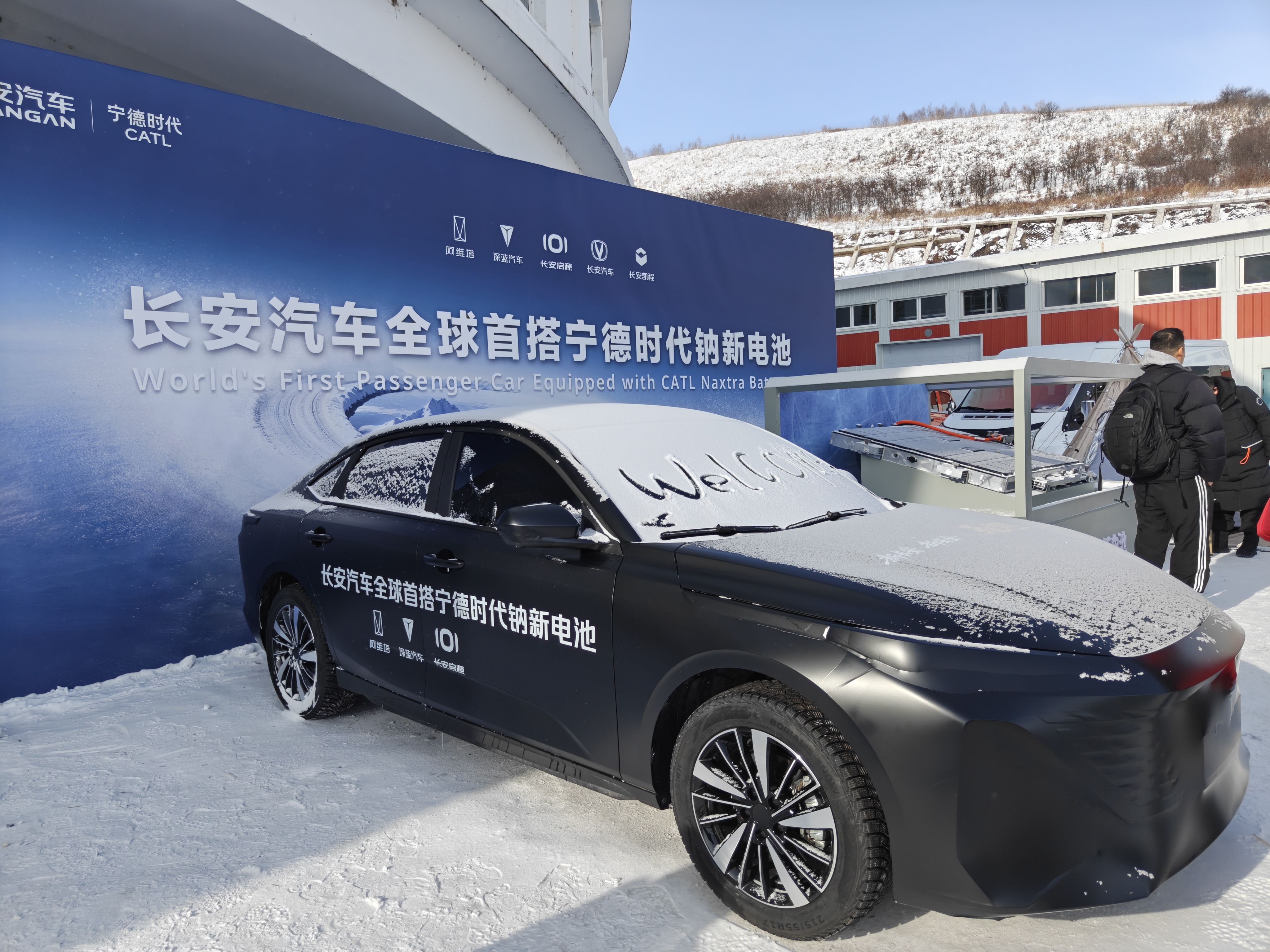
钠电上车!长安宁德时代推出全球首款量产乘用车
Zhong Guo Neng Yuan Wang· 2026-02-06 04:03
Core Viewpoint - Changan Automobile and CATL jointly launched the global sodium battery strategy and unveiled the world's first mass-produced passenger vehicle equipped with CATL's sodium battery technology at a conference held in Inner Mongolia [1]. Group 1: Product Launch and Features - The first mass-produced sodium battery vehicle has completed rigorous winter validation tests in Yakeshi, achieving over 400 kilometers of pure electric range with precise battery display [5]. - The sodium battery exhibits exceptional low-temperature performance, with discharge power nearly tripling compared to lithium iron phosphate battery models at -30°C, and maintaining over 90% capacity at -40°C, even functioning at -50°C [5]. - The energy density of the sodium battery cell has reached the industry's highest level of 175Wh/kg [5]. Group 2: Safety and Testing - The sodium battery demonstrated extreme safety features, remaining smoke-free, flame-free, and non-explosive after undergoing severe abuse tests, including crushing and drilling [5]. - Even after being sawed through, the battery pack continued to discharge normally, significantly exceeding national safety standards [5]. Group 3: Future Plans and Investments - CATL plans to build over 3,000 "chocolate" battery swap stations across more than 140 cities by 2026, prioritizing northern regions with severe winter conditions [6]. - The company has invested nearly 10 billion yuan in sodium-ion battery research since 2016, conducting tests on nearly 300,000 battery cells with over 300 R&D personnel involved [6]. - Future advancements in sodium battery technology are expected to enhance pure electric range capabilities to 500-600 kilometers, covering over 50% of the market's range demands [6].

宁德时代钠电池大规模应用于乘用车
Mei Ri Jing Ji Xin Wen· 2026-02-05 06:30
Core Viewpoint - Changan Automobile has officially launched its global sodium battery strategy and unveiled the world's first mass-produced passenger vehicle powered by sodium batteries in Yakeshi, in collaboration with CATL [1] Group 1: Company Developments - Changan Automobile's brands, including Avita, Deep Blue, Qiyuan, and Inertia, will all feature CATL's new sodium batteries in the future [1] - The sodium battery cells developed by CATL have a maximum energy density of 175Wh/kg, enabling pure electric range upgrades to 500km or even 600km, and hybrid range improvements to over 300km or even 400km [1] Group 2: Industry Infrastructure - By 2026, CATL plans to establish over 3,000 chocolate battery swap stations across more than 140 cities nationwide [1]
新增开业47座,巧克力换电全国累计落站1107座
Bei Jing Shang Bao· 2026-01-23 04:03
Core Insights - CATL's Chocolate Battery Swap Stations have expanded significantly, with 41 new stations added and 47 stations opened between January 8 and January 21 [1] - As of January 21, a total of 1,107 battery swap stations have been established nationwide, covering 46 core cities [1]
锂电产业链集结海南:封关红利落地
高工锂电· 2026-01-17 04:13
Core Viewpoint - The article discusses the transformation of Hainan into a significant hub for lithium battery production and green energy, driven by the implementation of a zero-tariff policy and the establishment of a comprehensive industrial chain from resource importation to processing and distribution [2][4]. Group 1: Lithium Industry Developments - Hainan Free Trade Port commenced full island closure operations on December 18, 2025, increasing the proportion of zero-tariff goods from approximately 21% to 74% [2]. - The first lithium signal post-closure was marked by the arrival of about 28,950 tons of lithium concentrate at the Guotou Yangpu Port, marking the first zero-tariff declaration for new energy minerals [3]. - Hainan Mining is advancing a project in Yangpu Industrial Park to produce 20,000 tons of battery-grade lithium hydroxide annually, with a total investment of approximately 1.056 billion yuan, aiming for trial production by February 2025 [5]. Group 2: Electric Vehicle Infrastructure - CATL is establishing a network of battery swap stations in Hainan, with plans to build over 22 swap stations within three years and more than 100 within five years, targeting electric heavy-duty trucks [7][8]. - The establishment of a zero-carbon park construction alliance, led by CATL, aims to promote green transformation and industrial collaboration in Hainan [10]. Group 3: Recycling and Sustainability Initiatives - Ruikemei plans to establish a joint venture in Haikou Comprehensive Bonded Zone to build a facility with a capacity of 20,000 tons per year for processing retired lithium batteries, focusing on green recycling and high-value regeneration for Southeast Asia and the Asia-Pacific region [11]. - The article emphasizes that the closure is not merely about cheaper imports but about facilitating smoother cross-border factor flows and bonded processing for re-export [12]. Group 4: Broader Green Energy Initiatives - Yangpu is also advancing offshore wind power demonstration projects and planning a manufacturing park for wind power equipment, targeting exports and operations in Southeast Asia [14]. - Additional projects, such as green methanol, are being accelerated to meet the demand for green shipping fuels and support the construction of international shipping hubs [15].

长寿命电池+换电网络,宁德时代与蔚来签署全面深化战略合作协议
Sou Hu Cai Jing· 2026-01-06 10:58
Core Viewpoint - CATL and NIO have signed a five-year comprehensive strategic cooperation agreement to deepen collaboration in technology, ecology, and market sectors, aiming to advance the electric vehicle industry in Hefei [1][3]. Group 1: Strategic Cooperation Agreement - The agreement was signed in Hefei by senior executives from both companies, including NIO's CEO Li Bin and CATL's CEO Zeng Yuqun, with local government officials present [1]. - This partnership focuses on enhancing the electric vehicle industry's technological advancements and innovative business models [3]. Group 2: Areas of Collaboration - In the technology sector, the collaboration will emphasize joint development of long-life batteries and battery swap technology, aiming to improve product competitiveness [4]. - In the ecological aspect, both companies will work on establishing battery swap technology standards and sharing resources within the battery-as-a-service (BaaS) model [4]. - In the market domain, they will strengthen brand promotion efforts both domestically and internationally to enhance global market presence and share [4]. Group 3: Investment and Infrastructure Development - CATL is planning a strategic investment of up to 2.5 billion RMB in NIO to further solidify their partnership [6]. - As of January 6, 2026, NIO has established a total of 8,543 charging and battery swap stations, with 3,683 being battery swap stations and 4,860 charging stations [8].

杭州为10位新锐杭商授牌,宇树科技王兴兴等企业家获得表彰;雷军直播回应拆车原因丨智能制造日报
创业邦· 2026-01-04 03:48
Group 1 - CATL has built 1,020 and 305 battery swap stations for its "Chocolate" and "Qiji" services respectively within a year, marking significant progress in both passenger and commercial vehicle sectors [2] - The company plans to establish nearly 4,000 battery swap stations by 2026, with over 3,000 of these in more than 140 cities for the "Chocolate" service, and aims for a long-term goal of 30,000 stations [2] - The "Chocolate" battery swap service is currently operational in 45 cities across major economic regions in China, including the Yangtze River Delta and the Greater Bay Area [2] Group 2 - Lei Jun, during a live stream, addressed the reasons behind the car disassembly event, emphasizing the importance of honest feedback and the quality of materials used in Xiaomi's vehicles [3] - He expressed hope that more reviewers would provide fair assessments rather than exaggerating issues for attention [3] Group 3 - At the sixth Hangzhou Business Conference, ten entrepreneurs, including Wang Xingxing from Yushu Technology, were recognized for their contributions to innovation and technology [4] - Wang highlighted that the next 5 to 10 years will be crucial for China's technological innovation efforts [4] Group 4 - Punkt. has launched the MC03 "privacy phone" priced at €699, which includes a one-year subscription service, followed by a monthly fee of €10 [4] - The manufacturer claims that without a paid subscription, the phone's basic functionalities will be severely limited, emphasizing the importance of privacy in the product's value proposition [4]
雷军直播回应拆车原因:希望大家能说些公道话;宝马中国回应30多款车型降价;罗永浩否认与华为有过节丨邦早报
创业邦· 2026-01-04 01:08
Group 1 - Lei Jun responded to the拆车直播, emphasizing the quality of Xiaomi's vehicles and encouraging fair criticism from reviewers [2] - BMW China announced a price adjustment for 31 models starting January 1, 2026, clarifying that it is not engaging in a price war [3] - The Hong Kong Court upheld a Mareva injunction against former Evergrande CEO Xia Haijun, preventing him from transferring assets worth HKD 60 billion [3] Group 2 - Xiaomi aims to deliver 410,000 vehicles in 2025, showcasing its growth in the automotive sector [7] - Chinese automaker Chery's model, Jetour, became the best-selling vehicle in Israel in 2025, with approximately 13,000 units sold [9] - CATL reported significant progress in battery swap stations, with plans to establish nearly 4,000 stations by 2026 [10] Group 3 - Netflix plans to shorten the theatrical release window for Warner Bros. films to 17 days post-acquisition, raising concerns among traditional cinemas [10] - The 2025 New Year's box office in China surpassed RMB 700 million, with top films including "Zootopia 2" and "Avatar 3" [18] - China's share of the global new energy vehicle market reached 68.4% from January to November 2025, indicating strong performance in the sector [19]



今日新闻丨阿尔宾娜成为宝马子品牌!宁德时代1325座换电站落成!
电动车公社· 2026-01-02 16:00
Group 1 - ALPINA has officially become an independent brand under the BMW Group as of January 1, following the completion of trademark transfer [1][4][6] - The acquisition of ALPINA by BMW was announced on March 10, 2022, but the agreement only took effect this year [1] - BMW ALPINA is positioned to achieve a unique balance between performance and comfort, known for its distinctive driving experience and offering extensive customization options [4][6] Group 2 - CATL has completed the establishment of 1,325 battery swap stations, with the "Chocolate" and "Qiji" swap systems comprising 1,020 and 305 stations respectively [2][8] - These swap stations provide services for both passenger and commercial vehicles, marking a new phase in the scale network layout of battery swapping services [8][10] - Current models utilizing the Chocolate swap stations include GAC Aion UT Super, FAW Bestune battery swap version, and Changan Auchan 520, indicating CATL's extensive deployment across the country [10]
【快讯】每日快讯(2025年12月31日)
乘联分会· 2025-12-31 08:39
Domestic News - The National Development and Reform Commission and the Ministry of Finance announced a policy to support the scrapping and replacement of vehicles in 2026, offering subsidies of 12% (up to 20,000 yuan) for new energy vehicles and 10% (up to 15,000 yuan) for fuel vehicles with an engine size of 2.0 liters or less [3] - Four departments issued the "Automobile Industry Digital Transformation Implementation Plan," aiming for significant improvements in manufacturing capabilities and digitalization by 2027, including a 10% increase in labor productivity and a 20% reduction in product development and delivery cycles [4] - The National Energy Administration reported that as of November, there are 7.05 million charging facilities built in highway service areas across the country, contributing to a total of 19.32 million charging facilities nationwide [5] - Xiaopeng Motors' chairman stated that the next generation of fully autonomous driving will arrive in 2026, transitioning from L2 to L4 capabilities [6] - Leap Motor announced four service commitments, including free roadside assistance during holidays and clear visibility of maintenance costs through their app [7] - Tesla's global production reached 9 million electric vehicles, with the latest unit being a Model Y produced at the Shanghai Gigafactory [8] - Firefly officially launched in Austria, marking rapid expansion in Europe since its initial release [9] - CATL's "Chocolate" battery swap station network reached its 1,000th station, with plans to expand to over 3,000 stations by 2026 [10] Commercial Vehicles - Weichai's new energy commercial vehicles received a 36-month COP certification in Vietnam, marking a significant step in compliance for the market [16] - Foton Motor announced the mass production of its "Star" series electric light trucks, with a projected output of 32,000 units in 2025 [17] - The 2026 national subsidy policy will prioritize support for the replacement of old commercial vehicles with electric ones [18] - Zhuoyue Technology has initiated a heavy-duty truck NOA project, with the first models expected to be produced in the first half of 2026 [20]