布鲁可拼搭玩具

Search documents
2025年第37周:跨境出海周度市场观察
艾瑞咨询· 2025-09-25 00:03
Group 1: Long Video Overseas Expansion - The Southeast Asian streaming market is intensifying, with an expected market size of $6.8 billion by 2030. Chinese platforms like iQIYI, WeTV, and Youku are challenging Netflix through differentiated strategies, such as high-budget local original content and flexible subscription models [3][4] - iQIYI focuses on high-budget local original content and flexible subscription models, while WeTV emphasizes idol cultivation to enhance user engagement. Youku exports mature variety show formats [3] - Chinese platforms are leveraging low subscription prices, deep localization, and local payment advantages to capture market share, particularly in Thailand where their share exceeds 40% [3][4] Group 2: New Energy Heavy Trucks Going Global - The global new energy heavy truck sector is undergoing significant transformation, with Chinese manufacturers making breakthroughs in overseas markets. The year 2025 is seen as a "breakout year" for Chinese new energy heavy trucks, with exports increasing by 200% from January to July this year [5] - Companies like DeepWay and Weitu Technology have successfully entered markets in the Middle East, Europe, and Southeast Asia through technological innovation and flexible mechanisms [5] - Key competitive advantages include technological breakthroughs and customized products, such as DeepWay's battery swap system and high-temperature resistant models [5] Group 3: Home Furnishing Industry Going Global - The Chinese home furnishing industry is shifting towards a "strategic deep cultivation" approach, with the global furniture retail market expected to reach $800 billion by 2025. North America remains the primary target market, while emerging markets like Southeast Asia and the Middle East are also gaining attention [7][8] - Companies face challenges from trade changes and supply chain adjustments, making traditional price competition unsustainable. Key strategies include supply chain integration, R&D investment, and precise marketing to enhance competitiveness [7][8] Group 4: Chinese Brands Globalization - Chinese tea brands are rapidly rising in Southeast Asia, with Mixue Ice City as a standout performer. The region's cultural proximity and young population make it an ideal market for tea brands [9] - Mixue Ice City has become a leading brand in Southeast Asia within five years, achieving revenue of 14.87 billion yuan in the first half of 2025 and over 50,000 global stores [9] - The success of Mixue's strategy includes supply chain cost reduction, localized IP, and refined operations, with its coffee brand also leveraging the same approach for global expansion [9] Group 5: Robotics Industry Going Global - Chinese robotics products are rapidly expanding in overseas markets, with some leading companies achieving over 50% of their revenue from abroad. However, data security and privacy issues pose significant challenges for startups [10] - Companies are adopting AI tools for vulnerability scanning and traffic monitoring to enhance security. Emphasis is placed on "entering the sea" rather than merely "going out," integrating into international ecosystems [10] Group 6: Xiaomi's Globalization Strategy - Xiaomi has transitioned from product export to "model export," covering over 100 markets since its global journey began in 2014. The company plans to open 10,000 Xiaomi Home stores overseas in the next five years [11][12] - Xiaomi's strategy includes high-end positioning in Europe and maintaining market share in emerging markets, with significant growth in high-end smartphone sales [11][12] Group 7: Domestic Beauty Brands Accelerating Global Expansion - Domestic beauty brands are seeking new growth through multi-brand matrices and overseas investments, with top companies like Proya and Shiseido leading the way [13] - The beauty industry is shifting focus from domestic competition to international collaboration, with brands needing to enhance their brand power and supply chain capabilities for successful globalization [13] Group 8: Flying Book's Globalization Efforts - Flying Book, a global office platform, integrates AI and collaboration capabilities to assist companies in their overseas expansion. It addresses organizational management and compliance challenges for multinational enterprises [14] Group 9: iFLYTEK's AI Global Strategy - iFLYTEK achieved a revenue of 10.911 billion yuan in the first half of 2025, with a 38% growth in C-end business. The company emphasizes the importance of self-control in its strategic direction [15][16]



轻工消费2025年夏季策略:新消费需求多点迸发,竞争格局重构进行时
Shenwan Hongyuan Securities· 2025-07-11 11:44
Group 1 - The report highlights the emergence of new consumer demands driven by generational changes, with the Z generation becoming the main consumer force, leading to a restructuring of the competitive landscape in the consumer goods sector [3][5][11] - The growth of domestic brands is emphasized, particularly in categories such as personal care, pet products, and home goods, where companies like Baiya Co., Ltd. and Dengkang Oral Care are gaining market share through innovative products and effective marketing strategies [5][19][24] - The report identifies significant opportunities in the AI-driven product categories, such as AI mattresses and AI glasses, which are expected to see high growth in the medium to long term [5][19][29] Group 2 - The housing market is projected to stabilize, with policies encouraging home upgrades and replacements, which will drive demand for home goods, particularly in the AI mattress segment [6][9] - The packaging industry is undergoing a global supply chain restructuring, leading to accelerated consolidation and improved profitability for leading companies [7][10] - The report notes that the export sector is expected to see a reduction in the impact of tariff policies, allowing for better growth prospects in overseas markets [10][19] Group 3 - The report discusses the rise of IP-derived products, particularly in the emotional consumption space, where younger consumers are increasingly drawn to products that fulfill social and emotional needs [34][37][43] - Companies like Bluku and Chengyuan Co., Ltd. are highlighted for their innovative approaches in the IP toy market, leveraging strong brand partnerships and diverse product offerings to capture market share [44][49][56] - The report emphasizes the importance of digital marketing and e-commerce strategies in driving sales for companies in the consumer goods sector, particularly in the context of changing consumer behaviors [50][52][61]



万达押注、冲刺港股的52TOYS,收入不及泡泡玛特5%、市占仅1.2%
Xin Lang Cai Jing· 2025-05-27 16:52
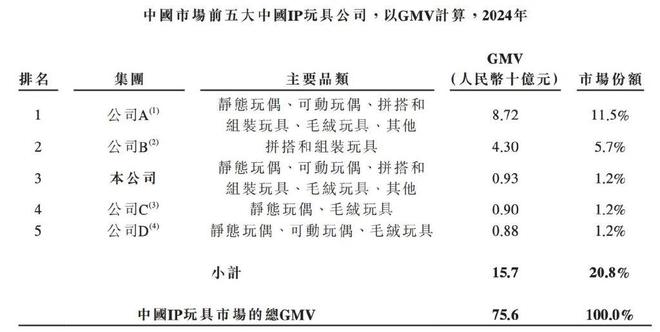
Core Viewpoint - The company Lezi Tiancheng is seeking to go public on the Hong Kong Stock Exchange, with its main brand 52TOYS being a leading player in the Chinese IP toy market, which is rapidly growing due to the "Guzi Economy" trend [1][3]. Market Position - According to the prospectus, 52TOYS is the third-largest IP toy company in China by GMV, with a projected GMV of 0.93 billion RMB for 2024, which is significantly lower than the leading companies, Pop Mart and Blok, whose GMVs are 8.72 billion RMB and 4.30 billion RMB respectively [2][3]. - The overall Chinese IP toy market is expected to grow from 48.6 billion RMB in 2020 to 75.6 billion RMB in 2024, with 52TOYS currently holding a market share of 1.2% [3][4]. Financial Performance - 52TOYS's revenue from 2022 to 2024 is projected to be 463 million RMB, 482 million RMB, and 630 million RMB respectively, which is less than 5% of Pop Mart's revenue in 2024 [3][4]. - The adjusted net profit for 52TOYS is expected to be -57 million RMB in 2022, 19 million RMB in 2023, and 32 million RMB in 2024, indicating a struggle to achieve significant profitability [4][5]. Profitability and Cost Structure - The gross margin for 52TOYS is relatively low, at 28.9% in 2022, 40.5% in 2023, and 39.9% in 2024, compared to competitors like Pop Mart and Blok, which have gross margins of 66.8% and 52.6% respectively [5][6]. - A significant portion of 52TOYS's revenue comes from licensed IP, which accounted for 50.2% in 2022 and is expected to rise to 64.5% by 2024, leading to high IP licensing costs [5][6]. Investment and Future Prospects - Despite its current performance, the company has attracted significant investment, including a recent 144 million RMB investment from Wanda Film and China Ruyi, indicating confidence in its future growth potential [7][9]. - The company plans to expand its self-operated stores in China and overseas, aiming to reduce reliance on distributors and improve profit margins [14][15]. International Expansion - 52TOYS has been expanding its international presence, with overseas revenue growing from 35.4 million RMB in 2022 to 147.4 million RMB in 2024, representing a growth rate of 149.15% year-on-year [15][16]. - The company aims to leverage partnerships with major film and gaming IPs to enhance its product offerings and market reach [12][14].