
弗缦

Search documents
千元童颜针遭上游厂商“围剿”?新氧创始人:对业务没有太大影响
Xin Lang Cai Jing· 2026-01-29 05:56
Core Viewpoint - The CEO of New Oxygen Group, Jin Xing, stated that the friction with upstream suppliers has not significantly impacted the company's business, despite some suppliers expressing concerns about the company's pricing strategy and product sourcing [1][2][6]. Group 1: Pricing Strategy and Market Impact - In September 2025, New Oxygen launched the "Youth Needle" product priced at 2999 yuan, which is significantly lower than the market price of over 10,000 yuan, disrupting the existing pricing structure of upstream manufacturers [1][6]. - Despite backlash from several upstream manufacturers, including claims of unauthorized product sourcing and training issues, sales of the "Youth Needle" reportedly surged in October, November, and December 2025, indicating strong consumer acceptance [2][6][7]. Group 2: Business Expansion and Partnerships - As of January 8, 2026, New Oxygen has established 50 clinics across 16 cities and achieved a cumulative treatment volume of 1 million [3][6]. - New Oxygen announced the formation of the "Youth Premium Alliance" with 14 upstream manufacturers, aiming to enhance collaboration through price-volume linkage, tiered supply, training, and product traceability [3][6]. Group 3: Industry Dynamics and Future Outlook - The medical beauty industry is experiencing a shift towards a buyer's market, with an increasing number of suppliers providing more options for medical institutions, which can now select long-term partners and customize products based on their needs [4][7]. - The industry has seen a significant increase in the issuance of medical device certifications, with 52 Class III medical device certificates issued in 2025, suggesting a growing supply landscape [4][7].

双证落地、竞争升级,胶原蛋白赛道谁能抢占下一程?
Bei Jing Shang Bao· 2025-12-18 09:00
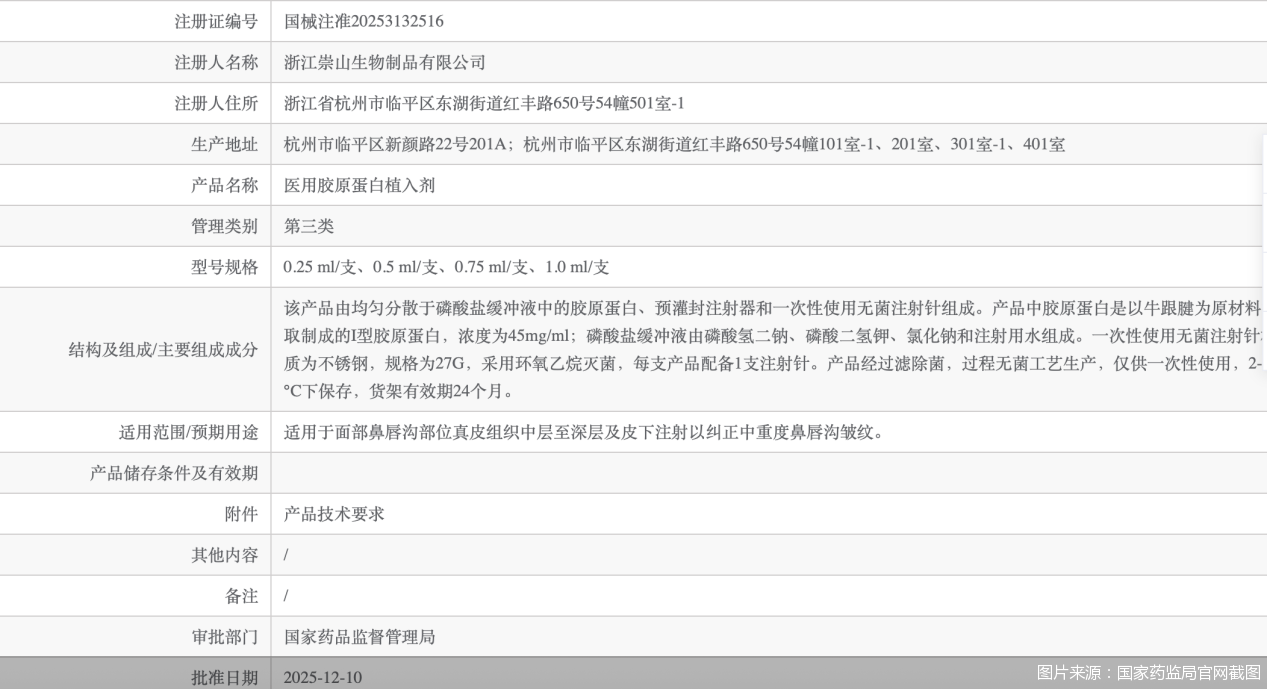
Core Viewpoint - The collagen market is undergoing significant changes with the approval of new products from Chongshan Bio and Aibai Rui, expanding the competitive landscape in the animal-derived collagen sector. The focus is shifting towards differentiation in terms of cost-effectiveness, brand recognition, product safety, and efficacy as the market becomes increasingly crowded [1][2]. Group 1: New Product Approvals - Chongshan Bio's new product is the world's first collagen implant with a concentration of 45mg/ml, aiming to establish a strong product image through high concentration [2]. - Aibai Rui's new product targets specific needs by improving cheek smoothness, attempting to create a niche in the market despite similarities to existing products [4]. Group 2: Market Dynamics - The animal-derived collagen market has formed an "eight strong" competitive landscape, with established players like Shuangmei Bio leading the market due to their early entry and established brand recognition [6]. - New entrants are focusing on differentiation strategies, such as high-quality ingredients and innovative product forms, to compete effectively [6]. Group 3: Growth of Recombinant Collagen - The recombinant collagen market is experiencing rapid growth, with a projected compound annual growth rate (CAGR) of 41.4% from 2023 to 2027, surpassing the 27.7% CAGR of animal-derived collagen [8]. - The market size for recombinant collagen products in 2023 is estimated at 28.63 billion yuan, slightly below the 29.79 billion yuan for animal-derived collagen, indicating a shift in consumer preference towards recombinant options [8]. Group 4: Competitive Landscape and Future Outlook - The approval of new recombinant collagen products is intensifying competition, with companies like Jinjian Bio and others entering the market, challenging the previous dominance of Jinbo Bio [9]. - The future of the collagen market will likely see increased competition, with a focus on cost-effectiveness, brand strength, and product efficacy becoming critical for success [12].

童颜针949元拼团价惹厂商抵制 新氧回应称挤价格泡沫
Zhong Guo Jing Ji Wang· 2025-12-17 06:52
Core Viewpoint - The pricing power battle in the medical aesthetics industry is intensifying, with New Oxygen (SY.O) challenging upstream manufacturers over the pricing of its "youthful needle" products, leading to significant price reductions and disputes regarding product sourcing and compliance [1][2][3]. Group 1: Pricing Strategy and Market Dynamics - New Oxygen launched its "Miracle Youth 1.0" at a price of 4,999 yuan per unit, marking the first time the market price for youthful needles reached the 5,000 yuan range, while the manufacturer's price was 16,800 yuan per unit [1]. - In June, New Oxygen introduced "Miracle Youth 2.0" at 5,999 yuan per unit, using a product from Saint Boma, which has a market average price of approximately 18,800 yuan per unit [1]. - On December 15, New Oxygen's youth clinics offered a group purchase price as low as 949 yuan per unit, representing a drastic reduction of about 95% compared to the manufacturer's controlled price of 16,800-18,800 yuan per unit [2]. Group 2: Manufacturer Responses and Industry Implications - Multiple upstream manufacturers have publicly distanced themselves from New Oxygen, with Fiman Bio announcing it ceased supplying products to New Oxygen and its clinics, warning that continued sales could indicate non-compliance or counterfeit products [2]. - New Oxygen argues that the ongoing pricing battle reflects a structural shift in the medical aesthetics market from a "seller's market" to a "buyer's market," driven by the approval of more products like youthful needles and hyaluronic acid [2]. - The company believes that a rational price return will benefit both upstream and downstream players, allowing for stable orders that can reduce production and R&D costs, while also fostering healthier customer acquisition and repurchase models [3].
上万元的“童颜针”现在只卖900多元 背后原因揭秘
Zhong Guo Neng Yuan Wang· 2025-12-16 23:37
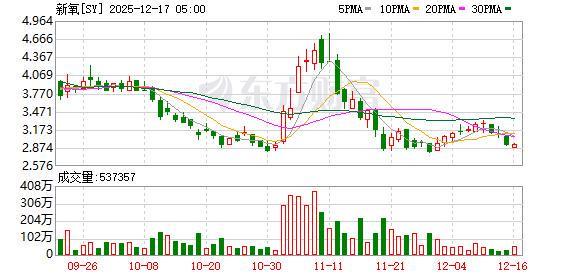
Core Viewpoint - The low-price strategy of the medical beauty company New Oxygen has intensified conflicts with upstream suppliers, leading to resistance from multiple vendors and a significant drop in its stock price [2][3]. Group 1: Supplier Conflicts - On December 11, the collagen filler manufacturer Faiman Biotech announced it had stopped supplying products to New Oxygen since October 1, claiming that continued sales would imply products were obtained from non-compliant channels or were counterfeit [2]. - Another manufacturer, Puliyan, listed over 40 New Oxygen clinics as "non-official cooperative medical institutions," while Saint Boma stated that New Oxygen's sales of its product "Aivilan" were through non-compliant channels [2][3]. - In response to supplier pushback, New Oxygen's clinic issued a statement accusing suppliers of maintaining a high-price system that undermines the pricing autonomy of medical institutions [2]. Group 2: Pricing Strategy - New Oxygen's pricing strategy has led to significant price reductions, with its own brand "Miracle Youth 3.0" priced at 999 yuan for the basic version and 2999 yuan for the upgraded version, while similar products from major brands are priced above 10,000 yuan [3][4]. - The company has been able to sell products at prices significantly lower than the original manufacturers by eliminating middlemen and utilizing lower-cost contract manufacturing [4]. - A recent promotion on New Oxygen's platform offered a product originally priced at 1999 yuan for as low as 949 yuan, resulting in over 22,000 units sold by December 15 [4]. Group 3: Market Dynamics - The medical beauty industry is experiencing a competitive landscape where New Oxygen's low-price model is seen as a survival strategy amid fierce competition [5]. - The products sold by New Oxygen are classified as approved Class III medical devices, but concerns remain regarding the quality control and long-term safety of newer domestic brands compared to established international ones [5]. - The ongoing conflict between New Oxygen and its suppliers is expected to have limited deep-seated impacts on the manufacturers, serving primarily to delineate boundaries publicly [5].
上万元的“童颜针”现在只卖900多元,背后原因是→
第一财经· 2025-12-16 11:42
Core Viewpoint - The article discusses the recent conflicts between medical beauty company New Oxygen and its upstream suppliers due to New Oxygen's low pricing strategy, which has led to a significant drop in its stock price and supplier resistance [3][6]. Summary by Sections Supplier Conflicts - New Oxygen's low pricing strategy has intensified conflicts with suppliers, leading to several suppliers, including Faiman Bio, ceasing to supply products to New Oxygen since October 1 [3][4]. - Suppliers claim that New Oxygen's pricing disrupts the market's pricing system, resulting in a "supply cut" from multiple manufacturers [5][6]. Pricing Strategy - New Oxygen offers its own brand of "童颜针" (youthful needle) products at significantly lower prices compared to the market, with prices as low as 999 yuan for the basic version and 2999 yuan for the upgraded version [5]. - The article highlights that while major brands price their products above 10,000 yuan, New Oxygen's pricing strategy allows it to sell similar products for much lower prices, attracting a large customer base [5][6]. Business Model - New Oxygen's business model is characterized by using low prices as a customer acquisition strategy, collaborating with upstream manufacturers to eliminate middlemen and reduce costs [6][7]. - The company reportedly utilizes lower-cost OEM production methods, allowing it to maintain high profit margins despite lower retail prices [6][7]. Market Impact - The ongoing conflict between New Oxygen and its suppliers is expected to have limited long-term effects on the overall market, with the public disputes serving to clarify positions among the involved parties [8].

上万元“童颜针”为何能卖到千元以内?新氧低价模式激化医美商战
Di Yi Cai Jing· 2025-12-16 11:19
Core Viewpoint - The low-price strategy of the medical beauty company New Oxygen has intensified conflicts with upstream suppliers, leading to resistance from multiple vendors and a significant drop in its stock price [1][3]. Group 1: Pricing Strategy and Market Impact - New Oxygen's model involves attracting customers through low prices by collaborating with upstream manufacturers of "童颜针" (youthful needle) and eliminating intermediaries to significantly reduce product costs and achieve higher profits [1][4]. - The company's pricing for "童颜针" products is substantially lower than the market average, with some products priced at 4999 yuan and 5999 yuan, compared to official prices exceeding 10,000 yuan [3][4]. - New Oxygen's aggressive pricing strategy has disrupted the market's pricing system, prompting suppliers to cut off supplies [4]. Group 2: Supplier Relations and Compliance Issues - Suppliers, including斐缦生物 and 普丽妍, have publicly declared New Oxygen as a non-compliant partner, halting supplies and labeling its sales as potentially involving counterfeit products [1][3]. - Despite supplier claims, New Oxygen continues to sell certain products, asserting that they are traceable through official channels [3]. - The compliance of New Oxygen's products is under scrutiny, as newer domestic brands may lack the long-term safety data compared to established international brands [5]. Group 3: Business Model and Industry Context - New Oxygen's business model is seen as a survival strategy in a competitive medical beauty market, leveraging excess production capacity from smaller brands to offer low-priced products [5]. - The industry comparison to smartphone branding illustrates how lower-priced products can still maintain profitability despite significant price differences from premium brands [4][5]. - The ongoing conflict with suppliers is expected to have limited deep impacts on the overall market, serving primarily to clarify positions among the involved parties [5].
新氧再“撕”上游供应商:过度控价时代一去不复返
Bei Jing Shang Bao· 2025-12-13 03:16
Core Viewpoint - Beijing Xinyang Technology Co., Ltd. (referred to as "Xinyang") has issued a statement in response to recent public criticisms from upstream medical beauty manufacturers regarding its product procurement channels and service capabilities, asserting that these claims are misleading and damaging to its reputation [1][2] Group 1: Company Response - Xinyang emphasizes that all medical devices used are sourced from legally qualified suppliers and are traceable through proper documentation [2] - The company asserts that its chain of clinics operates as legally established medical institutions, with physicians practicing in accordance with the Medical Practitioners Law [2] - Xinyang criticizes upstream manufacturers for prioritizing internal rules over regulatory requirements and consumer rights, stating that these manufacturers have a legal obligation to provide support to compliant medical institutions [2] Group 2: Industry Context - The statement highlights a shift in the medical beauty industry from a market dominated by scarce registration certificates and price control to one characterized by price transparency and fair competition [2] - Xinyang argues that attempts by upstream companies to create a sense of consumer anxiety through terms like "official" and "certified" are detrimental to market dynamics and consumer interests [2]