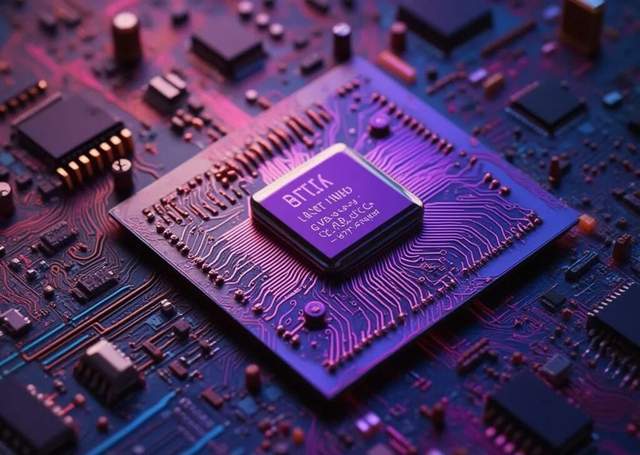
昆仑芯P800系列

Search documents
不只是分拆,更是宣战:昆仑芯IPO单飞,百度豪赌AI硬科技
Sou Hu Cai Jing· 2026-01-04 02:25
Core Viewpoint - Baidu has officially announced the plan for the independent listing of Kunlun Chip Technology on the Hong Kong Stock Exchange, marking a significant event in the domestic AI computing power sector [2] Group 1: Motivations Behind the Spin-off - The first strategic motivation is value reassessment, as Baidu has been perceived primarily as an "internet advertising" platform, which suppresses its valuation in the AI sector. By spinning off Kunlun Chip, Baidu aims to enjoy a higher valuation premium as a tech company [3] - The second motivation is independent development, allowing Kunlun Chip to become a standalone AI chip supplier, which will help expand its customer base beyond Baidu's ecosystem [3] - The third motivation is independent financing, as chip development is capital-intensive. An independent listing will enable Kunlun Chip to secure more funding for its research and development [3] - The fourth motivation is leveraging the Hong Kong capital market to enhance Kunlun Chip's brand recognition and potentially open up international markets [4] Group 2: Kunlun Chip's Strengths - Kunlun Chip is positioned as a critical component of Baidu's AI strategy and is one of the few domestic AI chips that can compete with international giants in specific scenarios. Its overall valuation reached approximately 21 billion yuan by 2025 [5] - The performance of Kunlun Chip, particularly the P800 series, is noteworthy, achieving a FP16 computing power of 345 TFLOPS, which is more than double that of Nvidia's H20 chip tailored for the Chinese market [6] - Kunlun Chip has successfully secured large orders, including a 10 billion-level AI computing device procurement from China Mobile, indicating its transition from experimental phases to large-scale production [6] Group 3: Challenges and Concerns - One major concern is the ecological barrier, as Kunlun Chip faces challenges in migrating customers from Nvidia's established software ecosystem, which complicates the transition for enterprises [7] - Another issue is customer dependency, as significant orders currently come from government procurement and Baidu, raising questions about acquiring more clients in a fully market-driven environment [7] - Supply chain vulnerabilities exist, particularly with high-end chips relying on TSMC for manufacturing. Potential restrictions on TSMC's services to domestic companies could hinder Kunlun Chip's production capabilities [7] - The financial aspect is also concerning, as Kunlun Chip is projected to have a revenue of nearly 2 billion yuan in 2024 but will incur a net loss of about 200 million yuan, highlighting the high costs associated with AI chip development [8] Group 4: Implications for Baidu and the Industry - The spin-off of Kunlun Chip is seen as a pivotal move for Baidu, marking the beginning of its transition away from an advertising-centric model. A successful IPO would solidify Baidu's position in the "computing power infrastructure" sector [9] - If Kunlun Chip achieves a high valuation upon listing, it could significantly boost confidence in the domestic AI chip industry and potentially trigger a new wave of IPOs in the hard tech sector [9] - Overall, this move is a demonstration of Baidu's capabilities in both application-level internet services and foundational hard tech development, despite the competitive and ecological challenges ahead [10]


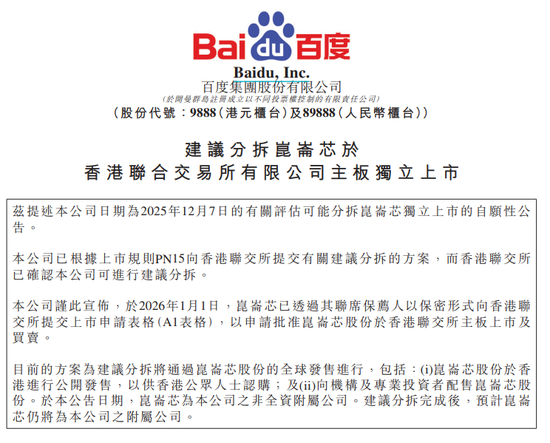
百度股价大涨6%,公司官宣:分拆芯片业务,独立IPO!昆仑芯最新估值210亿元,机构预测:今年收入将大增6倍
Mei Ri Jing Ji Xin Wen· 2026-01-02 02:19
Core Viewpoint - Baidu's subsidiary Kunlun Core has submitted a listing application to the Hong Kong Stock Exchange, aiming for an independent public offering to enhance its operational and financial transparency, attract specialized investors, and improve its market position [1][3]. Group 1: Listing and Financial Impact - Kunlun Core's listing is expected to reflect its value based on its strengths, allowing investors to independently assess its performance and potential [3]. - The company aims to attract investors focused on AI computing chips and related hardware and software systems, differentiating itself from Baidu's diversified business model [3]. - Following the announcement, Baidu's stock surged by 6.92%, with a total market capitalization of HKD 386.7 billion [4]. Group 2: Company Background and Valuation - Kunlun Core, previously Baidu's Intelligent Chip and Architecture Department, completed its first round of independent financing in April 2021, with an initial valuation of approximately RMB 13 billion [5]. - The latest financing round in July 2023 valued Kunlun Core at around RMB 21 billion (approximately USD 2.97 billion), with Baidu holding a 59.45% stake [6]. - Analysts predict that Kunlun Core's revenue will increase from approximately RMB 1.3 billion in 2025 to RMB 8.3 billion in 2026, a sixfold increase, potentially leading to a valuation exceeding RMB 80 billion [8]. Group 3: Product and Market Position - Kunlun Core's P800 series chips have been deployed in thousands, with a single cluster exceeding 30,000 cards, demonstrating significant market acceptance [8]. - The P800 chip is recognized for its performance and energy efficiency, supporting configurations of 8 and 16 cards, with a maximum throughput of 482 times per second [9]. - IDC data indicates that Kunlun Core's shipment volume is projected to reach 69,000 units in 2024, significantly outpacing competitors like Cambricon [9].
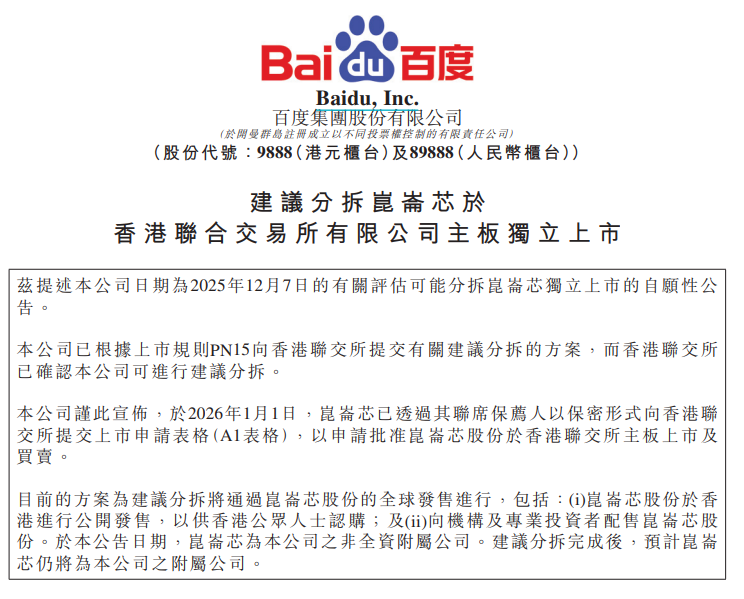
突发!百度股价大涨6%,公司官宣:分拆芯片业务,独立IPO!昆仑芯最新估值210亿元,机构预测:今年收入将大增6倍
Mei Ri Jing Ji Xin Wen· 2026-01-02 02:17
Core Viewpoint - Baidu's subsidiary Kunlun Core has submitted a listing application to the Hong Kong Stock Exchange, aiming for an independent public offering to enhance its operational and financial transparency, attract specialized investors, and improve its market position [1][3]. Group 1: Listing and Financial Impact - Kunlun Core's listing is expected to reflect its value based on its strengths, allowing investors to independently assess its performance and potential [3]. - The company aims to attract investors focused on general AI computing chips and related hardware and software systems, differentiating itself from Baidu's diversified business model [3]. - Following the announcement, Baidu's stock surged by 6.92%, with a market capitalization of HKD 386.7 billion [3]. Group 2: Company Background and Valuation - Kunlun Core, previously part of Baidu's smart chip division, completed independent financing in April 2021, with an initial valuation of approximately RMB 13 billion [4]. - The latest financing round in July 2023 valued Kunlun Core at around RMB 21 billion (approximately USD 2.97 billion), with Baidu holding a 59.45% stake [5]. - If successfully listed, Kunlun Core's valuation increase could positively impact Baidu's long-term equity investment value, leading to a potential revaluation of Baidu's overall market capitalization [5]. Group 3: Product Development and Market Position - Morgan Stanley predicts Kunlun Core's revenue will soar from approximately RMB 1.3 billion in 2025 to RMB 8.3 billion in 2026, a sixfold increase, with a potential valuation exceeding RMB 80 billion based on a price-to-sales ratio of 10 [7]. - Kunlun Core's third-generation P800 series has been deployed in thousands of units, with significant internal usage for AI model training, demonstrating high performance and cost efficiency [8]. - The company has secured a significant order from China Mobile worth over RMB 1 billion, enhancing its position as a neutral supplier and increasing its appeal to external clients [8]. Group 4: Competitive Landscape - Kunlun Core is positioned in the top tier of the domestic AI chip market, with its P800 chip recognized for its performance and energy efficiency, supporting configurations that achieve high throughput [9]. - IDC forecasts that Kunlun Core's shipment volume will reach 69,000 units in 2024, significantly outpacing competitors like Cambricon, which is expected to ship 26,000 units [10].
AI周报:摩尔线程上市首日股价涨4倍 DeepSeek推出两款新模型
Di Yi Cai Jing· 2025-12-07 01:39
Group 1: Market Developments - Moole Technology, the first domestic GPU stock, saw its share price surge by 425.46% on its debut, closing at 600.5 CNY per share, with a market capitalization of 282.3 billion CNY, significantly exceeding its issue price of 114.28 CNY per share [1] - DeepSeek launched two new models, DeepSeek-V3.2 and DeepSeek-V3.2-Speciale, claiming global leadership in inference capabilities, with Speciale surpassing Google's Gemini3 Pro in several benchmarks [2] - ByteDance and ZTE announced the release of the "Doubao AI Phone," which features advanced AI capabilities, although initial user feedback indicated some operational issues [3] Group 2: Strategic Moves - OpenAI's CEO Sam Altman declared a "red alert" to prioritize the rapid improvement of ChatGPT, delaying other projects in response to competitive pressures from Google [4] - Baidu's Kunlun chip division is reportedly preparing for an IPO in Hong Kong, aiming to submit its application by Q1 2026 [5][6] - Lenovo introduced its "AI Factory" solution and upgraded its AI server offerings, emphasizing the need for enhanced computational power in AI applications [7] Group 3: Industry Trends - Nvidia's CFO indicated that major model manufacturers are seeking direct partnerships with Nvidia, moving away from reliance on cloud service providers [8] - UBS analysts noted that the likelihood of an AI bubble in China is low, attributing this to limited domestic financing and a cautious approach to capital expenditure [9] - Micron Technology announced its exit from the consumer storage business to focus on providing storage solutions for AI applications [13] Group 4: Technological Innovations - Amazon launched its custom AI chip, Trainium3, which reportedly offers four times the computational speed of its predecessor and can reduce AI model training costs by up to 50% compared to equivalent GPU systems [14] - Nvidia expanded its strategic partnership with Synopsys, investing approximately 2 billion USD to enhance virtual design and testing capabilities in various industries [10]
百度AI王牌昆仑芯赴港IPO,国产算力突围迎关键试炼
Sou Hu Cai Jing· 2025-12-05 14:44
Core Viewpoint - Kunlunxin, a subsidiary of Baidu, is preparing for an IPO in Hong Kong, having completed a new financing round of $283 million, with a post-money valuation of $2.97 billion (approximately 21 billion RMB) [2][3][4] Group 1: IPO Plans and Market Reaction - The IPO preparation for Kunlunxin has entered the preliminary stage, with potential application to the Hong Kong Stock Exchange as early as Q1 2026 [3] - Following the IPO news, Baidu's stock price surged by 7.77%, indicating a market reassessment of its AI computing assets [3] - This is not the first time Kunlunxin has been rumored to go public, but the current preparations appear more substantial [4] Group 2: Company Background and Growth - Kunlunxin originated from Baidu's internal smart chip and architecture department, which became independent in 2021 with an initial valuation of approximately 13 billion RMB [4] - Over four years, Kunlunxin's valuation has increased by nearly 60%, reflecting changing market perceptions of domestic AI chip assets [4][6] - The latest financing round included state-owned entities, enhancing Kunlunxin's credibility for its IPO [5] Group 3: Strategic Considerations for Baidu - Baidu's decision to spin off Kunlunxin aims to unlock value, as the company's market valuation has been hampered by its advertising business [6] - An independent listing could allow Kunlunxin to be revalued according to technology stock metrics, potentially supporting Baidu's second growth curve [6] - The IPO coincides with a critical moment for domestic AI chip companies, as several are also pursuing public listings [6] Group 4: Technological Advancements - Kunlunxin's revenue is projected to exceed 1 billion RMB in 2024, outpacing competitors like Cambricon and Moore Threads [6] - The company showcased its technological capabilities at the Baidu World Conference, introducing new products optimized for large-scale inference and training [7] - The P800 series, a third-generation product, has achieved performance metrics that compete with international giants like NVIDIA [7][8] Group 5: Market Validation and Expansion - Kunlunxin secured a significant order from China Mobile for AI computing devices, marking a milestone in its market penetration [10] - The company has expanded its client base across various sectors, including telecommunications, finance, and energy [12] - Its unique position as a subsidiary of Baidu provides a testing ground for its products, facilitating market entry and product refinement [12][14] Group 6: Challenges and Competitive Landscape - Despite high valuations, concerns about the sustainability of Kunlunxin's revenue model and market competition persist [17][19] - The company faces challenges in building a robust developer ecosystem and competing with established players like NVIDIA [18][22] - Geopolitical and supply chain risks remain relevant, as Kunlunxin relies on global supply chains for chip manufacturing [20] Group 7: Future Outlook and Industry Impact - Kunlunxin's IPO is seen as a litmus test for the maturity of the domestic AI chip industry, with implications for future financing and market confidence [24] - The company must balance technological innovation, ecosystem development, and commercialization to convert valuation expectations into sustainable enterprise value [25]