易方达全球医药行业

Search documents
公募开年力推医药基金!创新药迎“赚美元”新周期?
证券时报· 2026-01-10 12:43
Core Viewpoint - The Chinese innovative drug industry is entering a new phase of "earning dollars," prompting public funds to rapidly launch new pharmaceutical funds in early 2026 [1][3]. Group 1: Fund Launches and Market Activity - In the first week of 2026, there has been a surge in new fund launches focused on innovative drugs, with significant investments directed towards the Hong Kong pharmaceutical sector [3][4]. - Notable new products include the Hua Bao Hong Kong Medical Theme ETF, which raised 331 million yuan and quickly built a stock position of 14.70% [3]. - The Fu Guo Hang Seng Biotechnology ETF also launched, raising over 320 million yuan and focusing on leading Hong Kong pharmaceutical companies [3][4]. Group 2: Performance and Demand for Pharmaceutical Funds - The strong performance of Hong Kong pharmaceutical funds in 2025 has heightened demand from both institutional and retail investors for new pharmaceutical fund offerings [6][7]. - The Hong Kong pharmaceutical theme funds delivered impressive returns in 2025, with some achieving over 113% cumulative returns, significantly influencing investor interest [6][7]. - Despite a market correction at the end of 2025, this has created an opportunity for new funds to lock in low-priced assets, leading to a rebound in fund net values [6]. Group 3: Future Expectations and Market Trends - The innovative drug sector is expected to experience a "performance verification phase" in 2026, with key indicators such as revenue from business development (BD) payments and the sales growth of core innovative drugs being closely monitored [9]. - Fund managers anticipate that 2026 will see more products entering large-scale global Phase III clinical trials, which could enhance market confidence and drive up the global value of innovative drugs [8][9]. - The industry is viewed as transitioning from following innovation to achieving global commercialization, with expectations that more Chinese innovative drug companies will realize overseas commercialization by 2027, leading to a systematic revaluation of the sector [9].


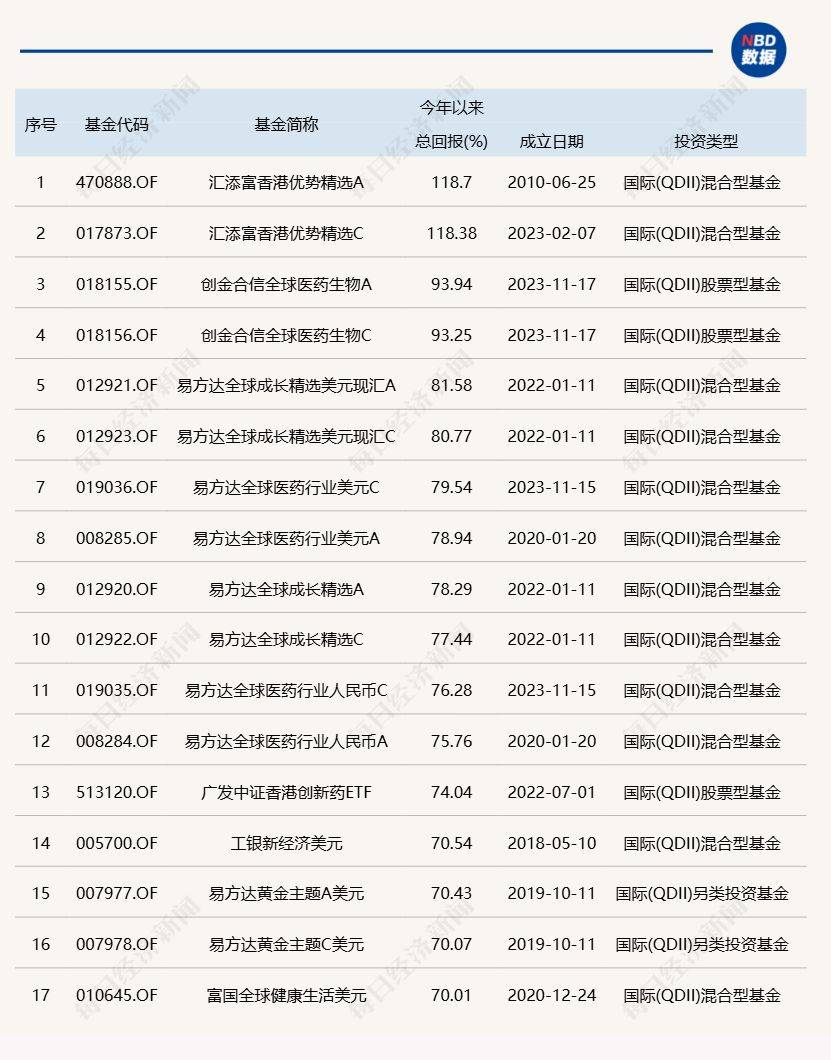
QDII基金2025年业绩爆发,17只收益率超70%,2026年该怎么投?
Mei Ri Jing Ji Xin Wen· 2025-12-25 14:51
Core Insights - QDII funds have emerged as a significant channel for investors to participate in global wealth growth amid increasing volatility in global capital markets and diversified asset allocation needs [1] - In 2025, QDII funds delivered impressive returns, with many products achieving high yields, and the focus for 2026 will be on investment opportunities in Hong Kong and U.S. markets [1][2] Group 1: 2025 Performance Review - The QDII fund market showed a clear trend of "overall improvement with partial differentiation," with over half of the products achieving returns exceeding 15% and 17 products surpassing 70% [2] - Notable performers included Huatai-PB Hong Kong Advantage Selection, with A and C class shares returning 118.70% and 118.38% respectively, and several other funds in the healthcare and technology sectors also achieving over 70% returns [2] - However, there was significant performance differentiation, with some funds focused on single assets, such as oil and real estate, experiencing negative returns, highlighting the risks associated with concentrated investments [2] Group 2: 2026 Opportunity Outlook - Market expectations for QDII funds in 2026 are optimistic, particularly for U.S. and Hong Kong stocks, with a focus on sectors like innovative pharmaceuticals and new consumption [3][4] - Analysts remain positive about the mid-term trends in the innovative pharmaceutical sector, despite some short-term risks related to high valuations and geopolitical tensions [3] - The Hong Kong market is expected to benefit from increased participation and recognition, with a focus on the performance of innovative pharmaceutical companies and their R&D capabilities [4] Group 3: Investment Strategy for 2026 - Investment strategies for 2026 suggest allocating to broad-based index QDII funds tracking major indices like NASDAQ 100 and S&P 500, as well as comprehensive index funds covering the Hong Kong market [5] - Given potential market volatility, a dollar-cost averaging approach is recommended to mitigate risks associated with short-term fluctuations, particularly in the Hong Kong market [5][6] - Investors are advised to consider the investment management capabilities of fund managers, the research strength of fund companies, and fee structures when selecting QDII funds to build a diversified portfolio for long-term growth [6]
QDII基金2025年业绩爆发:17只收益率超70%,2026年该怎么投?
Sou Hu Cai Jing· 2025-12-22 03:17
Core Viewpoint - QDII funds have emerged as a significant channel for investors to participate in global wealth growth amid increasing volatility in global capital markets and diversified asset allocation needs [1]. Group 1: 2025 Performance Overview - As of December 18, 2025, the QDII fund market showed a clear trend of "overall improvement with partial differentiation," with most products achieving positive returns [2]. - Over half of the QDII products recorded returns exceeding 15%, with more than 50 products surpassing 50%, and 17 products achieving returns over 70%, with some top products exceeding 100% [2]. - Notable performers include Huatai-PineBridge Hong Kong Advantage Selection A and C classes, with total returns of 118.70% and 118.38% respectively, leading the market [3]. Group 2: 2026 Investment Outlook - The market is optimistic about investment opportunities in QDII funds for 2026, particularly in Hong Kong and U.S. stocks, with a focus on sectors like innovative pharmaceuticals and new consumption [4][5]. - Analysts suggest that the structural trends in the innovative pharmaceutical sector are expected to continue, despite some short-term risks related to high valuations and geopolitical disturbances [5]. - The Hong Kong market is viewed positively due to its expanding asset base and increasing participation from mainland investors, with a notable reduction in the AH premium [5]. Group 3: Investment Strategy for 2026 - Investment strategies for 2026 recommend allocating to broad-based index QDII funds tracking major indices like the Nasdaq 100 and S&P 500, as well as comprehensive index funds covering the Hong Kong market [6]. - Given potential market volatility, a systematic investment approach such as dollar-cost averaging is advised to mitigate risks associated with short-term market fluctuations [7]. - Investors are encouraged to consider the management capabilities of fund managers, the research strength of fund companies, and fee structures when selecting QDII funds to build a diversified portfolio for long-term asset appreciation [7].
淡化业绩重风格?赛道基金最新变化
券商中国· 2025-11-03 13:07
Core Viewpoint - The growth of fund scale in the pharmaceutical sector is increasingly influenced by product style clarity and predictable holdings, rather than just performance metrics [2][8]. Group 1: Fund Performance and Scale Dynamics - Despite having the highest performance, some pharmaceutical funds are experiencing significant scale growth challenges, with many funds seeing scale increases despite lower returns [2][3]. - As of November 2, 2025, the top-performing pharmaceutical fund achieved a return of 118% but had a scale of only approximately 530 million yuan, while other funds with lower returns had scales exceeding 2.4 billion yuan [3]. - The disparity in scale growth among similar funds managed by the same fund manager indicates that performance alone is not a sufficient driver for scale [5][6]. Group 2: Importance of Style and Transparency - The clarity of product style and transparency of holdings are becoming critical factors for investors when selecting funds, especially in a market with a wide variety of offerings [2][8]. - Funds that maintain stable styles and transparent holdings are more likely to attract investment, as investors prefer predictable products in a segmented market [8][9]. - Frequent changes in fund holdings can negatively impact scale growth, highlighting the importance of consistent investment strategies [8][9]. Group 3: Case Studies of Fund Managers - Fund managers with similar holdings and performance levels can see vastly different scales, as evidenced by the comparison between two funds managed by the same manager, where one fund had a scale of 2.45 billion yuan and the other 41.52 billion yuan despite differing performance [6][7]. - The lack of mandatory investment scope in fund contracts can hinder scale growth for high-performing funds, as seen with the "champion pharmaceutical fund" that did not have a strict mandate to invest solely in the pharmaceutical sector [4][8].

不断加码!
Zhong Guo Ji Jin Bao· 2025-08-13 06:49
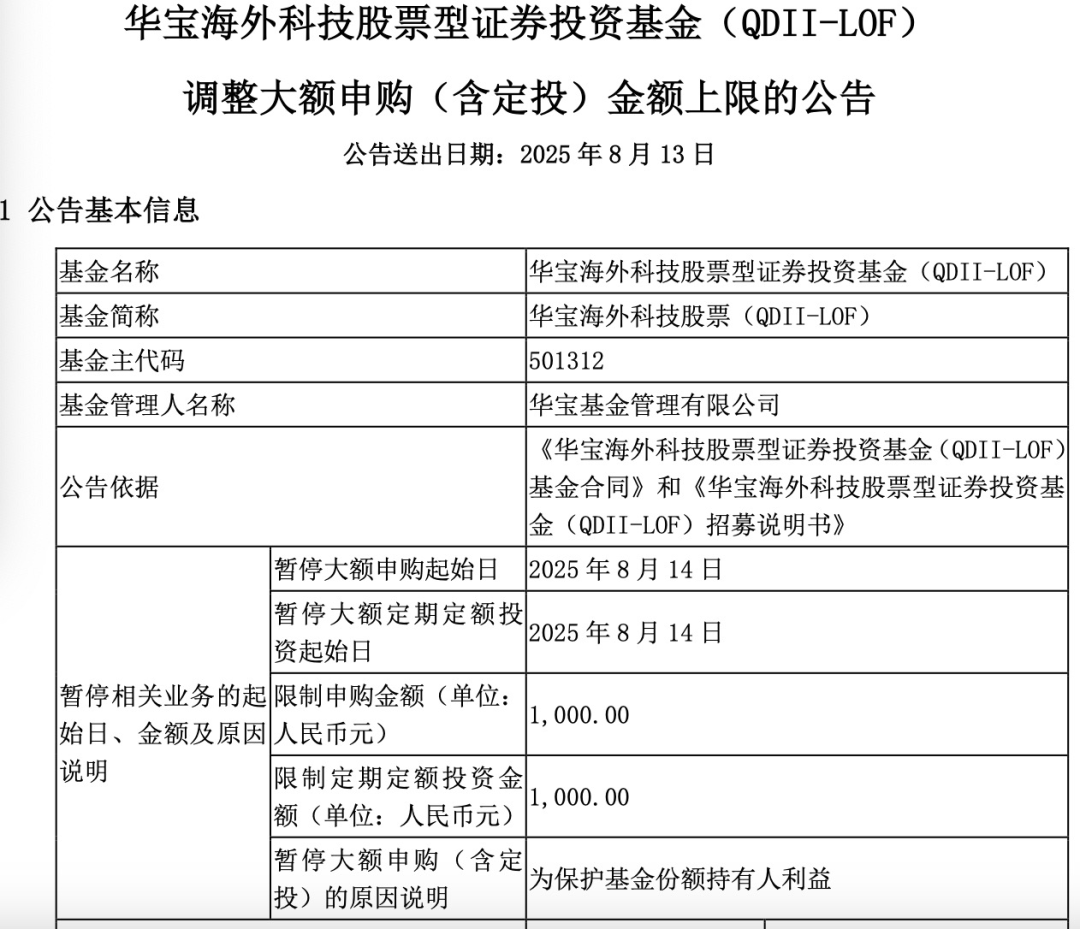
Group 1 - The core viewpoint of the news is that QDII funds are experiencing increased restrictions on large subscriptions, with many funds lowering their maximum subscription limits significantly [1][2][3] - Several QDII funds have adjusted their large subscription limits, with the maximum now set as low as 500 yuan, indicating a trend of tightening access to these investment vehicles [2][5] - The adjustment in subscription limits is aimed at protecting the interests of fund shareholders, as seen in the case of the Hua Bao Overseas Technology Stock Fund, which reduced its daily subscription limit to 1,000 yuan [3][4] Group 2 - The performance of QDII funds has been strong this year, with many funds showing positive net asset value growth, which has attracted significant inflows [6][7] - Notable performers include the Huatai-PineBridge Hang Seng Innovation Drug ETF and the GF CSI Hong Kong Innovation Drug ETF, both of which have achieved returns exceeding 85% this year [7] - Market analysts suggest that the tightening of QDII fund subscriptions may be a response to the strong performance and increased investor interest, as funds like the Huatai-PineBridge Hong Kong Advantage Selection have seen a net value growth rate of over 135% [6][8]
不断加码!
中国基金报· 2025-08-13 06:47
Core Viewpoint - The recent trend shows an increase in restrictions on QDII funds, with many funds lowering their large subscription limits to as low as 500 yuan, indicating a tightening of investment access despite previously approved new quotas [2][3][5]. Summary by Sections QDII Fund Subscription Limits - Several QDII funds have recently reduced their large subscription limits, with the minimum now set at 500 yuan [3][8]. - On August 13, the Hua Bao Overseas Technology Stock (QDII-LOF) announced a new limit of 1,000 yuan for single-day subscriptions, down from 2,000 yuan just a week prior [5][8]. - Other funds, including Hua Bao Nasdaq Select Stock (QDII) and Hua Bao S&P US Quality Consumption Stock Index Fund (LOF), have also adjusted their limits to between 500 and 1,000 yuan [8][10]. Performance of QDII Funds - QDII funds have shown strong performance this year, with many funds reporting positive unit net value growth rates. For instance, the Hui Tian Fu Hong Kong Advantage Selection (QDII) has a growth rate exceeding 135%, leading the market [11][12]. - The overall market sentiment is improving, with expectations of more certainty in global markets as risks are gradually released [12]. Market Trends and Future Outlook - The tightening of subscription limits may be a response to the influx of capital attracted by the strong performance of QDII funds [12]. - There is a potential shift in global capital allocation, with investors possibly reducing their exposure to US stocks in favor of high-quality non-US assets due to rising uncertainties in the US political and economic landscape [12].