
创金合信全球医药生物

Search documents
公募“出海”再提速!30只QDII收益超50%、5家申请设立境外子公司
Xin Lang Cai Jing· 2026-02-09 08:15
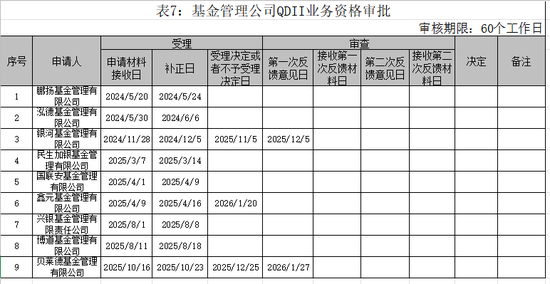
Core Viewpoint - The public fund industry in China is steadily advancing its overseas expansion, with significant growth in QDII funds and increasing establishment of overseas subsidiaries by fund management companies [1][5][14]. Group 1: QDII Fund Growth - As of the end of 2020, there were only 168 QDII funds with a total scale of 128.89 billion yuan, but by the end of 2025, the number had surged to 329 funds with a scale of 981.56 billion yuan, nearly doubling in quantity and increasing nearly sevenfold in scale [12][14]. - By February 9, 2026, the total scale of QDII funds reached 996.23 billion yuan, a 59.46% increase compared to 624.73 billion yuan in the same period of 2025, accounting for 2.68% of the total market fund scale [12][14]. - In 2025, many QDII fund products achieved positive returns, with 30 products (considering multiple share classes) yielding over 50%, led by E Fund with six products, and ICBC Credit Suisse and Fortune Fund each with four products [12][14]. Group 2: Performance of Specific Funds - The top-performing QDII fund was Huatai-PB Hong Kong Advantage Selection, achieving a return of 112.69%, followed by CCB Fund's Global Pharmaceutical and Biotechnology at 88.43%, and E Fund's Global Growth Selection at 88.93% [12][14]. - The Vietnam market has become a highlight for public funds, with Tianhong Vietnam Market Equity Fund growing from 200 million yuan at inception in 2020 to over 4.8 billion yuan by the end of 2025, marking a 24-fold increase in four years [12][14]. Group 3: Overseas Subsidiaries and Regulatory Support - The establishment of overseas subsidiaries by public funds is accelerating, with several companies like Yongying Fund and Ruifeng Fund receiving approvals for their Hong Kong subsidiaries in recent years [16][17]. - The China Securities Regulatory Commission has emphasized the importance of supporting qualified fund management companies to "go global," which has facilitated the rapid expansion of public funds overseas [5][14]. - Leading public funds have received substantial QDII investment quotas, with E Fund at the top with 7.78 billion USD, followed by Huaxia Fund with 6.77 billion USD, and Southern Fund with 6.02 billion USD [15][14]. Group 4: Cross-Border ETF Development - Major institutions are collaborating with foreign asset management firms to launch cross-border ETF products, with E Fund partnering with Itaú Asset Management in Brazil and Huaxia Fund promoting an ETF through Bradesco Asset Management [17]. - As of February 9, 2026, the management scale of cross-border ETFs reached 977.72 billion yuan, reflecting a 119.32% increase compared to the previous year [17].

跨境ETF规模首次突破万亿 百亿级产品激增至25只
Zheng Quan Shi Bao· 2026-01-14 18:21
Group 1 - The total scale of cross-border ETFs reached 1,009.8 billion RMB as of January 13, marking the first time it has surpassed the trillion RMB threshold, with a growth of 138% from 424.2 billion RMB in early 2025 [1][2] - The leading cross-border ETF is the Invesco Hong Kong Internet ETF, with a scale of 91.509 billion RMB, followed by the Huaxia Hang Seng Technology Index ETF at approximately 53.434 billion RMB [2] - As of January 14, 2026, the premium rate for the Invesco Nasdaq Technology ETF reached 19.28%, indicating a significant demand-supply imbalance in the secondary market [4] Group 2 - The QDII market has shown strong performance, with 95.2% of 650 comparable QDII funds reporting net value increases in 2025, driven by sectors like artificial intelligence and innovative pharmaceuticals [3] - Fund managers remain optimistic about investment opportunities in Hong Kong stocks, viewing them as a bridge for foreign capital into Chinese assets, particularly in the technology sector [6][7] - The S&P 500 index is expected to see a 10% growth in earnings per share in 2026, which will support continued stock market gains [7]
公募开年力推医药基金!创新药迎“赚美元”新周期?
证券时报· 2026-01-10 12:43
Core Viewpoint - The Chinese innovative drug industry is entering a new phase of "earning dollars," prompting public funds to rapidly launch new pharmaceutical funds in early 2026 [1][3]. Group 1: Fund Launches and Market Activity - In the first week of 2026, there has been a surge in new fund launches focused on innovative drugs, with significant investments directed towards the Hong Kong pharmaceutical sector [3][4]. - Notable new products include the Hua Bao Hong Kong Medical Theme ETF, which raised 331 million yuan and quickly built a stock position of 14.70% [3]. - The Fu Guo Hang Seng Biotechnology ETF also launched, raising over 320 million yuan and focusing on leading Hong Kong pharmaceutical companies [3][4]. Group 2: Performance and Demand for Pharmaceutical Funds - The strong performance of Hong Kong pharmaceutical funds in 2025 has heightened demand from both institutional and retail investors for new pharmaceutical fund offerings [6][7]. - The Hong Kong pharmaceutical theme funds delivered impressive returns in 2025, with some achieving over 113% cumulative returns, significantly influencing investor interest [6][7]. - Despite a market correction at the end of 2025, this has created an opportunity for new funds to lock in low-priced assets, leading to a rebound in fund net values [6]. Group 3: Future Expectations and Market Trends - The innovative drug sector is expected to experience a "performance verification phase" in 2026, with key indicators such as revenue from business development (BD) payments and the sales growth of core innovative drugs being closely monitored [9]. - Fund managers anticipate that 2026 will see more products entering large-scale global Phase III clinical trials, which could enhance market confidence and drive up the global value of innovative drugs [8][9]. - The industry is viewed as transitioning from following innovation to achieving global commercialization, with expectations that more Chinese innovative drug companies will realize overseas commercialization by 2027, leading to a systematic revaluation of the sector [9].

2025年度QDII业绩出炉:最高汇添富香港优势精选涨超112%VS易方达原油跌逾13%(附涨跌榜)
Xin Lang Cai Jing· 2026-01-09 08:36
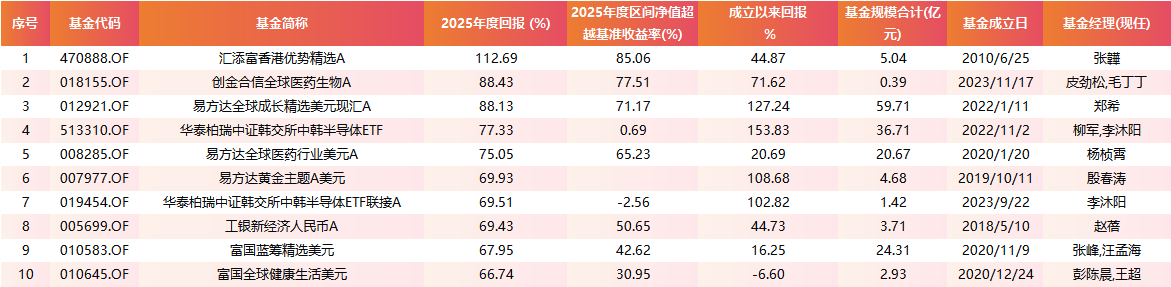
Core Insights - The QDII (Qualified Domestic Institutional Investor) funds have shown significant performance differentiation in 2025, with some funds achieving remarkable returns while others faced substantial losses due to market volatility and sector-specific challenges [1][4][6]. Performance Highlights - The top-performing QDII fund, Huatai-PB Hong Kong Advantage Selection, achieved a return of over 112%, benefiting from the global rise in innovative pharmaceuticals and biotechnology [2][9]. - Other notable funds include China Universal Global Pharmaceutical Biology and E Fund Global Growth Selection, both with returns exceeding 88%, driven by the global pharmaceutical sector's growth [2][9]. - The E Fund Gold Theme QDII also performed well, nearing a 70% return amid global risk aversion and monetary policy adjustments [2][9]. Underperformers - In contrast, several QDII funds focused on oil and real estate faced significant declines, with returns ranging from -10.78% to -13.76% for oil-themed funds like E Fund Oil and Southern Oil [4][11]. - Funds tracking the Saudi Arabian market also struggled, with returns exceeding -12% since their inception in 2024 [4][11]. - Real estate-focused funds, such as Penghua US Real Estate and Nuveen Global Real Estate, reported negative annual returns, reflecting broader market challenges [4][11]. Market Trends - The performance of QDII funds in 2025 highlights the importance of sector-specific trends, with technology and healthcare being key drivers of growth, while traditional cyclical assets like oil and real estate remain sensitive to macroeconomic conditions [6][13]. - The ability to diversify across different asset classes and geographic regions is emphasized as a critical strategy for investors to mitigate risks associated with concentrated investments [6][13].
QDII基金2025年业绩爆发:17只收益率超70%,2026年该怎么投?
Sou Hu Cai Jing· 2025-12-22 03:17
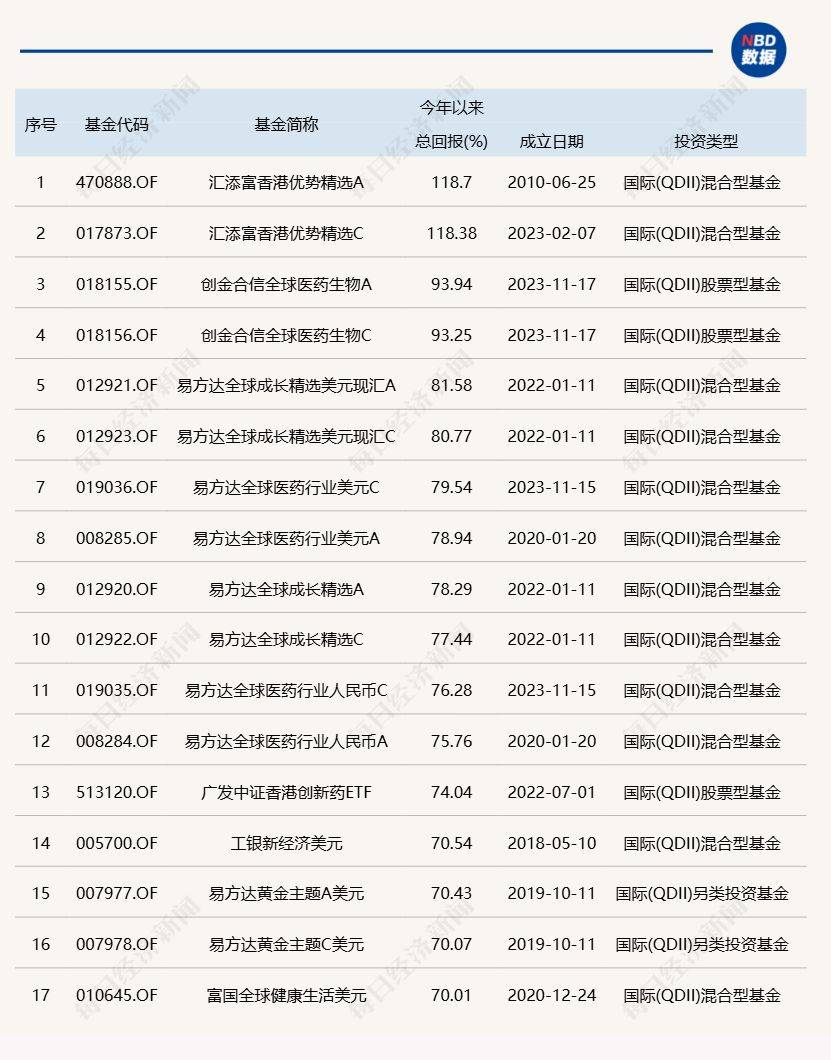
Core Viewpoint - QDII funds have emerged as a significant channel for investors to participate in global wealth growth amid increasing volatility in global capital markets and diversified asset allocation needs [1]. Group 1: 2025 Performance Overview - As of December 18, 2025, the QDII fund market showed a clear trend of "overall improvement with partial differentiation," with most products achieving positive returns [2]. - Over half of the QDII products recorded returns exceeding 15%, with more than 50 products surpassing 50%, and 17 products achieving returns over 70%, with some top products exceeding 100% [2]. - Notable performers include Huatai-PineBridge Hong Kong Advantage Selection A and C classes, with total returns of 118.70% and 118.38% respectively, leading the market [3]. Group 2: 2026 Investment Outlook - The market is optimistic about investment opportunities in QDII funds for 2026, particularly in Hong Kong and U.S. stocks, with a focus on sectors like innovative pharmaceuticals and new consumption [4][5]. - Analysts suggest that the structural trends in the innovative pharmaceutical sector are expected to continue, despite some short-term risks related to high valuations and geopolitical disturbances [5]. - The Hong Kong market is viewed positively due to its expanding asset base and increasing participation from mainland investors, with a notable reduction in the AH premium [5]. Group 3: Investment Strategy for 2026 - Investment strategies for 2026 recommend allocating to broad-based index QDII funds tracking major indices like the Nasdaq 100 and S&P 500, as well as comprehensive index funds covering the Hong Kong market [6]. - Given potential market volatility, a systematic investment approach such as dollar-cost averaging is advised to mitigate risks associated with short-term market fluctuations [7]. - Investors are encouraged to consider the management capabilities of fund managers, the research strength of fund companies, and fee structures when selecting QDII funds to build a diversified portfolio for long-term asset appreciation [7].
多只绩优权益基金限购,释放什么信号?
Guo Ji Jin Rong Bao· 2025-12-04 00:41
Group 1 - Multiple public equity funds have announced the suspension of large subscriptions as the year-end approaches, including several high-performing funds that ranked well over the past year [1][2][3] - The suspension of large subscriptions is seen as a measure to prevent fund sizes from exceeding optimal investment strategies and market capacity, reflecting a shift from pursuing scale to focusing on high-quality development [4][5] - Notable funds that have implemented subscription limits include 中欧红利优享, 中欧价值回报, and 安信远见成长, with recent one-year net value increases of 44.47%, 41.62%, and 39.09% respectively [3][4] Group 2 - The market remains volatile, and the actions of fund companies to limit subscriptions indicate a strategy to manage growth and protect fund performance [4] - Investment firms are preparing for a "cross-year market" with expectations of a rebound in industry allocations and a focus on emerging technologies and undervalued sectors [5][6] - December is anticipated to be a period of resonance among policies, liquidity, and fundamentals, with a focus on growth sectors such as AI and electric vehicles, as well as potential policy-driven opportunities in hospitality and logistics [5][6]