景顺长城纳斯达克科技ETF

Search documents
国泰海通:12月适度偏向成长 重视主投科技领域基金
Zhi Tong Cai Jing· 2025-12-01 13:21
Core Viewpoint - The report from Guotai Junan Securities indicates that the external geopolitical situation has become complex, leading to a temporary pullback in the A-share market. It suggests that future fund allocations should maintain a balanced style while slightly favoring growth, with a focus on technology sector funds and consideration of cyclical and financial assets [1][2]. Equity Mixed Funds - In November, the manufacturing PMI rose to 49.2%, an increase of 0.2 percentage points from the previous month, supported by improved foreign trade conditions due to recent US-China economic negotiations [2]. - The Chinese stock market experienced a rapid decline in the penultimate week of November, followed by a recovery in the last week, indicating potential for stabilization and upward movement as a good opportunity for increasing holdings [2]. - The report emphasizes a focus on technology growth and low-position investment opportunities in large financial and consumer sectors, suggesting a structural investment opportunity in both value and growth styles for 2024 [2]. Bond Funds - Following a significant drop, the bond market may enter a phase of corrective rebound, although the extent of recovery may not exceed that of October. The macro environment provides support for bond pricing, allowing for participation in the rebound of certain underpriced bonds [3]. - The report recommends maintaining a "quick in and out" strategy to capitalize on structural opportunities, with a focus on flexible duration interest rate bonds and high liquidity credit bonds [3]. QDII and Commodity Funds - The report highlights that global sovereign credit differentiation and the weakening of the US dollar are prompting central banks to diversify reserves, enhancing the position of gold relative to the dollar and US Treasuries. It suggests a suitable allocation to gold ETFs for long-term and hedging investments [4]. - With the anticipated expansion of capital expenditure in the AI industry and technology companies, the report expects upward revisions in earnings forecasts for US stocks by 2026, recommending an overweight position while being cautious of short-term volatility risks [4]. Fund Recommendations - Recommended equity mixed funds include: Southern Quality Preferred, E Fund Environmental Protection Theme, Boda Huatai Preferred, GF Multi-Factor, Guotai Consumption Preferred, Huatai Baoxing Growth Preferred, and others [5]. - Recommended open-end bond funds include: Bank of China Pure Bond, Fortune Tianli Growth Bond, and China Europe Prosperity [6]. - Recommended QDII and commodity funds include: E Fund Gold ETF, Huaan Yifu Gold ETF, GF Nasdaq 100 ETF, and Invesco Great Wall Nasdaq Technology ETF [6].

多只明星QDII基金闭门谢客
21世纪经济报道· 2025-11-21 07:43
Core Viewpoint - The recent surge in QDII fund market has led to a wave of purchase restrictions, primarily driven by tight foreign exchange quotas and saturated strategy capacities, prompting investors to be cautious of high premium risks and consider alternative investment channels [2][10]. Group 1: QDII Fund Purchase Restrictions - Since November, numerous QDII funds have announced purchase limits, with several popular products opting to stop accepting new investments [2][6]. - Notably, QDII products focused on U.S. indices have been heavily impacted, with major fund companies announcing limits on large subscriptions for several funds, including the 富国全球消费精选混合 (QDII) and 摩根标普500指数 (QDII) [4][5]. - As of November 20, over 80 announcements regarding adjustments to QDII product subscription limits have been made, indicating a widespread trend of limiting or halting large subscriptions [6]. Group 2: Performance and Premium Rates - Many of the restricted QDII products have shown strong performance, with some funds achieving returns exceeding 20% over the past year, leading to significant interest and inflows [7]. - Premium rates for some QDII funds have surged, with certain products experiencing premiums over 10%, and some even exceeding 20%, as investors shift to secondary market purchases due to restrictions [7][8]. - The 富国全球消费精选混合 (QDII) fund has reported a remarkable return of 44.31% this year, highlighting the performance-driven demand for these products [4]. Group 3: Reasons for Purchase Restrictions - The primary reasons for the current purchase restrictions include the limited quotas set by the State Administration of Foreign Exchange (SAFE) and the strategy capacity constraints faced by fund managers [10][11]. - Fund companies aim to prevent rapid scale expansion that could dilute investment returns and avoid performance degradation due to excessive inflows [10][11]. - The total approved QDII quota as of June 2025 was $170.87 billion, with a significant concentration among leading institutions, leading to a structural shortage of available quotas [10]. Group 4: Alternative Investment Channels - In response to the purchase restrictions, investors are increasingly turning to alternative investment channels, such as Hong Kong mutual recognition funds and cross-border wealth management programs, which offer more flexible quotas and a wider range of products [11]. - Experts suggest that the current wave of purchase restrictions may continue until mid-2026, indicating a need for investors to diversify their portfolios and consider products with more lenient subscription limits [11].


多只美股QDII基金“闭门谢客”,港股产品或受热捧
2 1 Shi Ji Jing Ji Bao Dao· 2025-11-20 13:20
Core Viewpoint - The recent surge in QDII fund market has led to a wave of purchase restrictions, primarily driven by tight foreign exchange quotas and saturated strategy capacities, prompting investors to be cautious of high premium risks and consider alternative investment channels [1][5][9]. Group 1: QDII Fund Purchase Restrictions - Since November, numerous QDII funds have announced purchase limits, with several popular products opting to stop accepting new investments [1][5]. - Major QDII products focused on U.S. indices have been particularly affected, with several funds setting strict daily purchase limits for both RMB and USD shares [3][4]. - The trend of limiting purchases is not only seen in equity funds but also in traditionally stable bond QDII products, indicating a broader market tightening [4][5]. Group 2: Performance and Premium Rates - Many restricted QDII products have shown strong performance, with some achieving returns over 20% in the past year, leading to significant interest and investment inflows [5][9]. - The premium rates for some QDII ETFs have surged, with certain products experiencing premiums exceeding 20%, driven by investors shifting to on-market purchases due to off-market restrictions [7][9]. Group 3: Reasons Behind Purchase Restrictions - Fund companies cite the need to protect existing investors' interests as a primary reason for implementing purchase limits, aiming to prevent rapid scale expansion that could dilute investment returns [9][10]. - The core issue is the limited QDII quotas set by the foreign exchange authority, which have become increasingly strained due to the strong performance of U.S. stocks since 2025 [10][11]. Group 4: Future Investment Strategies - Experts suggest that the current purchase restrictions may persist until mid-2026, as significant increases in QDII quotas are not expected in the short term [11][12]. - Investors are encouraged to diversify their investments, considering alternatives such as Hong Kong mutual funds, which are not subject to the same quota restrictions and offer a wider range of products [10][12].

国泰海通证券 10 月基金投资策略:A股持续演绎慢牛行情,相对偏向成长配置风格
GUOTAI HAITONG SECURITIES· 2025-10-10 11:22
Group 1 - The report indicates that the A-share market is experiencing a slow bull market, with the effects of anti-involution policies becoming evident in the August PPI data, leading to continued increases in major broad-based indices in September [1][8] - The report suggests a shift towards growth-oriented investment strategies while maintaining a balanced overall style in fund allocation, with recommendations to consider gold and US stock-related ETFs [1][8] - Structural investment opportunities are highlighted, particularly in emerging technologies and financial sectors, with expectations for new highs in A/H share indices [1][8][13] Group 2 - The report notes that the manufacturing PMI for September is at 49.8%, reflecting a seasonal increase, while the service sector shows a slight decline, indicating a mixed economic outlook [10][11] - The report emphasizes the importance of the lithium battery sector, which is benefiting from favorable policies and a surge in overseas demand for energy storage, contributing to strong performance in related industries [8][10] - The report identifies a positive trend in the AI sector, with significant collaborations and advancements, suggesting continued growth potential in technology-related investments [8][10] Group 3 - The bond market is expected to enter a stabilization phase in October, with a likelihood of oscillation and potential recovery in certain bond types, despite a long-term weakening trend [17][20] - The report highlights the central bank's active role in maintaining liquidity and supporting the bond market, particularly during the quarter-end period [18][20] - The report suggests that the demand for high-grade, liquid credit bonds remains strong, with a focus on flexible duration products [17][20] Group 4 - The report indicates that the number of new funds launched in September reached the highest level since 2022, with a total fundraising amount of 167.34 billion, reflecting a recovery in the public fund market [56][60] - The report notes that equity funds accounted for a significant portion of new fund launches, indicating a growing investor interest in equity investments amid a recovering A-share market [56][60] - The report highlights the performance of various fund styles, with growth-oriented funds outperforming balanced and value funds, particularly in the TMT and midstream manufacturing sectors [48][49]
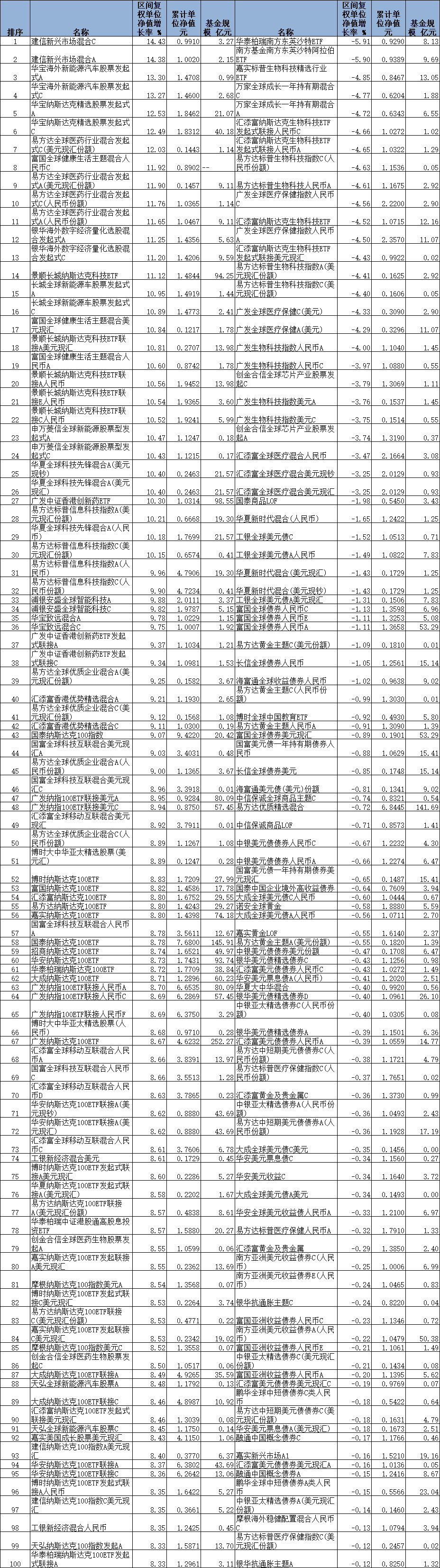
5月份八成QDII正收益 景顺长城纳斯达克科技ETF涨11%
Zhong Guo Jing Ji Wang· 2025-06-04 23:16
Group 1 - In May 2023, out of 670 comparable QDII funds, 558 funds saw an increase in net value, representing over 80% of the total [1] - 30 QDII funds had a growth rate exceeding 10% in May, with the top performers being Jianxin Emerging Markets Mixed C and A, achieving returns of 14.43% and 14.38% respectively [2] - Jianxin Emerging Markets Mixed A and C had year-to-date returns of -1.18% and -1.29% respectively, while their cumulative returns since inception were 0.20% and 23.41% [2] Group 2 - The top 30 QDII funds with over 10% monthly growth included Invesco Great Wall Nasdaq Technology ETF and GF CSI Hong Kong Innovative Medicine ETF, with sizes of 9.425 billion and 9.855 billion respectively, achieving growth rates of 11.12% and 10.30% in May [2][3] - The Invesco Great Wall Nasdaq Technology ETF, established on July 19, 2023, had a year-to-date return of 0.27% and a cumulative return of 48.44% [3] - The GF CSI Hong Kong Innovative Medicine ETF, established on July 1, 2022, had a year-to-date return of 43.03% and a cumulative return of 3.13% [3] Group 3 - Only two QDII funds experienced a decline of over 5% in May, both tracking the FTSE Saudi Arabia Index, with declines of 5.91% and 5.90% [4] - The performance of the top 100 QDII funds in May showed significant variations, with Jianxin Emerging Markets Mixed C and A leading the gains, while the two funds tracking the Saudi index were at the bottom of the list [5]