
暖通空调

Search documents
海信家电:公司信息更新报告:2025年内销市场承压,外销稳中向好态势持续-20260401
KAIYUAN SECURITIES· 2026-04-01 08:24
Investment Rating - The investment rating for Hisense Home Appliances is maintained at "Buy" [1] Core Views - The domestic sales market is under pressure in 2025, while the overseas sales show a steady improvement. The company is expected to achieve revenue of 879.3 billion yuan in 2025, a year-on-year decrease of 5.2%, with a net profit attributable to the parent company of 31.9 billion yuan, down 4.8% [1] - The company has adjusted its profit forecasts for 2026-2027 and added a new forecast for 2028, expecting net profits of 32.1 billion yuan, 35.3 billion yuan, and 38.2 billion yuan for 2026, 2027, and 2028 respectively [1] - The company maintains a good profitability despite rising raw material prices, and the overseas business continues to perform well [1] Financial Performance Summary - In 2025, the HVAC business generated revenue of 388.3 billion yuan, down 3.6%, with a gross margin of 27.4%, a decrease of 2.1 percentage points. The company holds over 23% market share in the central air conditioning sector [2] - The ice washing business achieved revenue of 312.0 billion yuan, an increase of 1.2%, with a gross margin of 17.6%, up 1.1 percentage points. The retail market share for Hisense refrigerators reached 17.0% [2] - Domestic revenue was 454.1 billion yuan, down 5.4%, primarily due to the low prosperity of the domestic real estate industry and price wars. In contrast, overseas revenue was 379.2 billion yuan, up 6.4%, with significant growth in various regions [2] Profitability and Cost Structure - The overall gross margin for 2025 was 21.3%, an increase of 0.5 percentage points, while the expense ratio rose to 16.7%, up 0.7 percentage points. The net profit margin for 2025 was 5.4%, a slight decrease of 0.1 percentage points [3] - In Q4 2025, the gross margin improved to 22.3%, while the expense ratio increased to 19.5%, leading to a net profit margin of 4.0% [3] - The company implemented a dividend of 1.75 billion yuan in 2025, accounting for 54.9% of the annual net profit attributable to the parent company [3] Financial Projections - Revenue projections for 2026-2028 are as follows: 94.4 billion yuan in 2026, 99.9 billion yuan in 2027, and 105.9 billion yuan in 2028, with corresponding net profits of 32.1 billion yuan, 35.3 billion yuan, and 38.2 billion yuan [4] - The expected EPS for 2026, 2027, and 2028 are 2.31 yuan, 2.55 yuan, and 2.76 yuan respectively, with the current P/E ratios at 11.9, 10.8, and 10.0 times [4]
海信家电(000921):营收阶段回落,毛销差同比提升
Changjiang Securities· 2026-04-01 06:52
Investment Rating - The investment rating for the company is "Buy" and is maintained [12]. Core Insights - In 2025, the company achieved operating revenue of 87.928 billion yuan, a year-on-year decline of 5.19%. The net profit attributable to shareholders was 3.187 billion yuan, down 4.82% year-on-year, and the net profit after deducting non-recurring gains and losses was 2.445 billion yuan, a decrease of 6.18% year-on-year. In Q4 2025, the company reported operating revenue of 16.396 billion yuan, a year-on-year decline of 26.03%, with a net profit of 375 million yuan, down 32.46% year-on-year, and a net profit after deducting non-recurring gains and losses of 118 million yuan, a decrease of 62.79% year-on-year. The company plans to distribute a cash dividend of 12.65 yuan per 10 shares (including tax), corresponding to a dividend payout ratio of 54.95% [2][6]. Summary by Sections Revenue Performance - The company's revenue declined by 5.19% in 2025, with specific segments showing varied performance: HVAC revenue decreased by 3.61%, while washing machines and refrigerators saw growth of 1.16% and 6.48%, respectively. Domestic sales fell by 5.38%, but international sales increased by 6.44%. Notably, the European market for white goods grew by 22%, with refrigerators up 15% and washing machines up 38% [12]. Profitability Metrics - The gross margin improved by 0.53 percentage points year-on-year. However, the HVAC segment's gross margin decreased by 1.12 percentage points due to intensified domestic competition and rising copper prices. The overall operating profit declined by 4.06% year-on-year, with a slight increase in operating profit margin of 0.05 percentage points [12]. Future Outlook - The company is expected to enhance its brand synergy and supply chain optimization to achieve efficiency improvements. It aims to expand into automotive compressors and comprehensive thermal management systems while strengthening its overseas market presence. Projected net profits for 2026, 2027, and 2028 are 3.224 billion yuan, 3.395 billion yuan, and 3.641 billion yuan, respectively, with corresponding price-to-earnings ratios of 9.18, 8.72, and 8.13 [12].
海信家电(000921):公司信息更新报告:2025年内销市场承压,外销稳中向好态势持续
KAIYUAN SECURITIES· 2026-04-01 05:48
Investment Rating - The investment rating for Hisense Home Appliances is maintained at "Buy" [1] Core Views - The domestic sales market is under pressure in 2025, while the overseas sales show a steady improvement. The company is expected to achieve revenue of 87.93 billion yuan in 2025, a year-on-year decrease of 5.2%, with a net profit attributable to the parent company of 3.19 billion yuan, down 4.8% [1] - The company has adjusted its profit forecasts for 2026-2027 and added a new forecast for 2028, expecting net profits of 3.21 billion yuan, 3.53 billion yuan, and 3.82 billion yuan for 2026-2028, respectively [1] - The company maintains a good profitability despite rising raw material prices, and the overseas business continues to perform well [1] Financial Performance - In 2025, the HVAC business generated revenue of 38.83 billion yuan, down 3.6%, with a gross margin of 27.4%, a decrease of 2.1 percentage points [2] - The ice washing business achieved revenue of 31.20 billion yuan, an increase of 1.2%, with a gross margin of 17.6%, up 1.1 percentage points [2] - The company’s total revenue from domestic sales was 45.41 billion yuan, down 5.4%, while overseas revenue reached 37.92 billion yuan, up 6.4% [2] Profitability Metrics - The overall gross margin for 2025 was 21.3%, an increase of 0.5 percentage points, while the expense ratio rose to 16.7%, up 0.7 percentage points [3] - The net profit margin for 2025 was 5.4%, a slight decrease of 0.1 percentage points [3] - The company implemented a dividend of 1.75 billion yuan in 2025, accounting for 54.9% of the net profit attributable to the parent company [3] Valuation Metrics - The projected earnings per share (EPS) for 2026-2028 are 2.31 yuan, 2.55 yuan, and 2.76 yuan, respectively, with corresponding price-to-earnings (P/E) ratios of 11.9, 10.8, and 10.0 [4] - The company’s return on equity (ROE) is expected to decline from 26.5% in 2025 to 17.7% in 2028 [4] - The price-to-book (P/B) ratio is projected to decrease from 2.5 in 2025 to 1.5 in 2028 [4]
中美暖通对比-低位布局暖通龙头正当时
2026-03-04 14:17
Summary of Key Points from Conference Call Records Industry Overview - The conference call focuses on the HVAC (Heating, Ventilation, and Air Conditioning) industry, specifically comparing the markets in China and the United States. The analysis indicates a strong oligopolistic structure in both markets, with local companies showing better profitability than their overseas counterparts, contrasting with Japan's market dynamics where overseas performance is stronger than local [1][2]. Core Insights and Arguments - **Market Recovery Signals**: The white goods sector is expected to see a turning point between Q1 and Q2 of 2026, with signs of recovery in air conditioning exports and production in April and May [1][2]. - **Company Comparisons**: Trane Technologies is highlighted for its focus on the commercial market (60% of revenue) and high service income (35%), providing it with better operational stability and valuation premium compared to Carrier Global [1][2]. - **Domestic Company Selection Logic**: The preferred domestic companies are ranked based on their commercial market share and proactive strategies: Midea > Hisense > Haier > Gree. Midea has a 20% share in the B-end market and leads in internationalization, while Hisense benefits from its unique central air conditioning offerings [1][2][11]. Demand Structure and Market Dynamics - **Demand Characteristics**: Both China and the U.S. have substantial domestic demand, but the demand structure differs. The U.S. market is primarily driven by commercial needs, while China's market is more focused on residential air conditioning due to the "one household, multiple machines" logic [3][4]. - **Channel Structures**: Both markets primarily utilize distribution channels, with a significant portion of sales through third-party distributors. This is in contrast to Japan, where the market relies heavily on retail channels [4]. Profitability and Business Strategies - **Profitability Comparison**: Chinese HVAC companies show superior domestic profitability compared to their overseas performance, while U.S. companies also perform better domestically. Japanese companies, however, exhibit stronger overseas profitability [5]. - **Carrier Global's Strategy**: Carrier has focused on enhancing its commercial business and service offerings, with the commercial aftermarket valued at 5-10 times the installation value. The company anticipates growth in the commercial sector, driven by infrastructure demands [6][7]. Financial Performance and Market Position - **Carrier's Market Performance**: Since its IPO in 2020, Carrier has outperformed the S&P 500 but remains undervalued compared to Trane Technologies. The valuation discount is attributed to weaker operational growth and profitability metrics [7][10]. - **Trane Technologies' Growth Outlook**: Trane aims for a growth rate of 6-7%, supported by macroeconomic indicators like GDP and fixed asset investment. Its stock has outperformed Carrier and the S&P 500, maintaining a valuation premium [9]. Investment Recommendations - **Valuation and Growth Potential**: The four major domestic HVAC companies (Midea, Hisense, Haier, Gree) are seen as having potential for valuation recovery, with Midea being the most favored due to its financial metrics relative to the market index [14][15]. - **Investment Timing**: The white goods sector is expected to reach a valuation turning point by Q2 2026, suggesting a favorable investment opportunity in the near term [15]. Additional Insights - **Market Constraints**: Gree's internationalization progress is slow, limiting its potential for growth in the commercial sector. The Chinese commercial air conditioning market is currently smaller than that of the U.S., which may restrict future growth opportunities [12][14]. This summary encapsulates the key points discussed in the conference call, providing a comprehensive overview of the HVAC industry dynamics, company comparisons, and investment insights.




鑫磊股份(301317) - 301317鑫磊股份投资者关系管理信息20260303
2026-03-03 09:40
Group 1: Core Business and Product Matrix - The company focuses on the "Power + Cold and Heat" fluid sector, forming a core product matrix that includes scroll compressors, screw compressors, centrifugal compressors, and HVAC systems, with an emphasis on developing magnetic levitation series products [2] - Key applications cover industrial, commercial, and civilian sectors [2] Group 2: Strategic Planning for 2026 - The company will continue to leverage the "Magnetic Levitation +" technology platform, enhancing global localization and focusing on key customers, leading manufacturers, and data centers [2] - The company aims to strengthen its market expansion efforts in Europe and globally [2] Group 3: Financial Performance and Challenges - In the first three quarters of 2025, the net profit attributable to shareholders was CNY 379 million, significantly impacted by non-recurring gains and losses; the net profit excluding non-recurring items was -CNY 19.3765 million due to pressure on traditional business gross margins and emerging business market expansion [3] - The company is adjusting its product structure to improve profitability [3] Group 4: R&D Investment Focus - In 2026, R&D expenses will primarily target magnetic levitation technology and high-temperature heat pump technology [3] - The company has accumulated 352 patents by mid-2025, including 77 invention patents, supporting ongoing technological innovation and long-term development [3] Group 5: Overseas Market Revenue and Distribution - In 2024, overseas revenue accounted for approximately 35%, mainly distributed in Europe, Southeast Asia, and the Middle East [3] - The company is focusing on local service teams and customized products to strengthen its position in the European market while accelerating expansion in emerging markets [3] Group 6: Competitive Response Strategies - The company enhances its overall competitiveness through continuous technological innovation, product differentiation, cost control via supply chain optimization, and service upgrades, including energy lifecycle management [3]
美的集团(000333) - 2026年1月30日投资者关系活动记录表
2026-01-30 14:18
Group 1: Business Strategy - In 2026, Midea's business strategy focuses on "core growth," aiming to achieve a leading global position in white goods and HVAC sectors, targeting to be "number one or two" globally [2] - The company emphasizes the need to strengthen market advantages in technology innovation and user experience to achieve its global market goals [2] - Midea plans to maintain strategic focus on robotics, energy, and healthcare sectors, which have significant market potential and are crucial for navigating economic cycles [2] Group 2: Raw Material Management - Midea has implemented bulk procurement strategies to mitigate the impact of raw material price fluctuations, which have seen significant volatility [3] - In 2021, copper prices increased by approximately 40%, leading to a slight decline in net profit margin by less than 1%, but by 2022, the net profit margin had returned to an upward trajectory [3] - The company will address future raw material price volatility through cost reduction via technology development, product structure upgrades, efficiency improvements across the value chain, and optimized supply chain management [3] Group 3: AI Empowerment - Midea's Wuhu kitchen appliance factory has been recognized as a "lighthouse factory" by the World Economic Forum, marking it as the first fully AI-enabled water heater factory globally [4] - The factory utilizes AI for comprehensive data transparency across 23 process nodes, with a 39% improvement in end-to-end delivery cycles, significantly exceeding the industry average improvement of 10%-15% [4] - Midea is integrating AI tools into its home appliance products, creating a unified ecosystem of "people, vehicles, and homes," and collaborating with major partners like Huawei and BYD to enhance connectivity [5]
美的集团亚太区域总裁蒋轩:广货家电如何在东南亚争第一
2 1 Shi Ji Jing Ji Bao Dao· 2026-01-23 23:08
Core Insights - Midea aims to become a global leader in white goods and HVAC, targeting over 400 billion yuan in revenue by 2024 [1] - The company has significantly increased its overseas OBM revenue, which now accounts for over 45% of its TO C business, with notable contributions from the Asia-Pacific region [1] - Midea's manufacturing base in Thailand has become its largest overseas facility, with nine factories, and is positioned as a key hub for both manufacturing and sales in the ASEAN market [8] Group 1: Global Expansion Strategy - Midea's transition from product export to a full-chain approach of R&D, manufacturing, and branding is a strategic upgrade to enhance its global presence [2] - The company has established Thailand as its "second home" for manufacturing due to favorable political and labor conditions, as well as its ability to serve both local and export markets [7] - Midea's acquisition of Toshiba's local factories has facilitated its manufacturing expansion in Thailand, allowing it to address tariff challenges and diversify its supply chain [7] Group 2: Cost and Efficiency - Production costs in Thailand are higher than in China, but Midea has found that the overall cost advantage lies in local manufacturing due to tariff differences [4][6] - The company is focusing on local talent development to improve operational efficiency and reduce costs associated with expatriate management [6] Group 3: Market Penetration and Brand Strategy - Midea's multi-brand strategy is crucial for penetrating diverse ASEAN markets, leveraging both its own brand and acquired international brands like Toshiba [9] - The company is investing significantly in after-sales service to build brand reputation and customer trust, learning from past experiences of other Chinese brands in the region [10] Group 4: Sales and Distribution Channels - Midea is employing a tiered approach to build its after-sales service network, including authorized service points and exclusive service providers to ensure quality and efficiency [11][12] - The company is focusing on enhancing brand awareness and conversion rates through targeted marketing strategies, with a current investment split of 50% on awareness, 30% on consideration, and 20% on conversion [14][15] Group 5: Future Global Strategy - Midea's future global strategy will emphasize regional operations to meet local demands while ensuring inter-regional collaboration [18][19] - The company recognizes the need to adapt its R&D, supply chain, and product quality to align with local market requirements, moving beyond a purely export-oriented mindset [18][19]


三菱电机:拟出售汽车零部件业务
Zhong Guo Qi Che Bao Wang· 2026-01-20 01:28
Group 1 - Mitsubishi Electric plans to sell its automotive parts business, with first-round bids expected by January 26, and the estimated sale price is between 200 billion to 300 billion yen (approximately 8.8 billion to 13.2 billion RMB) [1][3] - The automotive parts business includes inverters and motors for hybrid and electric vehicles, as well as in-car entertainment systems, generating revenue of 422.8 billion yen in the first half of fiscal year 2025, but with an operating profit margin of only 5%, significantly lower than the company's overall margin of 8.2% [3][4] - The divestiture is part of a broader strategy to enhance operational efficiency and optimize the business structure, following previous restructuring efforts that began in April 2024 [3][4] Group 2 - The automotive parts business has faced multiple market pressures, including a slowdown in the global electric vehicle market and intensified price competition, leading to reduced profit margins [4] - Mitsubishi Electric's strategic shift includes focusing on high-growth areas such as power semiconductors, HVAC, and digital solutions, with power semiconductors being a key focus due to their increasing demand in electric vehicles and renewable energy sectors [6] - The company aims to rebuild trust following a quality fraud scandal in 2021, with ongoing efforts to improve compliance and corporate culture [7] Group 3 - The sale of the automotive parts business is a critical component of Mitsubishi Electric's large-scale restructuring strategy, which also includes the transfer of other non-core assets to refocus on high-value sectors [6][7] - The company is currently in the critical phase of selecting potential buyers, with market analysts noting that the outcome will depend on the reasonableness of bids and business integration plans [7]

八图看懂2025年能源转型进程:清洁能源高歌猛进 化石能源逆势回潮
智通财经网· 2025-12-31 03:34
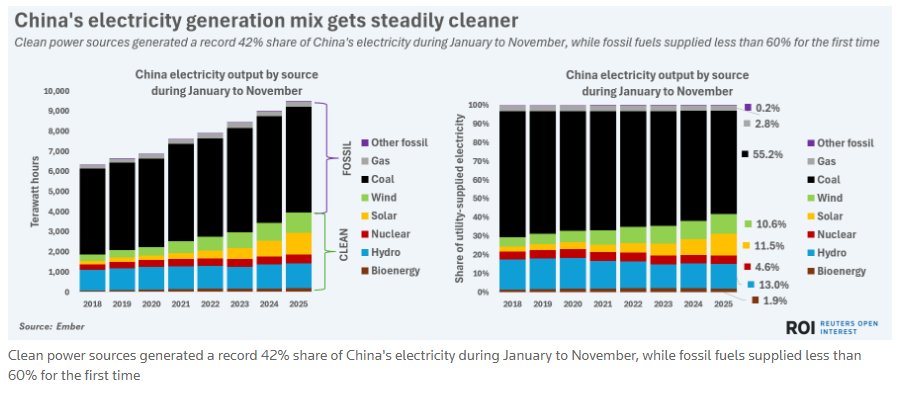
Group 1 - The core challenge for clean energy supporters in 2025 includes significant setbacks in U.S. clean energy policies, a "windless season" for European wind power, reduced corporate wind investments, and a strong rebound in coal power capacity [1] - Despite these challenges, there are positive developments such as record-high global battery storage installations, numerous countries achieving record solar power shares, and continued growth in electric vehicle sales in major automotive markets [1] Group 2 - China continues to lead in clean energy development, maintaining the world's largest installed capacity in nuclear, photovoltaic, wind, and biomass energy [2] - Clean electricity production in China is expected to achieve strong growth for the seventh consecutive year, with a reported 15.4% year-on-year increase in clean power generation for the first 11 months of 2025 [2] - By 2025, clean energy generation is projected to exceed 40% of the total electricity supply in China, while fossil fuel generation will reach its lowest historical share [5] Group 3 - Over the next decade, China's expansion in solar, wind, nuclear, and energy storage capacity is expected to further increase the share of clean energy in the national power generation mix [7] - China's clean technology exports have also surged, with a record-breaking export value of over $180 billion in the first ten months of 2025 [7] - Energy storage systems emerged as the top export category, generating nearly $66 billion in sales, followed by electric vehicle exports at approximately $54 billion [10] Group 4 - In contrast to China's progress, the U.S. clean energy transition faces setbacks due to the repeal of federal renewable energy support policies during Trump's second term, leading to a significant reduction in tax credits for power developers [11] - As a result, U.S. coal power production saw a 13% year-on-year increase, marking a three-year high, while carbon emissions from the power sector are expected to rise [13] - The average annual price of natural gas in the U.S. is projected to be about 50% higher in 2025 compared to 2024, leading utilities to rely more on cheaper coal to meet winter demand [16] Group 5 - Despite the increase in coal consumption, the U.S. battery storage installations also reached a record high of over 39 GW in 2025, representing a 43% increase from 2024 [17] - This rapid growth in battery storage is reshaping the dynamics of power flow in key grids, with California and Texas significantly altering their peak power supply structures [20] - Solar power systems also performed exceptionally well in 2025, with several countries achieving new highs in solar power shares, contributing to reduced electricity costs and carbon emissions [23] Group 6 - Looking ahead to 2026, more countries are expected to achieve new highs in solar power generation shares, indicating a persistent momentum in the global energy transition despite policy fluctuations in major economies like the U.S. [25]
雪人集团(002639) - 002639雪人集团投资者关系活动记录表20251215
2025-12-15 11:30
Group 1: Company Overview - Fujian Snowman Group Co., Ltd. was established in 2000, focusing on thermal power technology for cold chain logistics, industrial refrigeration, clean energy, and hydrogen power sectors [1] - In the first three quarters of 2025, the company achieved a revenue of CNY 1.631 billion, representing a year-on-year increase of 24.26% [1] Group 2: Data Center Business Expansion - The company has entered the data center business through compressor refrigeration equipment supply and key project construction [1] - It offers a diverse product line including piston compressors, open screw compressors, semi-hermetic screw compressors, and centrifugal compressors, with a new centrifugal compressor designed for high-efficiency data centers now on the market [1] - The company utilizes low-charge ammonia refrigeration technology, replacing traditional refrigerants, exemplified by its provision of third-generation low-charge ammonia cooling technology to Facebook's Denmark data center [1][2] Group 3: Controlled Nuclear Fusion Business - The company produces helium compressors essential for large-scale low-temperature systems, crucial for projects like the superconducting tokamak [2] - Its "megawatt-level" helium compressors can achieve cooling capacities at -271°C, with the technology recognized as internationally leading [2] Group 4: Hydrogen Energy Sector - The company is developing hydrogen fuel cell technology, focusing on core components and systems, while extending its existing compressor and refrigeration technologies to liquid hydrogen applications [2] - It has established a global hydrogen fuel cell technology R&D and supply chain system, with research institutions in Europe and Japan [2] - The new generation of metal plate fuel cell stacks has been developed, and the company is advancing the mass production of hydrogen fuel cells and core components domestically [2]
