
有源相控阵雷达

Search documents
趋势研判!2026年中国有源相控阵雷达行业政策、发展历程、运行现状、细分市场及未来发展趋势分析:军民融合加速,场景多元拓展空间广阔[图]
Chan Ye Xin Xi Wang· 2026-02-05 01:13
Core Insights - The active phased array radar (APAR) is a cornerstone of national defense and a key infrastructure for the digital economy, featuring advantages such as non-inertial scanning and multi-target tracking [1][2] - China's policies are promoting the technological iteration and civilian application of APAR, accelerating its penetration into the civilian economy [1][5] - The industry is characterized by a foundation in military applications, explosive growth in civilian markets, and leading technology, with the market expected to reach approximately 43.5 billion yuan by 2025 [1][5] Industry Overview - Active phased array radar (AESA) utilizes independent T/R components for each antenna unit, allowing for flexible beam steering and high data rates, overcoming the limitations of traditional mechanical scanning radars [2][3] - The classification of AESA includes analog, digital, and software-defined types, with applications spanning military and civilian sectors [3][4] Policy Environment - Recent policies in China, such as the "General Aviation Equipment Innovation Application Implementation Plan (2024-2030)" and others, support the development of APAR technology and its integration into civilian applications [5] - These policies aim to enhance core technology, expand application scenarios, and foster collaboration between academia and industry, facilitating the transition from military to civilian use [5] Current Industry Status - The APAR industry in China is in a golden development phase, characterized by technological independence, accelerated military-civilian integration, and steady market expansion [5][6] - The military market is expected to reach 44.8 billion yuan by 2030, with a compound annual growth rate (CAGR) of 10.7% from 2024 to 2030, while the civilian market is projected to reach 36.7 billion yuan with a CAGR of 21.5% [5][6] Industry Chain - The APAR industry has established a complete upstream, midstream, and downstream ecosystem, with significant domestic production capabilities [6] - Upstream focuses on core materials like GaN and GaAs, while midstream involves system integration and manufacturing led by state-owned enterprises [6] Development Trends - Future advancements in the APAR industry will focus on technological iteration, industrial upgrades, and application expansion, fostering a positive development environment [11][12] - Key trends include the widespread adoption of GaN materials, the integration of AI in radar technology, and the expansion of application scenarios in both military and civilian sectors [11][12][13]




关税回去了,但美国回不去了
Sou Hu Cai Jing· 2025-05-13 11:30
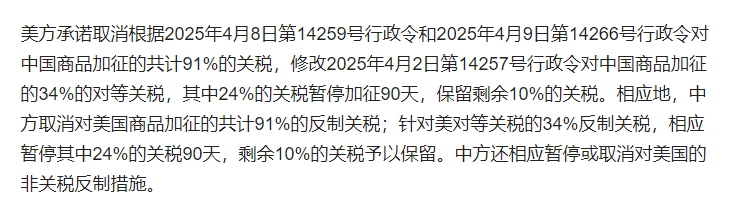
Core Viewpoint - The recent negotiations between China and the U.S. have led to a significant reduction in tariffs, with both sides canceling 91% of tariffs and reducing additional tariffs to 10%, marking a return to the pre-April 2 status, but the underlying dynamics of trade and pricing have fundamentally changed [1][4]. Group 1: Trade Dynamics - Following the tariff negotiations, U.S. clients have begun to place orders with Chinese manufacturers, creating an illusion of normalcy, yet the market dynamics have shifted [2]. - China's export to the U.S. saw a 21% decline in April, but overall exports increased by 9.3%, indicating a global shift towards sourcing from China to capture the U.S. market [7]. - The high tariffs imposed by the U.S. have not crippled China; instead, they have contributed to rising inflation in the U.S., with national debt surpassing $36 trillion and major retailers expressing concerns over empty shelves [7]. Group 2: Pricing Power and Market Perception - Chinese exporters have adapted to the trade tensions by forming a consensus to raise prices, moving away from the previous strategy of undercutting prices to secure orders [8][17]. - The prices of rare earth metals have surged dramatically, with dysprosium doubling to $850 per kilogram and terbium increasing over 210% to $3,000, reflecting the new pricing power of Chinese manufacturers [9]. - The perception of Chinese manufacturing is changing, with more American consumers recognizing the quality of products made in China, leading to a shift in branding strategies [19][23]. Group 3: Long-term Implications - The trade conflict has inadvertently highlighted China's advancements in manufacturing and its critical role in global supply chains, particularly in high-tech and military sectors where the U.S. heavily relies on Chinese rare earth materials [11][14]. - The ongoing tariff situation may lead to lasting changes in pricing structures, making it difficult for prices to revert to previous levels even if the trade war ends [24]. - The current trade tensions serve as a public acknowledgment of China's decade-long efforts to upgrade its manufacturing capabilities and redefine its market position [21][25].
军贸体系装备阔步“走出去”
2025-05-12 15:16
Summary of Key Points from Conference Call Records Industry Overview - The records discuss the military trade (military trade system) and its international performance, particularly focusing on China's military equipment exports and the implications of the India-Pakistan conflict on military trade dynamics [1][2][8]. Core Insights and Arguments - **China's Military Trade Position**: China is the fourth largest military trade exporter globally, with over 60% of its weapons sold to Pakistan, primarily high-end equipment, enhancing China's recognition in the international military equipment market [1][2][8]. - **Impact of India-Pakistan Conflict**: The recent conflict highlighted the advanced capabilities of Chinese military equipment, as Pakistan successfully used Chinese-made J-10C aircraft to shoot down Indian jets, showcasing the effectiveness and brand strength of Chinese military exports [2][8]. - **Investment Trends**: In Q1, public investment institutions reduced their holdings in the air force industry chain, particularly in leading military aircraft and engine companies, while significantly increasing their positions in companies related to munitions, such as Feilihua and Aerospace Electronics [1][4]. - **Potential of Key Companies**: Companies like AVIC Shenyang Aircraft Corporation (中航沈飞) and AVIC Optoelectronics (中航光电) are highlighted as quality stocks within the air force industry chain, with ROE nearing or exceeding 20%, currently at low valuation and expectation levels, indicating potential for growth in the trillion-yuan military trade market [1][5]. Important but Overlooked Content - **Data Link Importance**: The significance of data link systems in modern warfare is emphasized, as they enhance information warfare capabilities. Companies like CETC 54 and 712 Institute are expanding their offerings in this area, indicating a long-term growth potential [2][16]. - **Market Dynamics**: The military trade's impact on China's A-share military assets is significant, opening up vast foreign trade markets and enhancing profitability through systemic equipment exports, which leads to stable long-term business relationships [12]. - **Technological Advancements**: The transition from traditional to intelligent warfare systems is noted, with a focus on the increasing demand for connectors in military applications, particularly in active phased array radars, which are crucial for modern military operations [17][18]. Future Outlook - **AVIC Optoelectronics' Growth**: The company is expected to perform well in the next military business development cycle, despite short-term pressures. The anticipated recovery in orders and the company's strategic positioning in the market suggest a favorable outlook [20][21]. - **Strategic Developments**: AVIC Shenyang's recent advancements in asset quality and its focus on transitioning to next-generation aircraft (4th, 5th, and future 6th generation) are expected to enhance its competitive edge in the international market [14][15]. This summary encapsulates the critical insights and trends discussed in the conference call records, providing a comprehensive overview of the military trade landscape and the strategic positioning of key companies within the industry.
激浊扬清,周观军工第118期:军贸体系装备阔步“走出去”
Changjiang Securities· 2025-05-12 01:07
Investment Rating - The report maintains a "Positive" investment rating for the defense and military industry [2] Core Insights - The ongoing India-Pakistan conflict has reinforced the recognition of domestic equipment performance advantages, driving long-term high prosperity for domestic manufacturers in the military trade market [6][8] - The demand for advanced fighter jets is being driven by air combat needs, with the J-35 model leading the way in production expansion [50][59] - The development of a systematic combat approach is crucial for enhancing operational efficiency and decision-making speed in military engagements [103][111] Summary by Sections Section 1: India-Pakistan Conflict - The recent India-Pakistan conflict has escalated due to terrorist attacks and military friction, leading to significant military actions and heightened tensions [11][14] - Pakistan has demonstrated strong air superiority, utilizing Chinese-made J-10C fighter jets to achieve notable victories against Indian aircraft [19][22] Section 2: Military Trade Dynamics - Pakistan has been a core customer for Chinese military exports, with 62.17% of China's military trade weapons exported to Pakistan from 2015 to 2024 [23] - The global military trade market is significantly larger than the domestic market, with a financial value of at least $138 billion in 2022 [40][41] Section 3: Systematic Combat and Data Links - The systematic approach to combat has proven advantageous for Pakistan, allowing for better coordination and effectiveness compared to India's diverse procurement strategy [27][31] - Data links are essential for real-time information sharing and operational efficiency, significantly enhancing combat effectiveness [106][111] Section 4: Company Insights - AVIC Shenyang Aircraft Corporation - AVIC Shenyang is investing 11 billion yuan in production expansion and modernization to meet the demand for new aircraft models [76] - The company is focusing on supply chain management and lean production to ensure timely delivery and high-quality output [81][85] - Despite a decline in revenue due to external factors, the company maintains a high gross margin and is preparing for future demand increases [97][99]

