机械制品

Search documents
2025年钱凯港为当地贡献税收超10.37亿索尔
Shang Wu Bu Wang Zhan· 2026-02-04 15:08
Core Insights - In 2025, the Chancay Port contributed over 10.37 billion soles in tax revenue to the local economy, with the highest monthly revenue recorded in October at 1.21 billion soles [1] - Chancay Customs ranked sixth in national customs revenue in Peru, highlighting its significance in the country's trade landscape [1] Import Statistics - The main imported products through Chancay Port in 2025 included vehicles, bulk commodities, and machinery, with import values of 2.47 billion soles, 2.33 billion soles, and 2.18 billion soles respectively [1] - The highest number of customs declarations occurred in August and December, with 2,936 and 2,975 declarations respectively [1] Logistics Role - Over 126,000 TEUs (Twenty-foot Equivalent Units) of goods were transshipped from China through Chancay Port to other ports in Latin America, underscoring its role as a regional logistics hub [1] - The data reflects the growing vitality of Chancay Port and its strategic importance to Peru's foreign trade, as stated by the Minister of Economy and Finance, Millares [1]
本以为首个撑不住的是乌克兰,没想到是瑞士,瑞士金融业近乎完蛋
Sou Hu Cai Jing· 2025-08-15 08:09
Core Viewpoint - Switzerland is facing an unprecedented economic crisis due to the U.S. government's decision to impose high tariffs on Swiss exports, leading to significant capital outflows and a loss of investor confidence in the Swiss financial system [3][12]. Group 1: Historical Decisions and Trust Crisis - In February 2022, the Swiss Federal Council made a historic decision to freeze $8.23 billion in Russian assets, breaking its long-standing tradition of neutrality and participating in sanctions against Russia [7]. - This decision sparked a trust crisis among investors, leading to a significant withdrawal of funds from Swiss banks, particularly after the Swiss government intercepted humanitarian goods destined for Iran [7]. - The signing of a financial data exchange agreement with the U.S. in June 2024 further eroded the traditional banking secrecy in Switzerland, prompting wealthy clients to relocate their assets to jurisdictions like Hong Kong and Dubai [7]. Group 2: Collapse of Swiss Financial Institutions - In 2023, Credit Suisse, a 167-year-old bank, was acquired by UBS for only 3 billion Swiss francs after its market value plummeted by 97% [10]. - Over a span of 10 months, $120 billion in capital fled from Swiss banks, with significant inflows into private banks in Singapore, which saw an increase of $300 billion in assets under management [10]. - UBS itself faced challenges, including a drop in stock price by 60% from its 2023 peak due to allegations of assisting Russian oligarchs in asset transfers [10]. Group 3: Impact of U.S. Tariffs - On August 7, 2025, the Trump administration announced a 39% tariff on Swiss goods, significantly higher than tariffs faced by the EU, leading to predictions of a 0.7% decline in Swiss GDP if key industries like pharmaceuticals were affected [12]. - The tariff policy is expected to trigger a wave of unemployment and economic recession in Switzerland, exacerbating the existing financial crisis [12]. - Many Swiss companies are relocating production and R&D to countries like Singapore and Ireland in response to the economic pressures [16]. Group 4: Shift in Wealth Management - The turmoil in the Swiss financial system has led to a shift in global wealth management, with Singapore's private banking clientele increasing by 48% in 2025, largely due to capital moving from Switzerland [18]. - The private banking sector in Switzerland, which once accounted for 12% of its GDP, is now facing systemic collapse [18]. - Singapore's stock market capitalization is projected to exceed $1 trillion by 2030, as reforms attract global capital [18]. Group 5: Swiss National Bank's Response - In response to the crisis, the Swiss National Bank has engaged in "silent actions" to stabilize the Swiss franc by increasing foreign exchange reserves, which reached a record high of 716 billion Swiss francs in July 2025 [22]. - The International Monetary Fund (IMF) has indicated that Switzerland will be the most severely impacted European country by U.S. tariffs, particularly amid global supply chain restructuring [22].



瑞士成美关税打击最重欧洲国家
Sou Hu Cai Jing· 2025-08-09 02:29
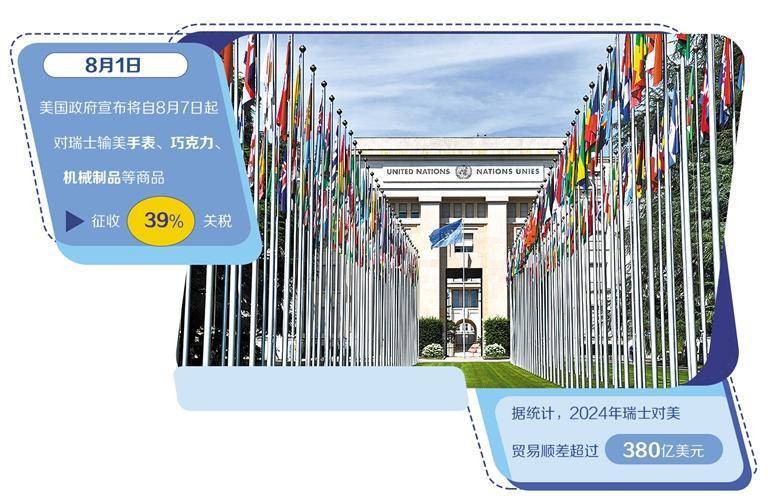
Group 1 - The U.S. government announced a 39% tariff on Swiss imports, effective August 7, which is higher than the previous 31% tariff and more than double the tariff on EU imports, making Switzerland the hardest-hit European country by U.S. tariffs [2] - Switzerland's trade surplus with the U.S. exceeded $38 billion in 2024, prompting the U.S. to impose these high tariffs due to concerns over trade imbalances [2] - The Swiss government expressed dissatisfaction with the U.S. decision, highlighting that the trade surplus is not based on unfair practices and that they have unilaterally eliminated all industrial tariffs since January 1, 2024, allowing over 99% of U.S. goods to enter Switzerland duty-free [3] Group 2 - The imposition of the 39% tariff is expected to significantly impact the Swiss job market, with potential increases in short-term work and layoffs, particularly affecting key industries [3] - The pharmaceutical sector, which accounts for over half of Switzerland's exports to the U.S., is currently not covered by the new tariffs, but any future inclusion could lead to a GDP decline of at least 0.7% [3] - A high-level Swiss delegation, including the Federal President and the Minister of Economy, has been sent to Washington to negotiate and propose more attractive terms to reduce the tariff levels on Swiss exports [3] Group 3 - The situation illustrates the U.S. government's unilateral approach to trade, focusing primarily on trade surpluses without considering the broader economic context [4] - The case of Switzerland serves as a lesson for other countries on how to engage in trade with the U.S. and the challenges they may face [4]