
巧克力

Search documents
原料涨价、渠道分流、小品牌围攻,巧克力厂商的突围指南
凯度消费者指数· 2026-03-24 03:52
Core Viewpoint - The chocolate market is facing both challenges and opportunities, with rising raw material costs and the emergence of small brands impacting traditional manufacturers, while consumer preferences are shifting towards quality and price-performance ratio [1][18]. Group 1: Market Dynamics - Chocolate sales account for over half of the candy category, and this proportion continues to rise [1]. - The trend of "consumption alternatives" is affecting the chocolate market, with non-leading brands capturing significant market share, accounting for nearly half of chocolate sales in e-commerce channels [2]. - The price of cocoa futures surged to a historical high in April 2025 due to supply issues caused by pests and extreme weather, leading to increased production costs for chocolate manufacturers [2]. Group 2: Private Label Brands - Retailers are accelerating the development of private label brands, with the proportion of urban households purchasing private label products rising from 45% to 53% between 2024 and the first three quarters of 2025 [3]. - Private label brands are increasingly priced closer to manufacturer brands, with 41% of private label fast-moving consumer goods priced higher than other brands, indicating a shift in strategy beyond just low pricing [3]. Group 3: Consumer Preferences - Flavor preference is the primary consideration for consumers when purchasing chocolate, accounting for nearly 30% of the decision-making process [4]. - Over 80% of chocolate consumers in snack stores prefer products priced below 10 yuan or weighing less than 80 grams, with more than half favoring items under 5 yuan [8]. Group 4: Channel Growth - Snack stores have rapidly expanded, significantly increasing chocolate penetration rates, which grew by 36% in the past year, outpacing overall channel growth [6]. - The average price of chocolate in snack stores is only 38% of the overall channel average, making it an attractive option for consumers [7]. Group 5: Targeting Families - Families with children are the core consumer group for chocolate in snack stores, with "purchasing for children" and "attractive packaging" being the main drivers of consumption [8][12]. - Chocolate brands should focus on appealing packaging and product design to capture the attention of children and encourage impulse purchases [12]. Group 6: Long-term Trends - The aging population is becoming a new consumer force in the chocolate market, with middle-aged families showing the highest growth in sales and penetration rates [11]. - Brands should target this demographic by offering products suitable for sharing and gifting, aligning with their social needs and usage scenarios [12][13]. Group 7: Seasonal Trends - During the Spring Festival, the proportion of sales from gifts increased from 15% to over 20%, indicating a growing trend towards gifting quality chocolate products [15][16]. Group 8: Strategic Recommendations - Chocolate manufacturers should track flavor and ingredient trends, innovate products based on consumer preferences, and ensure precise channel alignment to achieve sustainable growth [18].

原料短缺,美国巧克力零售价格持续上涨
Xin Lang Cai Jing· 2026-02-15 04:14
Core Insights - The price of chocolate in the United States has increased significantly, with a year-on-year rise of over 14% as of early February 2023 [1] Price Trends - From January 1 to early February 2023, the retail price of chocolate in the U.S. rose by 14.4% compared to the same period last year [1] - Specific cities such as Denver and Los Angeles experienced price increases of approximately 17%, while the Dallas-Fort Worth area saw an even higher increase of 19% [1] Supply Chain Factors - The primary driver of the rising chocolate prices is the global supply shortage of cocoa beans, which are predominantly produced in West Africa, accounting for about 70% of global production [1] - Extreme weather conditions have led to poor harvests, pushing cocoa futures prices to historical highs [1] - Although international cocoa prices have recently declined, chocolate products in the U.S. are still adjusting to previously high procurement costs, indicating that the upward price trend may continue in the short term [1]
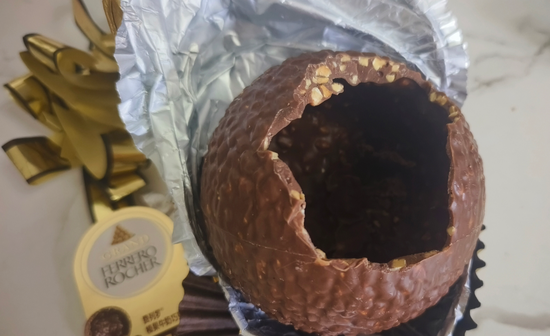
情人节送费列罗“翻车”!包装像拳头,打开是空气……60元买个空壳?
Xin Lang Cai Jing· 2026-02-14 06:51
Core Viewpoint - Ferrero's product, the "Golden Ball" chocolate, has faced significant consumer backlash due to misleading packaging that suggests a full product but contains mostly air, leading to accusations of deceptive marketing practices [2][3][7] Group 1: Consumer Complaints - Multiple consumers reported that the Ferrero "Golden Ball" chocolate appears to be full but is actually hollow, resulting in disappointment and loss of trust in the brand [2][3][7] - Customers expressed frustration over the lack of clear labeling indicating that the product is hollow, with key information obscured on the packaging [5][19] - Social media reactions included mockery of the product as "air chocolate," highlighting consumer dissatisfaction with perceived value versus actual content [7][21] Group 2: Company Response - Ferrero's customer service stated that the hollow design is not intended to mislead consumers and that product information is compliant with national regulations [7][21] - The company acknowledged consumer concerns but indicated that current policies do not allow for refunds or compensation in these cases [21][28] Group 3: Company Background and Financials - Ferrero, founded in 1946 in Italy, operates in over 50 markets with 41 production facilities and employs over 50,000 people globally [8][22] - The company has made significant investments in the Chinese market since establishing its local subsidiary in 2007, including opening its first factory in Hangzhou in 2015 [22] - Ferrero reported a 4.6% increase in revenue for the fiscal year 2024/2025, reaching €19.3 billion [22]
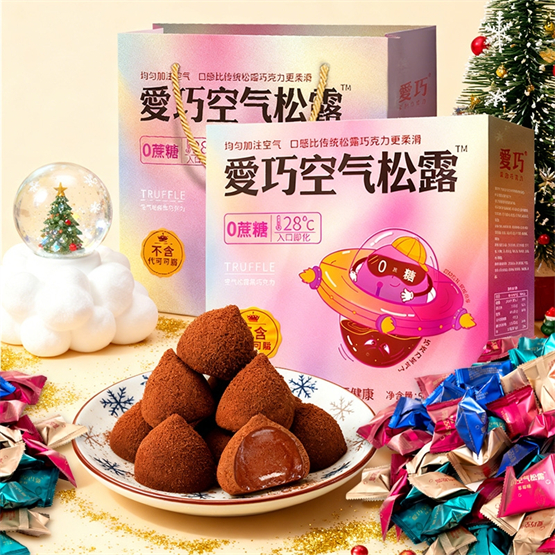
深圳爱巧完成亿元A轮融资:双轮驱动布局,发力打造国民巧克力
Sou Hu Wang· 2026-01-30 09:26
Core Insights - Shenzhen Aiqiao E-commerce Co., Ltd. has completed a 100 million RMB Series A financing round, marking a significant step towards establishing itself as a leading national chocolate brand [1] - The financing will focus on product innovation, brand marketing, supply chain integration, and upgrading intelligent production capabilities [1] Business Model - Aiqiao operates a dual-driven model combining "self-owned brand innovation + international brand empowerment" [3] - The self-owned brand segment emphasizes "healthy and delicious" products, featuring a diverse product matrix including the flagship "Aiqiao Air Truffle Chocolate" and various themed gift boxes for key consumption occasions [3] Agency and Empowerment - Aiqiao serves as a key e-commerce partner and import agent for global chocolate giants like Mars, Ferrero, Nestlé, and Hershey, while also innovating in "brand secondary packaging" [5] - This secondary packaging business has seen strong sales during key gifting occasions, catering to both individual and corporate preferences [5] Technological Innovation - As a national high-tech enterprise, Aiqiao focuses on integrating technology with chocolate and snack product development, leveraging artificial intelligence and internet information technology [7][8] - The company employs a C2B2F (Consumer to Business to Factory) product development model, utilizing big data to align product development with consumer preferences, thus enhancing market responsiveness [8] Market Positioning - The Chinese chocolate market is characterized by high brand recognition but low penetration, with a market size of approximately 30 billion RMB, where over 80% is dominated by international brands [10] - Aiqiao aims to meet the growing demand for innovative national brands that resonate with Chinese consumers, supported by the recent financing to enhance product innovation and market expansion [10]
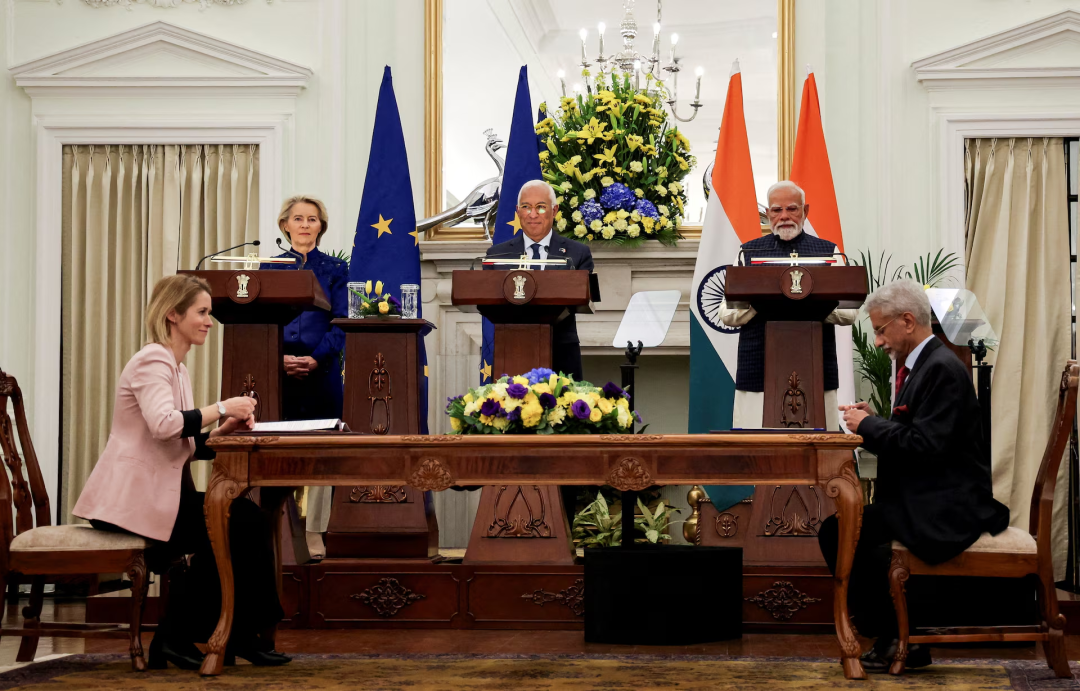
史上最大协议!印度、欧盟联手了,回击特朗普
Zhong Guo Ji Jin Bao· 2026-01-27 11:17
Core Points - The European Union and India have reached a historic free trade agreement after nearly two decades of negotiations, aiming to deepen economic ties and mitigate the impact of U.S. tariff policies [1][4] - The agreement creates a free trade area covering 2 billion people, with both parties expected to benefit significantly [3] Group 1: Trade Agreement Details - The EU's goods exports to India are projected to double by 2032, while India will eliminate or reduce tariffs on 96.6% of EU goods, including automobiles, industrial products, and various food items [4] - India will allow up to 250,000 European-manufactured cars to enter its market at preferential tax rates, a quota significantly larger than in previous trade agreements [4][5] - The agreement includes commitments from the EU on student mobility and post-graduation visas, while India has excluded dairy products from the deal [5] Group 2: Strategic Implications - The agreement reflects a shift in focus for both the EU and India towards reducing economic dependence on the U.S., particularly in light of the trade policies under former President Trump [4] - India is actively seeking new markets and has already signed trade agreements with the UK, Oman, and New Zealand, with plans to establish partnerships with other regions to enhance its global influence [5] - The bilateral trade volume between the EU and India is currently $136.5 billion, with the EU accounting for over 17% of India's total exports [5]
西贝获投资;半亩花田母公司冲刺IPO;华润饮料换帅
Sou Hu Cai Jing· 2026-01-25 12:30
Financing Dynamics - Xibei Restaurant Group has completed an A-round financing with investors including Taizhou Xinrongtai Investment Co., Hohhot Collective Co-Creation Enterprise Management Center, Chengdu Xunda Optoelectronics Co., and Hangzhou Zhouxuan Equity Investment Management Partnership. The financing amount has not been disclosed [3] - The registered capital of Xibei Restaurant increased from 89.902896 million yuan to 101.680175 million yuan, a growth of approximately 13.1%. The shareholder list has been updated with the new investors, leading to a corresponding decrease in the shareholding ratios of founder Jia Guolong and some existing shareholders [3] Acquisition Dynamics - L Catterton, a private equity firm backed by LVMH, has acquired a majority minority stake in French high-end perfume brand Ex Nihilo from Eurazeo. The transaction value exceeds the 29 million euros Eurazeo paid in 2024 [7] - Ex Nihilo, founded in 2013, is known for its unique fragrances and personalized services. The brand plans to reopen its flagship store in Paris in 2026 and expand into multiple cities in the U.S. [7] - China Duty-Free Group has agreed to acquire DFS's travel retail business in Greater China from LVMH and co-founder Robert Miller. This acquisition will give CTG control over DFS retail stores in Hong Kong and Macau, along with exclusive rights to the DFS brand and intellectual property [10] Listing Dynamics - Shandong Huawutang Cosmetics Co., the parent company of the brand "Banmu Huatian," has submitted an application for an IPO on the Hong Kong Stock Exchange, with CITIC Securities as the sole sponsor. The company expects revenue of 1.4989 billion yuan in 2024, a 25% increase from 1.1987 billion yuan in 2023 [12] - The funds raised from the IPO will primarily be used for brand exposure, supply chain expansion, and R&D upgrades, aiming to capture the mid-to-high-end body care market [12] Brand Dynamics - Bosideng has launched a new high-end product line "Areal" in the Galeries Lafayette Haussmann in Paris, marking its first overseas public presentation since the line's release in 2025 [15] - This event signifies Bosideng's establishment as the first Chinese down jacket brand to open a pop-up store in Galeries Lafayette, marking a significant milestone for the brand's entry into the EU market [15] Personnel Dynamics - Tiffany & Co. has appointed David Ponzo as the new Vice CEO, effective January 26, succeeding the retiring Chief Commercial Officer Gavin Haig. Ponzo previously served as Chief Commercial Officer at Louis Vuitton [17] - Nike has announced that Angela Dong, the head of Greater China, will leave the company on March 31, with Cathy Sparks taking over the position. This change is part of Nike's strategy to enhance competitiveness in the Chinese market [20] - Barry Callebaut has appointed Hein Schumacher, a former Unilever executive, as the new CEO, effective January 26. This leadership change comes as the company faces challenges in cocoa sales [23] - China Resources Beverage has announced a leadership change, with Gao Li taking over as chairman from Zhang Weitong, amid a significant decline in revenue and profit [27]



张勇重任海底捞CEO,能否打造第二曲线?
2 1 Shi Ji Jing Ji Bao Dao· 2026-01-14 03:26
Group 1: Company Leadership Changes - Zhang Yong has returned to the CEO position of Haidilao, effective January 13, 2026, following the resignation of Guo Yiqun as CEO [1] - Zhang Yong previously handed over the CEO role to Yang Lijuan in March 2022, and Guo Yiqun took over in June 2024 [1] - The leadership change comes as Haidilao faces performance challenges, with a 3.0% year-on-year revenue decline to 20.703 billion yuan and a 13.7% drop in net profit to 1.755 billion yuan in the first half of 2025 [1] Group 2: Industry Context - The Chinese restaurant industry is experiencing a slowdown, with revenue growth decelerating, profits declining, and competition intensifying, as reported by the China Cuisine Association [1] - Competitors like Xiaobai Xiaobai reported an 18.88% revenue decline to 1.942 billion yuan and a net loss of 84 million yuan in the same period [1] Group 3: Strategic Initiatives - Zhang Yong's return is linked to the "Pomegranate Plan," a multi-brand incubation strategy launched in August 2024, aimed at creating a second growth curve for Haidilao [2] - As of June 2025, the "Pomegranate Plan" has incubated 14 restaurant brands, generating a 227% year-on-year revenue increase to 600 million yuan from related businesses [2] - The company is at a critical transformation juncture, with Zhang Yong becoming more involved in operational details [2]






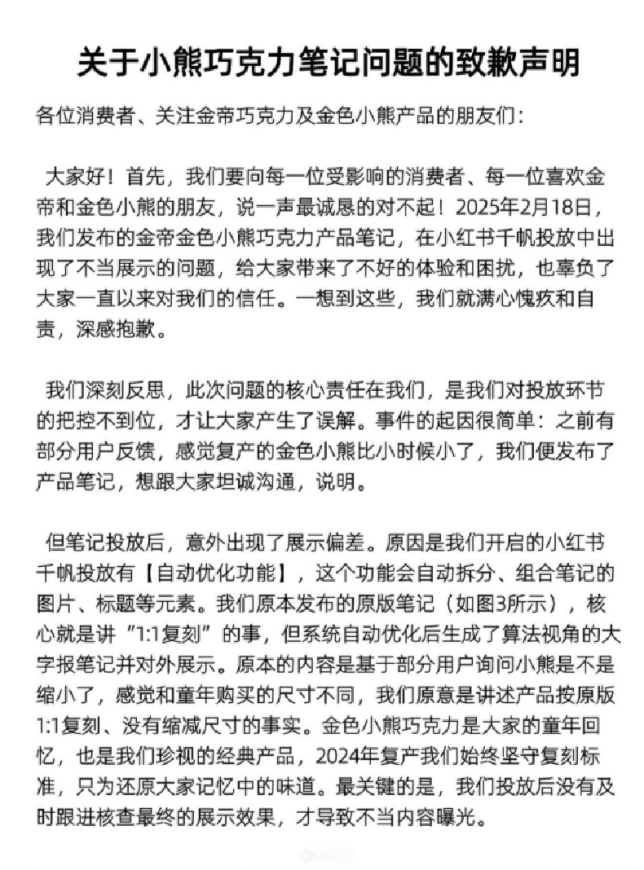
陷“擦边营销”争议,金帝巧克力道歉
Guo Ji Jin Rong Bao· 2026-01-13 07:14
Core Viewpoint - The controversy surrounding Jindi Chocolate's marketing content has led to significant backlash from consumers, particularly due to perceived inappropriate implications in their promotional material [1][2][4]. Group 1: Marketing Controversy - Jindi Chocolate faced criticism for a promotional post on Xiaohongshu that included the phrase "The bear gets bigger? Is it something you can hold?" which was interpreted as having vulgar connotations [1][2]. - Consumers expressed discomfort with the marketing approach, with some parents stating they would not purchase the product for their children [2][6]. - In response to the backlash, Jindi Chocolate issued an apology, attributing the issue to an "automatic optimization feature" in their marketing system that generated inappropriate content without human oversight [2][4]. Group 2: Brand Response and Impact - Following the controversy, Jindi Chocolate took steps to hide the problematic content and paused all related marketing campaigns on Xiaohongshu, while forming a special team to review the marketing system [4][6]. - The initial apology did not quell the criticism, leading to a second apology that clarified the content was generated by the system and not manually created [4][6]. - The incident has negatively impacted Jindi Chocolate's brand reputation, with many consumers expressing their discontent by removing the brand from their shopping carts and unfollowing them on social media [6]. Group 3: Company Background - Jindi Chocolate, originally established in 1990 as Zhongliang Jindi Food (Shenzhen) Co., Ltd., was once a leading domestic chocolate brand [7]. - The company was acquired and restructured by Haolinjia Co., Ltd. in 2016, and is now planning a revival strategy for 2024 aimed at rekindling consumers' childhood memories associated with the brand [7].
新一年,华商试水新领域拓展生意圈(侨界关注)
Ren Min Ri Bao· 2026-01-08 19:51
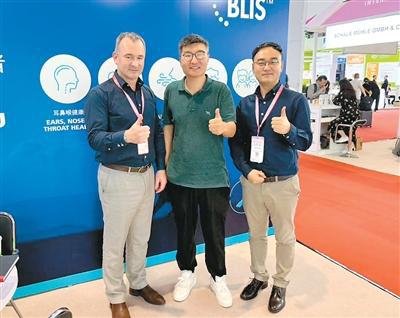
Group 1 - The new chapter of 2026 presents more positive factors supporting China's economy and will generate more development and investment opportunities [3] - Chinese businesses reflect on their achievements in 2025 and share their plans and expectations for 2026 [3] Group 2 - Wang Siwei, a Chinese businessman in New Zealand, successfully expanded trade between China and New Zealand in 2025, introducing a health product brand and a card game brand to the New Zealand market [4] - In 2026, Wang plans to participate in more exhibitions in China, particularly focusing on the Hainan Free Trade Port, which offers significant business opportunities due to its zero-tariff policies on medical devices [4][6] - Wang aims to leverage the advantages of Hainan's logistics and cultural familiarity to expand into Southeast Asian markets [5] Group 3 - Belgian businessman Fu Bodi is planning to establish a chocolate museum in Hangzhou, China, in celebration of the 55th anniversary of diplomatic relations between China and Belgium [7] - The chocolate museum will feature a variety of attractions, including a chocolate supermarket and a DIY workshop, integrating modern technology with traditional chocolate-making [8] - Fu Bodi's vision includes expanding the chocolate tourism industry in China, supported by the growing cultural tourism market and government initiatives [8][9] Group 4 - He Cheng, a businessman from Kazakhstan, emphasizes the importance of talent resources for enhancing Sino-Kazakh trade relations [10] - He notes the positive environment for trade between China and Central Asian countries, with a focus on sectors like non-ferrous metals and agricultural products [10][11] - In 2026, He plans to invest in both physical infrastructure and human resources to strengthen bilateral trade [11]
迪拜巧克力凭什么火了2年还在涨粉?
东京烘焙职业人· 2025-12-31 08:34
Core Viewpoint - The Dubai chocolate trend has evolved from a viral sensation to a mature product category, indicating significant growth potential and consumer interest in high-end and specialty foods [1][15]. Group 1: From Social Media Trend to Brand Consensus - Hershey's is launching a limited edition Dubai chocolate, with only 10,000 pieces available, emphasizing its exclusivity [2]. - The trend's popularity on social media has prompted major brands like Lindt and Läderach to introduce their own versions of Dubai chocolate, showcasing its market appeal [7]. - Hershey's innovation manager highlighted the importance of exclusivity in marketing this product, targeting collectors and trendsetters [5]. Group 2: Evolution of Product Offerings - Dubai chocolate has expanded beyond traditional chocolate bars to become a "flavor IP," appearing in various consumer products such as ice cream, desserts, and beverages [10]. - This diversification meets consumer demands for luxury, regional authenticity, and novelty, enhancing its visual appeal for social media sharing [11]. Group 3: Challenges of Mainstreaming a Niche Category - By 2025, Dubai chocolate is expected to transition from a trendy item to a globally influential mature category, with growth potential in high-end chocolates and specialty foods [15]. - However, challenges include the rising production costs due to global supply issues of key ingredients like pistachios and the complex manufacturing processes that lower efficiency [15]. - The high price point of Dubai chocolate may limit its accessibility as a daily consumer product [15]. Group 4: Future Outlook - The potential for Dubai chocolate lies in balancing exclusivity with broader market appeal, leveraging cultural elements and ingredient innovation to strengthen its luxury regional identity [17]. - Future strategies may include deepening high-end market penetration and expanding into mainstream products like ice cream and baked goods to maintain consumer interest [17].
