李渡高粱1955

Search documents
李渡多款产品全面停货
Xin Lang Cai Jing· 2026-02-12 02:14
新浪财经"酒价内参"重磅上线 知名白酒真实市场价尽在掌握 新浪财经"酒价内参"重磅上线 知名白酒真实市场价尽在掌握 2月12日,新浪财经《酒业内参》从业内获悉,李渡酒业今日发布通知,即日起正式停止供应李渡高粱 1308、1955、1975及李渡王系列酒,恢复时间另行通知。 责任编辑:杨赐 2月12日,新浪财经《酒业内参》从业内获悉,李渡酒业今日发布通知,即日起正式停止供应李渡高粱 1308、1955、1975及李渡王系列酒,恢复时间另行通知。 责任编辑:杨赐 ...
消费板块共振上涨,消费行业结构性回暖
KAIYUAN SECURITIES· 2025-11-16 08:14
《底部布局,柳暗花明—行业投资策 略》-2025.11.14 《白酒底部布局,兼顾成长型标的— 行业周报》-2025.11.9 《三季报业绩压力增大,白酒报表持 续出清—行业周报》-2025.11.2 消费板块共振上涨,消费行业结构性回暖 ——行业周报 食品饮料 2025 年 11 月 16 日 投资评级:看好(维持) 行业走势图 数据来源:聚源 -14% -7% 0% 7% 14% 22% 29% 2024-11 2025-03 2025-07 食品饮料 沪深300 相关研究报告 张宇光(分析师) 张思敏(分析师) zhangyuguang@kysec.cn 证书编号:S0790520030003 zhangsimin@kysec.cn 证书编号:S0790525080001 核心观点:消费已有企稳迹象,布局机会渐行渐近 11 月 10 日-11 月 14 日,食品饮料指数涨幅为 2.8%,一级子行业排名第 5,跑赢 沪深 300 约 3.9pct,子行业中预加工食品(+6.9%)、烘焙食品(+5.1%)、乳品 (+4.3%)表现相对领先。本周消费板块集体上行,是由于 10 月 CPI 由负转正 引发催化, ...



从李渡操盘手到集团CEO,汤司令的“跨越”方法论
Xin Lang Cai Jing· 2025-10-16 05:50
Core Viewpoint - The appointment of Tang Xiangyang as CEO of Zhenjiu Lidou is a strategic response to the new industry cycle, aiming for long-term growth and innovation to overcome market uncertainties and homogenization challenges [3][12][16]. Group 1: Company Background - Zhenjiu Lidou Group appointed Tang Xiangyang as CEO effective October 13, 2023, to oversee overall management and the operations of its core subsidiaries [3][4]. - The company has transformed from near bankruptcy to a successful listing on the Hong Kong Stock Exchange, marking a significant turnaround in its fortunes [4][11]. Group 2: Tang Xiangyang's Journey - Tang Xiangyang, known as "Tang Commander," has a solid background in brewing and market experience, having turned around the fortunes of Lidou after years of losses [6][7]. - Under his leadership, Lidou introduced innovative concepts like "immersive experiences" to engage consumers, which significantly contributed to the brand's revival and recognition [9][12]. Group 3: Financial Performance - Zhenjiu Lidou's revenue for 2024 reached 1.31 billion yuan, a year-on-year increase of 18.3%, solidifying its position as the fifth-largest brand in the Chinese liquor market [11][12]. - The company has successfully established itself as a leading player in the high-end liquor segment, with its flagship product, Li Dou Gao Liang 1955, becoming a trendsetter in the market [9][11]. Group 4: Strategic Insights - The company's approach emphasizes long-termism as a cornerstone for navigating market cycles and enhancing personal value within the organization [13][15]. - Tang's strategy focuses on avoiding homogenization through innovation, creating emotional connections with consumers, and establishing a competitive edge in the evolving liquor market [15][16]. Group 5: Future Outlook - Tang's new role as CEO is seen as a pivotal moment for Zhenjiu Lidou, with expectations that he will leverage his extensive experience to drive further growth and innovation [20]. - The company is positioned to capitalize on its past successes while addressing the challenges of a competitive market landscape [18][20].

2025年中国新消费品牌势能创新增长研究白皮书-百思特
Sou Hu Cai Jing· 2025-09-23 07:23
Core Insights - The report highlights the emergence of new consumer brands in China, emphasizing the need for innovative marketing strategies to thrive in a rapidly changing competitive landscape [1][2][18] - The PMC (Potential Marketing Communication) theory is introduced as a framework for understanding the growth logic and innovative models of new consumer brands [1][2][18] Group 1: Market Dynamics - The competitive environment has drastically changed, with the rise of new consumer demographics and the advent of new consumerism, leading to the decline of traditional brand marketing methods [1][2][18] - New consumer brands like Gao Fan and Li Du have achieved exponential growth through innovative approaches, such as premium product offerings and immersive consumer experiences [1][2][19][20] Group 2: Brand Growth Characteristics - New consumer brands share common growth characteristics, including a focus on niche markets, preference for high-end positioning, and the use of content marketing over traditional advertising [1][2][19][20] - Successful brands have utilized strategic public relations and new retail channels, such as online short video and live-streaming e-commerce, to reach target audiences effectively [1][2][19][20] Group 3: PMC Marketing Innovation Model - The PMC model encompasses several key elements: market growth positioning, celebrity endorsements from entrepreneurs and KOLs, and the creation of star products that stand out in the market [2][18][46] - The report also analyzes successful case studies of traditional brands that have revitalized their market presence through innovative strategies, such as Yaya's transformation and the collaboration of Da Bai Tu with new brands [2][18][46] Group 4: Case Studies of New Consumer Brands - Gao Fan achieved a sales breakthrough of 1.7 billion yuan in three years, becoming the top brand in high-end down jackets [19] - Li Du transformed its business model, resulting in a 60-fold revenue increase over ten years and becoming the first stock of light bottle liquor in Hong Kong [20][22] - Three Dunsan, with its freeze-dried coffee innovation, reached a valuation of 4.5 billion yuan, outperforming Nestlé in the instant coffee market [28][29] - Lululemon surpassed Adidas in market capitalization, becoming the third-largest sports brand globally, with a revenue growth of over 10 times in a decade [30][32] Group 5: Future Trends - The report emphasizes the importance of emotional and cultural values in brand building, suggesting that brands must create additional benefits to remain competitive in the new commercial era [2][18][46] - The shift from traditional advertising to customer value innovation is identified as a fundamental change in brand-building strategies, with a focus on building brand equity through authentic consumer engagement [46][47]

2025中国新消费品牌势能创新增长研究白皮书
Sou Hu Cai Jing· 2025-09-22 15:57
Core Insights - The report highlights the failure of traditional brand marketing models in the new commercial era, emphasizing that new consumer brands achieve exponential growth through innovative strategies [1][10][16] - It introduces the PMC (Potential Marketing Communication) model, which focuses on customer value innovation, niche market penetration, and content marketing as key drivers for brand growth [1][16][48] Group 1: Market Environment Changes - The competitive landscape has dramatically shifted, leading to the decline of traditional brands and the rise of new consumer groups and consumption ideologies [1][10][14] - New consumer brands are not relying on traditional advertising but are instead focusing on value innovation and brand engagement to drive growth [1][10][46] Group 2: Case Studies of New Consumer Brands - High Fan achieved the top position in high-end down jackets within three years, breaking the 2000 price barrier with innovative materials and marketing strategies [1][18] - Li Du created the most expensive light bottle liquor in China, becoming the first liquor stock in Hong Kong, with a tax revenue increase of 100 times over ten years [1][19][21] - Orange Du led the domestic makeup market, achieving significant sales growth by expanding product categories and targeting diverse consumer demographics [1][22][24] - Babycare entered the top tier of the mother and baby market within three years, offering a wide range of products and achieving over 50 billion in sales by 2024 [1][26][28] - Three Dots Half surpassed Nestlé in the instant coffee market, achieving a valuation of 4.5 billion with innovative product offerings and marketing strategies [1][29][30] - Lululemon's market value surpassed Adidas, becoming the third-largest sports brand globally, with a revenue increase of 19% in 2023 [1][31][35] - Tineco achieved a valuation of 10 billion within five years by redefining the cleaning appliance market through user-centric innovations [1][36][37] - De You created a new category in wet toilet paper, achieving over tenfold growth in four years, with a market share exceeding 50% [1][38][40] - NIO became the highest-valued car company in China within six years, surpassing traditional automotive giants through innovative branding and customer engagement strategies [1][41][42] Group 3: New Marketing Strategies - The shift from advertising to customer value innovation is a fundamental change in brand building, with a focus on creating star products and enhancing consumer experience [1][47] - Niche market selection has become the primary path for new consumer brands, allowing them to build competitive advantages in less saturated markets [1][48] - High-end strategies have led to exponential growth for many new consumer brands, emphasizing the importance of brand equity and emotional connection with consumers [1][49]
白酒公司温和参与618大促
Xin Lang Cai Jing· 2025-06-09 11:19
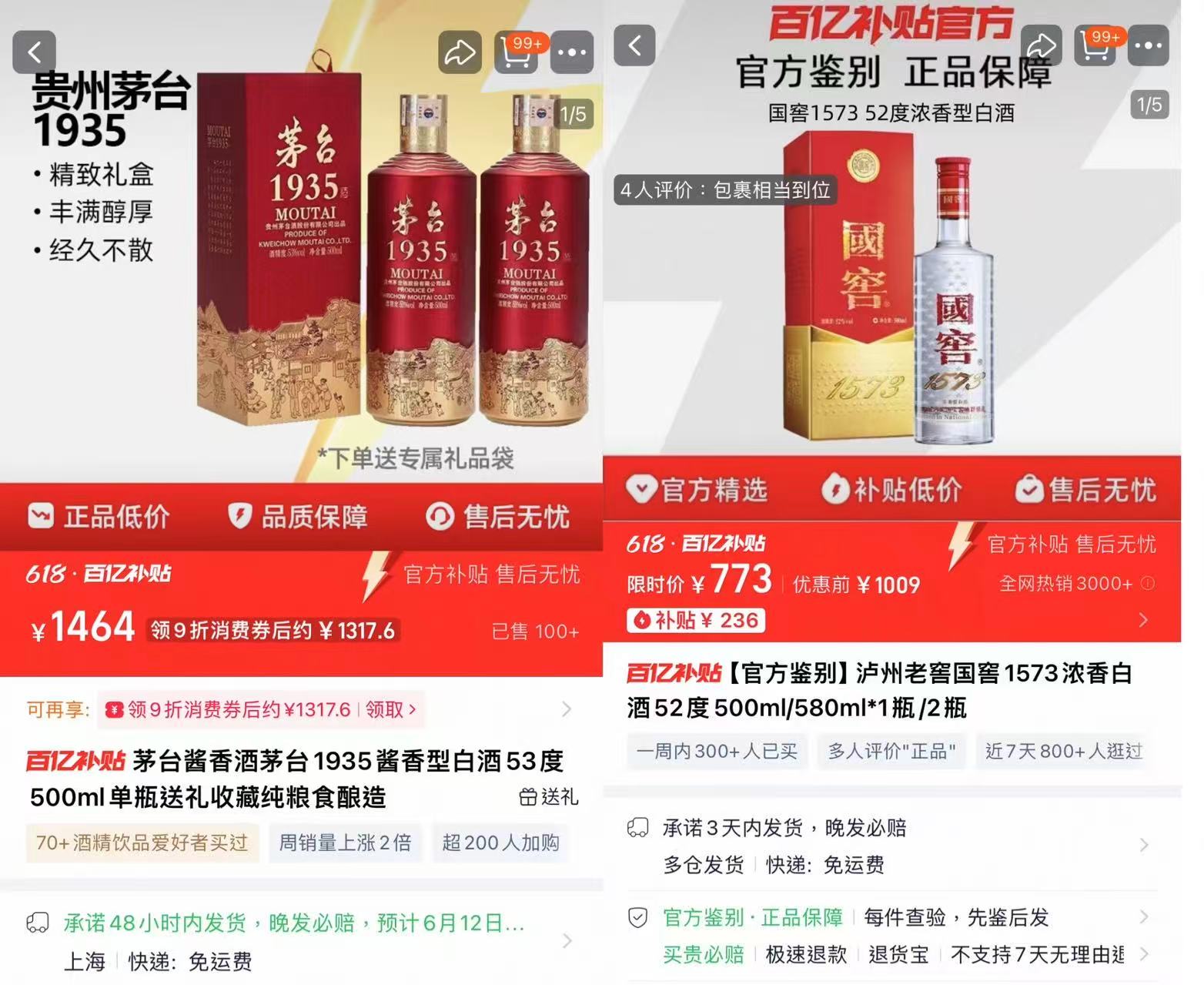
Core Insights - The 2025 "618 Shopping Festival" started on May 13 and will last until June 18, marking the longest duration in its history, aimed at stimulating consumer spending [1] - Despite a pessimistic outlook for the liquor market in 2023, data from e-commerce platforms during the 618 period shows strong sales momentum for alcoholic beverages [1][2] - The sales of liquor products on platforms like Tmall and Meituan have seen significant year-on-year growth, with Tmall's core liquor brands increasing by 72% in the first phase of the event [1][2] E-commerce Performance - From May 13 to May 26, Tmall's liquor sales saw a 72% increase compared to the same period last year, with domestic liquor, wine, and yellow wine all achieving double-digit growth [1] - Meituan's flash sales reported a nearly 19-fold increase in liquor sales, with over 50 categories of products, including liquor, experiencing over 100% growth compared to last year [1][2] - Live streaming has significantly boosted liquor sales, with Tmall's liquor live streaming sales increasing by 20% year-on-year, and wine live streaming sales soaring by 108% [1] Pricing Strategies - The competitive pricing during the 618 event has contributed to the strong sales, with notable discounts on premium liquor brands [2][4] - For instance, Moutai 1935 was priced below 800 yuan on various platforms, while Guojiao 1573 was available for as low as 773 yuan per bottle, making them attractive to consumers [2] - Despite the discounts, liquor companies are managing their pricing strategies to avoid disrupting the overall pricing system for distributors [4][5] Market Dynamics - The liquor industry is facing challenges with price inversions, where retail prices are lower than distributor prices, affecting profitability for offline retailers [5][6] - In 2025, liquor companies have adopted a "control inventory and maintain prices" strategy, with several brands issuing stop-sale notices to stabilize prices [5][8] - The offline retail market has not been significantly impacted by the online promotions, as many stores did not engage in similar discounting activities [6][7] Industry Outlook - Major liquor companies, including Moutai and Wuliangye, have adjusted their revenue growth targets downward, indicating a cautious outlook for the industry [8] - The ongoing competition from online channels continues to pressure traditional retail margins, as consumers have more options and price comparison capabilities [6][8]