
液体硅橡胶

Search documents
有机硅专家20260303
2026-03-04 14:17
Summary of the Conference Call on Organic Silicon Industry Industry Overview - The organic silicon industry has reached a consensus on a price increase of 300 RMB, with the mainstream price of DMC rising to 14,200-14,300 RMB. Future price adjustments will follow a rolling increase strategy of 300-500 RMB per instance [2][3] - The supply side is shifting from "production for sale" to "sales determine production," with no major new capacity expected in 2026. A reduction execution rate of 35% is needed to achieve supply-demand balance [2][3] - The global capacity of organic silicon is expected to increase from 77% to 85% in China by 2026 due to the accelerated exit of overseas capacities, such as Dow's planned shutdown of certain facilities [2][11] Demand Dynamics - Demand is characterized by "traditional steady growth + emerging explosive growth," with core increments coming from photovoltaic adhesives, electronic adhesives, and liquid silicone rubber for robotics. Traditional demand accounts for approximately 70% [2][24] - The cost side is supported by rising methanol prices, while industrial silicon remains stable due to reductions in the photovoltaic chain, with prices around 9,300-9,600 RMB. The complete cost for monomer plants is estimated at 10,500-11,000 RMB [2][24] Price Adjustments and Market Reactions - The cancellation of export tax rebates on April 1 has increased costs by approximately 1,200 RMB per ton, leading to a short-term rush in orders for March and pushing the industry towards high-value-added product transformation [2][22] - The next meeting is expected to be held between late April and early May, with price adjustments based on inventory levels, downstream inquiries, and procurement intensity [3] Cost Structure and Competitive Landscape - Major companies like Hesheng and Luxi have cost advantages of 300-700 RMB/ton through integration, low electricity prices, or energy efficiency of new facilities [2][24] - The procurement frequency for raw materials has increased from every 2-3 months to approximately 1-1.5 months due to a buyer's market [9] Future Price and Demand Projections - The price mechanism has significantly strengthened since November 2025, with prices no longer strictly following traditional seasonal logic. The ability to increase prices will depend on downstream acceptance and the rolling increase strategy [10] - The demand growth in 2026 is expected to be around 5%-7% for traditional sectors, while emerging sectors like photovoltaic adhesives and electronic adhesives will see faster growth [14][15] Emerging Applications and Innovations - The demand for photovoltaic adhesives is projected to grow significantly, with new installations estimated at 180-240 GW in 2026 [14] - The robotics sector is transitioning from R&D to commercialization, with expected global shipments of over 50,000 units in 2026 [16] Export Dynamics and Policy Impacts - China's organic silicon exports are projected to grow from 187,800 tons in 2021 to approximately 280,000 tons by 2025, with a compound annual growth rate of about 10.50% [22] - The cancellation of export tax rebates is seen as a double-edged sword, potentially reducing export volumes while pushing for a shift towards higher-value products [22] Conclusion - The organic silicon industry is undergoing significant changes in supply dynamics, pricing strategies, and demand structures. The focus on high-value products and the impact of external factors like export policies will shape the industry's future trajectory.

合盛硅业:公司加速研发中心升级进程
Zheng Quan Ri Bao Wang· 2026-02-06 12:45
Core Viewpoint - The company is accelerating the upgrade of its R&D center, focusing on innovative manufacturing technologies and smart production models to cultivate cutting-edge production capabilities in the silicon-based new materials sector [1] Group 1: Silicon-based New Materials - The company is steadily advancing its R&D plans in the organic silicon technology field, with new downstream products such as amino silicone oil and silicone emulsions expected to be industrialized by the first half of 2025, achieving international leading quality to meet the needs of the textile and cosmetics industries [1] - Other ongoing R&D projects include 0-degree human silicone, medical-grade mixing rubber, liquid silicone rubber, and electronic-grade silicone gel [1] Group 2: Silicon Carbide Technology - The company has fully mastered the core process technologies across the entire industry chain of silicon carbide materials, including raw material synthesis, crystal growth, substrate processing, and epitaxy, overcoming technical barriers in key materials and equipment [1] - The company's silicon carbide product yield is at the leading level among domestic enterprises, with key technical indicators catching up to international leaders [1] - The 6-inch silicon carbide substrate has entered full-scale production, achieving a crystal yield of over 95% and an epitaxy yield stabilizing at over 98%, placing the company in an industry-leading position [1] - The company has begun small-batch production of 8-inch silicon carbide substrates, while the R&D of 12-inch silicon carbide substrates is progressing smoothly [1] - In the high-end silicon carbide powder sector, the company has successfully developed ultra-pure silicon carbide ceramic powders that meet the high purity and customization requirements for various fields, including semiconductors, thermal spraying, and high-temperature structural components [1]
华鑫证券:给予合盛硅业买入评级
Zheng Quan Zhi Xing· 2025-08-31 01:28
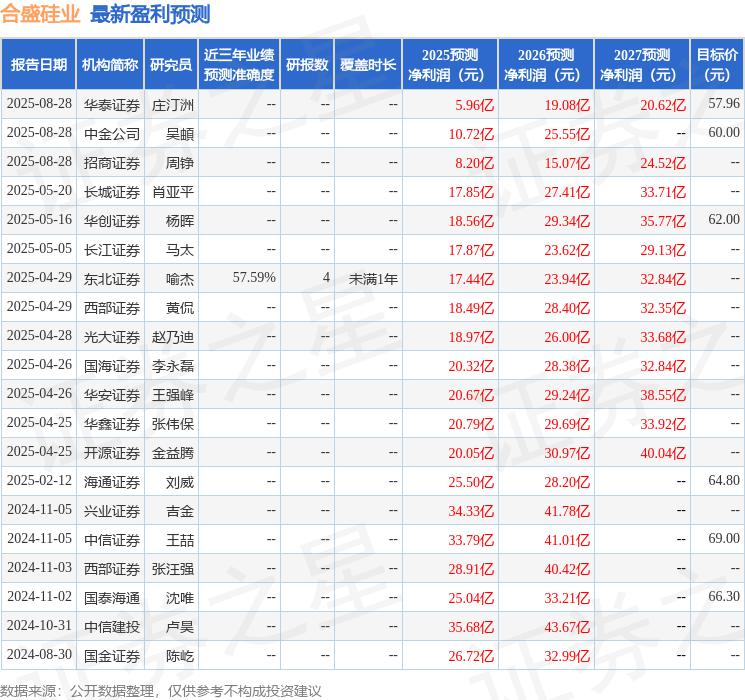
Core Viewpoint - The report highlights that Hoshine Silicon Industry's performance is under pressure due to the downturn in industrial silicon and organic silicon markets, leading to a significant decline in revenue and net profit [1][2][3] Company Performance - In the first half of 2025, Hoshine Silicon achieved revenue of 9.775 billion yuan, a year-on-year decrease of 26.34%, and a net profit attributable to shareholders of -397 million yuan, a year-on-year decline of 140.60% [2] - In Q2 2025, the company reported revenue of 4.548 billion yuan, down 42.11% year-on-year and 13.02% quarter-on-quarter, with a net profit of -657 million yuan, reflecting a year-on-year decline of 245.87% and a quarter-on-quarter decline of 352.93% [2] Industry Analysis - The decline in performance is attributed to falling sales prices of industrial silicon and organic silicon products, with the industrial silicon market experiencing a downward price trend due to supply-demand imbalances [3] - Domestic industrial silicon production in the first half of 2025 was 1.85 million tons, showing a year-on-year decrease, while the production of polysilicon was 597,000 tons, down 44.0% year-on-year [3] - The organic silicon industry saw a consensus on production cuts in Q1, but production increased in Q2, with total domestic DMC production exceeding 1.2 million tons, a nearly 20% year-on-year increase [3] Financial Metrics - The company's R&D expense ratio decreased due to lower material inputs, while net cash flow from operating activities increased by 1987.93% due to reduced production and inventory clearance [4] - The company is accelerating the upgrade of its R&D center, focusing on innovative manufacturing technologies and smart production models, aiming to enhance its competitive edge in the silicon-based materials sector [5] Profit Forecast - Due to the decline in product prices, the profit forecast for Hoshine Silicon has been slightly adjusted, with expected net profits for 2025, 2026, and 2027 at 1.024 billion yuan, 1.889 billion yuan, and 2.113 billion yuan respectively [6] - The current stock price corresponds to P/E ratios of 60.8, 33.0, and 29.5 for the respective years, with a maintained "buy" investment rating due to the company's leading position in the organic silicon and silicon carbide industries [6]

营收97.75亿,现金流增近20倍!合盛硅业穿越周期底气十足
Di Yi Cai Jing· 2025-08-27 13:58
Core Viewpoint - The company faced operational pressure in the first half of 2025 due to challenges in the industrial silicon, organic silicon, and photovoltaic sectors, resulting in a decline in performance despite a significant increase in cash flow from operating activities [1][8]. Organic Silicon Business - The organic silicon market is expected to recover, with the company positioned to benefit from this rebound due to its leading market position and the anticipated increase in demand from sectors like real estate, photovoltaics, and new energy vehicles [2]. - The industry is projected to see an increase in operating rates from 67% in 2024 to 76% in 2025 and 83% in 2026, indicating a gradual improvement in supply-demand dynamics [2]. Industrial Silicon Business - The company has a significant cost advantage and resource superiority in the industrial silicon sector, focusing on optimizing resource allocation and enhancing product quality while reducing production costs [4]. - The industrial silicon prices have started to rebound after hitting a low in June, with expectations for prices to stabilize within a reasonable range as market demand improves [4]. Silicon Carbide Business - The company is extending its silicon-based new materials industry chain, with a focus on silicon carbide (SiC) products, which are crucial for domestic semiconductor self-sufficiency [5]. - The company has achieved leading production metrics in silicon carbide substrates, with 6-inch substrates in full production and 8-inch substrates in small batch production [5][6]. Research and Development - The company invested 1.79 billion yuan in R&D in the first half of 2025, maintaining a leading position in the industry in terms of research intensity and technological advancement [6]. Future Outlook - The company is optimistic about the second half of 2025, anticipating stable capacity in the organic silicon market and continued demand growth in emerging sectors such as electric vehicle battery sealing and 5G base station cooling [7]. - The photovoltaic industry is undergoing significant adjustments, with government interventions expected to facilitate a return to healthy development, positively impacting the upstream industrial silicon market [7]. Financial Performance - The company reported a significant increase in net cash flow from operating activities, reaching 35.24 billion yuan, a year-on-year growth of 1987.93%, indicating strong cash flow management during industry downturns [1][8]. - The company has also initiated a bond issuance to optimize its funding structure and support ongoing operations and new business ventures [8].
Select Medical(SEM) - 2025 Q2 - Earnings Call Transcript
2025-08-13 14:00
Financial Data and Key Metrics Changes - EBITDA increased from €11.1 million in Q1 to €19.6 million in Q2, representing a 77% improvement [2] - Overall sales declined by 7%, leading to a 35% decrease in EBITDA and a margin drop from 13.7% to 9.6% year on year [3][4] - Earnings after taxes turned negative at €11.2 million, but the company maintains a solid financial footing with an equity ratio of 45.5% and cash reserves of approximately €113 million [4][12] Business Line Data and Key Metrics Changes - Semperit Industrial Applications saw a 4.7% decline in sales and a 19.2% decrease in EBITDA year on year, with margins at 18.1% [5] - Semperit Engineered Applications experienced a 9% drop in sales and a 46.9% decline in EBITDA compared to the previous year [7][8] - The hoses business showed signs of recovery with improved order intake, while the profiles segment continues to struggle due to a weak construction industry [6][9] Market Data and Key Metrics Changes - The overall order book and order intake for the first six months are higher than last year's comparable figures, indicating a recovery trend [3][24] - The construction industry is expected to turn around in 2026, but short-term benefits are not anticipated [25] Company Strategy and Development Direction - The company is focused on optimizing costs and expanding its profile business in the U.S. market [25][26] - There is an ongoing effort to explore inorganic growth opportunities through potential acquisitions that can leverage existing business [28] - The company aims to maintain a resilient balance sheet while investing in digitalization projects [12][13] Management's Comments on Operating Environment and Future Outlook - Management expressed confidence in a recovery in the second half of the year, driven by improved order intake and market dynamics [24][27] - The company confirmed its guidance for operating EBITDA in the range of €65 million to €85 million for 2025 [4][27] - Management acknowledged uncertainties but emphasized a positive momentum in customer restocking and order processing [24][27] Other Important Information - The company paid a dividend of $0.50 per share, totaling $10.3 million, signaling confidence in its business model [13][22] - Free cash flow was reported at €13.9 million, with capital expenditures halved to €18.5 million year on year [17][22] Q&A Session Summary Question: Order dynamics in Q2 and summer months - Management noted a gradual increase in order intake starting in April, continuing through July, with a stronger order book compared to the previous year [31][32] Question: Revenue generation expectations for Q3 - Management is hopeful for a good Q3 and Q4, but noted potential impacts from weather and shipping activities [33] Question: CapEx reduction from €60 million to €50 million - The reduction is primarily a period shift related to specific growth projects, particularly in the U.S. railway systems [34] Question: Pricing dynamics and revenue increase - Pricing management has been proactive, with approximately €3 million of revenue attributed to price increases, though some businesses experienced price decreases [40][41] Question: Working capital development and operating cash flow - Management is confident in maintaining tight working capital targets and believes operating cash flow will cover the €50 million CapEx [42][44] Question: Impairment in the LSI business - Management provided assurance that the impairment was based on a comprehensive review and that there is remaining headroom for the Ricoh business [51][52] Question: Impact of Continental's spin-off on business - No concrete evidence of impact was reported, but management suggested it could be positive [56] Question: Current situation in the hoses business - The company is building up capacity and hiring to meet increased demand [60][61] Question: Margin quality of belting orders - Margin quality remains volatile, with improvements noted in the second quarter, but still lower than two to three years ago [67][70] Question: Impact of U.S. tariffs on business - The uncertainty from tariffs had a significant impact, but the current situation allows for better planning and has led to an uptick in order activity [76][78]
