
液晶显示板

Search documents
出口与出海趋势观察(2026年1-2月):开门红验证出口韧性,美线需求有望接力
Orient Securities· 2026-03-11 07:12
Export Performance - In January-February 2026, exports increased by 21.8% year-on-year, a significant rebound of 15.2 percentage points compared to December 2025[5] - Imports also saw a year-on-year growth of 19.8%, up 14.1 percentage points from December 2025[5] - The Lunar New Year effect contributed approximately 7.2 percentage points to the export growth, while the impact of VAT rebate adjustments was only about 1.25 percentage points[5] Regional Insights - Exports to the US, EU, ASEAN, South Korea, Russia, and Africa all saw year-on-year growth of at least 16 percentage points compared to December 2025, except for Japan and Latin America, which had lower increases of 3.6 and 6.6 percentage points respectively[5] - The weak performance in Japan is attributed to geopolitical tensions, while Latin America's decline is due to new tariffs imposed by Mexico on January 1[5] Sector Analysis - High-tech sectors, particularly semiconductors and shipbuilding, showed strong performance, with semiconductor exports soaring by 129.7% year-on-year[5] - Capital goods exports, such as general machinery, rose by 19.2% year-on-year, significantly up from 3.4% in December 2025[5] - Traditional consumer goods exports, including bags, shoes, and home appliances, grew by 14%, a substantial increase of 39.6 percentage points from December 2025[5] Future Outlook - Despite short-term factors affecting exports, the underlying demand remains robust, with expectations of a gradual recovery in US consumer goods imports by the end of Q1 2026[5] - The report suggests that the export momentum is likely to continue beyond the seasonal effects of the Lunar New Year[5]
先进制造业表现抢眼 数字经济异军突起 绵阳经济发展走出上扬线
Si Chuan Ri Bao· 2026-01-04 06:14
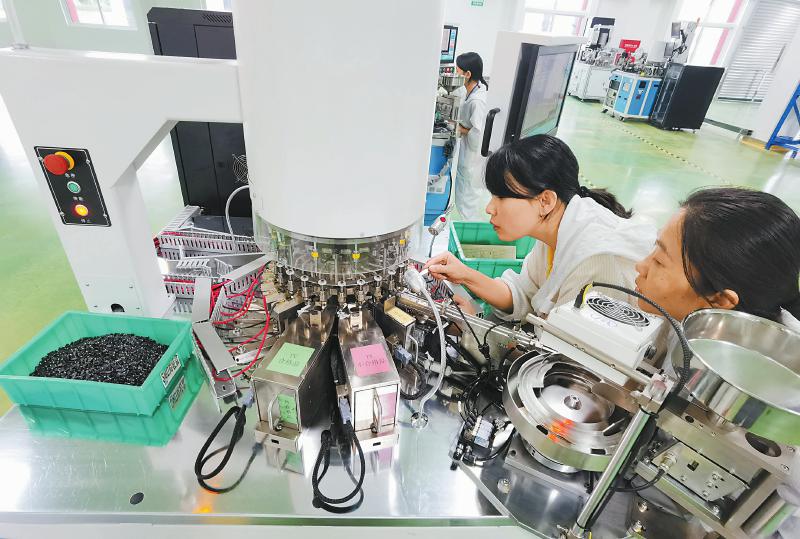
Core Insights - Mianyang's economy has recovered from a low point earlier in the year, with key economic indicators showing positive changes and some data reaching new highs [4][10] Group 1: Company Performance - Sichuan Teruixiang Technology Co., Ltd. has expanded its production capacity tenfold with the completion of a new factory, increasing expected orders from 80 million to 200 million yuan [1] - The company has established direct or indirect cooperation with nearly all of the Fortune 500 electronic enterprises [1] Group 2: Economic Indicators - Mianyang's electricity consumption has shown a strong upward trend, with a 12.85% year-on-year increase in the first half of the year, reaching 6.219 billion kilowatt-hours [4] - The second industry accounts for approximately 53.9% of the electricity consumption, indicating stable growth [4] - The information transmission and software services sector saw a remarkable 36.14% increase in electricity consumption, with a 51.25% increase in June alone [4] Group 3: Trade and Financial Growth - Mianyang's foreign trade and exports have experienced rapid growth, with total foreign trade reaching 13.38 billion yuan in the first seven months, a 17.4% increase year-on-year [5] - Exports of electromechanical products grew by 57.7%, accounting for 71.3% of total exports [5] - Financial institutions in Mianyang reported a loan balance of 273.823 billion yuan, a 16.02% increase from the previous year [5] Group 4: Technological Advancements - The Longhong Intelligent Manufacturing Industrial Park has improved production efficiency significantly, with a 20%-30% reduction in workforce and a 65% increase in per capita efficiency [6] - Automation in logistics has reached 95%, enhancing overall production efficiency [6] - The glass utilization rate at Huike Optoelectronics has reached over 98%, indicating significant cost savings and economic benefits [6] Group 5: Industrial Transformation and Investment - Mianyang has introduced 83 industrial projects with investments exceeding 500 million yuan, including six projects worth over 10 billion yuan [7] - The city has a total of 4,683 projects in reserve for the 14th Five-Year Plan, with a total investment of 2.23 trillion yuan [8] - The focus on advanced manufacturing and digital economy sectors, such as 5G and IoT, is expected to drive further growth [8][9]


21个市州前三季度经济“成绩单”出炉 服务业逐步回暖成为重要动力源
Si Chuan Ri Bao· 2026-01-04 03:58
Economic Performance Overview - Sichuan's 21 cities have released their economic performance for the first three quarters, with Chengdu continuing to shine and the South Sichuan Economic Zone showing rapid development [1] - Chengdu's GDP reached 14,438.75 billion yuan, growing by 10.0% year-on-year, maintaining a 37% share of the provincial total [2] - Yibin and Mianyang have surpassed the 200 billion yuan mark in GDP, while Deyang is close to achieving this milestone [2] Growth Rates and Economic Zones - Nine cities outperformed the provincial GDP growth rate of 9.3%, with Yibin leading at 10.3% [2] - The South Sichuan Economic Zone, including cities like Ziyang and Yibin, showed strong growth, while the Northeast Sichuan Economic Zone lagged behind [2] Emerging Industries and New Growth Drivers - Yibin's economic growth is significantly driven by emerging industries, with new energy and smart vehicles growing by 82.2% and smart terminals by 49.9% [4] - Mianyang's strategic emerging industries and high-tech sectors also maintained rapid growth, outpacing overall industrial growth [4] - Deyang's new industries, including general aviation and advanced materials, contributed significantly to industrial growth [4] Service Sector Recovery - The service sector is gradually recovering, contributing to economic growth in several cities, with the third industry in the province growing by 9.8% [4] - In Bazhong, the third industry's contribution to economic growth reached nearly 60%, driven by tourism [4] Investment, Consumption, and Export Dynamics - Investment, consumption, and exports are the three main drivers of economic development [5] - Deyang's fixed asset investment grew by 13.8%, exceeding both national and provincial averages [5] - Chengdu led in retail sales, with significant growth in smart and energy-efficient products, and a remarkable 55.9% increase in restaurant revenue [7][8] - Chengdu's total import and export volume reached 586.13 billion yuan, accounting for 87.6% of the provincial total, with notable growth in machinery and electronics exports [8]

东海证券晨会纪要-20251209
Donghai Securities· 2025-12-09 08:26
Key Insights - The report emphasizes a continuation of a proactive policy stance, with an increased focus on domestic demand as a strategic priority for the economy in 2026 [5][6][8] - Export resilience is highlighted, with November 2025 showing a year-on-year export growth of 5.9%, reversing a previous decline [12][13] Group 1: Economic Policy Outlook - The Central Political Bureau's meeting on December 8, 2025, reiterated the importance of balancing domestic economic work with international trade challenges, maintaining a focus on economic construction as a core task [5][6] - The fiscal policy for 2026 is expected to maintain a general deficit ratio around 4%, with broad deficit levels similar to 2025 [7] - Monetary policy is projected to have room for a 50 basis point reserve requirement ratio cut and a potential interest rate reduction of 10-20 basis points [7][8] Group 2: Domestic Demand and Growth - The meeting underscored the need to prioritize domestic demand and build a strong domestic market, indicating a strategic elevation of domestic demand's role in economic growth [8][10] - The focus on consumption is expected to shift towards services, with policies supporting the replacement of old goods to stimulate physical consumption [8][10] Group 3: Export Performance - November 2025 saw exports reach $330.35 billion, marking a historical high for the month, with a significant recovery from previous declines [12][13] - The report notes that while exports to the U.S. have decreased, there has been notable growth in exports to Africa, the EU, and Japan, indicating a shift in trade dynamics [15][16] - Intermediate goods and capital goods exports are expected to remain strong, supported by industrialization in emerging markets and infrastructure needs in regions like Africa [12][16]
4月进出口点评:超预期出口得以延续
Orient Securities· 2025-05-14 02:36
Export Performance - In April 2025, exports increased by 8.1% year-on-year, down from 12.4% in the previous month[3] - Traditional consumer goods exports showed a decline, with footwear, toys, luggage, and clothing down by -8.6%, -5.4%, -12.7%, and -1.5% respectively[5] - Mechanical and electrical products exports performed well, with a year-on-year growth of 8.3% in April 2025[5] Import Trends - Imports decreased by -0.2% year-on-year, a significant improvement from -4.3% in the previous month[3] - The decline in imports was narrowed by increased purchases of bulk commodities like soybeans and copper ore[5] - The import growth rate for certain mechanical and electrical products also increased[5] Trade Dynamics - Exports to ASEAN countries saw a remarkable increase of 20.8% year-on-year, while exports to the US fell sharply by -21%[5] - The proportion of tariff exemptions for exports to the US was approximately 27.1%, with 22.8% being tariff exemptions on electronics[5] - Indirect trade channels have shown resilience, with a potential offsetting ratio of 44.5% to 90% for trade losses with the US[5]