
烫捞

Search documents
进入“20元时代”,中式米饭快餐没有退路
虎嗅APP· 2026-01-29 00:23
Core Viewpoint - The Chinese rice fast food sector is undergoing a significant paradigm shift in 2026, characterized by intense competition among leading brands and the entry of cross-industry players, leading to a consensus that profitability is increasingly difficult to achieve [4][6]. Group 1: Industry Challenges - The primary challenge for Chinese rice fast food brands remains profitability, with industry leaders like Chaoyixing reporting a mere profit of 0.7 yuan per 10 yuan meal [7]. - Rising costs for ingredients, labor, and rent, combined with a return to rational consumer spending, are squeezing profit margins, forcing brands to adapt their business models to survive [8][9]. - The average consumer spending in the rice fast food sector has decreased from 29.7 yuan in 2022 to 27.5 yuan in 2025, indicating a downward trend in pricing [15]. Group 2: Business Model Transformation - Brands are focusing on creating "all-day, all-customer, all-capable" stores to attract a wider customer base and improve profitability [5][10]. - Successful adaptations include diversifying product offerings and enhancing customer experience, as seen with brands like Nanchengxiang and Xiaonv Dangjia, which have introduced new menu items and self-service options [10][11]. - The shift towards a "price down, experience up" strategy is evident, with brands like Xiangcunji and Dami Xiansheng emphasizing fresh, high-quality ingredients while maintaining competitive pricing [18][19]. Group 3: Market Expansion and Competition - The market for Chinese rice fast food is projected to reach 277 billion yuan in 2024, with a potential to exceed 300 billion yuan in 2025, indicating a growing demand for this segment [21]. - Leading brands are rapidly expanding into new regions, with Nanchengxiang opening a new store every 0.85 days on average, while others like Mivun Banfan have paused their aggressive expansion due to operational challenges [23][25]. - The competitive landscape is shifting, with brands needing to adapt their models to local markets rather than relying on a one-size-fits-all approach, as evidenced by the struggles of brands like Chaoyixing and Nanchengxiang in new territories [25][26]. Group 4: Future Outlook - The next decade for Chinese rice fast food will involve a multi-faceted competition focusing on freshness, transparency, intelligence, low pricing, and health [27]. - Brands that can balance cost management with quality and customer experience will be better positioned to thrive in a market where consumer expectations are evolving [28][29].

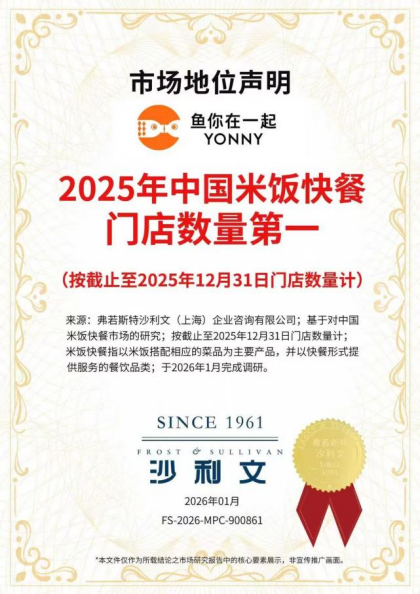
沙利文认证:鱼你在一起成为“中国米饭快餐门店数量第一”!
Jin Rong Jie Zi Xun· 2026-01-21 12:47
Core Insights - The Chinese rice fast food brand "Fish You Together" has been officially recognized by Frost & Sullivan as having the largest number of rice fast food outlets in China by 2025, with over 2,600 operational stores globally [1][5][11] - The brand's growth is attributed to its ability to standardize operations, integrate supply chains, and expand internationally, marking a new phase for Chinese fast food [1][3] Group 1: Brand Growth and Market Position - "Fish You Together" started its journey in 2017 with a focus on a standardized fast food model based on traditional dishes, successfully transforming the traditional sauerkraut fish into a fast food product [3][6] - The brand has expanded to over 360 cities worldwide, including major international cities like New York and Dubai, while also targeting lower-tier markets in China [3][5] - The certification from Frost & Sullivan is seen as a sign of maturity and scale in the Chinese rice fast food industry, highlighting the importance of operational standards and supply chain stability for brand expansion [5][6] Group 2: Operational Excellence and Social Impact - The founder emphasizes that the growth in store numbers is not the ultimate goal; the brand aims to create social value by supporting entrepreneurs and generating employment opportunities [6][8] - The brand employs a "light asset, high efficiency" model to assist thousands of franchisees and create jobs, while maintaining consistent quality across different market tiers [6][9] - Recent product innovations, such as the "Hot Pot" series, have been introduced to diversify offerings and enhance customer experience, further solidifying the brand's market position [9][11] Group 3: International Expansion and Strategic Partnerships - The brand is committed to global expansion, using sauerkraut fish as a cultural vehicle to introduce authentic Chinese cuisine worldwide [8][11] - A partnership with Oracle has been established to develop a global supply chain integration system, ensuring a balance between standardization and localization [8] - The introduction of dual-category stores featuring both sauerkraut fish and the new "Hot Pot" offerings marks a strategic shift towards a more diverse product lineup [9][11]
鱼你在一起董事长魏彤蓉:做一个值钱的品牌比赚钱品牌更有意义
Xin Lang Cai Jing· 2026-01-19 06:57
Core Viewpoint - The 2025 China Brand Person Annual Conference emphasizes the importance of building valuable brands over merely profitable ones, highlighting the global expansion of Chinese cuisine, particularly through the brand "YONNY" [2][12]. Group 1: Brand Development and Strategy - "YONNY," the international name for "鱼你在一起," aims to resonate with global consumers by embodying qualities such as deliciousness, oriental essence, natural ingredients, nutrition, and joy [6][16]. - The brand has established over 2,600 locations across approximately 10 countries in just nine years, making it the leading global brand for sour fish dishes as recognized by Sweeney [12][2]. - The company has adopted a "globalization + localization" dual strategy to transition from being perceived as a foreign brand to becoming a local lifestyle partner [15][4]. Group 2: Market Opportunities - The overseas Chinese food market is experiencing unprecedented growth, with significant increases in the Chinese population in Southeast Asia and the Americas, reaching approximately 34.64 million and 10.09 million respectively in 2023 [14][3]. - The demand for diverse and high-quality dining options is driven by the rapid rise of the middle class in these regions, creating a favorable environment for Chinese cuisine [14][3]. - The sour fish dish has gained popularity, particularly in Southeast Asia, due to its high standardization and replicability, positioning it well within the global fast-food market [14][4]. Group 3: Implementation of Strategy - The brand's localization efforts include maintaining 70% of classic dishes while introducing 30% localized specialties, collaborating with local artists for thematic designs, and employing local talent to enhance operational efficiency [15][5]. - Marketing strategies involve partnerships with local celebrities and social media influencers to resonate with local consumers, thereby enhancing brand visibility and engagement [15][5]. - The brand has achieved notable success in Malaysia, opening multiple locations rapidly and achieving high customer turnover rates, indicating the effectiveness of its localization strategy [16][17]. Group 4: Future Plans - The company plans to deepen its presence in Southeast Asia while also expanding into developed markets in the Asia-Pacific region and North America, aiming to create a comprehensive global network [18][8]. - A new store model combining sour fish and hot pot will be introduced in 2026, targeting a price point that positions it between traditional hot pot and fast food [17][8]. - The brand's vision is to lead the global appreciation of Chinese cuisine, emphasizing its cultural significance and commitment to quality [18][8].

荣获“中国出海品牌人物50强” 鱼你在一起魏彤蓉解码“谁为中国赢得尊重”
Sou Hu Wang· 2025-12-31 03:05
Core Insights - The 2025 China Brand Person Annual Conference was held in Shenzhen, focusing on the theme "Who Earns Respect for China," showcasing the power of Chinese brands and exploring globalization paths [1][3] - The event highlighted the importance of the restaurant industry's globalization, with significant participation from industry leaders and experts discussing brand innovation and cultural dissemination [3][4] Industry Trends - The international Chinese restaurant market is projected to grow from $233 billion in 2020 to $362.5 billion in 2024, and is expected to reach $445.2 billion by 2027, indicating substantial market potential [3] - Despite the growth, the industry faces challenges such as standardization, supply chain issues, and localization adaptation, which were discussed during the conference [3] Company Strategy - The company "Fish You Together" has initiated a dual strategy of "globalization + localization" to address the challenges of international expansion, aiming to transform from a "foreign Chinese brand" to a "local lifestyle partner" [6][12] - The brand's global layout focuses on Southeast Asia as the core market, with North America as a supplementary region, employing a gradual strategy of pilot verification and regional expansion [6][10] Operational Tactics - The company has developed four adaptation systems for local operations: product, culture, team, and marketing, maintaining 70% classic and 30% innovative menu items while incorporating local flavors [8][9] - The team structure includes 80% local staff to ensure that local expertise drives operations, while marketing efforts leverage local social media platforms for enhanced visibility and sales [9][10] Performance Metrics - "Fish You Together" has over 2,600 global stores across more than 360 cities, making it the leading brand in the global chain of sauerkraut fish [10] - The brand's successful entry into the Malaysian market included opening six stores simultaneously within three months, while the first store in Thailand achieved a table turnover rate of 11.59 times on opening day, with over 80% local customers [10][12]

大国品牌出海记,鱼你在一起魏彤蓉解码“谁为中国赢得尊重”
Jin Rong Jie Zi Xun· 2025-12-30 02:53
Core Insights - The 2025 China Brand Person Annual Conference was held in Shenzhen, focusing on the theme "Who Earns Respect for China" and showcasing the power of Chinese brands and their globalization paths [1][3] - The event highlighted the importance of the restaurant industry's globalization, with significant participation from industry leaders and experts discussing brand innovation and cultural dissemination [3][4] Industry Overview - The international Chinese restaurant market is projected to grow from $233 billion in 2020 to $362.5 billion by 2024, and is expected to reach $445.2 billion by 2027, indicating substantial market potential [3] - Challenges such as standardization, supply chain issues, and localization remain prevalent in the industry, necessitating diverse strategies for successful international expansion [3] Company Strategy - The company "Fish You Together" has established a "globalization + localization" dual strategy, aiming to transition from being perceived as a foreign Chinese brand to becoming a local lifestyle partner [6][11] - The brand's global layout focuses on Southeast Asia as the core market, with North America as a supplementary region, employing a gradual strategy of pilot testing and regional expansion [6][9] Localization Efforts - The company has developed a four-part adaptation system for local operations, including product, culture, team, and marketing strategies, ensuring a blend of classic and innovative menu items [8] - The brand has implemented a dual-track system for team composition, with 80% of the operational team being local, enhancing local engagement and effectiveness [8] Market Performance - The company has over 2,600 global stores across more than 360 cities, maintaining its position as the leading global chain in the sauerkraut fish category [9] - In Malaysia, the brand opened six stores simultaneously within three months, while in Thailand, the first store achieved a table turnover rate of 11.59 times on opening day, with over 80% local customer participation [9] Future Goals - The ultimate goal is to replicate the brand internationally and facilitate the transition from "Chinese brands going global" to "Chinese culinary ecosystems going global," while continuously optimizing the global operational system [11]

鱼你在一起在马来西亚获双奖,酸菜鱼品类跑出出海新标杆
Bei Ke Cai Jing· 2025-12-05 15:30
Core Insights - The brand "YONNY" has successfully established itself as the leading Chinese restaurant chain in Kuala Lumpur, Malaysia, by December 2023, following its market entry in February 2023 [1][2] - The brand received the "Most Popular Sauerkraut Fish Brand 2025" award at the seventh "Yuzhong Different - Malaysia-China Cultural and Food Festival" [1][9] - The founder, Wei Tongrong, was honored as the "Cultural Promotion Ambassador for Malaysia-China Cuisine," highlighting the brand's effective globalization strategy [6][7] Brand Expansion and Cultural Integration - The festival, organized by the Malaysia Chinese Restaurant Association, signifies a shift in Chinese cuisine's international presence from mere product export to deeper cultural integration and industry collaboration [3] - Wei Tongrong emphasized a clear strategy of "global brand, localized operation," which includes adopting an international brand identity and collaborating with local designers to enhance brand recognition [7] Market Performance and Consumer Engagement - The brand's rapid establishment in Malaysia is attributed to a well-defined menu structure of "70% classic dishes + 30% local innovations," catering to local tastes while maintaining brand identity [7] - In September 2025, YONNY opened six stores simultaneously in Malaysia, achieving a total of 2,834 diners on the first day, with a 56% increase in average daily revenue per store [11] Industry Trends and Future Outlook - The international Chinese cuisine market is projected to grow from $227.55 billion in 2020 to $359.39 billion by 2024, with expectations to reach $577.68 billion by 2030 [10] - The brand's approach to avoid either excessive adaptation or strict adherence to original flavors reflects a broader trend in the industry, emphasizing flavor inclusivity and standardized production [10] Supply Chain and Industry Collaboration - The brand's success is linked to its proactive supply chain management and standardized operations, aligning with China's "14th Five-Year Plan" for promoting integrated trade and investment [12] - Wei Tongrong advocates for the role of Chinese cuisine in global supply chain development, emphasizing the export of agricultural and food products as a means to support domestic industries [12]

产品战略再升级!鱼你在一起全球首家酸菜鱼+烫捞门店落地北京
Jiang Nan Shi Bao· 2025-09-22 07:30
Core Insights - The company has launched a new store in Beijing with a fresh design and a new product line called "烫捞" (hot pot), which has attracted significant customer interest and long queues on opening day [1] - The new product line features seven unique soup bases, including classic herbal bone soup and international flavors like Singapore Laksa and Thai Tom Yum, aiming to enhance product competitiveness and customer satisfaction [2] - The strategic focus on the hot pot segment is seen as a key growth opportunity, leveraging the company's existing strengths in product development and ingredient quality to meet rising consumer demand [3] Product Development - The new "烫捞" series addresses industry pain points such as limited flavors and ingredient homogeneity by offering diverse soup bases and high-quality ingredients [2] - The introduction of premium seafood and a six-meter open display for ingredients enhances customer choice and experience [2] Market Strategy - The hot pot category is positioned as a response to the growing demand for branded and standardized fast food, with the company aiming to create a new growth curve following its success with "酸菜鱼" (sour cabbage fish) [3] - The combination of "酸菜鱼" and "烫捞" products is expected to optimize store efficiency and attract customers during non-peak hours, thereby increasing overall profitability [3] Cultural Integration - The new store design incorporates traditional Chinese aesthetics and modern elements, creating a unique dining environment that reflects both cultural heritage and contemporary trends [4] - The brand's international expansion has been positively received, with high customer ratings in markets like Malaysia, indicating a successful blend of Eastern culinary traditions with global tastes [5] Global Expansion - The company has over 2,500 stores worldwide, including locations in the US, Canada, Singapore, Malaysia, and Thailand, showcasing its commitment to globalizing Chinese cuisine [5] - The new product line and cultural aesthetic are part of a broader strategy to convey the diversity and confidence of Chinese cuisine on the international stage [5]