焕新极氪007GT

Search documents
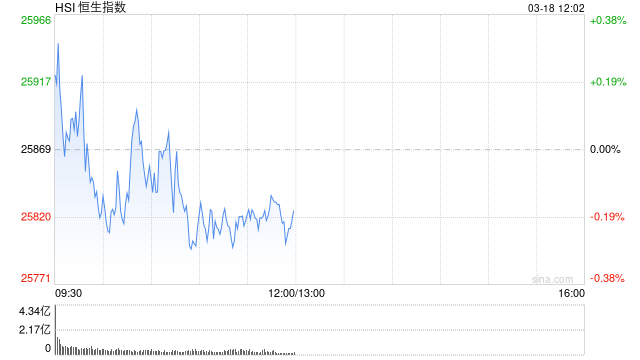
港股午评:恒指跌0.17% 科指跌0.81% 汽车股普跌 石油股下挫 理想汽车跌超6%
Xin Lang Cai Jing· 2026-03-18 04:02
Market Overview - The Hong Kong stock market indices collectively declined, with the Hang Seng Index falling by 0.17% to 25,824.70 points, the Hang Seng Tech Index down by 0.81%, and the National Enterprises Index decreasing by 0.61% [1][9]. Sector Performance - The technology sector saw mixed results, with Bilibili rising by 4% while Kuaishou and Xiaomi both dropped over 1% [1][9]. - The semiconductor sector performed well, highlighted by a more than 10% increase in Zhaoyi Innovation [1][9]. - The automotive sector experienced a pullback, with Li Auto declining over 6% [1][5][12]. - Oil stocks fell, with CNOOC down more than 3% [1][8][12]. Semiconductor Insights - UBS noted that the current storage cycle is influenced by HBM taking up DRAM capacity and AI driving up storage value weight. Traditional price acceleration methods for predicting market peaks have low accuracy, with operating profit being a more effective leading indicator. Historically, stock prices peak in 90% of cases in sync with or ahead of profit peaks. UBS expects the current profit peak to occur in Q3 2027, suggesting a potential continuation of the semiconductor stock rally until Q2 2027 [2][10]. Automotive Sector Challenges - Automotive companies, including NIO, Li Auto, and Xiaomi, have warned about cost challenges due to rising chip prices. Chery's high-end brand announced a price increase for its ET5 model by 5,000 yuan, and there are reports of upcoming price adjustments for the Zeekr 007GT model, with increases expected between 5,000 to 8,000 yuan [5][11]. Oil Market Dynamics - Morgan Stanley warned that the current $55 price differential is due to regional inventory surplus and policy interventions, which do not reflect the true global supply tightness. If the Strait of Hormuz remains blocked, Brent and WTI prices are expected to realign upwards towards Middle Eastern spot prices [8][12].



“我的两艘船在波斯湾飘着”
汽车商业评论· 2026-03-12 23:05
Core Viewpoint - The article discusses the impact of the recent military conflict between the US, Israel, and Iran on the Chinese automotive export market, particularly focusing on the disruptions faced by Chinese car manufacturers in the Middle East due to the conflict [3][4][21]. Group 1: Impact on Automotive Exports - The UAE, as a significant market for Chinese automotive exports, imported 567,000 vehicles from China last year, making it the third-largest destination for Chinese car exports [4][19]. - The conflict has led to a halt in operations for Chinese automotive dealers in Dubai, with many switching to remote work, severely affecting sales [4][9]. - A large number of vehicles en route to the Middle East are facing delivery delays due to shipping disruptions, with shipping companies either halting operations or imposing high war risk surcharges [4][10][12]. Group 2: Shipping and Logistics Challenges - The blockade of the Strait of Hormuz by Iran has created significant logistical challenges, as it is a crucial route for shipping vehicles to the Middle East [10][22]. - Shipping costs have surged, with the price to transport a vehicle to Europe increasing from approximately $1,500 to over $3,000 due to rerouting around the Cape of Good Hope [21]. - The blockade has also affected the supply chain for essential automotive components, with potential increases in raw material costs by 15% to 25% if the situation persists [22][23]. Group 3: Market Reactions and Future Outlook - Companies like Geely have shifted focus from the Middle East to markets like Canada, which recently opened up for Chinese electric vehicle exports [5][4]. - The conflict has prompted some Chinese automakers to announce price increases for their vehicles due to rising costs of raw materials and logistics [24]. - Analysts predict that the geopolitical tensions will have long-lasting effects on the automotive supply chain, similar to past disruptions caused by geopolitical events [30][31].

焕新极氪007GT将涨价?公司回应;百度萝卜快跑恢复阿联酋迪拜与阿布扎比的全无人测试及运营服务丨汽车交通日报
创业邦· 2026-03-10 10:35
Group 1 - The core viewpoint of the article discusses the ongoing developments in the electric vehicle (EV) market, highlighting significant investments and technological advancements [2][3]. - Zeekr's new model, the Zeekr 007GT, is set to launch in Q2 of this year, but there is no confirmed information regarding price adjustments, and the vehicle will feature the new NVIDIA DRIVE Thor-U chip and a 900V high-voltage architecture [2]. - The CEO of CALSTART, Michael Berube, emphasized that despite reports of $50 billion in asset write-downs in the EV sector, over $1 trillion in investments are still being deployed in the U.S. EV market, indicating a robust future for the industry [2]. - He Xiaopeng, Chairman of Xiaopeng Motors, stated that not all car manufacturers will successfully transition into robotics, but the integration of AI with physical entities like cars and robots will lead to transformative changes in productivity and production relationships [2]. - Xiaopeng Motors plans to accelerate its global expansion from 2027 to 2028, with a focus on commercializing its technology, which has historically accounted for over 10% of its revenue [2]. Group 2 - Baidu's autonomous driving service, "Luobo Kuaipao," has resumed its fully autonomous testing and operational services in Dubai and Abu Dhabi, indicating a revival in the company's autonomous vehicle initiatives [3].