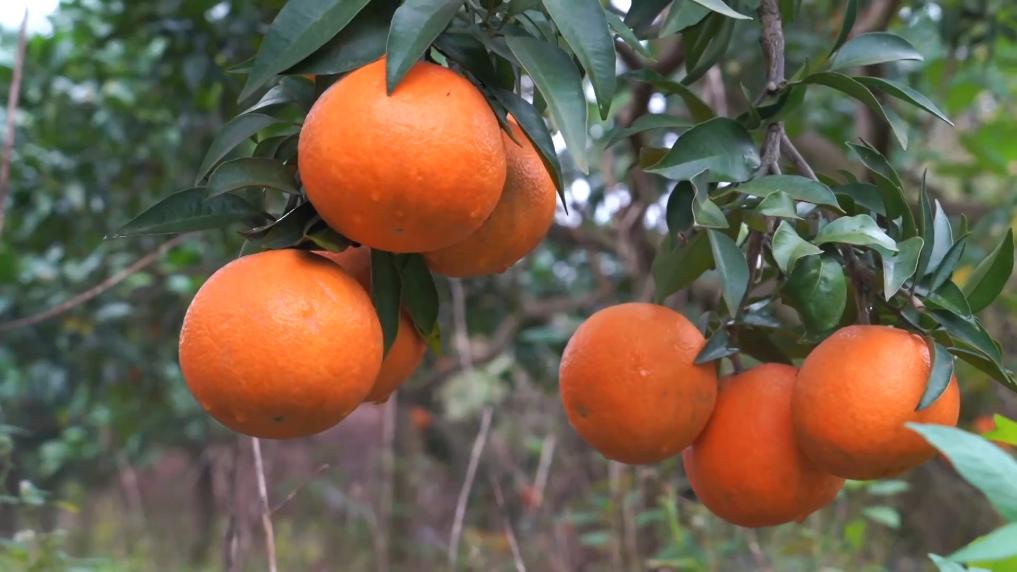
爱媛果冻橙

Search documents
视频丨农产品踏上“碳足迹” 这个新标尺让柑橘“甜”上加“值”
Xin Lang Cai Jing· 2026-01-12 05:36
Core Viewpoint - The article highlights the emergence of "carbon footprint" as a new standard for green agricultural products, particularly in the context of citrus production in Pujin County, Sichuan, where multiple citrus products have received "carbon label" certification, leading to a price premium of 10% to 30% over similar products [1][2]. Group 1: Carbon Footprint and Certification - The carbon footprint of a Pujin citrus is calculated to be 0.2956 kg of CO2 equivalent, which is nearly half of that of ordinary citrus [2]. - Pujin County has established 103 "zero pesticide residue" bases, promoting ecological transformation across 450,000 acres of citrus orchards [8]. - The carbon label serves as a "green bond" that connects the entire supply chain, allowing for traceability of the carbon footprint and enhancing the visibility and quantification of "green" practices [10]. Group 2: Economic Impact and Production - The citrus industry in Pujin County has become a pillar of agriculture, with an expected total production of 1.1 million tons and a direct output value of 7.2 billion yuan, contributing to a total industry chain value of 10 billion yuan [2]. - The implementation of the "two replacements" project has significantly increased the area under citrus cultivation, projected to reach 450,000 acres by the 2025-2026 harvest season [2]. - The integration of carbon labels with green finance has incentivized local farmers, resulting in a shared green low-carbon benefit for 260,000 farmers in Pujin [12]. Group 3: Technological Innovations and Standards - Advanced sorting and packaging technologies have been adopted to ensure that citrus products meet international market standards, with a focus on reducing carbon emissions throughout the supply chain [10]. - The establishment of a national carbon footprint factor database for agricultural products aims to monitor greenhouse gas emissions from various agricultural activities, with plans to expand to 50 core products by 2027 [14]. - The shift towards low-carbon agricultural products is seen as beneficial for the overall green transition of the agricultural sector, emphasizing the importance of understanding carbon emissions [16].


贵阳贵安四大经营主体发力,推动农业农村现代化
Sou Hu Cai Jing· 2026-01-12 02:54
Core Insights - The article emphasizes the development of a modern agricultural operating system in Guiyang and Gui'an, focusing on the integration of leading enterprises, cooperatives, family farms, and large-scale farming households to drive rural revitalization and increase farmers' income [2][3][5]. Group 1: Leading Enterprises - Leading enterprises are identified as the "locomotive" of modern agricultural development, with successful examples such as the collaboration between a modern ecological breeding area and Wens Foodstuff Group, achieving a chicken survival rate of over 98% and increasing annual income for farmers by over 110,000 yuan [3]. - Gui'an has introduced four leading enterprises, including Wens and Dekang, and aims for a chicken production capacity of 30 million birds and a production value of 1.22 billion yuan by 2024, maintaining the highest output in the province [5]. - The local government is actively supporting the growth of leading enterprises through financial products like "Shuangnong Direct Loan," with 62 enterprises receiving loans totaling 120 million yuan [5]. Group 2: Cooperatives - Cooperatives serve as a crucial link between farmers and markets, with successful models like the cooperative in Wengjing Village, which integrates pig farming and vegetable planting, benefiting local villagers through land transfer and collective dividends [6]. - The government is enhancing cooperative development by providing project support and facilitating access to funding, leading to the establishment of 73 new professional cooperatives by 2025 [7]. Group 3: Family Farms - Family farms are highlighted as key units for specialized operations and income generation, with examples like Zhang Ya's family farm producing 20,000 kg of fruit annually, generating a total output value of 400,000 yuan [8]. - The local government encourages the establishment of family farms by optimizing the business environment, resulting in the addition of 248 new family farms by 2025 [11]. Group 4: Large-scale Farming Households - Large-scale farming households are strengthening the agricultural foundation, with examples of innovative practices in mushroom cultivation and earthworm farming, contributing to local employment and ecological sustainability [12][14]. - Gui'an is promoting the expansion of large-scale farming households, with plans to cultivate 2,265 households by 2025, supported by financial policies and project assistance [14]. Group 5: Future Directions - Guiyang and Gui'an will continue to focus on the collaborative development of leading enterprises, cooperatives, family farms, and large-scale farming households, aiming to create a competitive agricultural ecosystem with a target of "ten chains, hundred parks, billion-level, and ten thousand entities" [15].


冬日暖阳里 听一首乡村振兴交响曲
Xin Hua Wang· 2025-12-09 07:10
Group 1: Technological Advancements in Agriculture - The modern agricultural park in Jiang'an, Sichuan, utilizes advanced technologies such as tracked orchard transport vehicles, water-based fermentation devices, and smart cloud platform management systems to enhance efficiency and sustainability in agricultural processes [1][3] - The park employs a "grass management" strategy to improve soil organic matter content, effectively using beneficial weeds to control harmful ones [3] Group 2: Economic Impact and Community Development - In Xinshan Village, Guangyuan, various models including large households, cooperatives, and family farms have been implemented to develop specialty industries, benefiting over 200 households and reinforcing poverty alleviation efforts [9] - The citrus planting area in Luzhou County exceeds 110,000 acres, generating an annual output value of approximately 280 million yuan [11] Group 3: Integration of Agriculture and Tourism - In Mianzhu, Sichuan, the local industry promotes experiential projects such as fruit picking and cooking events to attract tourists, thereby expanding market access [14] Group 4: Aquaculture Development - In Hebei's Shexian, the sturgeon industry is being developed with a complete industrial chain that includes research, processing, and sales, capitalizing on the region's suitable water conditions [16][17] - Shaanxi's Shanzhong City is advancing aquaculture with modern indoor facilities that utilize AI and big data for temperature control, oxygen management, and disease prediction, contributing to the region's agricultural modernization [20]
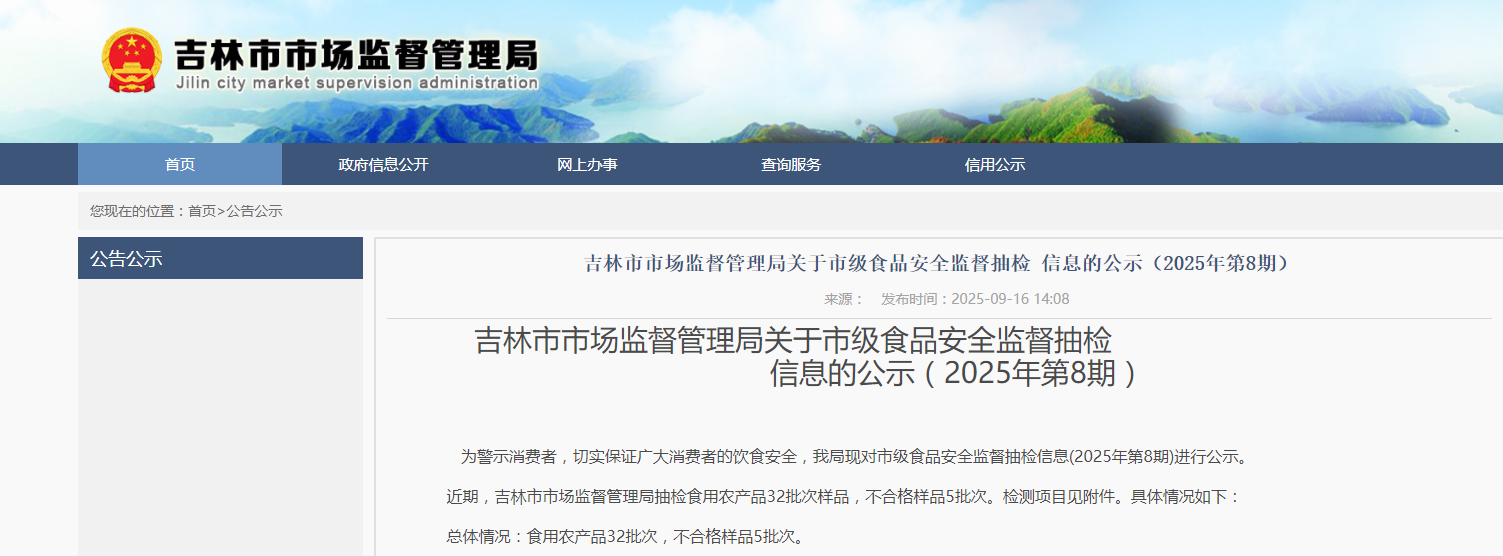
吉林省吉林市市场监督管理局关于市级食品安全监督抽检信息的公示(2025年第8期)
Zhong Guo Zhi Liang Xin Wen Wang· 2025-09-18 04:49
Summary of Key Points Core Viewpoint - The Jilin Municipal Market Supervision Administration has publicly announced the results of food safety inspections, revealing that out of 32 batches of food products tested, 5 batches were found to be non-compliant, highlighting ongoing concerns regarding food safety in the region [1]. Group 1: Inspection Results - A total of 32 batches of edible agricultural products were sampled, with 5 batches identified as non-compliant [1]. - The non-compliant products included various food items, with specific details provided in the attached documentation [1]. Group 2: Consumer Awareness - Consumers are encouraged to report any food safety violations by calling the market supervision department's hotline at 12315 [1].