
特色存款

Search documents
申万期货品种策略日报——股指-20260209
Shen Yin Wan Guo Qi Huo· 2026-02-09 01:53
1. Report Industry Investment Rating No relevant content provided. 2. Core View of the Report - The overall market is expected to continue the staged positive pattern in February. It is in the "Spring Market" window period, with the release of policy dividends at the beginning of the "15th Five - Year Plan", clear profit expectations for main lines such as AI and going global, and seasonal recovery on the consumption side and implementation of investment projects, which will further boost market confidence. However, due to the upcoming Spring Festival holiday, there may be significant fluctuations in overseas capital markets during the holiday, especially geopolitical risks, so potential disturbances need to be vigilant [2]. 3. Summary by Relevant Catalogs 3.1 Stock Index Futures Market - **IF Contracts**: The previous day's closing prices of IF contracts decreased compared to the day before yesterday, with decreases of -31.80, -29.40, -29.20, and -29.20 for the current month, next month, next quarter, and the quarter after next respectively. The trading volumes were 21,296.00, 70,073.00, 19,501.00, and 7,170.00 respectively, and the positions were 31,336.00, 156,652.00, 75,925.00, and 30,103.00 respectively. The changes in positions were 445.00, -4,936.00, 646.00, and 652.00 respectively [1]. - **IH Contracts**: The previous day's closing prices of IH contracts decreased compared to the day before yesterday, with decreases of -22.60, -24.40, -21.40, and -23.80 for the current month, next month, next quarter, and the quarter after next respectively. The trading volumes were 10,090.00, 34,178.00, 7,642.00, and 3,786.00 respectively, and the positions were 13,763.00, 59,121.00, 25,416.00, and 10,817.00 respectively. The changes in positions were -47.00, -1,136.00, 885.00, and 739.00 respectively [1]. - **IC Contracts**: The previous day's closing prices of IC contracts decreased compared to the day before yesterday, with decreases of -15.60, -19.40, -22.00, and -31.60 for the current month, next month, next quarter, and the quarter after next respectively. The trading volumes were 30,849.00, 113,205.00, 39,951.00, and 15,096.00 respectively, and the positions were 35,365.00, 146,089.00, 95,540.00, and 41,648.00 respectively. The changes in positions were -1,617.00, -3,835.00, -2,261.00, and 505.00 respectively [1]. - **IM Contracts**: The previous day's closing prices of IM contracts decreased compared to the day before yesterday, with decreases of -58.20, -65.80, -66.20, and -86.80 for the current month, next month, next quarter, and the quarter after next respectively. The trading volumes were 38,635.00, 147,053.00, 39,470.00, and 17,497.00 respectively, and the positions were 52,205.00, 187,915.00, 109,419.00, and 56,496.00 respectively. The changes in positions were 1,058.00, 981.00, 1,394.00, and 2,054.00 respectively [1]. - **Inter - month Spreads**: The current values of the inter - month spreads of IF, IH, IC, and IM contracts were -2.20, -0.80, -23.20, and -36.00 respectively, compared to the previous values of -6.40, -2.20, -24.80, and -38.00 [1]. 3.2 Stock Index Spot Market - **Major Indexes**: The previous day's closing prices of the CSI 300, SSE 50, CSI 500, and CSI 1000 indexes decreased compared to the day before yesterday, with decreases of -0.57, -0.69, 0.00, and -0.20 respectively. The trading volumes (in billions of lots) were 202.72, 46.79, 218.64, and 281.08 respectively, and the total trading amounts (in billions of yuan) were 5,057.60, 1,336.06, 4,183.73, and 4,445.90 respectively [1]. - **Industry Indexes**: Among the CSI 300 industry indexes, the energy, raw materials, industrial, and optional consumption sectors had increases of 0.86%, 0.61%, -0.22%, and -0.57% respectively. The main consumption, medical and health, real - estate finance, and information technology sectors had decreases of -1.91%, -0.30%, -0.69%, and -0.34% respectively. The telecommunications and public utilities sectors had decreases of -2.60% and -0.23% respectively [1]. 3.3 Futures - Spot Basis - **IF Contracts**: The previous day's basis values of IF contracts compared to the CSI 300 index were -3.80, -6.00, -33.40, and -83.80 respectively, compared to the day - before - yesterday values of 1.18, -5.22, -34.42, and -85.22 [1]. - **IH Contracts**: The previous day's basis values of IH contracts compared to the SSE 50 index were -0.86, -1.66, -4.46, and -36.66 respectively, compared to the day - before - yesterday values of 4.59, 2.39, -2.41, and -31.01 [1]. - **IC Contracts**: The previous day's basis values of IC contracts compared to the CSI 500 index were -5.81, -29.01, -130.81, and -246.41 respectively, compared to the day - before - yesterday values of -1.11, -25.91, -133.91, and -245.91 [1]. - **IM Contracts**: The previous day's basis values of IM contracts compared to the CSI 1000 index were -24.77, -60.77, -220.77, and -395.97 respectively, compared to the day - before - yesterday values of 9.72, -28.28, -187.88, and -348.08 [1]. 3.4 Other Domestic and Overseas Indexes - **Domestic Indexes**: The previous day's closing prices of the Shanghai Composite Index, Shenzhen Component Index, Small and Medium - sized Board Index, and ChiNext Index had changes of -0.25%, -0.33%, 0.28%, and -0.73% respectively compared to the day before yesterday [1]. - **Overseas Indexes**: The previous day's closing prices of the Hang Seng Index, Nikkei 225, S&P 500, and DAX Index had changes of -1.21%, 0.81%, 1.97%, and 0.94% respectively compared to the day before yesterday [1]. 3.5 Macro Information - **Market Sentiment**: "Holding stocks through the holiday" is the mainstream suggestion of institutions, based on the review of the historical "Spring Festival effect" and the comprehensive assessment of the current economic expectations, liquidity environment, and risk preferences. Many brokerages believe that before the festival, attention should be paid to balance and defense, and after the festival, focus on growth and industrial trends [2]. - **Market Events**: This week, important domestic events include the release of China's January CPI and PPI on February 11, the possible release of credit data such as new loans and social financing, the announcement of the results of the fourth - quarter 2025 Hang Seng Index series review on February 13, and the continuation of the Spring Festival red - envelope war among technology giants. International events include the release of the delayed US January non - farm payrolls and inflation data, a new round of negotiations between the US and Iran, and the Cannes World Artificial Intelligence Summit on February 12. Many companies such as McDonald's, Coca - Cola, SMIC, and NetEase will disclose their latest financial reports [2]. - **Industry Trends**: Tesla CEO Elon Musk said that in the next three years, space will become the most economical place to deploy AI. He believes that the number of "simulated digital humans" will far exceed that of humans in the future. This year, AI may achieve a full - scale digital simulation of human capabilities, which will completely change many industries. Musk also warned about the US debt problem [2]. - **Financial Supervision**: Li Yunze, Secretary of the Party Committee of the Financial Regulatory Administration, led a team to conduct research in Liaoning, emphasizing the need to guide banking and insurance institutions to do a good job in the "five major articles" of finance, increase financial supply to local major projects and weak links, and support the high - quality development of Liaoning's economy [2]. 3.6 Industry Information - **Real Estate**: The Jiangsu provincial government held a symposium for real - estate practitioners. Governor Liu Xiaotao emphasized the need to control the increment, reduce inventory, and optimize supply according to local conditions, revitalize and utilize existing land, promote measures such as "talent housing vouchers" and "trading old houses for new ones", and support the reasonable financing needs of real - estate enterprises to promote the stable and healthy development of the real - estate market [2]. - **Banking**: Near the Spring Festival, many banks, mainly city commercial banks, rural commercial banks, and village and town banks, have launched special deposit and large - value certificate of deposit products and raised deposit interest rates on a phased basis, which is a phased and differentiated deposit - attracting behavior, not a reversal of the interest - rate cycle. State - owned large - scale banks and national joint - stock banks have basically remained unchanged [2]. - **Logistics**: Many express delivery companies such as China Post, SF Express, and JD Logistics have announced that they will ensure express delivery services during the Spring Festival, but some may charge a "resource adjustment fee" and the timeliness may be slightly slower [2]. 3.7 Stock Index Views - **Market Performance**: The three major US indexes rose, while the stock index fell in the previous trading day. The petroleum and petrochemical sector led the rise, and the food and beverage sector led the decline. The market turnover was 2.16 trillion yuan. On February 5, the margin trading balance decreased by 11.831 billion yuan to 2,664.067 billion yuan [2]. - **Outlook**: In February, the overall market is expected to continue the staged positive pattern. It is in the "Spring Market" window period, with the release of policy dividends at the beginning of the "15th Five - Year Plan", clear profit expectations for main lines such as AI and going global, and seasonal recovery on the consumption side and implementation of investment projects, which will further boost market confidence. However, due to the upcoming Spring Festival holiday, there may be significant fluctuations in overseas capital markets during the holiday, especially geopolitical risks, so potential disturbances need to be vigilant [2].
多家银行上调存款利率
Xin Lang Cai Jing· 2026-02-08 05:05
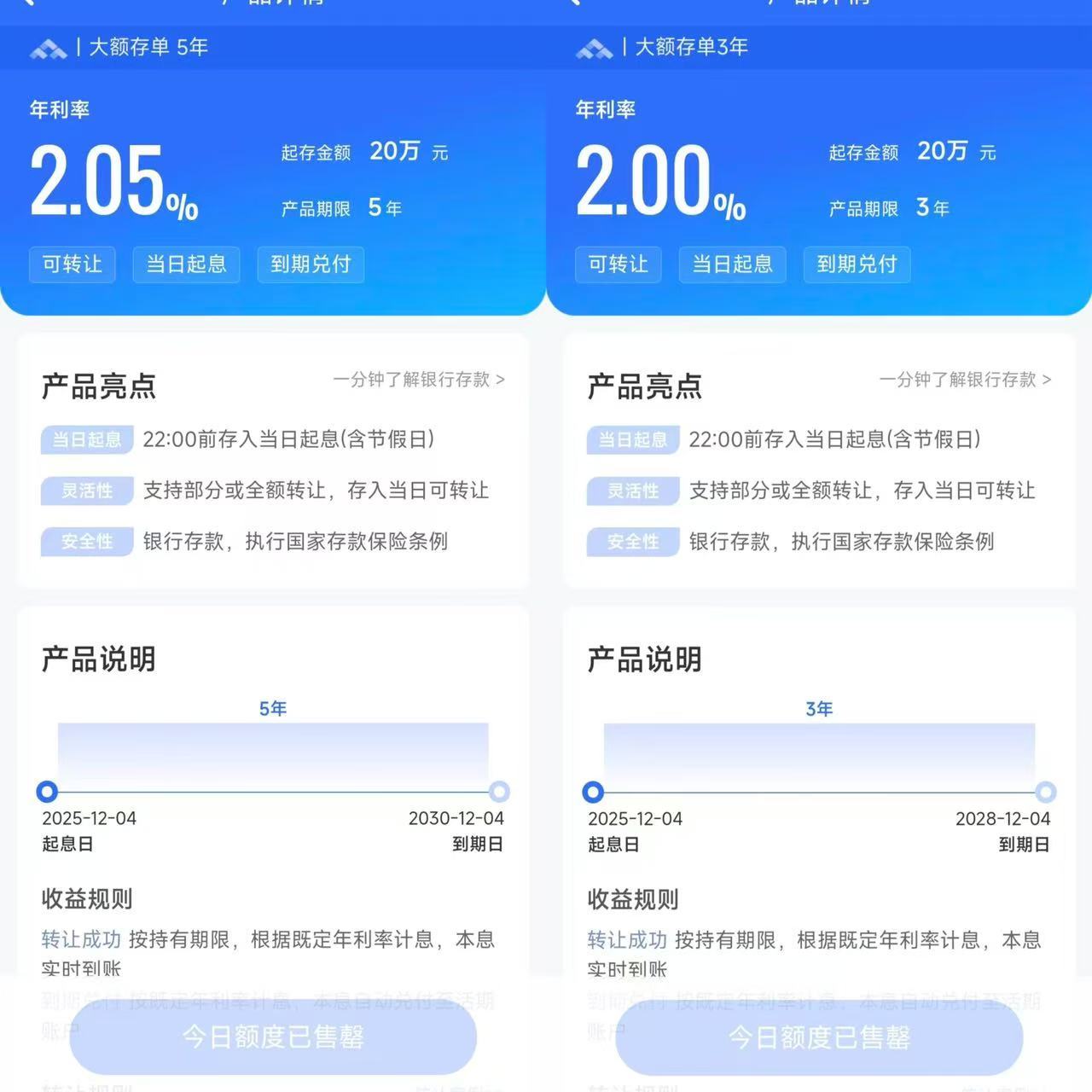
Core Viewpoint - Several banks have raised deposit interest rates, with new funds for three-year fixed deposits reaching 1.95%, an increase of approximately 10 basis points from previous rates [1] Group 1: Bank Actions - Many banks are launching special deposit and large-denomination certificate of deposit products as the Spring Festival approaches [1] - The increase in deposit rates is part of a broader trend among banks to attract new funds [1]

秒光、售罄,银行大额存单成稀缺资源,2%以上产品很难抢,有的门槛高达1000万元,专家:存款利率或长期下行
3 6 Ke· 2025-12-05 02:56
Core Viewpoint - The collective withdrawal of 5-year large denomination certificates of deposit (CDs) by the six major state-owned banks has led to a significant shift in the market, with smaller banks adopting varied strategies to attract customers and fill the gap left by the larger banks [1][3][19]. Group 1: Market Dynamics - The interest rates for large denomination CDs exceeding 2% have become extremely rare, with some banks raising the minimum investment threshold to millions [1][6]. - The withdrawal of long-term high-yield deposit products by major banks is creating a scarcity in the market, making it essential for investors to adjust their strategies and consider diversified asset portfolios [2][19]. - Smaller banks are leveraging the opportunity created by the exit of major banks to market their own long-term deposit products, emphasizing competitive interest rates and flexible terms [4][5][18]. Group 2: Competitive Strategies - Different types of banks are employing distinct strategies based on their market share, customer base, and service network, leading to a differentiated competitive landscape [2][18]. - Some smaller banks are promoting alternative deposit products with similar interest rates to large denomination CDs, catering to a broader customer base with lower minimum investment requirements [13][17]. - The marketing efforts of smaller banks are focused on highlighting the scarcity and advantages of their long-term deposit offerings in response to the major banks' withdrawal [4][5][18]. Group 3: Future Trends - The overall trend indicates a tightening supply of long-term, high-yield deposit products across all types of banks, suggesting a potential long-term decline in deposit interest rates [19][20]. - Experts predict that long-term, high-interest deposit products may become increasingly difficult to obtain, necessitating proactive adjustments from conservative investors [2][19]. - The competitive landscape will challenge banks to balance deposit volume and pricing while managing liquidity and risk effectively [20].


银行大额存单成稀缺资源:年利率2%+产品多被抢空 有的门槛高达1000万
Mei Ri Jing Ji Xin Wen· 2025-12-05 00:40
Core Viewpoint - The recent withdrawal of 5-year large deposits by six major state-owned banks has created a significant shift in the market, leading to a scarcity of high-yield deposit products, particularly those with interest rates above 2% [1][2][16]. Group 1: Market Dynamics - The exit of major banks from the 5-year large deposit market has resulted in a trend towards shorter deposit terms, with available options generally limited to 1.5% to 1.75% interest rates for up to 3 years [3][16]. - Some small and medium-sized banks have seized this opportunity to market their long-term deposit products, highlighting their competitive interest rates and terms on social media platforms [3][4]. - The competition among banks has intensified, with some institutions offering unique deposit products to attract customers, as traditional large deposits become harder to obtain [1][3][10]. Group 2: Interest Rate Trends - Interest rates for large deposits have dropped significantly, with rates above 2% becoming rare and often requiring high minimum deposits, sometimes reaching up to 1 million yuan [5][8][10]. - Certain small banks still offer 5-year large deposits with rates above 1.8%, but these products are quickly sold out due to high demand [5][7][10]. - The overall trend indicates that long-term, high-yield deposit products may become increasingly scarce, necessitating adjustments from conservative investors [2][16]. Group 3: Strategic Responses - Banks are adapting by introducing alternative deposit products with similar interest rates but lower minimum deposit requirements, effectively serving as substitutes for large deposits [10][14]. - The differentiation in deposit product offerings among banks is influenced by their market share, customer base, and service network, leading to varied strategies in maintaining long-term deposit supplies [15][18]. - Experts suggest that banks must enhance their service capabilities and market influence to sustain interest rate advantages while managing associated risks effectively [18][19].
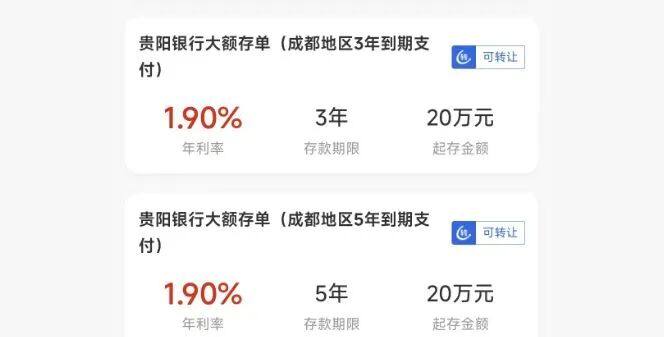
银行大额存单成稀缺资源,2%以上产品很难抢,有的门槛高达1000万元
Mei Ri Jing Ji Xin Wen· 2025-12-04 22:55
Core Viewpoint - The collective withdrawal of 5-year large-denomination certificates of deposit (CDs) by the six major state-owned banks has led to a significant shift in the market, with smaller banks adopting varied strategies to attract customers and fill the gap left by the larger banks [1][4][21]. Group 1: Market Trends - The interest rates for large-denomination CDs exceeding 2% have become extremely rare, with some banks raising the minimum investment threshold to millions [1][8]. - The trend indicates a shortening of the maturity structure for large-denomination CDs, with available options generally capped at three years and interest rates dropping to between 1.5% and 1.75% [4][23]. - The overall supply of long-term, high-yield deposit products is tightening across all types of banks, suggesting a long-term downward trend in deposit rates [22][23]. Group 2: Strategies of Smaller Banks - Smaller banks are leveraging the exit of major banks from the 5-year CD market as a marketing opportunity, promoting their own long-term deposit products on social media [5][6][7]. - Some smaller banks are offering alternative deposit products with similar interest rates to attract a broader customer base, despite the higher entry thresholds for large-denomination CDs [1][15][19]. - The marketing strategies of smaller banks are focused on highlighting the scarcity and advantages of their long-term deposit offerings, aiming to secure a customer base seeking stable returns [5][6][7]. Group 3: Customer Behavior and Preferences - Customers are increasingly seeking long-term, stable investment options, leading to a surge in demand for available high-interest deposit products, which are often sold out quickly [9][10][11]. - The shift in customer preferences is reflected in the growing inclination towards savings, with a notable percentage of residents expressing a desire for more savings rather than investments [24]. Group 4: Expert Insights - Experts suggest that the future of deposit rates may see a prolonged decline, influenced by policies aimed at reducing financing costs and optimizing banks' liability structures [22][24]. - The differentiation in strategies among banks is attributed to structural differences in market share, customer base, and service networks, which affect their ability to maintain long-term deposit products [21][22].
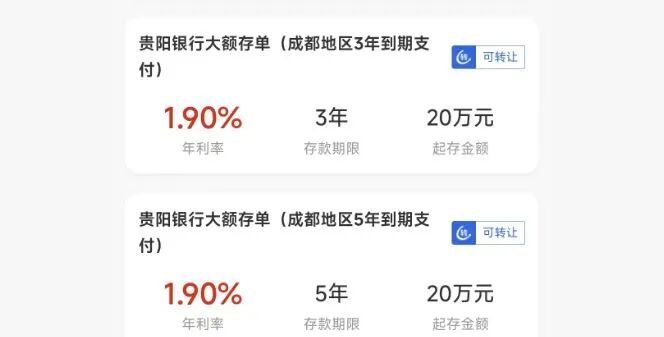
大行撤退,小行“补位”!中长期大额存单成稀缺资源:年利率“2%+”产品多被抢空,有的门槛高达1000万元
Mei Ri Jing Ji Xin Wen· 2025-12-04 16:54
Core Viewpoint - The collective withdrawal of 5-year large denomination certificates of deposit (CDs) by six major state-owned banks has led to a significant shift in the market, with some small and medium-sized banks seizing the opportunity to promote their long-term deposit products as alternatives [1][2][18]. Group 1: Market Trends - The trend of shortening the term structure of large denomination CDs is evident, with the maximum available term generally reduced to three years and interest rates dropping to between 1.5% and 1.75% [2][20]. - Long-term, high-interest deposit products are becoming increasingly scarce, posing challenges for conservative investors who need to adjust their strategies [2][20]. Group 2: Small and Medium-Sized Banks' Strategies - Small and medium-sized banks are actively marketing their long-term deposit products, highlighting their competitive interest rates and terms in response to the withdrawal of major banks [2][4]. - Some banks are offering large denomination CDs with interest rates above 1.8%, while others have introduced alternative deposit products with similar rates but lower minimum deposit requirements [5][12]. Group 3: Customer Engagement and Marketing - Customer managers from small banks are leveraging the situation to attract clients by emphasizing the scarcity and advantages of their deposit products on social media platforms [2][4]. - The marketing efforts align with the traditional peak season for deposit gathering, allowing banks to secure a customer base seeking stable returns before the year-end [4][20]. Group 4: Interest Rate and Accessibility - Interest rates for large denomination CDs have been raised in some banks, with minimum deposit requirements reaching as high as 1 million to 1 billion [9][11]. - Despite the scarcity of high-interest large denomination CDs, some banks continue to offer competitive rates on alternative deposit products, ensuring accessibility for a broader customer base [12][15]. Group 5: Future Outlook - The overall trend indicates a tightening of supply for long-term, high-yield deposit products across various banks, with expectations of a long-term decline in deposit rates [20][21]. - Banks face the challenge of balancing deposit volume and pricing while managing risks associated with higher interest rates and liquidity [21][22].



一路“童”行 共同成长 来自银行的儿童友好服务
Jin Rong Shi Bao· 2025-05-30 02:29
Group 1 - The article emphasizes the importance of cultivating financial awareness among minors, which can lead to lifelong habits of saving, budgeting, and rational consumption [1] - Financial institutions are increasingly offering products and services tailored for minors, such as specialized bank accounts and savings options [2] - Banks require strict documentation for minors to open accounts, ensuring the protection of their legal rights and financial safety [2][3] Group 2 - Many banks are organizing financial education activities for children, such as "financial knowledge classrooms," to introduce banking and financial concepts in an engaging manner [4] - Practical financial activities are being conducted in various regions, where children visit banks to learn about financial operations and the importance of money management [5] - Banks are also hosting themed events to enhance children's experiences and understanding of financial concepts, integrating cultural elements and interactive learning [6]