珍酒珍三十

Search documents
第三季度深度调整后 白酒再遇“双11” 有产品降不动价了
Nan Fang Du Shi Bao· 2025-11-11 16:35
Core Viewpoint - The "Double 11" shopping festival has seen a continuation of low prices for liquor, but some premium products have reached a price stabilization point, indicating a shift in market dynamics and strategies from liquor companies [1][2][4]. Price Trends - Many liquor products have experienced price drops during the "Double 11" event, with notable examples including: - Junpin Xijiu dropping to a minimum of 589 yuan per bottle from a thousand yuan price range [2]. - Jinsha Zhai's price falling below 400 yuan, reaching as low as 358 yuan per bottle [2]. - Dream Blue M6+ prices ranging from 560 to 650 yuan, with a new low of 499 yuan on e-commerce platforms [2][3]. - However, some products, such as Wuliangye and Guojiao 1573, have shown price stability compared to the "618" event, indicating a reluctance to further reduce prices [3][6]. Subsidy Dynamics - The subsidy levels for liquor during "Double 11" have not significantly increased compared to previous events, with more subsidies directed towards other categories like beauty and electronics [4][5]. - The ongoing presence of subsidies has led to a decrease in consumer demand for liquor, as initial excitement has waned [4][5]. Company Strategies - Liquor companies are adopting a strong stance on price maintenance, emphasizing authorized sales channels and penalizing unauthorized distributors [5][7]. - This approach aims to protect the interests of distributors and maintain product value amidst a challenging market environment [6][7]. Market Conditions - The liquor industry is currently undergoing a deep adjustment phase, with companies focusing on inventory clearance and price stability to support distributors [6][7]. - The overall market sentiment suggests that if prices continue to decline, it could further damage distributor confidence and industry stability [6][7]. Future Outlook - The industry will continue to monitor the impact of "Double 11" on liquor prices, assessing whether they will stabilize or decline further in the coming months [8].
“违规”“不提供任何检验和售后服务”,让酒企“发飙”的开盖酒是什么?
Sou Hu Cai Jing· 2025-10-25 17:04
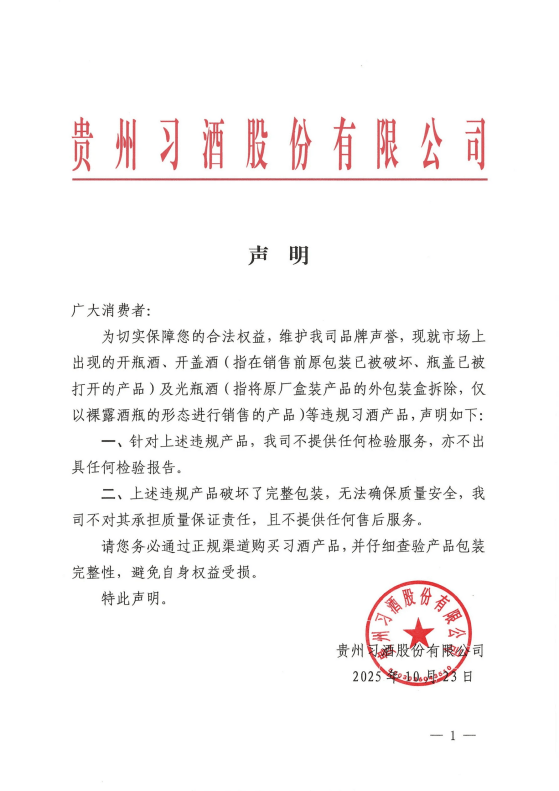
Core Viewpoint - The rise of "open bottle" and "open cap" liquor products during the "Double Eleven" shopping festival has led to various consumer issues, prompting Guizhou Xijiu to issue a statement denying responsibility for the quality of these products [1][16]. Group 1: Company Actions - Guizhou Xijiu announced it will no longer provide inspection and after-sales services for open bottle, open cap, and bare bottle products, thus not assuming quality guarantee responsibilities [1][3]. - The company defined open bottle and open cap products as those with damaged original packaging or opened caps, while bare bottles refer to products sold without their original packaging [3][16]. Group 2: Market Dynamics - Despite the company's statement, many merchants continue to sell low-priced open cap Xijiu products, with significant price discrepancies observed; for instance, a six-bottle pack of 53-degree 500ml Xijiu was priced at 379 yuan, while the official store listed it at 590 yuan, a difference of over 200 yuan [3][12]. - The proliferation of open bottle and open cap products is linked to liquor companies' "open bottle scan" red envelope policies, which incentivize consumers and distributors to increase sales through cash and points rewards [13][14]. Group 3: Consumer Risks - The existence of open bottle and open cap products raises concerns for both consumers and liquor companies, as these products can disrupt pricing systems, lead to price wars, and damage brand reputation due to potential quality issues [16][17]. - Consumers may mistakenly believe they are getting a bargain, but they risk purchasing inferior or counterfeit products, as the exposure to air can lead to spoilage, and the lack of traceability complicates accountability in case of issues [16][17].

湾区酒价半年图谱:库存压力下价格防线松动,千元档“失守”
Nan Fang Du Shi Bao· 2025-07-30 03:33
Core Insights - The white liquor market has experienced a collective price decline since 2025, affecting both high-end and mid-range products due to a cooling consumption environment and high inventory pressures [1][15][16] - The South China region, particularly the Guangdong-Hong Kong-Macao Greater Bay Area, has shown significant price differentiation and a notable decline in retail prices for various white liquor products [1][2][3] Market Performance - More than half of the monitored products have seen a price drop since the beginning of the year, with high-end products being the most affected [2][15] - Among 21 monitored products, 15 experienced a decline in average retail prices, with only 4 showing slight increases and 2 remaining stable [2][3] - The most significant price drop was observed in Feitian Moutai, which fell from approximately 2624 CNY to 2368 CNY, a decrease of 256 CNY [2][3] Price Trends by Product - Feitian Moutai's market price has dropped significantly, with current prices ranging from 2100 to 2400 CNY per bottle, marking a decline of over 15% from its peak [3][15] - Other products in the thousand CNY price range, such as the eighth generation Wuliangye and Guojiao 1573, also saw price reductions, with the eighth generation Wuliangye dropping by 110 CNY [10][15] - Mid-range products like Yanghe Dream Blue M6+ and Guotai Guobiao also experienced price declines, although to a lesser extent compared to high-end products [4][10] Regional Price Dynamics - In Guangzhou, 17 out of 21 products saw price declines, with Feitian Moutai dropping from 2648 CNY to 2305 CNY [7][8] - Shenzhen's market showed a downward trend in retail prices, although some products had inflated prices due to high-end retail channels [9][10] - Dongguan's market exhibited significant price fluctuations influenced by seasonal demand and promotional activities, with Feitian Moutai's price dropping to 2299 CNY during peak sales periods [12][13] Inventory and Market Conditions - The white liquor industry is currently in a deep adjustment phase, with high inventory levels leading to price pressures across all product categories [15][16] - Approximately 60% of companies are facing price inversion, particularly in the 800 to 1500 CNY price range, which is experiencing the most significant downward pressure [15][16] - The average inventory turnover days have increased to 900 days, indicating a challenging market environment for producers [15][16] Future Outlook - The market is expected to continue facing challenges as companies balance between maintaining prices and expanding market share [17][18] - The introduction of new statistical methods and the inclusion of additional cities like Foshan in price monitoring may provide a clearer picture of market dynamics moving forward [20][21]





618低价“厮杀”后:部分白酒价格回调,高端产品跌势难止
Nan Fang Du Shi Bao· 2025-07-04 11:08
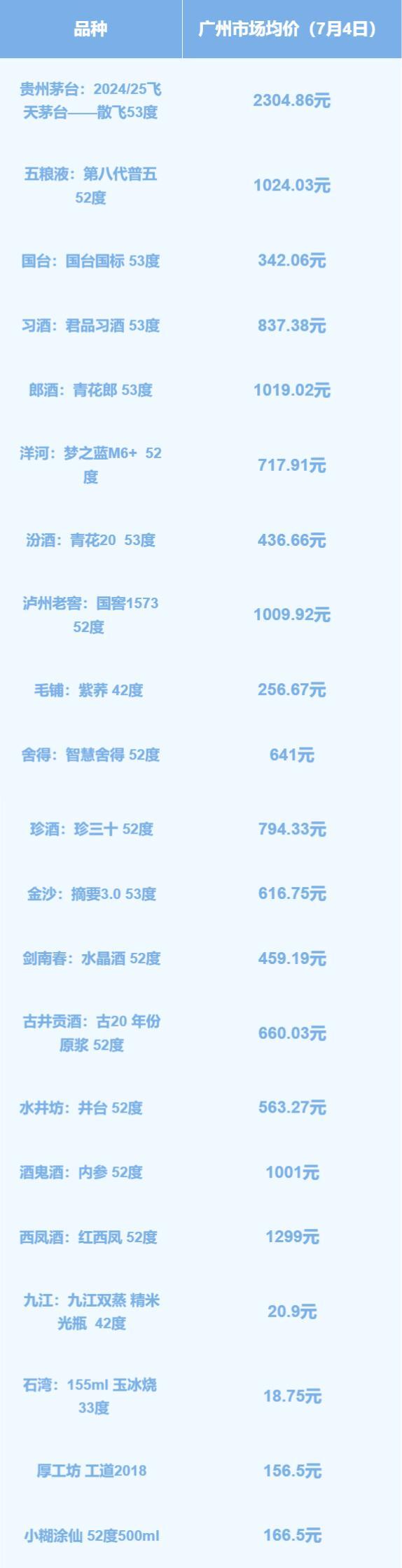
Core Insights - The 618 shopping festival has concluded, leading to varied price movements in the white liquor market, with some products experiencing price increases while others continue to decline [1][2][3] Price Trends in Major Cities - In Guangzhou, among 21 sampled white liquor products, 9 saw a decrease in average retail price, while 8 experienced an increase, and 4 remained unchanged [2] - Notably, high-end products like Moutai and Guojiao 1573 have seen price drops, with Moutai's average retail price falling to approximately 2304 RMB, a decrease of about 100 RMB from the previous period [2][3] - In Shenzhen, Moutai's average retail price is reported at 2298.5 RMB, with a notable decline in several high-end products due to ongoing market pressures [7][10] - East Dongguan's market shows a mixed trend, with 9 products increasing in price and 5 decreasing, highlighting the volatility in high-end liquor pricing [12][13] Online vs. Offline Pricing - Online platforms, particularly instant retail channels, are showing lower prices compared to offline supermarkets, with Moutai priced at 2229 RMB online, which is about 75 RMB lower than the overall average [3][8] - The price discrepancies between online and offline channels are significant, with products like Junpin Xijiu and Qinghua Lang being sold for much lower prices online compared to their offline counterparts [3][8] Impact of Regulatory Changes - The ongoing "ban on alcohol" has significantly impacted sales, particularly in high-end segments, leading to price reductions as businesses attempt to stimulate demand [9][10] - The combination of the 618 festival and regulatory changes has created a challenging environment for liquor companies, as they navigate maintaining sales volume and pricing stability [1][17] Summary of Average Prices - The average prices for key products as of July 4th are as follows: - Moutai: 2367.62 RMB [19] - Wuliangye: 1010.27 RMB [19] - Junpin Xijiu: 833.17 RMB [20] - Qinghua Lang: 943.11 RMB [20] - Guojiao 1573: 993.42 RMB [20]