古井贡酒古20

Search documents
2026春节酒市复盘:高端、次高端、大众酒反差迎来春节市场之最!
Sou Hu Cai Jing· 2026-02-27 00:25
Core Insights - The liquor market did not experience the anticipated overall growth during the 2026 Spring Festival, instead showcasing a highly differentiated landscape with significant disparities in performance across different segments [1] High-End Market - The high-end liquor segment (priced above 800 yuan) remained robust, driven by brand value, gifting attributes, and preservation functions, which were amplified during the Spring Festival [4] - Moutai's bottle price rose from 1500 yuan to 1650 yuan, with the original box price stabilizing around 1700 yuan. Wuliangye's price increased from 760 yuan to the 800 yuan range, indicating strong demand in high-end banquet and gifting scenarios [6] - As of February 11, many Moutai distributors had completed 35%-40% of their annual payment plans, with sales in multiple regions increasing by 10%-20% year-on-year, demonstrating the resilience of core assets in the high-end market [6] Mid-Range Market - The mid-range liquor segment (priced between 400-800 yuan) faced significant challenges, with a decline in sales due to a shift in consumer focus from business gifting to home consumption and genuine gatherings. The estimated decline in this price range varied from 10% to 50% [7] - For instance, Gujing Gongjiu's products experienced single-digit declines, while its higher-end offerings saw declines exceeding 20% due to reduced business banquets. Many mid-range brands resorted to price cuts and promotions to capture limited market share, which compressed distributor profits and intensified price competition [9] Mass Market - The mass liquor segment (priced between 50-200 yuan) experienced explosive growth, with some products expected to see significant increases in market share during the Spring Festival. Sales in the 100-300 yuan price range were notably better than the previous year [10] - Consumer behavior shifted towards focusing on value-for-money products rather than high-priced brands, indicating a deeper transformation in consumption logic. This trend aligns with the rise of practical consumption and rational choices, which became the defining characteristic of this year's Spring Festival [12] - The market is evolving into a new structure where high-end and ultra-high-end products maintain brand image and pricing power, while mass-market products drive volume and cover basic consumption needs, leaving the mid-range segment increasingly squeezed [12]



白酒“春节档”,茅台领涨!
Sou Hu Cai Jing· 2026-02-11 12:52
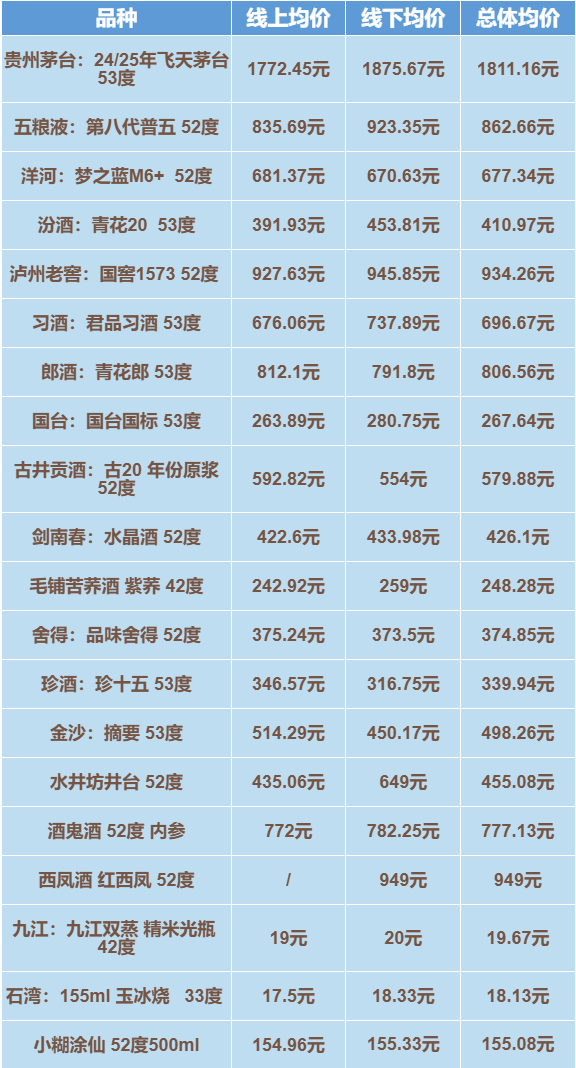
Core Insights - The white liquor market is experiencing a significant recovery as the Lunar New Year approaches, with notable price fluctuations and increased sales activity across major cities in the Bay Area [1][10]. Group 1: Market Trends - The demand for white liquor is rising, particularly for high-end brands like Moutai, which is leading a price increase trend due to strong gifting and collecting demand [1][8]. - The overall market shows a mixed price performance, with some high-end and mid-range brands experiencing price declines while others see increases, indicating a complex market landscape [1][3][11]. Group 2: Price Dynamics - In Guangzhou, the average price of several high-end products has decreased slightly, with the largest drop being approximately 32 yuan for the "Jiu Gui Jiu Neican" product [4]. - Conversely, in Shenzhen, the retail price of Moutai has increased significantly, with an average price of 1835.28 yuan per bottle, reflecting a rise of about 101 yuan compared to previous periods [8][9]. Group 3: Consumer Behavior - The upcoming Spring Festival is expected to drive social consumption, with corporate events and gatherings contributing to increased demand for white liquor [11]. - The market is witnessing a clear differentiation in brand performance, with Moutai showing strong resilience and acting as a market leader, while other brands face varying degrees of price volatility [11]. Group 4: Sales Channels - The price discrepancies between online and offline sales channels are notable, with promotional activities online affecting the pricing strategies of physical stores [11]. - The overall market dynamics suggest that brand strength and channel strategies are critical in navigating the current competitive landscape [1][11].
茅台价格“松动”掀起连锁降价潮?酒商坦言:行业大洗牌在即
Nan Fang Du Shi Bao· 2026-01-15 11:45
Core Viewpoint - The white liquor market is experiencing unexpected price declines instead of the anticipated seasonal increase, driven by price adjustments of benchmark products like Feitian Moutai, leading to a widespread price reduction across various brands and price segments [1][13]. Price Trends - In major cities like Guangzhou, Shenzhen, Foshan, and Dongguan, the average retail prices of high-end white liquors have generally decreased, with many premium products, especially sauce-flavored liquors, seeing significant price drops [1][11]. - In Guangzhou, the average price of sauce-flavored liquors has fallen sharply, with products like Junpin Xijiu dropping from approximately 731 yuan to around 698 yuan [2][3]. - The average retail price of Feitian Moutai in Shenzhen is reported at 1734.21 yuan, with some channels offering it as low as 1699 yuan [5][6]. Market Dynamics - The price adjustments are attributed to high inventory pressures and a shift towards "price for volume" strategies among distributors, indicating a challenging market environment for the white liquor industry [1][13]. - The introduction of the "i Moutai" platform has intensified competition, causing price fluctuations across the market, particularly affecting products in the 1000 yuan price range [2][7]. Regional Insights - In Shenzhen, high-end products like the eighth-generation Wuliangye have seen a price drop of approximately 39 yuan, while Junpin Xijiu's price has decreased by 22 yuan [5][6]. - In Dongguan, 13 out of 16 comparable high-end liquors have experienced price declines, with the eighth-generation Wuliangye averaging 884.43 yuan, down 20.57 yuan [11][12]. Future Outlook - The current price reductions reflect a lack of market momentum and high inventory levels, with many distributors indicating that clearing stock remains a primary focus [1][13]. - As the Spring Festival approaches, the ability of white liquor prices to stabilize will be a key indicator of the industry's recovery trajectory, with companies demonstrating brand resilience and channel control likely to emerge stronger from this market adjustment [13].
大众价格带韧性较强:白酒行业周报(20251229-20260104)-20260105
Huachuang Securities· 2026-01-05 10:13
Investment Rating - The report maintains a "Recommendation" rating for the liquor industry, indicating an expectation that the industry index will outperform the benchmark index by more than 5% in the next 3-6 months [21]. Core Insights - The report highlights that the demand for liquor is showing weak recovery, with a year-on-year decline of over 20% during the New Year period, although there is a slight month-on-month improvement from November and December [4]. - The report notes that the high-end liquor prices are under pressure, with a decline of over 10% for high-end products and 5-10% for mid-range products, while the mass consumption segment remains resilient [4]. - The report anticipates a narrowing of the decline in demand for the upcoming Spring Festival, with expectations of a double-digit decline but less severe than during the New Year [4]. - The report emphasizes that the pricing for high-end liquor will remain under pressure, with expectations of continued marginal declines in prices [4]. Industry Overview - The liquor industry consists of 20 listed companies with a total market capitalization of 288.22 billion yuan and a circulating market value of 288.18 billion yuan [1]. - The report provides a comparative performance analysis, indicating absolute performance declines of -6.0% over one month, -1.4% over six months, and -9.9% over twelve months [2]. Company Feedback and Strategies - Moutai is focusing on market-oriented transformation and has introduced a digital platform to stimulate consumer demand [5]. - Wuliangye is emphasizing sales growth and market order maintenance, with a strategy to enhance market share in the 800 yuan price range [5]. - Luzhou Laojiao plans to increase subsidies and rebates to ensure consumer affordability while maintaining its brand position [5]. - Shanxi Fenjiu is focusing on key markets and maintaining growth momentum for its premium products [5]. - Yanghe is adjusting its sales strategies based on terminal orders and distributor inventory, with a focus on maintaining reasonable inventory levels [5]. - Jinsiyuan is experiencing growth in its mass price segment, which is expected to continue contributing to overall growth [5]. Investment Recommendations - The report suggests that pessimistic factors have been priced in, and as the Spring Festival approaches, demand is expected to recover, particularly for Moutai and Gujing [4]. - The report recommends focusing on Moutai for its high certainty and dividend yield, while also highlighting Gujing as a key player in the mass price segment [4].




白酒渠道跟踪
2025-12-08 00:41
Summary of the Conference Call on the Baijiu Industry Industry Overview - The Baijiu market in 2025 is facing challenges such as declining sales and inventory buildup, with high-end brands like Moutai and Wuliangye experiencing price adjustments and increased inventory pressure [2][18] - The overall sales in the Henan region decreased by approximately 20% compared to 2024, with some manufacturers issuing reduction directives due to unfulfilled sales tasks [7][18] Key Points and Arguments Sales Performance - Moutai's sales have been stable, with all goods delivered by November 2025 and a 10% increase in December. However, online platforms have reported prices as low as 1,300 RMB, below cost [4][18] - Wuliangye expects a 10% sales growth in 2026, driven by new leadership and compensation for reduced output in 2025, but faces challenges with margins and potential negative profits [2][6][20] - Fenjiu has shown relative stability in Shandong, with a planned 10% growth for 2026, although it has faced historical low prices and reliance on rebates for profits [2][10] - The Jiangsu market has seen a 25%-30% decline in high-end Baijiu demand, with increased inventory levels and reduced enthusiasm from distributors [2][18] Inventory and Pricing - Moutai's current inventory is approximately 40 days, while Wuliangye's is about 10 days, with some stores facing up to two months of inventory due to wholesale restrictions [4][18] - Fenjiu's pricing has dropped to historical lows, with some products priced at around 350 RMB, impacting distributor profits [4][10] - The overall inventory levels in the Shandong region are high, with significant pressure on brands like Water Well and Shede, which have seen declines of 10% and 15% respectively [11][12] Future Outlook - Wuliangye's growth expectations for 2026 are contingent on pricing and subsidy negotiations, with no specific plans communicated yet [8][20] - Fenjiu has adjusted its product structure, increasing high-end offerings while facing challenges in profit generation due to low prices [10][20] - The overall sentiment in the Baijiu market indicates a cautious outlook, with expectations for improvement in 2026 if economic conditions stabilize and inventory is effectively managed [23][24] Additional Important Insights - Consumer behavior has shifted towards immediate consumption rather than stockpiling, leading to stable but non-explosive sales growth [3][18] - The competitive landscape shows that while high-end brands are under pressure, some mid-tier brands like Yanghe and Jinshiyuan are also struggling with high inventory and low prices [22][23] - The overall market dynamics suggest that brands need to adapt to changing consumer preferences and economic conditions to navigate the current challenges effectively [24][46]
第三季度深度调整后 白酒再遇“双11” 有产品降不动价了
Nan Fang Du Shi Bao· 2025-11-11 16:35
Core Viewpoint - The "Double 11" shopping festival has seen a continuation of low prices for liquor, but some premium products have reached a price stabilization point, indicating a shift in market dynamics and strategies from liquor companies [1][2][4]. Price Trends - Many liquor products have experienced price drops during the "Double 11" event, with notable examples including: - Junpin Xijiu dropping to a minimum of 589 yuan per bottle from a thousand yuan price range [2]. - Jinsha Zhai's price falling below 400 yuan, reaching as low as 358 yuan per bottle [2]. - Dream Blue M6+ prices ranging from 560 to 650 yuan, with a new low of 499 yuan on e-commerce platforms [2][3]. - However, some products, such as Wuliangye and Guojiao 1573, have shown price stability compared to the "618" event, indicating a reluctance to further reduce prices [3][6]. Subsidy Dynamics - The subsidy levels for liquor during "Double 11" have not significantly increased compared to previous events, with more subsidies directed towards other categories like beauty and electronics [4][5]. - The ongoing presence of subsidies has led to a decrease in consumer demand for liquor, as initial excitement has waned [4][5]. Company Strategies - Liquor companies are adopting a strong stance on price maintenance, emphasizing authorized sales channels and penalizing unauthorized distributors [5][7]. - This approach aims to protect the interests of distributors and maintain product value amidst a challenging market environment [6][7]. Market Conditions - The liquor industry is currently undergoing a deep adjustment phase, with companies focusing on inventory clearance and price stability to support distributors [6][7]. - The overall market sentiment suggests that if prices continue to decline, it could further damage distributor confidence and industry stability [6][7]. Future Outlook - The industry will continue to monitor the impact of "Double 11" on liquor prices, assessing whether they will stabilize or decline further in the coming months [8].
白酒双十一迎来“冷静期”?线上大促线下观望
Nan Fang Du Shi Bao· 2025-10-24 13:18
Core Insights - The annual Double Eleven shopping festival has begun, but the liquor industry is experiencing a "cooling period" with mixed price movements across online and offline channels [2][12] - High-end liquor prices have remained stable despite promotional activities, while some mid-to-high-end products are seeing slight price declines [2][12] Price Trends - In the Greater Bay Area, online platforms are using subsidies to lower high-end liquor prices, while offline channels are mostly observing the market [2][12] - In Guangzhou, over half of the sampled products saw price increases, with high-end products like Wuliangye and Guojiao 1573 experiencing minor price hikes [3][4] - Conversely, some products, including Moutai, saw price reductions due to adjustments by instant retail platforms [4][6] Regional Variations - In Shenzhen, liquor prices showed stability, with some products like Moutai and Guojiao 1573 experiencing slight declines, while others like Wuliangye saw price increases [5][6] - In Foshan, liquor prices remained stable, with Moutai showing a slight increase, while other products experienced minor fluctuations [8][9] - Dongguan reported significant price drops for Moutai, with online channels driving the decline, while mid-range products displayed mixed price movements [10][11] Market Dynamics - The Double Eleven promotions have intensified price competition among high-end liquors, with leading brands like Moutai facing downward pressure on prices [12] - The cautious attitude of distributors towards seasonal sales is reflected in the limited follow-up promotions in offline channels [12] - Despite overall pressure, some brands like Fenjiu and Xijiu have shown resilience with slight price increases, indicating consumer demand for specific products [12]


习酒董事长频赴一线调研背后:九大白酒品牌,君品习酒跌得最“惨”
Sou Hu Cai Jing· 2025-09-30 03:34
Core Insights - The chairman of Xijiu Group, Wang Diqiang, has been conducting extensive market research across various provinces, indicating a strategic response to market pressures [1][5][10] - The wholesale price of Junpin Xijiu has seen a significant decline of 39.82% over the past five years, making it the largest drop among T9 brands [5][9][12] - The company aims to enhance its market positioning and sales strategies amid changing consumer preferences and increased competition following its separation from Moutai [10][15][17] Market Research and Strategy - Wang Diqiang's recent visits to key markets such as Shaanxi and Tianjin are part of a broader initiative to understand market dynamics and unify corporate strategy [1][5] - The research aims to identify issues and foster consensus within the company to elevate its marketing efforts [5][9] Price Trends and Market Position - Junpin Xijiu's wholesale price has decreased from 955 yuan per bottle in June 2021 to approximately 683 yuan currently, reflecting a significant market adjustment [5][8] - The average inventory turnover days for the white liquor industry has increased to 900 days, indicating a growing challenge in managing stock and pricing strategies [9][12] Industry Context and Challenges - The white liquor industry is experiencing a structural shift in consumer behavior, with a growing preference for lower-priced products, impacting high-end brands like Junpin Xijiu [9][10] - Following its independence from Moutai in 2022, Xijiu faces intensified competition, necessitating a reevaluation of its market strategy [12][15] Future Goals and Development - Xijiu aims to achieve an asset scale of 33 billion yuan and revenue of 23.5 billion yuan by 2025, with current figures at 26.835 billion yuan and 19.864 billion yuan respectively [17] - The company's leadership is focused on stabilizing prices and enhancing market confidence to drive growth in a challenging industry landscape [17]
酒商以价换量 高端低度产品“杀出重围”
Nan Fang Du Shi Bao· 2025-09-25 23:12
Core Insights - The liquor market in the Greater Bay Area is experiencing price fluctuations, particularly in high-end products, as the Mid-Autumn Festival and National Day approach, leading to increased promotional activities by distributors [3][4][12] - High-end liquor prices have generally decreased, while low-end products remain stable, indicating a shift in consumer demand and pricing strategies [4][10][12] Price Trends - In Guangzhou, 15 high-end liquor products saw price declines, including notable brands like Moutai and Wuliangye, with Moutai's average price dropping to approximately 2065 yuan, a decrease of about 40 yuan [4][5] - Shenzhen's liquor prices have stabilized, with Moutai averaging 2102.91 yuan, reflecting a recovery in sales as the festive season approaches [6][8] - In Foshan, Moutai's average price is around 2131 yuan, with other products like Wuliangye and Qinghualang also experiencing slight declines [9][10] Market Dynamics - Distributors are implementing various promotional strategies, such as discounts and bundled offers, to boost sales and reduce inventory ahead of the festive season [5][12] - There is a noticeable increase in sales of high-end products, while low-alcohol beverages are gaining popularity, suggesting a diversification in consumer preferences [3][12] Regional Variations - In Dongguan, the market shows a downward trend in mid-to-high-end liquor prices, with significant drops in products like the金沙摘要, which fell by 8.81% [11][12] - The overall performance of the liquor market in the Greater Bay Area indicates a growing demand for high-end products, despite the general price decline, as distributors adapt to changing consumer behaviors [12]
中秋国庆白酒“大战”开启!酒商以价换量 高端低度杀出重围
Nan Fang Du Shi Bao· 2025-09-20 06:13
Core Insights - The liquor market is experiencing increased activity as the Mid-Autumn Festival and National Day approach, with a notable acceleration in the sales of white liquor, although prices are declining [1][21] - High-end liquor products are seeing a price drop, while low-end products remain stable, prompting distributors to launch various promotional activities to clear inventory [1][21] Price Trends - In Guangzhou, 15 products have seen a decline in retail prices, including high-end brands like Moutai and Wuliangye, with price reductions ranging from several to dozens of yuan [2][3] - Moutai's average price is approximately 2065 yuan, down about 40 yuan from the previous period, while Wuliangye's price decreased by 11 yuan to around 910 yuan [2][3] - In Shenzhen, Moutai's average retail price is 2102.91 yuan, with significant price variations between online and offline channels [9][11] Sales Dynamics - Distributors report a noticeable shrinkage in demand compared to last year, leading to aggressive pricing strategies to stimulate sales [5][21] - High-end products are experiencing increased sales, while low-alcohol products are gaining popularity, indicating a shift in consumer preferences [21] Regional Insights - In Shenzhen, the price fluctuations have stabilized as demand increases, with expectations of a 20% rise in high-end product sales in September [10][21] - In Dongguan, the market shows a downward trend in mid-to-high-end product prices, with 14 out of 18 products experiencing price drops [17][19] Promotional Strategies - Liquor distributors are implementing various promotional strategies, such as discounts and bundled offers, to boost sales ahead of the festive season [3][21] - Some stores are offering promotions like "buy five boxes, get one free" to increase sales volume, contributing to the overall price decline [3][5]