电池储能产品

Search documents
特斯拉跌落电车销冠王座
Bei Jing Shang Bao· 2026-01-04 15:44
Core Viewpoint - Tesla has lost its title as the world's top electric vehicle seller for the first time, being surpassed by Chinese manufacturer BYD in 2025, with Tesla's global deliveries dropping to 1.636 million units, a year-on-year decline of approximately 8.6% [1][2]. Group 1: Tesla's Performance - In Q4 2025, Tesla produced over 434,000 vehicles and delivered over 418,000, with a significant drop in annual deliveries compared to 2024 [1]. - Tesla's Q4 2025 deliveries decreased by about 16% compared to Q4 2024, and annual deliveries fell from 1.79 million in 2024 to 1.636 million in 2025 [1][2]. - Analysts estimate that Tesla's Q4 2025 delivery volume will be around 426,000 units [1]. Group 2: Market Dynamics - The decline in Tesla's Q4 sales is attributed to the U.S. federal government's early termination of electric vehicle incentives, which prompted a rush in sales during Q3 [2]. - In Europe, Tesla's registrations fell by 39% in the first 11 months of 2025, while BYD's registrations grew by 240% [2]. - The overall electric vehicle market in Europe is growing, accounting for approximately 16% of all new car sales in 2025 [2]. Group 3: BYD's Growth - BYD's pure electric vehicle sales reached nearly 2.26 million units in 2025, marking a nearly 28% increase from 2024 and surpassing Tesla for the first time [3]. - BYD is expanding its presence in overseas markets, including Europe, Latin America, and Southeast Asia, with new production facilities in Brazil and Thailand [3]. Group 4: Tesla's Future Outlook - Despite disappointing sales figures, Tesla is focusing on CEO Elon Musk's vision of "sustainable abundance," which includes future projects like robot taxis and humanoid robots [3]. - Tesla's stock price increased by 40% in Q3 2025 and reached an all-time high in Q4, with a market capitalization exceeding $1.6 trillion [4]. - Analysts suggest that Tesla's current valuation is heavily based on its potential in autonomous driving and AI technologies, which are estimated to account for over 70% of the company's total value [4]. Group 5: Energy Storage Business - Tesla's energy storage business continues to grow rapidly, with 14.2 GWh of battery storage products deployed in Q4 2025, a significant increase of 13.6% from 12.5 GWh in 2024 [5].


特斯拉全年交付数据出炉,以巨大劣势丢掉全球电车销冠王座
Feng Huang Wang· 2026-01-02 23:23
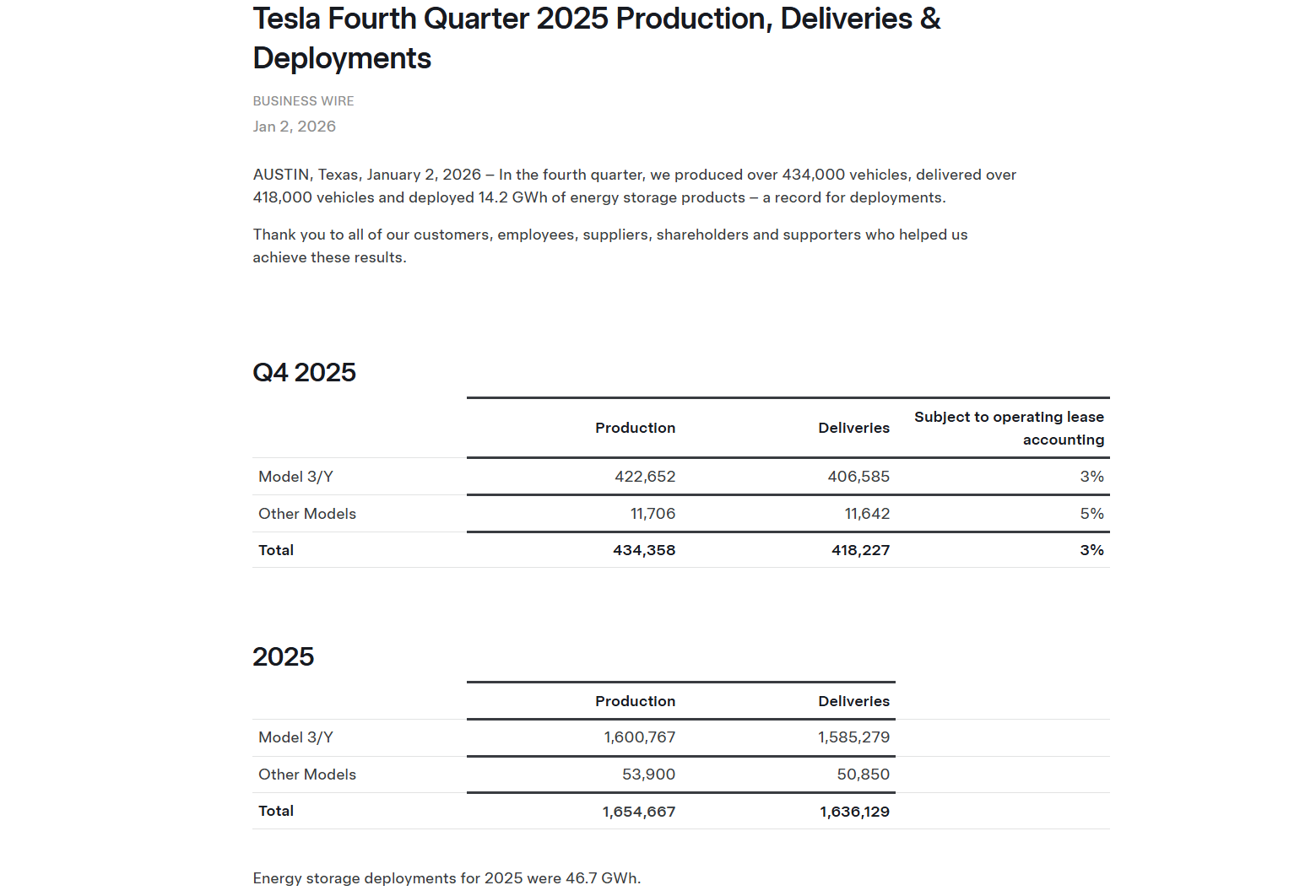
Core Insights - Tesla has lost its title as the world's top electric vehicle seller, with Q4 2025 deliveries of 418,227 vehicles, falling short of expectations [1][5] - The company delivered a total of 1,636,129 vehicles in 2025, which is lower than the previous year's total of 1,789,226 vehicles, marking a year-over-year decline of 8.6% [1][5] - In contrast, BYD, a leading Chinese electric vehicle manufacturer, reported a 27.86% increase in sales, delivering 2,256,700 vehicles in 2025 [5] Production and Deliveries - In Q4 2025, Tesla produced 434,358 vehicles, with Model 3/Y accounting for 422,652 units and other models contributing 11,706 units [3] - For the entire year of 2025, Tesla's production totaled 1,654,667 vehicles, with Model 3/Y at 1,600,767 units and other models at 53,900 units [4] Market Position and Competition - Tesla currently holds a 45% market share in the U.S. electric vehicle market, benefiting from previous government policies promoting clean energy [5] - The company is facing increasing competition from traditional automakers, such as Volkswagen, which has surpassed Tesla in electric vehicle sales in Europe [5] Strategic Shifts and Future Outlook - CEO Elon Musk is shifting focus towards Robotaxi services, AI, and robotics to support the company's stock price, despite limited consumer access to Robotaxi services [6] - Tesla deployed 14.2 GWh of energy storage products in Q4 2025, an increase from 12.5 GWh in the previous quarter, and a total of 46.7 GWh for the year [6] - Analysts predict a challenging outlook for U.S. electric vehicle sales in 2026, with expectations for Tesla's annual deliveries dropping to around 1.8 million vehicles [7]

股价七连跌!特斯拉第四季度交付量418227辆,不及预期
美股IPO· 2026-01-02 16:04
Core Viewpoint - Tesla's vehicle deliveries and production have declined, with a significant drop in annual delivery numbers for the second consecutive year, while its energy business continues to grow [2][3]. Group 1: Delivery and Production Data - In Q4 2025, Tesla delivered 418,227 vehicles and produced 434,358 vehicles, with an annual delivery total of 1.64 million vehicles and an annual production of approximately 1.65 million vehicles [2]. - Compared to Q4 2024, Tesla's Q4 2025 delivery volume decreased by about 16% from 495,570 vehicles, and production fell by 5.5% from 459,445 vehicles [2]. - The annual delivery volume for 2025 dropped by 8.6% from 1.79 million vehicles in 2024 to 1.64 million vehicles [2]. Group 2: Market Competition and Challenges - Tesla faces intense competition from companies like BYD, Kia, Hyundai, and Volkswagen, which has contributed to the decline in deliveries [3]. - The early termination of federal electric vehicle purchase incentives by the U.S. government has also negatively impacted Tesla's sales, as consumers shifted their purchasing decisions to Q3 [3]. - CEO Elon Musk's political activities and statements have led to consumer backlash, further complicating Tesla's market position despite the launch of a more affordable Model Y SUV [3]. Group 3: Regional Market Performance - Tesla's market share in Europe has significantly declined, with new car registrations dropping by 39% in the first 11 months of 2025, while BYD's registrations surged by 240% [4]. - The overall acceptance of pure electric vehicles in the European market has increased, with electric vehicles accounting for approximately 16% of new car sales in 2025 [4]. - Analysts suggest that the introduction of the more affordable Model Y standard version could help Tesla regain some market share in the coming quarters [4]. Group 4: Long-term Vision - Tesla's narrative extends beyond vehicle sales, focusing on Musk's vision of "sustainable prosperity," which includes promises of autonomous taxi services and humanoid robots that could perform various roles [5]. - These projects are seen as potential long-term value drivers for Tesla, supporting its future valuation [5].
特斯拉四季度交付量418227 辆,同比下滑16%
Xin Lang Cai Jing· 2026-01-02 14:19
Core Insights - The article discusses Tesla's recent challenges, including a recall of nearly all vehicles sold in the U.S. due to defects in its autonomous driving system, and the impact of the termination of federal EV subsidies on sales [3][7][12]. Group 1: Vehicle Production and Delivery - Tesla reported a total delivery of 418,227 vehicles and a total production of 434,358 vehicles for Q4 2025, which was slightly below Wall Street's expectation of 426,000 deliveries [4][5]. - The Q4 2025 delivery volume represents a 16% year-over-year decline compared to Q4 2024, where deliveries were 495,570 vehicles [5]. - The company faces increasing competition from rivals such as BYD, Kia, Hyundai, and Volkswagen in the electric vehicle market [5][7]. Group 2: Battery Storage Business - Tesla's battery storage deployment reached a record high of 14.2 GWh in Q4, up from 12.5 GWh in the previous quarter, indicating strong performance in its energy storage segment [6]. Group 3: Market Challenges and Competition - The termination of the $7,500 federal EV subsidy on September 30, 2025, has negatively impacted Tesla's sales, as some sales were pulled forward to Q3 due to policy changes [12]. - Tesla's market share in Europe has significantly decreased, with a reported 39% drop in vehicle registrations from January to November 2025, while BYD's registrations surged by 240% in the same period [14]. - The competitive landscape has expanded to include new entrants like Xiaomi and Geely, intensifying the pressure on Tesla [16]. Group 4: Future Outlook and Strategic Focus - Analysts suggest that the launch of the more affordable Model Y Standard Edition in October may help Tesla regain market share in the coming quarters [15]. - Tesla's current messaging to investors emphasizes a vision of "sustainable prosperity," focusing on future innovations such as autonomous taxis and humanoid robots, rather than just vehicle sales [16].
成就彼此 惠及世界(国际论道)
Ren Min Ri Bao Hai Wai Ban· 2025-08-03 22:41
Group 1 - The core viewpoint of the news is that the recent China-EU summit marks a significant opportunity to enhance bilateral relations, especially in the context of climate cooperation and economic collaboration [2][3][4] - The joint declaration on climate change emphasizes the importance of maintaining policy continuity and stability among major economies, highlighting the green partnership as a crucial aspect of China-EU relations [2][3] - The economic relationship has evolved significantly since the establishment of diplomatic ties, with trade volume increasing from $2.4 billion at the beginning to over $780 billion today, and bilateral investment stock reaching approximately $260 billion [4][5] Group 2 - The summit is seen as a pivotal moment for both parties to reaffirm their commitment to multilateralism and sustainable development, with calls for deeper dialogue on mutual respect and cooperation [6][9] - The growth in EU investment in China, which increased by 11.7% in the first quarter of this year, reflects the strong interest of European companies in the Chinese market [7] - The cultural and people-to-people exchanges are also thriving, with projections indicating that Chinese tourists will significantly contribute to the European economy in the coming years [8]