百度文心5.0

Search documents
全球自动驾驶商业化提速,天弘中证人工智能主题指数基金(A/C:011839/011840)紧跟产业发展浪潮
Xin Lang Cai Jing· 2026-02-13 05:10
Group 1: AI Industry Developments - Recent advancements in domestic AI companies have established generational advantages in video generation, intelligent programming, and computing power, breaking foreign technology monopolies [1] - ByteDance's Seedance 2.0 has set a new benchmark for AI video generation globally, while Zhiyu GLM-5's open-source release marks a significant step towards domestic computing power independence from Nvidia [1] - Major upgrades from companies like DeepSeek, Kimi, Alibaba Tongyi, and Baidu Wenxin have shifted focus from parameter competition to industry adaptation, with Baidu Wenxin 5.0 achieving a parameter scale of 2.4 trillion, leading globally [1] Group 2: Market Trends and Projections - 2026 is projected to be a critical year for AI technology commercialization, with large model capabilities and autonomous driving scaling up, driving deep integration of AI with new productive forces [2] - The Chinese government's "New Generation Artificial Intelligence Development Plan (2026-2030)" aims for an annual growth rate of at least 20% in AI computing infrastructure investment, with the global AI server market expected to exceed $250 billion by 2026 [2] - AI penetration in sectors like finance, healthcare, and manufacturing has surpassed 30%, with the enterprise AI solutions market projected to grow at a CAGR of 35% from 2024 to 2026 [2] Group 3: Investment Insights - The Tianhong CSI Artificial Intelligence Theme Index Fund has a scale of 3.394 billion yuan as of December 31, 2025, with A-class shares at 780 million yuan and C-class shares at 2.614 billion yuan [4] - The fund's historical performance for 2025 shows A-class shares yielding 64.98% and C-class shares yielding 64.66%, indicating strong returns [4] - The fund's tracking error for A-class and C-class shares is 1.34% and 1.02% respectively, positioning it favorably among similar AI index funds [5]
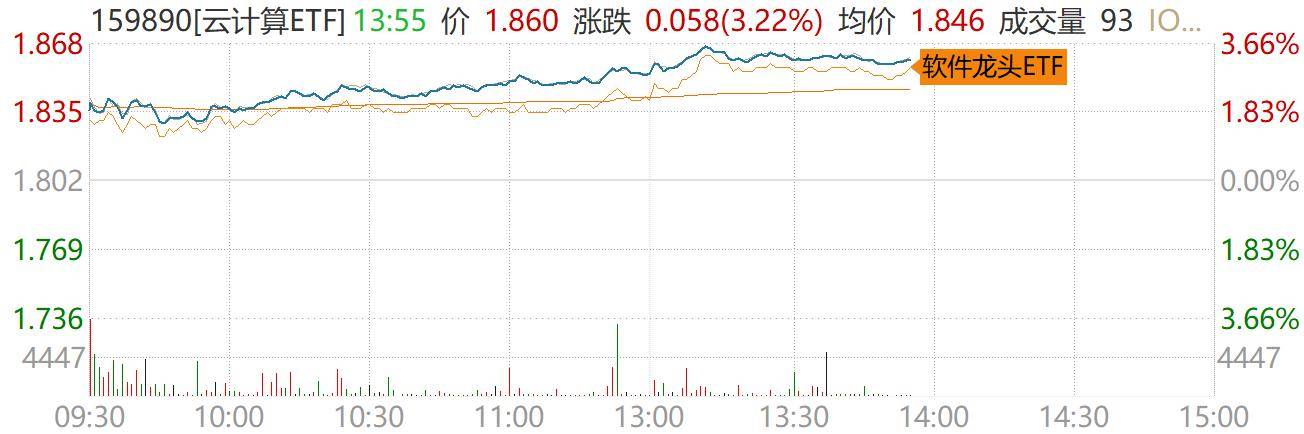
政策力推算力互联互通!AI算力应用持续上攻,云计算ETF(159890)、软件龙头ETF(159899)涨超3%
Sou Hu Cai Jing· 2026-02-09 06:17
Core Viewpoint - The article highlights the significant growth in the AI computing sector, driven by advancements in domestic models and government initiatives aimed at enhancing computing resource efficiency and service levels [3][4]. Group 1: Market Performance - Major indices saw an increase, with AI computing and application sectors leading the gains [1]. - Cloud computing ETFs (159890) and software leader ETFs (159899) both rose over 3% during trading [1]. - Notable stock performances included 360 Technology hitting the daily limit, and Oriental Guoxin rising over 18% [1]. Group 2: Government Initiatives - A recent government notification aims to promote the "1+M+N" national computing interconnection node system, which is expected to enhance the quality of the computing industry and improve the efficiency of public computing resource usage [3]. - The total number of operational computing center racks in the country has increased from 5.2 million to 12.5 million over the past five years, with an annual growth rate of 30% [3]. Group 3: Model Development and Investment - The period leading up to the Spring Festival has seen a surge in the release of domestic AI models, including significant updates from companies like DeepSeek, Alibaba, and Baidu [4]. - ByteDance plans to invest 160 billion yuan in capital expenditures by 2026, while Alibaba is advancing a 3-year plan for 380 billion yuan in AI infrastructure [4]. - The acceleration in model iteration is expected to drive rapid growth in demand for inference-side computing power, with 2026 anticipated to be a pivotal year for domestic super node deployment [5]. Group 4: Industry Outlook - The rapid iteration of domestic models is likely to significantly increase demand for inference-side computing power, benefiting the domestic computing industry [5]. - The cloud computing ETF (159890) tracks major players in the AI infrastructure and application sectors, while the software leader ETF (159899) focuses on key software development companies, both expected to benefit from the ongoing industry trends [5].


未知机构:CT电子继续看好国产算力国产模型进入密集发布期临近-20260204
未知机构· 2026-02-04 02:00
Summary of Conference Call Records Company and Industry Involved - The discussion primarily revolves around the domestic AI model development and cloud computing industry in China, with a focus on companies like ByteDance, Alibaba, and Huawei [1][2][3]. Core Points and Arguments - **Intensive Release of Domestic AI Models**: The domestic AI model sector is entering a dense release period, with significant models such as DeepSeek's OCR2, Kimi's K2.5, Alibaba's Qwen3-Max-Thinking, and Baidu's Wenxin 5.0 being launched. ByteDance plans to release three new AI models in February, including Doubao 2.0, Seedream 5.0, and SeedDance 2.0, with Alibaba also set to launch Qwen 3.5 during the Spring Festival [1]. - **High Capital Expenditure by Cloud Providers**: According to a report, ByteDance has planned a capital expenditure of 160 billion yuan for 2026, up from approximately 150 billion yuan in 2025. Alibaba is also advancing a three-year plan for AI infrastructure construction with a budget of 380 billion yuan [2]. - **Accelerated Demand for Inference Power**: The rapid iteration of domestic models is expected to enhance user interaction with AI, leading to a significant increase in demand for inference computing power. 2026 is anticipated to be a pivotal year for the deployment of domestic supernodes, with several companies, including Huawei and Alibaba, launching new supernode solutions [2]. - **Supply and Demand Dynamics**: The industry is poised for a significant growth phase, with both supply and demand sides actively engaging. The financial team has been recommending Chip Origin as a top pick in the domestic computing sector since December, emphasizing its importance [3]. Other Important but Possibly Overlooked Content - The release of multiple AI models is expected to accelerate the commercialization of these technologies, indicating a robust growth trajectory for the domestic AI industry [1]. - The ongoing investments in AI infrastructure by major cloud providers are crucial for establishing a solid foundation for domestic computing power demand [2].

财通证券:模型密集发布 国产算力需求有望加速
智通财经网· 2026-02-03 03:25
Group 1 - The core viewpoint of the report indicates that the domestic model iteration is accelerating, leading to a significant increase in inference-side demand, which will benefit the domestic computing power industry chain [1] - Major domestic models are entering a dense release period, with significant models such as DeepSeek's open-source OCR2, Kimi's K2.5, Alibaba's Qwen3-MaxThinking, and Baidu's Wenxin 5.0 being launched [1] - ByteDance plans to introduce three new AI models in February, including Doubao 2.0, Seedream 5.0, and SeedDance 2.0, while Alibaba is also set to release its next-generation flagship AI model Qwen 3.5 during the Spring Festival [1] Group 2 - Domestic cloud vendors are maintaining high levels of capital expenditure, with ByteDance planning a capital expenditure of 160 billion yuan for 2026, up from approximately 150 billion yuan in 2025 [2] - Alibaba announced a three-year plan for AI infrastructure construction with a budget of 380 billion yuan during the 2025 Cloud Habitat Conference, indicating sustained investment in cloud computing [2] Group 3 - The rapid iteration of domestic models is expected to capture user AI interaction entry points, leading to a corresponding increase in inference-side computing power demand [3] - 2026 is projected to be a pivotal year for the deployment of domestic supernodes, with numerous domestic manufacturers releasing next-generation supernode solutions, including Huawei's Atlas 950/960 and others [3] - The industry is poised for a significant growth phase as both supply and demand sides are actively engaged in the market [3]

人工智能周报(26年第4周):MiniMax Agent 2.0正式发布,百度文心5.0上线-20260126
Guoxin Securities· 2026-01-26 03:18
Investment Rating - The report maintains an "Outperform" rating for the industry, indicating expected performance above the market benchmark by over 10% [3][28]. Core Insights - The report highlights that 2026 is expected to see a surge in mature AI agent products due to advancements in large models, particularly in multi-modal capabilities, long text processing, and reasoning abilities. This increase in demand for reasoning will drive revenue growth for upstream cloud computing vendors [2][25]. - It notes that domestic internet giants are approximately one year behind their overseas counterparts in AI capital expenditures. As the capabilities of large models improve and supply builds up, AI will increasingly empower the core businesses of these giants [2][25]. - The report anticipates that the third quarter will mark a peak in spending for the internet giants' food delivery competition, with a projected narrowing of losses for Alibaba, Meituan, and JD.com in the fourth quarter [2][25]. - The report recommends focusing on AI-related stock selection, specifically highlighting Alibaba and Tencent Holdings as key investment opportunities [2][25]. Company Summaries - Tencent Holdings (0700.HK) is rated "Outperform" with an adjusted EPS forecast of 27.60 in 2025 and 32.63 in 2026, with PE ratios of 20.3 and 17.1 respectively [3]. - Alibaba Group (9988.HK) is also rated "Outperform," with an adjusted EPS of 6.66 for 2025 and 8.77 for 2026, and PE ratios of 23.8 and 18.1 [3]. - Meituan (3690.HK) is rated "Outperform," with a forecasted adjusted EPS of -1.26 in 2025 and 5.20 in 2026, reflecting a significant improvement in its financial outlook [3]. - Baidu Group (9888.HK) is rated "Outperform," with an adjusted EPS of 7.64 for 2025 and 8.87 for 2026, and PE ratios of 19.7 and 17.0 [3]. - Kuaishou (1024.HK) is rated "Outperform," with an adjusted EPS forecast of 4.68 in 2025 and 5.51 in 2026, with PE ratios of 16.3 and 13.9 [3]. - Tencent Music (TME.N) is rated "Outperform," with an adjusted EPS of 5.64 for 2025 and 6.50 for 2026, and PE ratios of 21.1 and 18.4 [3]. - NetEase Cloud Music (9899.HK) is rated "Outperform," with an adjusted EPS of 14.54 for 2025 and 12.09 for 2026, with PE ratios of 11.5 and 13.8 [3]. - Meitu (1357.HK) is rated "Outperform," with an adjusted EPS of 0.16 for 2025 and 0.27 for 2026, with PE ratios of 48.6 and 28.8 [3].
腾讯研究院AI速递 20260126
腾讯研究院· 2026-01-25 16:01
Group 1 - OpenAI CEO Altman announced the release of significant Codex-related content starting next week, with a technical blog revealing the core architecture of Codex CLI, specifically the intelligent agent loop [1] - The intelligent agent loop coordinates user instructions, model inference, and local tool execution through the Responses API, employing a "consistent prompt prefix" strategy to trigger cache optimization [1] - Codex supports zero data retention configurations to ensure privacy and utilizes automatic compression technology to manage context windows, with further details on tool invocation and sandbox models to be introduced later [1] Group 2 - Google DeepMind released D4RT, which unifies 3D reconstruction, camera tracking, and dynamic object capture into a single "query" action, achieving speeds 18 to 300 times faster than existing state-of-the-art methods [2] - The core innovation is a unified spatiotemporal query interface, where AI first globally "reads" videos to generate scene representations and then searches for 3D trajectories, depth, and poses of any pixel on demand [2] - This technology is significant for embodied intelligence, autonomous driving, and AR, although training still requires a 1 billion parameter model and 64 TPUs [2] Group 3 - Claude Code upgraded its internal "Todos" to "Tasks," enabling multi-session or sub-agent collaboration on long-term complex projects across multiple context windows [3] - Tasks are stored in a file system for easy collaboration among multiple sessions, with updates in one session broadcasting to all sessions handling the same task list [3] - The new feature is compatible with Opus 4.5, enhancing autonomous operation capabilities, allowing users to enable multiple sessions to collaborate on the same task list through environment variables [3] Group 4 - Baidu's Wenxin 5.0 officially launched with a parameter count of 2.4 trillion, utilizing native multimodal unified modeling technology to support understanding and generation of text, images, audio, and video [4] - It has topped the LMArena text and visual understanding leaderboard five times, entering the global first tier, with language and multimodal understanding capabilities leading internationally [4] - Practical tests show the model excels in complex emotional understanding, subtext analysis, and creative writing tasks, earning the title of "strongest liberal arts student" [4] Group 5 - The open-source project Clawdbot has gained popularity in Silicon Valley, capable of running on Mac mini, serving as both a local AI agent and chat gateway, allowing conversations via WhatsApp, iMessage, etc. [5] - Clawdbot addresses the memory limitations of large models, capable of recalling conversations from two weeks ago, proactively sending emails, reminders, and executing tasks on the computer [5] - The project has received 9.2k stars on GitHub, with a minimum monthly cost of approximately $25, though it requires some technical knowledge for deployment, and users report it can automate business management and code writing, replacing paid services like Zapier [5] Group 6 - Turing Award winner LeCun announced that AMI Labs' core direction is "world models," aiming to build intelligent systems that understand the real world, possess persistent memory, and have reasoning and planning capabilities [6] - This approach argues that merely predicting the next token does not lead to true understanding of reality, necessitating predictions and reasoning at a higher representational level to filter out unpredictable noise [6] - AMI Labs is reportedly seeking financing at a valuation of $3.5 billion, targeting applications in industrial control, robotics, and healthcare, where reliability is crucial [6] Group 7 - Anthropic launched the Claude in Excel plugin, available for Pro, Max, Team, and Enterprise users, based on the Opus 4.5 model, which can be installed and activated via Microsoft Marketplace [7] - The plugin can search the internet and automatically fill in spreadsheets, supporting formula reading, debugging errors, zero-based modeling, and pivot table creation, compatible with .xlsx and .xlsm formats [7] - Currently, it does not support conditional formatting, macros, or VBA, and the company warns of prompt injection risks, advising users to only use files from trusted sources, with high-risk functions triggering confirmation prompts [7] Group 8 - Claude Code's creator Boris Cherny provided a detailed tutorial on using Cowork, emphasizing its role as an "executor" rather than a chat tool, capable of directly manipulating documents, browsers, and various tools [8] - He reiterated that the core workflow involves running multiple tasks in parallel while overseeing Claude instances, starting with "planning mode" for communication until satisfaction is achieved, then switching to "auto-accept edits" mode for execution [8] - Cherny highlighted the importance of Claude.md as a team compounding knowledge base, where any mistakes made by Claude should be documented, and methods for validating Claude's outputs can significantly enhance quality [8] Group 9 - Google Cloud AI Director Addy Osmani warned that programmers who only write prompts will be eliminated by 2026, stating that AI can handle 70% of preliminary work, but the remaining 30% requires experienced engineers [9] - A Stack Overflow survey indicated that developer trust in AI accuracy dropped from 40% to 29%, with 73% of respondents encountering issues with code comprehension due to "ambient coding" [9] - By 2026, the true core competency will be transforming vague problems into clear execution intentions, designing appropriate contextual structures, and distinguishing what is truly important [9] Group 10 - At the Davos Forum, tech giants shared notable insights, with Musk predicting that AI will surpass human intelligence by the end of 2026 and be smarter than the collective intelligence of humanity by 2030, with Tesla set to launch the humanoid robot Optimus next year [10] - Microsoft CEO Nadella warned that if AI only consumes resources without improving outcomes, society will lose tolerance, while Huang Renxun stated that embodied intelligence represents a "once-in-a-generation opportunity" [10] - DeepMind CEO Hassabis believes AGI will still require 5-10 years, while Anthropic CEO Dario claimed that models are just 6-12 months away from being able to complete software development end-to-end [10]