百悦达(索托克拉)

Search documents
百济神州归母净利14.2亿扭亏 近四年研发费492.6亿占营收60%
Chang Jiang Shang Bao· 2026-03-02 00:34
Core Insights - After turning profitable, BeiGene (688235.SH, 06160.HK, NASDAQ: BGNE) has demonstrated significant growth momentum, with 2025 revenue reaching 38.205 billion yuan, a year-on-year increase of 40.4%, and a net profit of 1.422 billion yuan, recovering from a loss of 4.978 billion yuan in the previous year [2][3] Financial Performance - In 2025, BeiGene's product revenue was 37.77 billion yuan, up 39.9% year-on-year [2] - The company reported a net profit of 1.422 billion yuan for 2025, compared to a loss of 4.978 billion yuan in the same period last year [2] - The company had a cumulative net loss of approximately 59.1 billion yuan from 2017 to 2024, averaging over 20 million yuan in daily losses [2] Revenue Drivers - The growth in product revenue for 2025 was primarily driven by the sales of Baiyueze (Zebutinib), licensed products from Amgen, and Baizean (Tislelizumab) [3][4] - Baiyueze's global sales reached 28.067 billion yuan in 2025, marking a 48.8% increase, solidifying its position as a global leader in the BTK inhibitor market [3] - Sales in the U.S. totaled 20.206 billion yuan, up 45.5%, while Europe and China saw increases of 66.4% and 33.1%, respectively [3] R&D Investment - BeiGene has consistently invested over 10 billion yuan in R&D for four consecutive years, with cumulative R&D expenses reaching 49.264 billion yuan, accounting for approximately 60% of total revenue during this period [6][7] - R&D expenses for 2025's first three quarters were 11.159 billion yuan, a 9.77% increase year-on-year, representing about 40% of the revenue for that period [6] Product Development - Baiyueze is noted for having the broadest range of approved indications among BTK inhibitors globally, with over 45 clinical trials conducted across more than 30 countries [7] - Baizean is positioned as a cornerstone product in BeiGene's solid tumor portfolio, with ongoing clinical development in over 33 countries and more than 15,800 participants enrolled [8] - The company plans to submit new indication applications for Baizean in the U.S. and China in the first half of 2026 [8] Future Outlook - BeiGene anticipates strong financial performance in Q4 2025 and throughout the year, highlighting its competitive advantages in clinical development and a differentiated R&D pipeline [9]


首次实现全年盈利 百济神州2025年营收增长超四成
Xin Lang Cai Jing· 2026-03-01 20:57
Core Viewpoint - BeiGene has achieved a significant milestone by reporting a net profit of 1.422 billion yuan for the fiscal year 2025, marking its first annual profit and indicating a new phase of sustainable profitability for the innovative pharmaceutical company [1]. Financial Performance - The total revenue for 2025 reached 38.205 billion yuan, representing a substantial year-on-year increase of 40.4% [1]. - The product revenue amounted to 37.770 billion yuan, showing a growth of 39.9% compared to the previous year [2]. Product Performance - The growth in product revenue is primarily driven by the sales of the BTK inhibitor Brukinsa (Zebutinib) and the sales of licensed products from Amgen and Tislelizumab [2]. - Brukinsa's global sales reached 28.067 billion yuan in 2025, with notable growth across regions: 20.206 billion yuan in the U.S. (up 45.5%), 4.265 billion yuan in Europe (up 66.4%), and 2.472 billion yuan in China (up 33.1%) [2]. Research and Development Pipeline - BeiGene's R&D pipeline is expanding, with several key products nearing commercialization, including the BCL2 inhibitor, which has received priority review from the FDA and is expected to receive regulatory decisions in 2026 [4]. - The company is also advancing multiple new drugs targeting high-incidence tumors such as breast cancer and lung cancer, with several trials expected to commence in 2026 [5]. Market Position and Future Outlook - As a benchmark for Chinese innovative drugs on a global scale, BeiGene's 2025 performance highlights its development breakthroughs and the competitive edge of Chinese original innovative drugs in the global market [6]. - The company is poised to further solidify its global market position with the commercialization of new drugs and the continuous expansion of existing product indications [6].
扭亏为盈后百济神州股价却跌跌不休
Guo Ji Jin Rong Bao· 2026-02-27 23:53
Core Viewpoint - Despite achieving profitability in 2025, the stock price of BeiGene has experienced a significant decline, raising concerns among investors about future performance and market competition [1][3]. Financial Performance - In 2025, BeiGene reported total revenue of 38.205 billion yuan, a year-on-year increase of 40.4% - The net profit attributable to shareholders was 1.422 billion yuan, marking a turnaround from a loss of 5.379 billion yuan in the previous year - The adjusted net profit, excluding non-recurring items, was 1.381 billion yuan [1]. Stock Market Reaction - On February 26, 2025, BeiGene's Hong Kong stock price fell sharply, closing down 9.16% at 200 HKD, resulting in a market capitalization drop below 300 billion HKD - The stock continued to decline on February 27, closing at 192.3 HKD, a further decrease of 1.08%, with a market cap of 296.3 billion HKD - The A-share market also saw a decline, with a closing price of 263.44 CNY on February 26, down 5.65%, and a further drop to 257.7 CNY on February 27, down 2.18% [1]. Product Performance and Market Competition - BeiGene's core product, Zebrutinib (Brukinsa), is expected to face challenges in 2026, with sales projections falling short of expectations - In 2025, Zebrutinib generated revenue of 39.3 billion yuan, accounting for 73.5% of the company's total revenue, with a year-on-year growth rate of 48.8% - However, the quarterly growth rate for Zebrutinib in Q4 2025 was only 10.1%, significantly lower than the 20% growth in Q2 [3]. Competitive Landscape - Zebrutinib is facing increased competition, particularly from AstraZeneca's Acalabrutinib and Johnson & Johnson's Ibrutinib - AstraZeneca has recently launched a combination therapy involving Acalabrutinib, which has gained approval in key markets, posing a threat to Zebrutinib's market share [4]. Future Prospects - BeiGene's second major product, Tislelizumab (PD-1 inhibitor), is projected to have a global sales figure of 5.297 billion yuan in 2025, with an 18.6% year-on-year increase - The company plans to submit a new indication application for Tislelizumab in 2026, which could enhance its market position [6]. - Another product, Sotorasib (BCL-2 inhibitor), has received breakthrough therapy designation from the FDA and is expected to be a new growth driver in 2026, potentially offsetting the slowdown in Zebrutinib's growth [7].
1款产品狂揽267亿!“创新药一哥”稳了?
Xin Lang Cai Jing· 2026-02-27 10:31
Core Insights - BeiGene has become a focal point in China's innovative drug sector, achieving significant revenue and profit growth driven by its core products and strategic market positioning [1][11] - The company's total global revenue for 2025 reached $5.3 billion, marking a 40% year-on-year increase, primarily due to the strong performance of its flagship product, Brukinsa (Zebutinib) [1][11] - Brukinsa generated $3.9 billion in global sales, a 49% increase year-on-year, solidifying its role as the main driver of revenue growth [1][11] Revenue Growth - The two main self-developed products contributed over 90% of total revenue, with Brukinsa accounting for more than 70% [2][12] - The product matrix's synergy and the launch of new products, such as the BCL-2 inhibitor, have established a sustainable growth model for the company [2][12] Market Positioning - Brukinsa is recognized as the most widely approved BTK inhibitor globally, benefiting from its efficacy and safety, which has helped it secure a leading market position [3][13] - The BTK inhibitor market is experiencing a structural shift, with new-generation products gaining traction as first-generation products lose market share, providing a favorable environment for Brukinsa's growth [3][14] Product Development - The approval of the BCL-2 inhibitor, BeiGene's new product, in January 2026, fills a gap in the domestic treatment landscape and is expected to contribute to future revenue growth [5][15] - The steady growth of the other core product, Tislelizumab (Breztri), in the solid tumor space, further supports the company's dual-driven growth strategy [4][15] Industry Trends - The global demand for oncology drugs is expanding, driven by an aging population and increasing healthcare awareness, creating a broad market opportunity for innovative drug companies [6][16] - The competitive landscape in the innovative drug sector is intensifying, with both domestic and international companies vying for market share, leading to a phenomenon of "Matthew Effect" where established players gain more advantages [6][17] Future Outlook - The company projects total revenue for 2026 to be between $6.2 billion and $6.4 billion, indicating continued growth potential [9][20] - Future growth will rely on multiple product launches and expansions into new therapeutic areas, including autoimmune diseases, which could open new revenue streams [8][19]

百济神州穿越“死亡谷”:首次实现全年盈利,下一波增长点在哪?
2 1 Shi Ji Jing Ji Bao Dao· 2026-02-27 02:30
Core Insights - BeiGene reported a total revenue of 38.205 billion RMB for the fiscal year 2025, marking a 40.4% year-on-year increase, driven by product revenue growth and improved operational efficiency [1] - The net profit attributable to the parent company reached 1.422 billion RMB, indicating a significant turnaround from previous losses [1] - The company's flagship product, Brukinsa (Zebutinib), achieved global sales of 28.067 billion RMB, a 48.8% increase, solidifying its position as a global leader in the BTK inhibitor market [1][2] Revenue Breakdown - Product revenue for BeiGene reached 37.770 billion RMB, up 39.9%, primarily due to the sales growth of Brukinsa, Amgen-licensed products, and Tislelizumab [1][2] - In the U.S. market, Brukinsa's annual sales were 20.206 billion RMB, a 45.5% increase; in Europe, sales reached 4.265 billion RMB, up 66.4%; and in China, sales were 2.472 billion RMB, a 33.1% increase [1] Product Approvals and Pipeline - Brukinsa is the most widely approved BTK inhibitor globally, with approvals in over 75 markets [2] - The company plans to conduct a mid-term analysis of the MANGROVE trial in the first half of 2026, comparing Brukinsa combined with Rituximab against Bendamustine plus Rituximab for adult patients with mantle cell lymphoma [2] - Tislelizumab's global sales reached 5.297 billion RMB, an 18.6% increase, with ongoing efforts to submit new indications for regulatory approval in the U.S. and China [2] Market Position and Future Outlook - Analysts noted that BeiGene's transition from a "cash-burning machine" to a "cash-generating machine" reflects a significant shift in the global strategy for Chinese innovative drugs [3] - The company is expected to generate revenue between 43.6 billion and 45 billion RMB in 2026, with a gross margin projected to remain high at around 80% [4] - Concerns remain regarding the pipeline for new products following Brukinsa and Tislelizumab, with several late-stage candidates nearing commercialization [4][5] Strategic Initiatives - BeiGene is exploring the introduction of BTK inhibitors and IRAK4 degraders into autoimmune diseases, which could expand its market reach beyond oncology [5] - The company has received priority review status from the FDA for its BCL2 inhibitor, which is aimed at treating adult patients with relapsed/refractory mantle cell lymphoma [4][5] - The market is keenly awaiting the potential of new innovative candidates to emerge from BeiGene's pipeline, which could further enhance its valuation in the long term [5]
市值跌破3000亿的百济神州首次全年盈利
Di Yi Cai Jing Zi Xun· 2026-02-26 14:32
Core Viewpoint - The stock price of BeiGene (ONC.NS, 06160.HK, 688235.SH) experienced a significant drop of 9.16% on February 26, leading to concerns about the company's upcoming earnings report, with its market capitalization falling below HKD 300 billion to HKD 299.5 billion [2] Group 1: Financial Performance - For the fiscal year 2025, the company reported total revenue of RMB 38.205 billion, representing a year-on-year growth of 40.4% [2] - The net profit attributable to the parent company reached RMB 1.422 billion, marking the first time the company achieved annual profitability [2] - The highest revenue-generating product, BTK inhibitor Brukinsa (Zebutinib), achieved global sales of RMB 28.067 billion, with a year-on-year growth rate of 48.8%, although this growth rate has slowed compared to the doubling growth seen in 2023 and 2024 [2][3] Group 2: Product Performance - In the U.S. market, which remains the largest commercial market for Brukinsa, sales reached RMB 20.206 billion, growing by 45.5%, but this growth rate is lower than the 107.5% growth rate in 2024 [3] - The second highest revenue product, PD-1 monoclonal antibody Tislelizumab, achieved global sales of RMB 5.297 billion, with a year-on-year increase of 18.6% [3] Group 3: Future Outlook - The company forecasts that for 2026, revenue will be between RMB 43.6 billion and RMB 45 billion, indicating a growth rate of 14.12% to 17.79% compared to 2025 [3] - BeiGene is working to reduce its reliance on Brukinsa by advancing multiple late-stage pipeline products, including the BCL2 inhibitor, which has received the first global marketing authorization application approval in China for certain adult patients [4] - The company has submitted a marketing authorization application for this product in the EU and expects a regulatory decision from the U.S. FDA in the first half of 2026 [4]

市值跌破3000亿的百济神州首次全年盈利,但拳头产品收入增长放缓
Di Yi Cai Jing· 2026-02-26 13:14
Core Viewpoint - Despite achieving record revenue, the growth rate of Baiyueze is slowing down [1] Group 1: Financial Performance - On February 26, 2025, the company reported total revenue of 38.205 billion yuan, a year-on-year increase of 40.4% [1] - The net profit attributable to the parent company reached 1.422 billion yuan, marking the first annual profit for the company [1] - Baiyueze's global sales reached 28.067 billion yuan, with a year-on-year growth of 48.8%, which is a slowdown compared to the doubling growth rates in 2023 and 2024 [1] Group 2: Product Performance - Baiyueze is the most widely approved BTK inhibitor globally, with approvals in over 75 markets [3] - In the U.S., Baiyueze remains the largest commercial market, contributing sales of 20.206 billion yuan, with a year-on-year growth of 45.5%, which is lower than the 107.5% growth in 2024 [3] - The second-highest revenue product, PD-1 monoclonal antibody Baizean, achieved global sales of 5.297 billion yuan, with a year-on-year increase of 18.6% [3] Group 3: Future Outlook - The company forecasts 2026 revenue to be between 43.6 billion yuan and 45 billion yuan, representing a growth rate of 14.12% to 17.79% compared to 2025 [3] - The company is working to reduce its reliance on Baiyueze by advancing multiple cornerstone products in late-stage clinical trials [3][4] - Baiyue's new product, Baiyueda, has received the first global marketing approval application in China for treating R/R MCL and is expected to receive regulatory decisions from the FDA in the first half of 2026 [4]
百济神州总裁兼首席运营官吴晓滨:让创新走得更远,让希望触手可及|2026商业新愿景
Jing Ji Guan Cha Wang· 2026-02-13 12:58
Group 1 - The year 2025 marks a milestone for the company, celebrating its 15th anniversary and entering a clearer phase in its globalization process [2] - The company achieved significant global growth in the past year, reaching a critical profitability turning point, with its core self-developed BTK inhibitor, Baiyueze, establishing a leading position globally [2] - The company launched its second self-developed product in the hematology field, the BCL2 inhibitor Baiyueda (Sotukral), which is now commercially available [2] Group 2 - In Thailand, the approval process for Baizean took only 7 months, significantly reducing the time for patients to access innovative treatments [3] - In India, the company's two self-developed products have benefited over 1,500 patients, receiving positive clinical feedback [3] - The company is expanding its global footprint by supporting local commercialization efforts in Indonesia and providing PD-1 inhibitors for clinical trials in sub-Saharan Africa [3] Group 3 - The company's goals for 2026 remain clear: to continue pipeline expansion centered on science and to enhance drug accessibility for patients in more countries [4] - The commitment to making innovations accessible to more patients is seen as a long-term investment and a driving force for the company [4] - The company emphasizes the importance of collaboration with industry partners to gather diverse experiences and wisdom from different regions to improve patient outcomes globally [4]

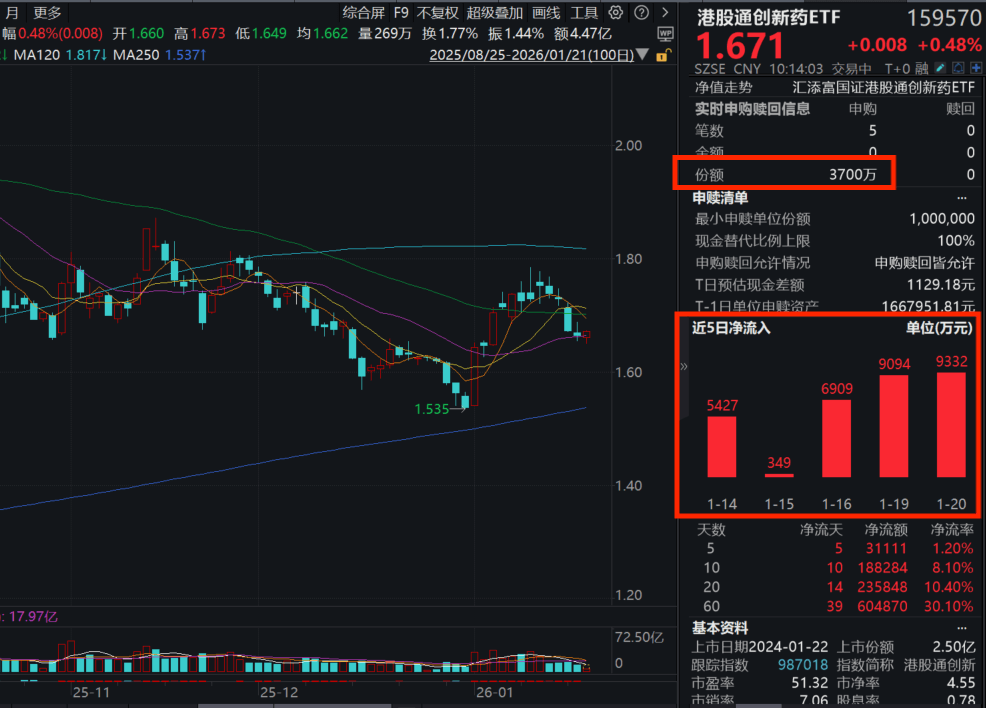
JPM收官,中国创新药加速全球化!港股通创新药ETF(159570)探底回升翻红,近5日净流入超3亿元,在全市场创新药ETF中规模领跑!
Xin Lang Cai Jing· 2026-01-21 02:41
Group 1 - The Hong Kong Innovation Drug ETF (159570) has seen a significant inflow of funds, with a recent trading volume exceeding 5 billion yuan and a net inflow of over 300 million yuan in the past five days [1] - As of January 20, the total size of the Hong Kong Innovation Drug ETF reached over 25.3 billion yuan, leading the market in terms of scale among innovation drug ETFs [1] - The index components of the ETF showed mixed performance, with notable gains from companies like Kingsoft Biotech and China Biologic Products, while companies like CanSino Biologics experienced declines [3][4] Group 2 - At the J.P. Morgan Healthcare Conference, several Chinese pharmaceutical companies showcased their advancements, including BeiGene's new drug approval in China and plans for accelerated approval in the U.S. [5] - Innovent Biologics and Pfizer are set to conduct five global Phase III trials for their drug SSGJ-707 by 2026, targeting various cancers [6] - The collaboration between NVIDIA and Eli Lilly aims to establish an AI innovation lab with a projected investment of up to 1 billion USD over five years, potentially transforming drug development processes [8] Group 3 - Tempus AI reported a revenue of approximately 1.27 billion USD for 2025, marking an 83% year-on-year increase, driven by significant growth in its diagnostic business [9] - The top ten components of the Hong Kong Innovation Drug ETF account for over 73% of its weight, highlighting the concentration of leading innovative drug companies within the ETF [10]