砷化镓光伏电池

Search documents
太空光伏行业深度3:从国内卫星制造产业链&价值链拆解展开
Guohai Securities· 2026-03-02 08:32
Investment Rating - The report maintains a "Recommended" rating for the space photovoltaic industry [1]. Core Insights - The report addresses key issues such as China's commercial aerospace policies, satellite launch history and forecasts, and the progress of major listed companies and research institutions in space silicon and perovskite battery layouts [6]. - The commercial aerospace sector in China has transitioned from "policy encouragement" to "strategic positioning," with significant policy support and regional collaboration forming a spatial economic landscape [9][12]. - The report highlights the rising demand for satellite power, predicting an increase in satellite launch volumes and advancements in space energy technology, particularly in silicon and perovskite solar cells [8][60]. Summary by Sections Industry Overview - The report outlines the strategic elevation of commercial aerospace to a key emerging industry, with policies increasingly focusing on capital, industry, and regulatory collaboration [12]. - Local governments are competing to develop commercial aerospace, with significant plans emerging from regions like Beijing-Tianjin-Hebei, the Yangtze River Delta, the Greater Bay Area, and the western region [15]. Cost Analysis - Current rocket launch costs in China range from $5,000 to $8,000 per kilogram, significantly higher than SpaceX's $1,500 to $3,000 per kilogram [16][17]. - The cost of a 50-kilogram small satellite in China is approximately 8 million RMB, which is 2.67 times higher than similar products abroad [16][17]. Satellite Launch and Development - In 2025, China is expected to conduct 92 launches, with commercial launches accounting for 54% and 311 commercial satellites entering orbit, representing 84% of total launches [9][42]. - The report forecasts that from 2025 to 2030, the power of communication satellites will increase from 0.69 kW to 1.93 kW, and computing satellites from 1.04 kW to 3.43 kW, with corresponding increases in solar wing area [60]. Technological Advancements - The report indicates that gallium arsenide remains the mainstream technology for space photovoltaic cells, with ongoing advancements in silicon and perovskite technologies [60][63]. - The industry is expected to see a gradual increase in satellite launches, driven by the need for cost reduction and scale expansion, which are critical for the industry's future competitiveness [9][17]. Key Companies - Notable companies in the space photovoltaic sector include Maiwei Co., Aotwei, High Measurement Co., Jingsheng Mechanical & Electrical, Jiejia Weichuang, Laplace, Dier Laser, and Shanghai Port [9].






“太空光伏”概念受密切关注,关注光伏ETF(159864)、创业板新能源ETF(159387)
Mei Ri Jing Ji Xin Wen· 2026-02-04 03:50
Core Viewpoint - The news highlights the significant developments in the space solar power sector, particularly with SpaceX's acquisition of xAI and its plans to deploy data centers in space, which could drive demand for solar photovoltaic (PV) technology [2]. Group 1: SpaceX Developments - SpaceX has announced the acquisition of xAI and plans to launch up to 1 million satellites to support AI applications and data centers in space [2]. - The satellite constellation will operate in low Earth orbit (500-2000 km) and will be powered by solar energy, connecting to the existing Starlink network [2]. Group 2: Solar Power in Space - Solar power is identified as a reliable and sustainable energy source for spacecraft, providing near-infinite stable supply due to the absence of atmospheric interference [3]. - The lightweight and flexible nature of solar panels allows for efficient installation on spacecraft, maximizing sunlight absorption [3]. Group 3: Technological Insights - The main technologies for space solar power include Gallium Arsenide (GaAs), crystalline silicon, and perovskite, each with distinct advantages and limitations [4]. - GaAs is currently the leading choice due to its high efficiency and durability, while crystalline silicon is progressing rapidly in terms of industrialization [4]. Group 4: Investment Opportunities - The solar power sector is expected to see a surge in demand due to SpaceX's initiatives, creating investment opportunities in solar equipment companies [5]. - Investors are encouraged to consider diversified investment strategies, such as ETFs that cover the entire solar supply chain, to mitigate risks associated with individual companies [5][6].

长城证券:太空光伏迎来“放量+降本”新机遇 行业迎来市场扩容与格局重塑机会
智通财经网· 2026-01-14 03:24
Group 1 - The core viewpoint of the report is that the domestic commercial aerospace industry is entering a phase of collective effort, with a focus on advancing product performance and cost efficiency through the perovskite tandem route, which could provide significant advantages for future competitive positioning [1] - The strategic value of low Earth orbit resources is increasingly highlighted due to SpaceX's dominant position, prompting a shift in China's aerospace ecosystem towards collaboration between state-owned and commercial enterprises, moving from isolated efforts to full-chain cooperation [1] - Major projects like the National Grid Constellation and Qianfan Constellation are expected to accelerate, with plans to deploy over 200,000 satellites within a specified timeline, including launching the first satellite within 7 years and completing 10% deployment within 9 years [1] Group 2 - The demand for cost reduction in power systems is driven by the commercial ecosystem, where power systems account for approximately 22% of the total satellite platform cost, and solar cell arrays represent 60%-80% of that cost [2] - The high cost of gallium arsenide photovoltaic cells, ranging from $50 to $150 per watt, and the final processing costs for flexible solar wings can exceed one million RMB per square meter, making them significantly more expensive than silicon-based cells [2] - The transition to p-type heterojunction technology is advantageous due to its lower defect impact under high-energy particle radiation, with advanced p-type ultra-thin HJT cells achieving thicknesses of 50-70μm, which reduces launch payloads and maintains competitive cost levels [3] Group 3 - Perovskite solar cells are seen as a promising ultimate solution for space applications, as their limitations in water vapor and oxygen are naturally resolved in space, making them suitable for spacecraft with shorter lifespans of 5-7 years [4] - The cost of materials and equipment for perovskite has significantly decreased due to advancements in ground-level production, and their energy-to-weight ratio of 20-50W/g is superior to gallium arsenide and crystalline silicon [4] - Although further validation of perovskite technology is needed, its customizable design and ongoing optimization of materials and processes could enhance its development as a core solar power solution for both low Earth orbit and deep space applications [4]

太空光伏:地外可靠能源,剑指万亿市场
Hua Er Jie Jian Wen· 2026-01-07 07:22
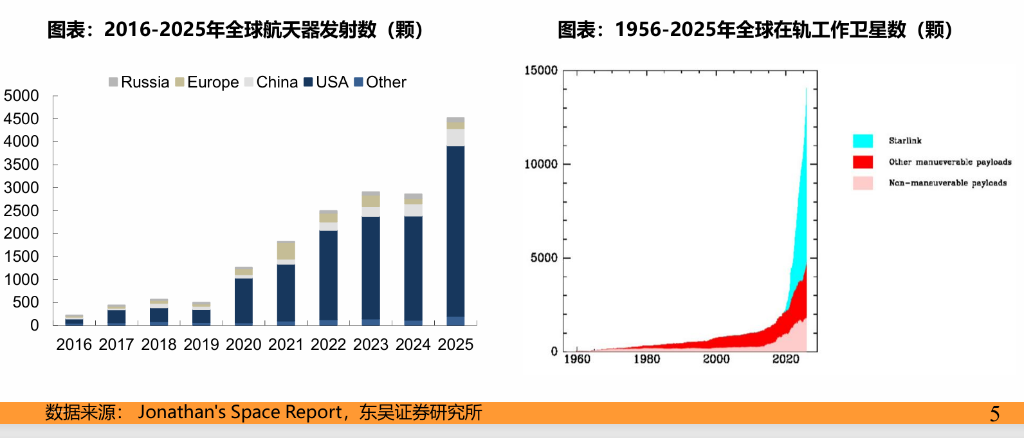
Core Insights - The maturity of reusable rocket technology is driving a significant decrease in launch costs, leading to a "Moore's Law" moment in commercial space, which is creating a massive demand for space photovoltaic systems [1] - By 2025, the number of global satellite launches is expected to exceed 4,300, representing a year-on-year growth of over 50% and a compound annual growth rate of 34% over the past decade [1][5] - The deployment of large satellite constellations will create a rigid demand for high-performance photovoltaic cells, potentially generating a market space of nearly 200 billion yuan for solar wings if 10,000 satellites are launched annually [5] Launch Cost and Frequency - The rapid rise of commercial space is primarily driven by the exponential decrease in launch costs, with SpaceX's Falcon 9 launch cost dropping to approximately $1,400-$1,800 per kilogram, significantly lower than traditional launch costs [6] - Global satellite launches are projected to exceed 300 by 2025, doubling from 2021 levels [6] Strategic Resource Competition - The scarcity of near-Earth orbital frequency bands and positions is accelerating deployment efforts by various countries, as these resources are non-renewable [9] - The U.S. currently leads in launch numbers and in-orbit satellites, while China is rapidly catching up with its "Thousand Sails" and "GW" constellation plans [9] Photovoltaic Systems in Satellites - The power system is crucial in satellite manufacturing, accounting for approximately 20%-30% of total costs, with solar wings representing 60%-80% of the power system's value [10] - As satellite payloads evolve, particularly in communication and computing, power demands are increasing, driving the development of larger and higher-power solar wings [10] Technological Pathways - The current technological landscape for space photovoltaics is characterized by diverse competition, focusing on balancing cost and performance [11] Space Computing and Future Potential - The demand for AI computing is pushing the space economy towards computing and data centers, with space offering ideal conditions for high-performance computing nodes [13] - If a 10 GW space computing system is realized, the solar wing market could reach several trillion yuan [13] Photovoltaic Technologies - Gallium Arsenide (GaAs) is the current mainstream choice in China, known for high efficiency and strong radiation resistance, but its high cost limits scalability [15] - Silicon solar cells are used by SpaceX for their Starlink satellites due to lower costs, despite lower efficiency [15] - Perovskite and tandem technologies are seen as potential disruptors, offering high energy-to-weight ratios and low manufacturing costs, although their stability in extreme space conditions needs further validation [15]