
碳化硅(SiC)半导体

Search documents
釜山加速布局功率半导体产业, 打造东北亚技术枢纽
Shang Wu Bu Wang Zhan· 2026-02-24 16:25
Core Viewpoint - Busan is establishing power semiconductors as a core strategic industry and accelerating the development of a Northeast Asia technology hub [1] Group 1: International Cooperation and Research - Busan is promoting technological collaboration among research institutions and companies from China, Japan, and South Korea to strengthen international cooperation and joint research [1] - The "2026 Power up WBG Semiconductor Seminar" is being held from January 28 to 30 at Pukyong National University, with around 50 experts from academia, industry, and government participating [1] Group 2: WBG Semiconductor Technology - Wide Bandgap (WBG) semiconductors, based on materials like Gallium Nitride (GaN) and Silicon Carbide (SiC), offer higher energy efficiency compared to traditional silicon semiconductors and can operate stably in high-temperature and high-power environments [1] - WBG semiconductors are critical technologies for electric vehicles, renewable energy, and power grid applications [1] Group 3: Research and Development Collaboration - The seminar features contributions from key industry players, including scholars from Nagoya University and Meijo University, as well as materials company Orbray, sharing cutting-edge research on SiC, GaN, and diamond semiconductors [1] - Participants will visit the Gijang Power Semiconductor Center and local companies to discuss the industrialization pathways of research outcomes [1] Group 4: Strategic Goals - Busan aims to strengthen the "Northeast Asia Semiconductor Triangle Cooperation Network" by connecting Japan's material and equipment technology, China's semiconductor application technology, and South Korea's research capabilities [1] - The city plans to establish an international joint research center to enhance the global competitiveness of Busan's semiconductor industry ecosystem [1]
日本功率半导体,大撤退
3 6 Ke· 2025-08-31 05:06
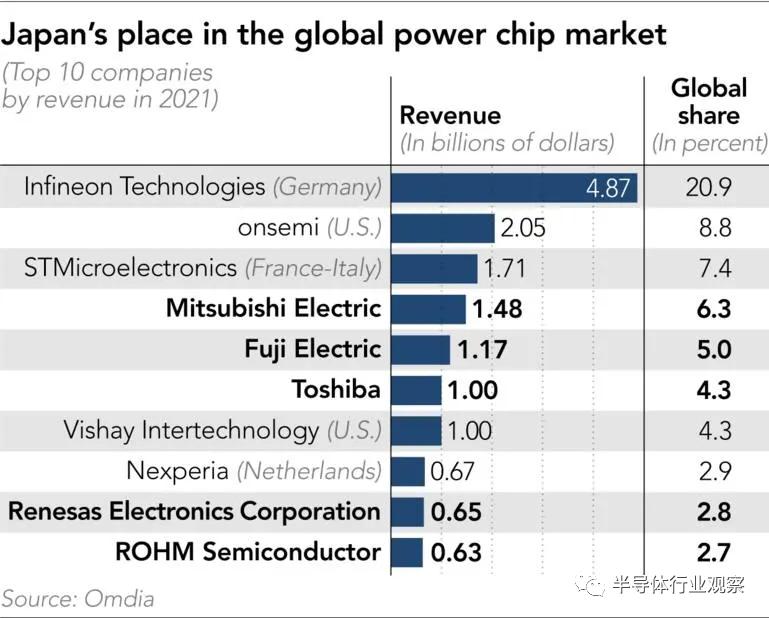
Group 1 - The semiconductor industry is experiencing a shift in focus, with AI chips and HBM gaining prominence, while the power semiconductor sector is losing its previous allure [1][2] - Japanese manufacturers, once leaders in power semiconductors, are facing delays in capacity expansion and losing market share to domestic competitors in China [3][4][6] - The competitive landscape for global power semiconductors is changing, with Japanese firms struggling to maintain their positions as domestic Chinese companies accelerate their growth [1][26] Group 2 - Japanese power semiconductor companies like Mitsubishi Electric, Fuji Electric, and Toshiba are showing signs of fatigue, with their market shares dropping below 5% in the latest rankings [7][9][12] - Financial struggles are evident, as companies like Rohm report significant losses and are forced to cut investment plans, while others like Renesas abandon their SiC market ambitions [9][16][21] - The rise of Chinese competitors is a critical factor in the decline of Japanese firms, as they leverage cost advantages and rapidly improve their technology [25][26][28] Group 3 - The Japanese government is attempting to support the power semiconductor industry through subsidies and strategic plans, aiming to increase market share from 20% to 40% by 2030 [6][31] - However, internal challenges such as lack of collaboration and trust among Japanese firms hinder effective industry consolidation [24][31] - The market dynamics are further complicated by changing demand patterns in the electric vehicle sector, which have not met Japanese companies' expectations [25][30]

梁文锋团队论文获评顶级会议最佳;京东再投具身智能丨科技风向标
2 1 Shi Ji Jing Ji Bao Dao· 2025-07-31 03:02
Group 1: Technology Developments - SpaceX's Starship V3 is expected to launch by the end of the year, with a test flight scheduled for August 4 [2] - Tesla's Robotaxi has introduced a dynamic pricing model, with current estimated fares around $13.70 for an 11 km trip, compared to over $16 for Uber [4] - Alibaba's new model Qwen3-30B-A3B-Thinking-2507 shows significant improvements in reasoning and general capabilities compared to its predecessor [5] - Baidu is testing an AI application entry on its search homepage, integrating various AI applications [6] - The national AI open-source platform "Huanxin Community" has launched, with ZTE releasing 11 core technology achievements [7] Group 2: Corporate Actions and Acquisitions - JD Group has made a voluntary public acquisition offer for CECONOMY AG at €4.60 per share [8] - Giant Legend announced a partnership with Yushu Technology to develop consumer-grade robots [10] - TaoTao Automotive and Yushu Technology have signed a strategic cooperation agreement to explore new opportunities in the robotics industry [11] Group 3: Financial Performance - Microsoft reported a 24% year-over-year increase in net profit for Q4, with revenues of $76.441 billion, marking the fastest growth in three years [25] - Meta's Q2 revenue reached $47.52 billion, a 22% increase, with net profit growing by 36% to $18.337 billion [26] Group 4: Market Movements and IPOs - ChipSea Technology is planning to issue H-shares and list on the Hong Kong Stock Exchange to enhance its international strategy [19] - Tianlian Robotics is moving forward with its A-share IPO process [20] - RoboScience has completed nearly 200 million yuan in angel round financing, led by JD [21] - Blue Arrow Aerospace has initiated its IPO process on the Sci-Tech Innovation Board [22]