
磷化铟激光器芯片

Search documents
688498,盘中20%涨停!新晋“千元股”,位列A股股价“亚军”
证券时报· 2026-03-20 03:26
Core Viewpoint - Source Technology (688498) has become the first new stock in the A-share market to exceed 1000 yuan since 2026, reaching a peak of 1140 yuan on March 20, 2026, and is now the second highest-priced stock in the A-share market after Kweichow Moutai [1][2][4]. Group 1: Stock Performance - Source Technology's stock price has seen a maximum increase of nearly 80% in less than three months since the beginning of 2026 [4]. - Since the beginning of 2025, the stock price has surged over 700% [4]. - The stock price reached a high of 1140 yuan, surpassing the previous high of Cambrian Technology, making it the "runner-up" in stock price within the A-share market [3][4]. Group 2: Company Overview - Source Technology specializes in the research, design, and production of high-speed semiconductor chips, covering the entire development process from crystal growth to chip testing and packaging [4]. - The company's products are widely used in various applications, including fiber-to-the-home, data centers, cloud computing, 5G mobile communication networks, communication backbone networks, and industrial IoT [4]. Group 3: Historical Context - Historically, only a few stocks in the A-share market have exceeded 1000 yuan, including Kweichow Moutai, Cambrian Technology, and others [6]. - Many former high-priced stocks have fallen below the 1000 yuan mark due to price declines and other factors, with only a few, like Kweichow Moutai, maintaining their status [6].


全球磷化铟争夺战!中国手握8成原料,高端磷化铟却仍需依赖进口
Sou Hu Cai Jing· 2026-02-26 11:40
Core Insights - The article highlights the explosive growth of AI computing power by 2026, with indium phosphide emerging as a critical semiconductor material in global technology competition [1][6] - Despite China monopolizing 85% of refined indium production and over 73% of global indium reserves, it remains dependent on imports for high-end indium phosphide, indicating a significant gap in technological capabilities [3][15] Industry Overview - Indium phosphide's rise is attributed to the upgrade in AI computing power and industrial transformation, showcasing its unique performance advantages over traditional silicon materials [6] - The demand for indium phosphide devices is projected to soar to 2 million units by 2025, while global stable production capacity is only 600,000 units, resulting in a supply-demand gap of 1.4 million units [10] Market Dynamics - The shortage of indium phosphide is driving significant revenue growth for companies like AXT in the U.S., with a backlog of orders reaching $50 million, reflecting its strategic value across civilian and military applications [13] - China's dominance in indium resources does not translate to a competitive edge in the indium phosphide industry, primarily due to technological barriers and U.S. export restrictions [15][20] Technological Challenges - High-end indium phosphide production requires ultra-pure indium and advanced crystal growth technologies, areas where China currently lacks expertise [17][19] - The production of high-end indium phosphide substrates is still in the developmental stage, with significant technological breakthroughs expected by 2028 [19] Strategic Responses - In response to global supply-demand imbalances and U.S. restrictions, China is focusing on domestic resource advantages and accelerating the localization of the indium phosphide industry [21][35] - Policies and funding are being implemented to support the development of indium phosphide, including tax incentives and research subsidies [23] Industry Collaboration - Chinese companies are working to create an integrated ecosystem from resource extraction to material production and chip manufacturing, addressing upstream and downstream disconnects [28][30] - Collaborations between resource companies and downstream manufacturers are being established to ensure a stable supply of core materials [31] Future Outlook - If China can overcome the technological bottlenecks in high-end indium phosphide production, it could leverage its 85% refined indium capacity to reshape the global indium phosphide market [33] - The ongoing transition from resource dependency to technological leadership in the semiconductor industry is seen as a critical step for China's future competitiveness [37]
这个半导体材料,火了!
半导体芯闻· 2026-01-23 09:38
Core Viewpoint - The article emphasizes the critical role of indium phosphide (InP) in the future of computing power, particularly in the context of AI and data centers, highlighting its unique properties that make it essential for high-speed optical communication [1][2]. Group 1: Indium Phosphide's Unique Properties - InP exhibits over ten times the electron mobility of silicon, making it suitable for high-frequency applications [2]. - It is particularly advantageous for optical communication at key wavelengths of 1310nm and 1550nm, where it can efficiently produce photonic devices [2]. - InP's high thermal resistance and radiation tolerance are crucial for AI servers operating in high-temperature environments [2]. Group 2: Market Demand and Growth - The global AI infrastructure spending is expected to exceed $1 trillion by 2026, driving demand for high-speed optical modules [1][5]. - The demand for InP devices is projected to reach 2 million units by 2025, with a supply gap of 70% as current production capacity is only 600,000 units [10]. - The market for InP is anticipated to grow at an annual rate of over 25% in the next five years, marking a historic growth period [6]. Group 3: Applications and Industry Expansion - InP is becoming increasingly important in various fields, including AI data centers, laser radar, 5G/6G mobile communication, and quantum computing [8]. - The commercialization of Co-Packaged Optics (CPO) technology is expected to further increase the demand for InP, as it reduces power consumption significantly [6][7]. - The global market for CPO is projected to grow approximately 166 times by 2030, indicating a substantial opportunity for InP [7]. Group 4: Global Market Dynamics - The InP industry is currently dominated by a few key players, with Japan's Sumitomo Electric holding a 60% market share [9]. - Major companies are expanding production capacities to meet the surging demand, but the market remains highly oligopolistic, with over 95% of production capacity controlled by a few firms [10]. - Domestic companies in China are making strides to break the foreign monopoly, with several firms achieving significant advancements in InP substrate production [11][13]. Group 5: Challenges and Future Outlook - The InP industry faces challenges related to production costs and technology, particularly in crystal growth processes that are complex and yield variable results [17][18]. - Despite these challenges, the industry is exploring ways to reduce costs through larger wafer sizes and improved production techniques [18]. - The geopolitical landscape and export controls are adding uncertainty to the supply chain, but they also drive nations to strengthen their domestic industries [19].

磷化铟,火了!
半导体行业观察· 2026-01-23 01:37
Core Viewpoint - The article emphasizes the critical role of indium phosphide (InP) in the future of computing power, particularly in the context of AI and high-speed optical communication, highlighting its unique properties that make it essential for advanced applications [1][19]. Group 1: Indium Phosphide's Unique Properties - InP exhibits over ten times the electron mobility of silicon, with a maximum of 1.2×10^4 cm²/V·s, making it suitable for high-frequency applications [2]. - It is particularly advantageous in the 1310nm and 1550nm wavelengths, which are optimal for fiber optic communication, due to its direct bandgap properties [2]. - InP's high thermal resistance and radiation tolerance are crucial for AI servers and data centers operating in high-temperature environments [2]. Group 2: Market Demand and Growth Drivers - The demand for InP is driven by the explosive growth of AI data centers, with the global AI infrastructure spending expected to exceed $1 trillion by 2026 [1]. - The need for 800G and 1.6T optical modules in AI data centers is creating a rigid demand for InP, as each 800G module requires 4-8 InP laser chips [5]. - AXT predicts that the demand for optical modules connecting server racks will nearly double by 2026, with the InP industry expected to maintain an annual growth rate of over 25% [6]. Group 3: Competitive Landscape and Supply Challenges - The global InP market is dominated by a few key players, with Sumitomo Electric holding a 60% market share and AXT capturing about 35% [10]. - By 2025, the demand for InP devices is projected to reach 2 million units, while production capacity is only 600,000 units, resulting in a 70% supply-demand gap [11]. - Major companies are expanding production capacity, with AXT planning to double its capacity by 2026 and Sumitomo Electric aiming for a 40% increase [11]. Group 4: Emerging Applications and Future Prospects - InP is penetrating various advanced fields, including lidar, 5G/6G mobile communications, low Earth orbit satellite communications, and quantum computing [8]. - The global market for CPO technology is expected to grow approximately 166 times by 2030, significantly boosting the demand for InP [7]. - The InP substrate market is projected to grow from $3 billion in 2022 to $6.4 billion by 2028, with a compound annual growth rate of 13.5% [8]. Group 5: Domestic Developments and Challenges - Domestic companies in China are accelerating efforts to break the foreign monopoly in the InP market, with several firms achieving significant advancements in production technology [12]. - The Chinese government is supporting the InP industry through policy initiatives, including lowering tariffs on key materials and promoting domestic production [12]. - Despite the rapid growth, the InP industry faces challenges related to production costs and technological complexities, particularly in crystal growth processes [15][16].



磷化铟领域重大突破!七大概念股盘点(名单)
Zheng Quan Zhi Xing· 2025-08-20 07:29
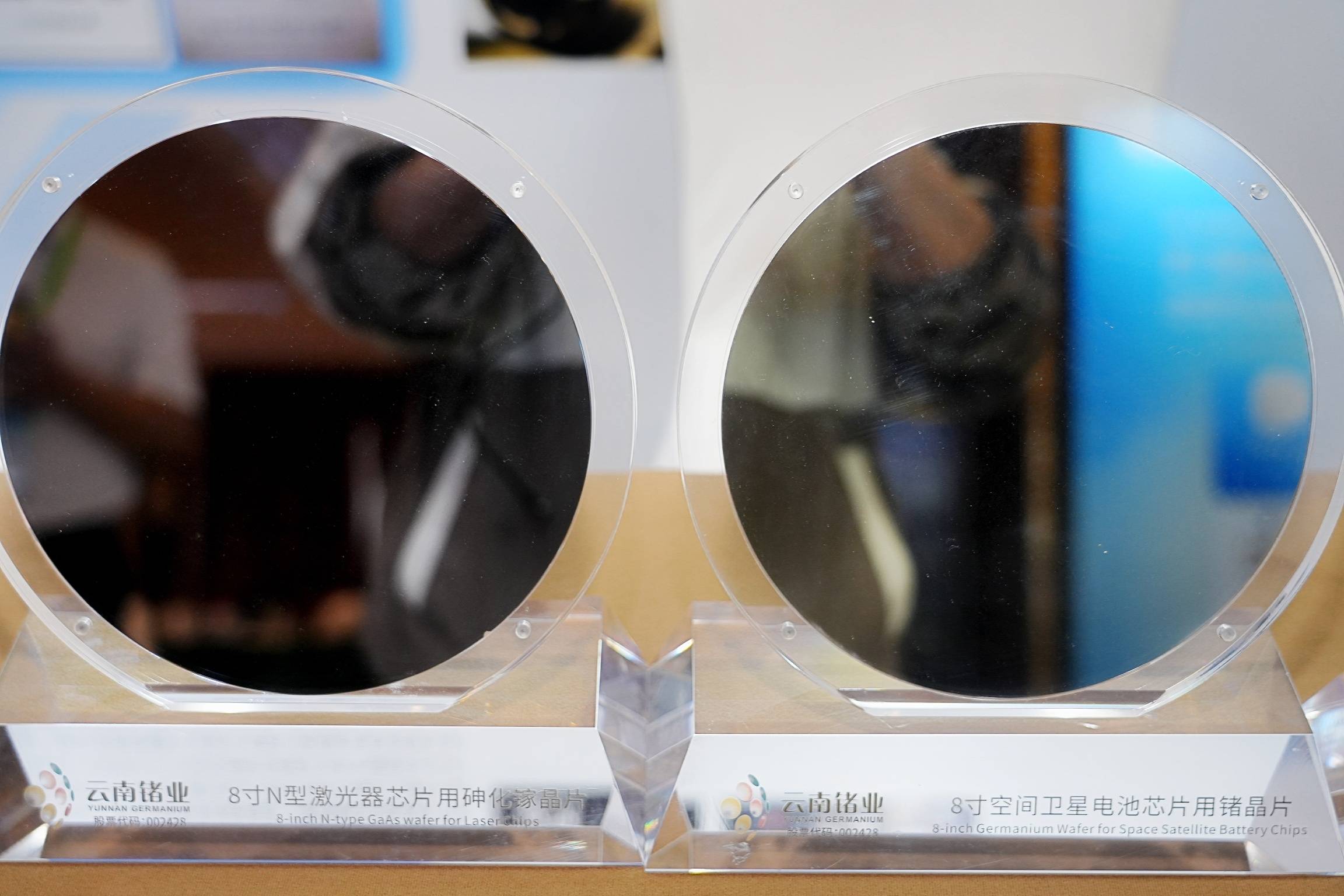
Group 1 - Recent breakthrough in indium phosphide (InP) technology by Jiufengshan Laboratory, achieving significant advancements in 6-inch InP-based PIN structure detectors and FP structure lasers, marking a first in large-scale InP material production in China [1] - InP is recognized as the second most mature semiconductor material after silicon, widely used in RF devices, optical modules, LEDs, lasers, detectors, and sensors due to its excellent electronic mobility and radiation resistance [2] - The InP photonics market is projected to reach $5.6 billion by 2027, with a compound annual growth rate (CAGR) of 14%, driven by advancements in 6-inch InP technology that could reduce domestic optical chip costs to 60%-70% of 3-inch processes [2] Group 2 - Companies involved in InP semiconductor materials include: - Hitec High-New (002023), providing key InP materials for optical communication through its subsidiary Huaxin Technology [3] - Yunnan Zinc Industry (002428), producing InP substrates for laser and detector applications [3] - Sanan Optoelectronics (600703), focusing on compound semiconductor materials including InP [3] - Yuanjie Technology, developing high-speed InP laser chips for various communication networks [3] - Kaide Quartz, supplying InP substrates for optical module production and collaborating with US-based companies [3] - Yueling Co., Ltd. (002725), engaging in InP-based semiconductor laser chip development through its subsidiary [3] - Bojie Co., participating in InP-related research and production through its subsidiary [3]

