
磷化铟

Search documents
铟供需分析与展望
2026-03-13 04:46
Summary of Indium Supply and Demand Analysis Industry Overview - The report focuses on the indium market, highlighting its supply and demand dynamics, pricing trends, and industry structure [2][4]. Key Points Pricing Trends - Indium prices have shown a stepwise increase since 2023, with projections to reach around 5,000 CNY/kg by the end of 2025, driven by precious metal trends and speculative investments [2][3]. - Historical price movements indicate a rise from approximately 1,500 CNY/kg in 2023 to around 4,800 CNY/kg currently, with peaks exceeding 5,000 CNY/kg [3]. Supply Dynamics - Indium supply is heavily reliant on lead-zinc by-products, with a native to recycled indium ratio of approximately 1:1. Total production is expected to reach about 1,900 tons by 2025, stabilizing around 2,000 tons before 2030 due to mining grade and smelting capacity limitations [2][4]. - Major producers include Guangdong Xian Dao and Wuhu Ying Ri, which hold an 80% market share due to scale and low-cost inventory [2][4][9]. Demand Structure - The demand for indium is concentrated, with 80% used in ITO target materials for LCD displays. The sensitivity of this sector to price increases is significant, as a doubling of indium prices can halve the profit margins of panel manufacturers [2][5]. - Emerging sectors like phosphide indium are growing rapidly, with an expected annual growth rate exceeding 30%, while HJT solar cells currently consume less than 5% of indium [2][5]. Market Inventory and Structure - A structural shift in market inventory has occurred, with 500-1,000 tons transitioning from factories to investors and traders. This shift could lead to supply shortages if new demand from sectors like photovoltaics materializes [2][6][10]. - The overall market is currently in a state of relative balance, with total consumption around 1,800 tons against a production of 1,900-2,000 tons, although speculative trading has disrupted this balance [6][7]. Competitive Landscape - The ITO target material industry is dominated by established players, while new entrants are generally unprofitable. The procurement model is shifting from annual contracts to quarterly agreements due to price volatility [9][10]. Future Outlook - Market participants have mixed views on future price movements. Traders are generally bullish, while panel manufacturers express caution due to insufficient demand to support high prices [7][10]. - If new applications in space photovoltaics emerge without viable substitutes, a competitive scramble for indium resources is likely [11]. Recycling and Raw Material Sources - The recycling of indium from ITO targets is becoming more prevalent, with the recovery process involving collaboration between panel manufacturers and processing plants [15][16]. - The supply of native indium is stable, primarily sourced from zinc and tin ores, with no independent indium mines identified [4][7]. Conclusion - The indium market is characterized by a complex interplay of supply constraints, demand sensitivity, and speculative trading. Future trends will depend on the balance between emerging technologies and traditional applications, as well as the industry's ability to adapt to price fluctuations and inventory shifts [12][13][14].
铟专家交流20260303
2026-03-04 14:17
Summary of Indium Industry Conference Call Industry Overview - China dominates global indium supply, accounting for over 90% of production and more than 70% of reserves [2][3] - Domestic refined indium production is expected to reach approximately 2,000 tons in 2025, with a projected growth of 10%-15% to 2,200 tons in 2026 [2][14] Key Points and Arguments - **Core Applications**: ITO (Indium Tin Oxide) targets are the primary downstream application, representing over 70% of demand, with more than 80% of global production concentrated in China [2][6] - **Semiconductor Demand**: Although the demand for indium in semiconductors (specifically indium phosphide) is growing at a rate of 20%-50%, the annual consumption is only 10-20 tons, which has a limited impact on overall supply and demand [2][7] - **Market Dynamics**: Indium prices surged past 5 million CNY/ton due to speculative factors, with limited acceptance from downstream users at this price level [2][12] - **Inventory Structure**: Current industry inventory includes approximately 400 tons at factories, 300-400 tons at downstream target manufacturers, and over 1,000 tons at Xianlead (formerly Pan-Asia), much of which is used for collateral [2][19] - **Price Transmission**: The ability to transmit prices downstream will be crucial, particularly with long-term contracts expected to be signed in Q2 2026 [2][13] Additional Important Insights - **Supply Chain Characteristics**: Indium is primarily sourced as a byproduct of lead-zinc smelting, with limited independent mining sources available [3][4] - **Production Capacity**: Domestic indium production capacity has been relatively stable, with estimates of around 3,000-3,100 tons by 2025 [5][14] - **Downstream Consumption**: The largest consumer of indium is the ITO target market, followed by the semiconductor sector, which accounts for about 15%-20% of total consumption [6][10] - **Future Demand Growth**: Potential growth areas for indium demand include advancements in display technologies and the photovoltaic sector, particularly with HJT (Heterojunction Technology) solar cells [17][18] - **Export Policies**: Indium is not restricted for export in China, unlike gallium, which has significant implications for global supply dynamics [9][12] Conclusion The indium market is characterized by a strong domestic supply chain in China, with significant reliance on ITO applications. While semiconductor demand is growing, it remains a small fraction of total consumption. Price dynamics are heavily influenced by speculative trading, and future growth will depend on technological advancements and market acceptance of higher prices.
全球疯抢磷化铟,中国垄断全球8成精铟,高端磷化铟却要依赖进口
Sou Hu Cai Jing· 2026-02-26 12:52
Core Insights - The global tech industry is engaged in a covert resource competition centered around indium phosphide, a niche semiconductor material, rather than rare earth elements [1] - Companies worldwide are scrambling to purchase indium phosphide, with order backlogs extending into next year and prices soaring [3] - China's dominance in indium production, holding 80% of global capacity, contrasts sharply with its struggles in the high-end indium phosphide sector, highlighting critical pain points in its semiconductor industry [3][12] Group 1: Market Dynamics - The surge in demand for indium phosphide is driven by the AI computing revolution and advancements in high-end communication technologies [5] - Indium phosphide's electron mobility is over ten times that of silicon, making it essential for high-frequency applications like satellite communications and AI data centers [6] - By 2025, global demand for indium phosphide devices is expected to reach 2 million units, while stable supply capacity is only 600,000 units, resulting in a significant shortfall of 1.7 million units [6] Group 2: Supply Chain and Production Challenges - The production expansion cycle for indium phosphide takes 12 to 24 months, making it difficult to alleviate the current supply shortages in the short term [8] - AXT, a U.S. company, reported a 250% increase in revenue from indium phosphide-related business in Q3 2024, with a backlog of $50 million in orders by 2025 [8] - The military applications of indium phosphide further intensify the competition among nations for this strategic resource [10] Group 3: China's Position and Challenges - Despite controlling 80% of global refined indium production, China primarily exports raw materials, lacking the ability to convert these into high-end products [12][14] - The high-end indium phosphide market is dominated by companies from Japan, the U.S., and France, which collectively hold over 90% of the market share [14] - China's self-sufficiency in high-end indium phosphide is extremely low, with some critical areas relying almost entirely on imports [16] Group 4: Technological Barriers - The core challenges in producing high-end indium phosphide lie in substrate production and epitaxial processes, with foreign companies achieving 8-inch substrate production while Chinese firms are limited to 4-inch substrates [21] - The purity of indium phosphide polycrystalline materials in China lags behind that of foreign products, which is a significant bottleneck for the development of high-end indium phosphide [23] - Even with breakthroughs in certain processes, domestic companies struggle to achieve large-scale production to meet the rapidly increasing demand [23] Group 5: Strategic Initiatives - In response to foreign technological barriers and market monopolies, China is accelerating the domestic production of indium phosphide [25] - The national chip fund is increasing investments and providing tax incentives to help domestic companies overcome technological challenges [25] - Companies like Yunnan Xinyao are making progress in developing 6-inch indium phosphide substrates, with production capacity expected to exceed 250,000 units by 2026 [27] Group 6: Future Outlook - The demand for indium phosphide is projected to grow at over 25% annually over the next five years, driven by advancements in AI, 6G, and lidar technologies [31] - To transform resource advantages into industrial strengths, sustained investment in R&D and the commercialization of scientific achievements are essential for breaking foreign monopolies and achieving true growth in the semiconductor industry [31]

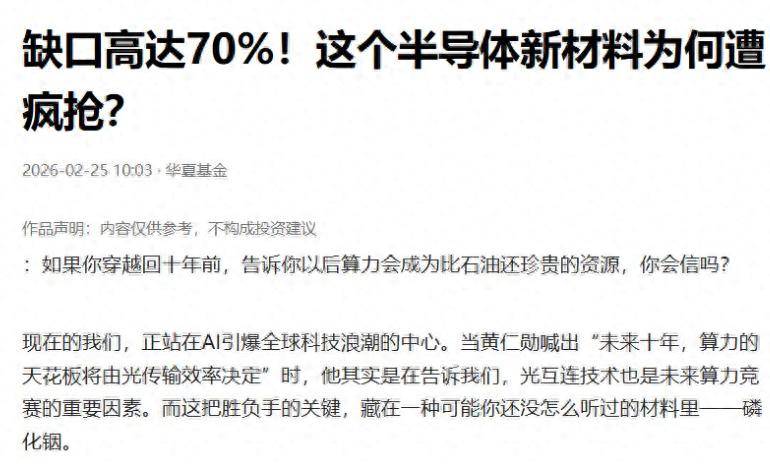
全球磷化铟争夺战!中国手握8成原料,高端磷化铟却仍需依赖进口
Sou Hu Cai Jing· 2026-02-26 11:40
Core Insights - The article highlights the explosive growth of AI computing power by 2026, with indium phosphide emerging as a critical semiconductor material in global technology competition [1][6] - Despite China monopolizing 85% of refined indium production and over 73% of global indium reserves, it remains dependent on imports for high-end indium phosphide, indicating a significant gap in technological capabilities [3][15] Industry Overview - Indium phosphide's rise is attributed to the upgrade in AI computing power and industrial transformation, showcasing its unique performance advantages over traditional silicon materials [6] - The demand for indium phosphide devices is projected to soar to 2 million units by 2025, while global stable production capacity is only 600,000 units, resulting in a supply-demand gap of 1.4 million units [10] Market Dynamics - The shortage of indium phosphide is driving significant revenue growth for companies like AXT in the U.S., with a backlog of orders reaching $50 million, reflecting its strategic value across civilian and military applications [13] - China's dominance in indium resources does not translate to a competitive edge in the indium phosphide industry, primarily due to technological barriers and U.S. export restrictions [15][20] Technological Challenges - High-end indium phosphide production requires ultra-pure indium and advanced crystal growth technologies, areas where China currently lacks expertise [17][19] - The production of high-end indium phosphide substrates is still in the developmental stage, with significant technological breakthroughs expected by 2028 [19] Strategic Responses - In response to global supply-demand imbalances and U.S. restrictions, China is focusing on domestic resource advantages and accelerating the localization of the indium phosphide industry [21][35] - Policies and funding are being implemented to support the development of indium phosphide, including tax incentives and research subsidies [23] Industry Collaboration - Chinese companies are working to create an integrated ecosystem from resource extraction to material production and chip manufacturing, addressing upstream and downstream disconnects [28][30] - Collaborations between resource companies and downstream manufacturers are being established to ensure a stable supply of core materials [31] Future Outlook - If China can overcome the technological bottlenecks in high-end indium phosphide production, it could leverage its 85% refined indium capacity to reshape the global indium phosphide market [33] - The ongoing transition from resource dependency to technological leadership in the semiconductor industry is seen as a critical step for China's future competitiveness [37]
这个半导体材料,火了!
半导体芯闻· 2026-01-23 09:38
Core Viewpoint - The article emphasizes the critical role of indium phosphide (InP) in the future of computing power, particularly in the context of AI and data centers, highlighting its unique properties that make it essential for high-speed optical communication [1][2]. Group 1: Indium Phosphide's Unique Properties - InP exhibits over ten times the electron mobility of silicon, making it suitable for high-frequency applications [2]. - It is particularly advantageous for optical communication at key wavelengths of 1310nm and 1550nm, where it can efficiently produce photonic devices [2]. - InP's high thermal resistance and radiation tolerance are crucial for AI servers operating in high-temperature environments [2]. Group 2: Market Demand and Growth - The global AI infrastructure spending is expected to exceed $1 trillion by 2026, driving demand for high-speed optical modules [1][5]. - The demand for InP devices is projected to reach 2 million units by 2025, with a supply gap of 70% as current production capacity is only 600,000 units [10]. - The market for InP is anticipated to grow at an annual rate of over 25% in the next five years, marking a historic growth period [6]. Group 3: Applications and Industry Expansion - InP is becoming increasingly important in various fields, including AI data centers, laser radar, 5G/6G mobile communication, and quantum computing [8]. - The commercialization of Co-Packaged Optics (CPO) technology is expected to further increase the demand for InP, as it reduces power consumption significantly [6][7]. - The global market for CPO is projected to grow approximately 166 times by 2030, indicating a substantial opportunity for InP [7]. Group 4: Global Market Dynamics - The InP industry is currently dominated by a few key players, with Japan's Sumitomo Electric holding a 60% market share [9]. - Major companies are expanding production capacities to meet the surging demand, but the market remains highly oligopolistic, with over 95% of production capacity controlled by a few firms [10]. - Domestic companies in China are making strides to break the foreign monopoly, with several firms achieving significant advancements in InP substrate production [11][13]. Group 5: Challenges and Future Outlook - The InP industry faces challenges related to production costs and technology, particularly in crystal growth processes that are complex and yield variable results [17][18]. - Despite these challenges, the industry is exploring ways to reduce costs through larger wafer sizes and improved production techniques [18]. - The geopolitical landscape and export controls are adding uncertainty to the supply chain, but they also drive nations to strengthen their domestic industries [19].

磷化铟,火了
3 6 Ke· 2026-01-23 03:28
Core Insights - The future of computing power will be determined by optical transmission efficiency, highlighting the critical role of optical interconnect technology and the growing market enthusiasm for indium phosphide (InP) materials [1][2] - The global AI infrastructure spending is expected to exceed $1 trillion by 2026, driving the rapid iteration of data center optical modules to 800G/1.6T and beyond [1] - The demand for InP materials is surging due to their unique properties, with a significant supply-demand gap projected to persist until 2026 [1][9] Group 1: InP Material Advantages - InP exhibits over ten times the electron mobility of silicon, making it suitable for high-frequency and high-speed applications, particularly in optical communication at critical wavelengths [3][4] - InP's high thermal resistance and radiation tolerance are essential for AI servers and data centers operating in high-temperature environments [3] - InP is positioned as the core material for high-end long-distance communication, outperforming silicon and gallium arsenide in efficiency and adaptability [4] Group 2: Market Demand Drivers - The explosive growth of AI data centers is the primary driver for the increasing demand for InP, with 800G optical modules becoming standard [6] - The introduction of Co-Packaged Optics (CPO) technology is expected to significantly increase the demand density for InP substrates, with a projected market growth of 166 times by 2030 [7] - In addition to data centers, InP is penetrating advanced fields such as LiDAR, 5G/6G mobile communications, low Earth orbit satellite communications, and quantum computing [8] Group 3: Global Market Dynamics - The global InP industry is characterized by a high degree of oligopoly, with major players like Sumitomo Electric and AXT dominating over 95% of the market [9] - A significant supply-demand gap is anticipated, with a projected need for 2 million InP devices by 2025 against a production capacity of only 600,000 [9] - Major manufacturers are ramping up production capacity to address this gap, with AXT planning to double its capacity by 2026 [9][10] Group 4: Domestic Industry Developments - Chinese companies are accelerating efforts to break the foreign monopoly in the InP market, with several firms achieving significant milestones in production capacity and technology [10][11] - The domestic market is witnessing a collaborative push towards a full-chain upgrade in the InP industry, enhancing quality and efficiency [12] - Government policies are supporting the development of InP materials, including tax reductions and funding for research in high-purity indium production [12] Group 5: Future Outlook and Challenges - The InP industry is on the brink of a significant scale-up, driven by the urgent need for high-performance materials in AI and optical communication [18] - Despite the promising outlook, challenges such as low crystal growth yield and high costs remain, necessitating technological advancements and cost reductions [14][15] - Geopolitical factors and export controls are creating uncertainties in the global supply chain, impacting the InP industry's growth trajectory [16]



磷化铟,火了!
半导体行业观察· 2026-01-23 01:37
Core Viewpoint - The article emphasizes the critical role of indium phosphide (InP) in the future of computing power, particularly in the context of AI and high-speed optical communication, highlighting its unique properties that make it essential for advanced applications [1][19]. Group 1: Indium Phosphide's Unique Properties - InP exhibits over ten times the electron mobility of silicon, with a maximum of 1.2×10^4 cm²/V·s, making it suitable for high-frequency applications [2]. - It is particularly advantageous in the 1310nm and 1550nm wavelengths, which are optimal for fiber optic communication, due to its direct bandgap properties [2]. - InP's high thermal resistance and radiation tolerance are crucial for AI servers and data centers operating in high-temperature environments [2]. Group 2: Market Demand and Growth Drivers - The demand for InP is driven by the explosive growth of AI data centers, with the global AI infrastructure spending expected to exceed $1 trillion by 2026 [1]. - The need for 800G and 1.6T optical modules in AI data centers is creating a rigid demand for InP, as each 800G module requires 4-8 InP laser chips [5]. - AXT predicts that the demand for optical modules connecting server racks will nearly double by 2026, with the InP industry expected to maintain an annual growth rate of over 25% [6]. Group 3: Competitive Landscape and Supply Challenges - The global InP market is dominated by a few key players, with Sumitomo Electric holding a 60% market share and AXT capturing about 35% [10]. - By 2025, the demand for InP devices is projected to reach 2 million units, while production capacity is only 600,000 units, resulting in a 70% supply-demand gap [11]. - Major companies are expanding production capacity, with AXT planning to double its capacity by 2026 and Sumitomo Electric aiming for a 40% increase [11]. Group 4: Emerging Applications and Future Prospects - InP is penetrating various advanced fields, including lidar, 5G/6G mobile communications, low Earth orbit satellite communications, and quantum computing [8]. - The global market for CPO technology is expected to grow approximately 166 times by 2030, significantly boosting the demand for InP [7]. - The InP substrate market is projected to grow from $3 billion in 2022 to $6.4 billion by 2028, with a compound annual growth rate of 13.5% [8]. Group 5: Domestic Developments and Challenges - Domestic companies in China are accelerating efforts to break the foreign monopoly in the InP market, with several firms achieving significant advancements in production technology [12]. - The Chinese government is supporting the InP industry through policy initiatives, including lowering tariffs on key materials and promoting domestic production [12]. - Despite the rapid growth, the InP industry faces challenges related to production costs and technological complexities, particularly in crystal growth processes [15][16].

上市公司TOP5济安评估 (1月12日至1月16日)|上市公司观察
Xin Lang Cai Jing· 2026-01-22 05:49
Group 1 - Institutional research activity decreased this week, with a reduction in the number of companies being surveyed, but top stocks received increased attention [1] - Xiangyu Medical (688626) was favored by 208 institutions, focusing on rehabilitation medical devices, with strong growth potential driven by aging population and health awareness [1] - The company has a solid capital structure rated BBB, indicating better financial stability compared to most listed companies, but faces challenges in operational efficiency and asset quality [1] Group 2 - SWOT analysis for Xiangyu Medical shows strengths in capital structure, but weaknesses in operational efficiency and scale, with significant room for improvement in multiple dimensions [2][3] - Opportunities exist for Xiangyu Medical to enhance operational efficiency and scale, with potential growth in market channels and cost control [2] - Threats include a notable decline in core capabilities, particularly in operational efficiency and profitability, indicating increased operational pressure [3] Group 3 - Lio Group (002131) was surveyed by 40 institutions, focusing on its dual business model of mechanical manufacturing and digital marketing, with strong interest in its growth potential in emerging sectors [5] - The company has strong scale strength rated AA, indicating significant competitive advantages, but faces challenges in cash flow and debt repayment capabilities [6] - SWOT analysis reveals Lio Group's strengths in asset quality and scale, but weaknesses in cash flow and development capabilities, with opportunities for improvement in emerging markets [7][8] Group 4 - Weichuang Electric (688698) was the subject of a survey by 35 institutions, focusing on its core products in industrial automation and its competitive advantages in the market [10] - The company has strong profitability and asset quality ratings, but faces challenges in cash flow and debt repayment capabilities [11] - SWOT analysis indicates strengths in profitability and operational efficiency, but weaknesses in cash flow and capital structure, with opportunities for growth in high-demand sectors [12][13] Group 5 - Light Optoelectronics (688150) was surveyed by 34 institutions, focusing on its core products in OLED materials and its competitive position in the market [15] - The company has strong debt repayment capabilities and a solid capital structure, but faces challenges in scale and operational efficiency [16] - SWOT analysis shows strengths in financial stability and profitability, but weaknesses in scale and operational efficiency, with significant opportunities for growth in emerging markets [17][18] Group 6 - Yunnan Ge Industry (002428) was surveyed by 32 institutions, focusing on its complete germanium industry chain and its strategic position in the market [20] - The company has a strong development capability rating, but faces significant challenges in cash flow, profitability, and operational efficiency [21] - SWOT analysis indicates strengths in development capability, but weaknesses in scale and financial stability, with opportunities for growth in commercial aerospace and semiconductor sectors [22][23]



云南锗业:近期国内磷化铟价格保持平稳
Zheng Quan Ri Bao Wang· 2026-01-14 14:12
Core Viewpoint - Yunnan Zhenye (002428) reported stable prices for indium phosphide in the domestic market, with increasing demand for indium phosphide chips driven by the growing prosperity of the downstream optical communication market [1] Company Strategy - The company aims to maintain existing customer relationships and ensure supply while increasing market development efforts [1] - Yunnan Zhenye plans to deepen its presence in the domestic market while actively expanding into overseas markets [1]
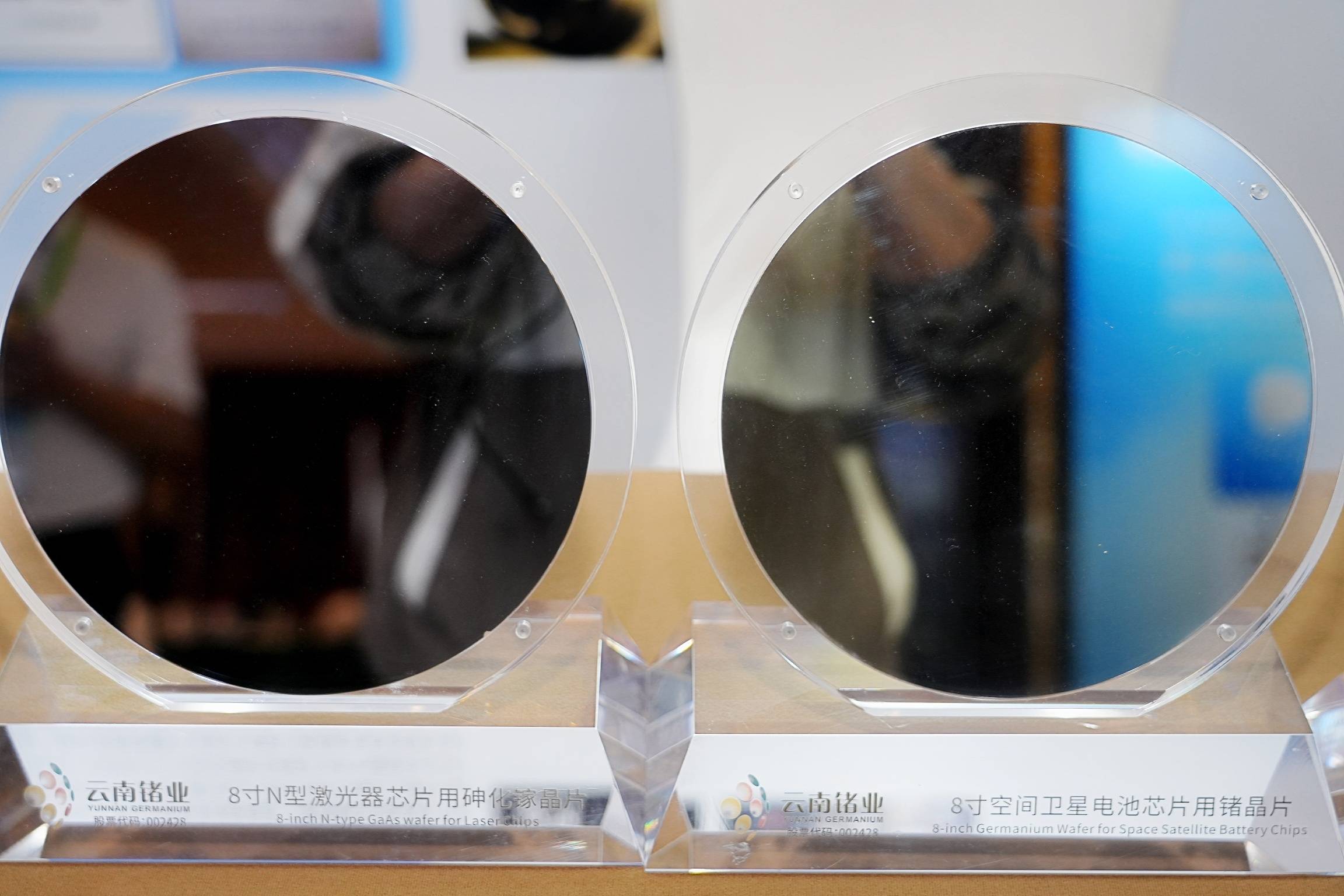
调研速递|云南锗业接受中信证券等12家机构调研 砷化镓项目规划年产70万片 光伏级锗晶片需求增长
Xin Lang Cai Jing· 2026-01-14 11:10
Group 1 - The company, Yunnan Ge Industry, held an institutional research meeting on January 14, 2026, in Kunming, attracting 12 institutions including Ming Shi Partners Fund and CITIC Securities [1] - The company’s Vice General Manager and Board Secretary, Jin Hongguo, along with the Securities Affairs Representative, Zhang Xinchang, engaged with institutional investors during the meeting [1] Group 2 - The company has applied for export licenses in compliance with national regulations regarding export controls, with some orders already approved for export [2] - The domestic price of indium phosphide has remained stable, with increasing demand driven by the growing optical communication market [3] Group 3 - The company plans to establish a new production line for gallium arsenide with a construction period of 18 months, aiming for an annual output of 700,000 six-inch wafers [4] - The company initiated a project for space solar cell-grade germanium wafers in March 2025, targeting an annual production capacity of 1.25 million wafers by the end of 2025 [5] Group 4 - The company sources germanium concentrate primarily from domestic lead-zinc mines and is actively expanding its resource reserves through acquisitions and exploration [6] - The company is coordinating with clients to determine the production plan for germanium wafers in 2026, with relevant data to be disclosed in the 2025 annual report [6]
